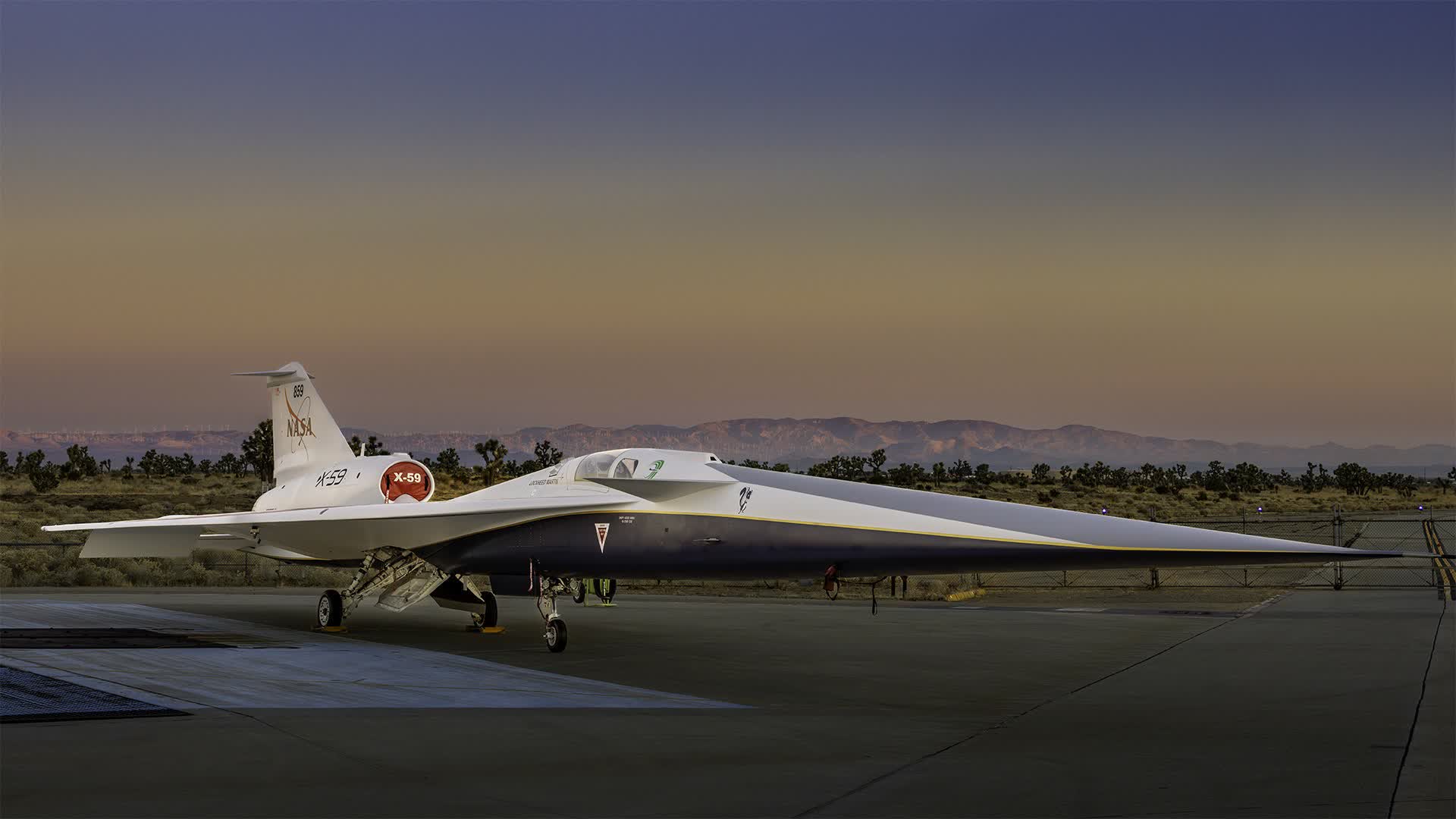
Why it matters: Supersonic flight has existed for nearly 80 years, but remains banned over land due to the deafening sonic booms produced when aircraft exceed Mach 1 (767 mph). NASA and Lockheed Martin have spent years tackling this problem with an experimental plane that recently completed its first test flight.
NASA's experimental X-59 supersonic jet recently completed its first test flight after years of development and delays. Aeronautical engineers at Lockheed Martin designed the aircraft to produce quiet sonic booms, potentially allowing supersonic flight over land and cutting travel times in half.
The inaugural flight took place over the California desert shortly after sunrise, testing the X-59's structural integrity rather than its supersonic capabilities. NASA plans to begin supersonic trials with the 100-foot aircraft in upcoming flights.
Loud sonic booms occur when an aircraft travels faster than sound, generating a shock wave – a sudden spike in air pressure followed by a rapid drop back to ambient levels. NASA began testing ways to reduce that effect in 2018, diving F/A-18 jets at Mach 1.1 over controlled areas in Galveston, Texas, and collecting feedback from residents. By performing steep dives and pulling up sharply, the planes created two downward-directed shock waves that weakened with distance, substantially lowering their perceived volume.
Meanwhile, Boom Supersonic's XB-1 was the first privately built aircraft to break the sound barrier earlier this year, reaching Mach 1.122. The prototype serves as a testbed for the company's upcoming Overture jet, which will carry up to 55 passengers at Mach 2.2 at an altitude of 60,000 feet – cutting London-to-New York travel to about three and a half hours. Boom also plans to use sustainable aviation fuel for net-zero carbon flights.
Multiple airlines have already started taking orders for the Overture, with deliveries potentially beginning before 2030. If successful, Boom Supersonic would reintroduce supersonic passenger flights for the first time in decades.
After the Bell X-1 became the first aircraft to break the sound barrier in 1947, successors such as the Anglo-French Concorde and the Soviet Tupolev series offered passenger service in later decades. The Tupolevs were grounded in the 1980s, and the Concorde retired in 2003 following the Air France Flight 4590 crash, which killed 113 passengers after debris punctured a tire during takeoff.