
It's 2026, and the GPU market finally feels… manageable. After a couple of chaotic years defined by erratic MSRPs, scarce stock, and an AI-driven parts squeeze, prices have mostly landed where they were supposed to all along. The current generation hasn't delivered the leap many hoped for, DRAM pricing is currently a big mess, and 8GB cards refuse to die, but at least you can buy a modern GPU without feeling like you're negotiating for minerals on Arrakis.
The current-gen GPU lineup has its disappointments, sure, but it also has a few genuine bright spots. Intel's Arc B580 finally settling at $250 (and staying in stock) feels like a minor miracle. The 9060 XT 8GB dipping under MSRP is welcome, too, but the real standout is the 16GB 9060 XT at $350. Yes, it's pricier than beloved cards from years past, but adjusted for inflation, it holds up impressively well.
PC builders have been through enough plot twists lately, and the next chapter looks just as unpredictable.

At the midrange, the 9070 XT hitting $600 might be the single biggest win of the generation. It's only a single-digit bump over the RTX 4070 Ti Super (both 16GB VRAM GPUs), but considering that card launched at $800 back in January 2024, a 25% price drop over two years is nothing to sneeze at.
But here's the catch: this might be as good as it gets for a while. DRAM costs are spiking thanks to relentless AI demand, and AMD is already signaling that future GPU shipments will reflect those increases. In other words, if you're waiting for a 9070 XT to sink even further, don't. The floor is already cracking.
PC builders have been through enough plot twists lately, and the next chapter looks just as unpredictable. So while we used to warn readers to hold off because a new launch was always looming, our advice now is refreshingly simple: if you need the upgrade and you've got the budget, this might be the best time you'll get.
Let's break down the market – from entry-level to no-limits – and find the best GPUs you can actually buy right now.

Entry-Level GPU (less than $300)
AMD Radeon 9060 XT 8GB or Intel Arc B580

Starting with the most affordable discrete GPU options, there are a few choices here, though sadly none are particularly good, each with its own glaring issues. The cheapest cards currently available include the RTX 3050 6GB for $180, which is complete garbage, so skip it. Even worse, somehow, is AMD's Radeon RX 6500 XT 4GB for $210, a true abomination.
Things start to recover in a big way with the Arc B570. It's not the fastest card out there, but at $210 it's inexpensive and offers 10GB of VRAM. The RX 7600 is still selling for around $240, but we'd skip that because the B580 at $250 is a much better deal, and this is where we start getting into the real contenders.
Another old but still viable option is the RTX 3060 for $250, the same price as the RTX 5050. Then we have the slightly discounted RTX 5060 at $280, while the RX 9060 XT 8GB is also available for $280.

The Intel Arc B580 is ~15% faster than the B570 on average, and includes an extra 2GB of VRAM, but it currently costs nearly 20% more, so either option is reasonable in our view. We'd personally choose the B580 for $40 more, it's a strong offering at $250 and clearly better than the RX 7600 and RTX 3060. It's also noticeably better than the RTX 5050, delivering performance similar to the RTX 5060.
The Nvidia RTX 5060 is outclassed by AMD's 9060 XT 8GB, with the Radeon GPU delivering roughly 15 – 20% more performance than the B580 while costing just 12% more, though it does come with less VRAM. FSR4 is impressive and helps to compensate. When it all shakes out, the Radeon 9060 XT 8GB is probably the best sub-$300 value, but the Arc B580 is also strong and certainly a viable alternative.

As important as VRAM is (and as much as we hate that AMD and Nvidia are still selling new GPUs with just 8GB), it's not everything. If the 9060 XT 8GB only matched the performance of the B580 and lacked a strong upscaling solution, we wouldn't bother with it. But as it stands, it's generally quite a bit faster.
Mainstream GPU ($300 to $500)
AMD Radeon 9060 XT 16GB

Stepping up to the $300 – $500 price range, there aren't many options right now. In fact, there are really just two viable choices: the Radeon RX 9060 XT 16GB and the GeForce RTX 5060 Ti 16GB. Both offer 16GB of VRAM, though each has a stinky 8GB version under the exact same name, proving yet again that AMD and Nvidia don't care much about consumer confusion. Moving past that frustration, we need to decide which of these GPUs is the better pick.
The Radeon 9060 XT is the cheaper of the two at $350, whereas the 5060 Ti currently commands an $80 premium, coming in at $430. That makes the 5060 Ti roughly 23% more expensive while being only about 9% faster in our latest testing, whether at native 1440p or with upscaling (FSR 4 vs DLSS 4).

Based on that, the Radeon GPU is the better value, delivering a comparable cost per frame with similar upscaling quality when FSR 4 is supported. The 5060 Ti is technically better in heavy ray tracing, but it's so weak in those workloads overall that the advantage is more of a technicality. For usable levels of ray tracing, there's very little meaningful difference between the two.
All told, they're quite similar, but the 9060 XT sits at a noticeably lower price point, giving it the better cost-per-frame ratio – and making it our number one pick in the $300 – $500 price range.
Mid-Range GPU ($500 to $600)
Radeon RX 9070 or GeForce RTX 5070
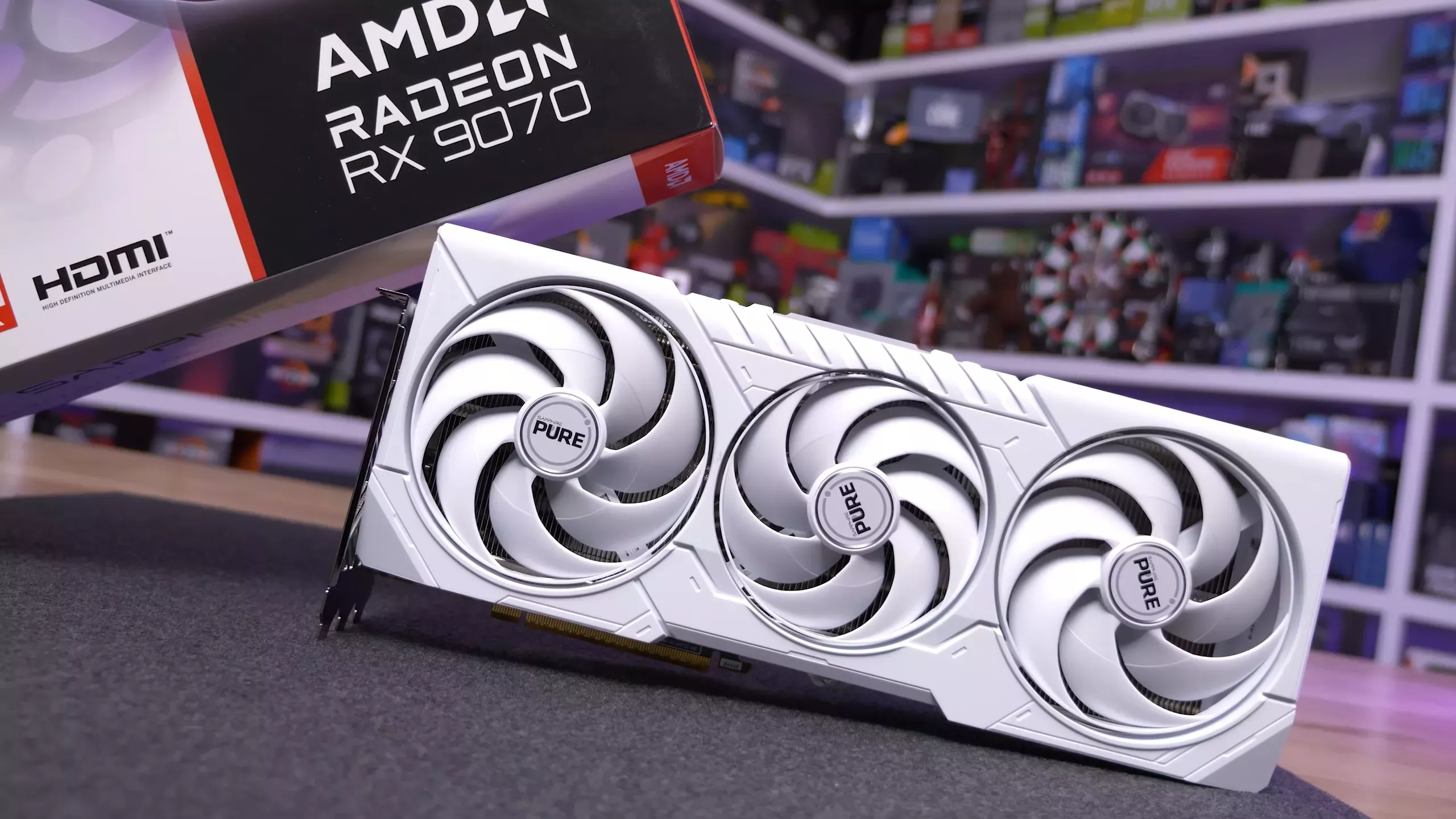
In the $500 – $600 price range we have two options: the Radeon RX 9070 and the GeForce RTX 5070. This category is a tough one. Both currently sit at around $540, placing them at the same price point – or very close – though pricing can vary from region to region. Be sure to check our monthly GPU pricing guides, which cover 10 key markets.

For context, our recent 23-game benchmark comparison found the RX 9070 to be, on average, 13% faster at 1440p, whether running natively or with upscaling. Based on current pricing, that gives the RX 9070 the better cost-per-frame ratio, but there's a bit more to this matchup.
The Radeon 9070 includes 16GB of VRAM, which we now consider the minimum when spending over $400 on a GPU. Unfortunately, the RTX 5070 is limited to 12GB. That said, the 5070 offers slightly superior upscaling quality and broader game support thanks to DLSS 4. And when the latest upscaling methods aren't available, GeForce still wins easily – DLSS 2 and 3 remain far stronger than FSR 2 and 3, especially at common resolutions like 1440p.

The RTX 5070 is also faster in heavy ray tracing scenarios, particularly in titles that use path tracing. However, the 5070 still isn't impressive in demanding RT workloads, and its 12GB VRAM capacity becomes a limiting factor, so we wouldn't call this a major advantage. Ultimately, the RTX 5070 and RX 9070 are very evenly matched, so your best choice may come down to pricing and availability in your region.
Our preference would be the Radeon RX 9070, mainly because of its 16GB of VRAM. Assuming we planned to keep the card for at least the next four years, we'd expect the Radeon option to age better thanks to that extra memory. And with performance being effectively neck-and-neck right now, that feels like a safe enough bet.
High-end GPU ($600 to $900)
AMD Radeon RX 9070 XT

The next tier shows a significant price gap between competing parts, and that's largely because by some miracle the Radeon RX 9070 XT has finally hit MSRP, at least at the time of writing. AMD has already warned that GPU pricing will rise soon, so if you're looking for a new card, especially the 9070 XT, we strongly recommend grabbing one now.
The good news is that $600 is an amazing price for this product. It's the official MSRP, but it has taken roughly eight months since launch to return to that level. As things stand, you'd need to spend around 25% more for the RTX 5070 Ti, and the GeForce GPU simply isn't worth that premium, not even close.

In terms of performance, the two are very similar overall. The 5070 Ti does retain an edge in heavy ray tracing workloads, but our recent testing shows that RT performance doesn't consistently favor the GeForce card.

Both feature 16GB of VRAM, both are highly power efficient, and both support strong upscaling technologies. With all that in mind, and given current pricing, this one is an easy call – the Radeon RX 9070 XT all day.
Benchmarking Your Budget ($1,000 and beyond)
Nvidia GeForce RTX 5090

Probably the dumbest GPU to come out of this generation – and certainly the dumbest high-end GPU – has to be the GeForce RTX 5080. Nvidia set the MSRP at $1,000, and you can buy one at that price, but why would you? That's a 33% premium over the RTX 5070 Ti for only a 15% performance gain. Worse still, it's nearly 70% more expensive than the Radeon RX 9070 XT while offering less than a 20% improvement.

The RTX 5080 has never been a good high-end option. People bought it either because the RTX 5070 Ti was also overpriced or because of the name – Nvidia's 80-series has traditionally held a certain prestige. The 5080 has definitely chipped away at that reputation.

That leaves just one high-end GPU from this generation worth getting excited about in terms of pure performance: the GeForce RTX 5090. But that excitement only makes sense if you have serious cash to burn. With an MSRP of $2,000, it was always a fantasy price for this card, as it has almost never sold anywhere near that number. Even now, the cheapest models are around $2,800, with most costing well above that.
And that's really the story. The RTX 5090 is the best of the best, and unfortunately there's nothing from AMD that can challenge it. As usual, Nvidia wins this category by default.