
First look: Nvidia has rolled out a new GPU fleet management platform aimed at giving data center operators real-time visibility into sprawling AI infrastructure. The system pulls telemetry from globally distributed deployments into Nvidia's NGC cloud platform, surfacing everything from hardware health and energy efficiency to the physical location of GPUs currently in operation.
The software relies on a customer-managed agent installed within each environment. That agent collects detailed system data and sends it to a centralized dashboard hosted on NGC. From there, operators can examine performance at multiple layers: a global view of all deployed hardware, compute zones corresponding to individual on-premises or cloud sites, and granular, node-by-node breakdowns.
The resulting data not only provides inventory and usage summaries but can pinpoint where each GPU is physically operating – functionality that may discourage smuggling or unauthorized exports of restricted AI processors.
Nvidia emphasizes that the software is strictly a monitoring layer. It has no ability to disable GPUs or remotely alter their behavior, a design choice meant to head off concerns about backdoors or manufacturer-controlled kill switches. In practical terms, Nvidia can see if its chips appear in regions where they are not permitted, but it lacks any technical mechanism to deactivate them. The company says the platform is open source, installed and managed by customers, and fully auditable.

Telemetry within the system also supports performance analysis. The platform tracks power behavior, including short-lived load spikes, allowing operators to stay within power budgets while fine-tuning energy efficiency.
It also captures GPU utilization, memory bandwidth usage, and interconnect performance across multi-node clusters. Taken together, these signals can expose subtle inefficiencies, such as bandwidth saturation or degraded links that can quietly undermine performance during large-scale training or inference workloads.
Thermal management is another focal point. The monitoring agent detects heat concentration and airflow irregularities that can signal insufficient cooling in dense server configurations. Early detection of these thermal imbalances enables corrective action before throttling or component aging occurs, issues that can shorten hardware lifespan and reduce throughput in GPU-heavy racks.
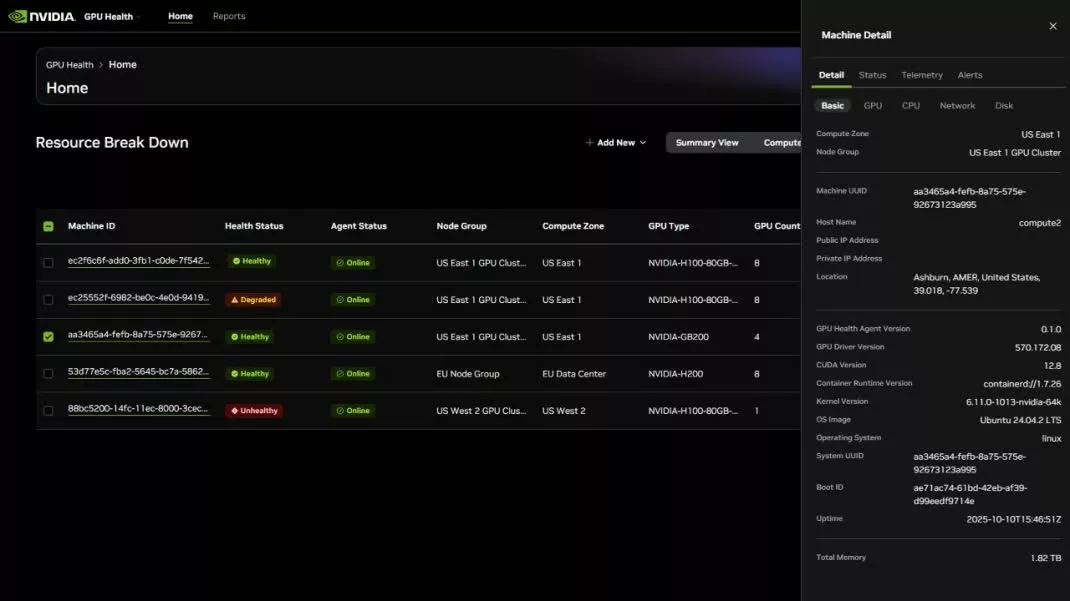
The platform also checks for consistency across distributed systems. It verifies that servers are running identical software stacks, driver versions, and configuration settings.
While the new system extends Nvidia's data center management portfolio, it does not replace existing tools. Data Center GPU Manager (DCGM) remains available for local, low-level diagnostics, though it lacks centralized visualization and typically requires custom integration.
Nvidia's Base Command platform, meanwhile, operates at a different layer entirely, handling AI job scheduling, dataset organization, and workflow orchestration. Together, the three services form a complete system that spans every layer of GPU management: DCGM provides node-level telemetry, Base Command governs workloads, and the new fleet-monitoring software bridges them with fleet-scale visibility across on-premises and cloud deployments.
The opt-in nature of the platform means it is unlikely to function as a meaningful anti-smuggling control, since operators can simply decline to participate. Its real impact is operational, not regulatory, marking a move toward unified GPU observability as AI deployments scale globally.