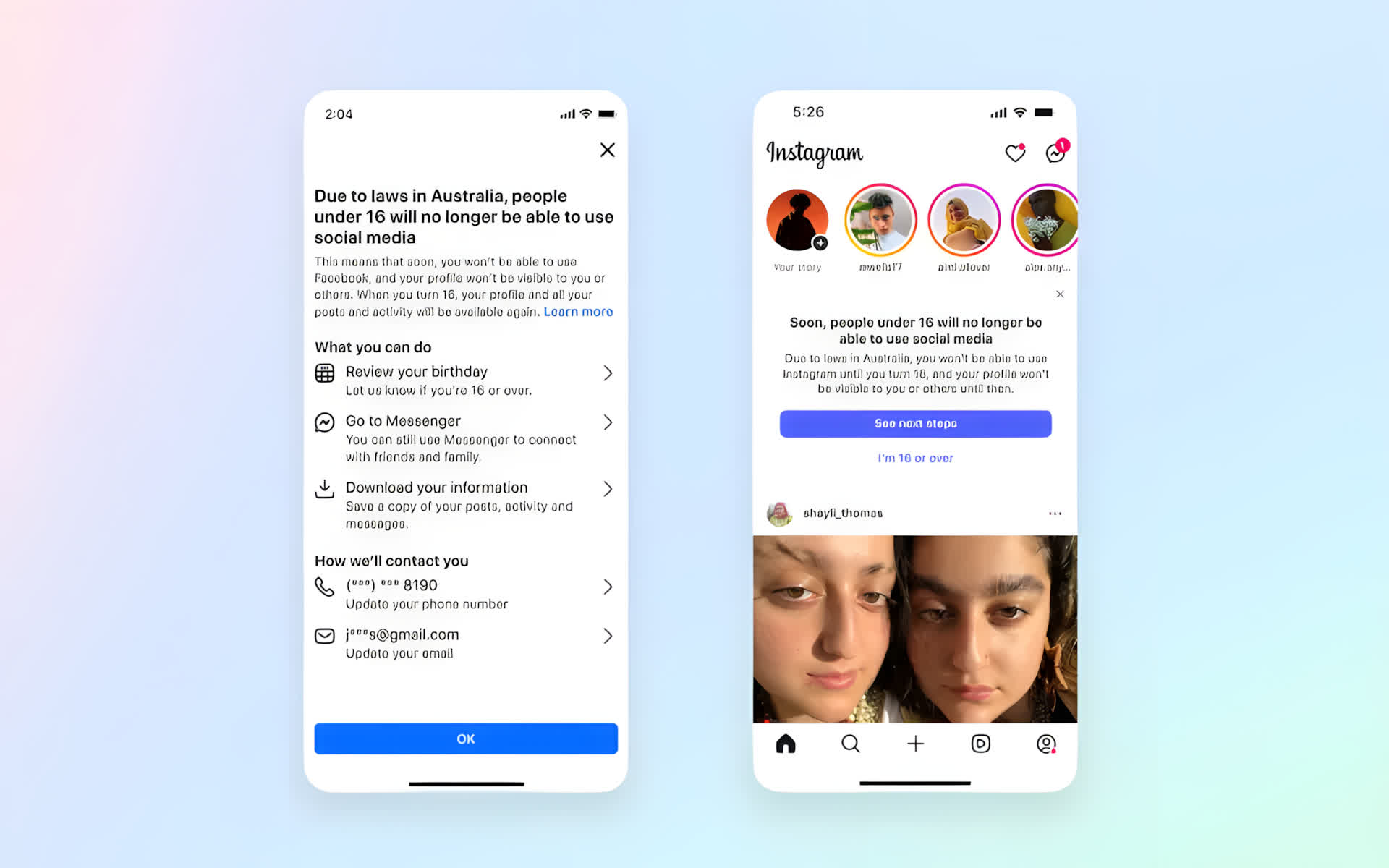
What just happened? Meta has shut down over 500,000 Instagram, Facebook, and Threads accounts to comply with Australia's new under-16s social media ban. But while the company is complying with the recently enacted law, it once again called on the country's government to reconsider the blanket ban.
Australia's under-16 social media ban came into effect on December 10, just over a year after the legislation was passed. It requires Facebook, Instagram, Kick, Reddit, Snapchat, Threads, TikTok, Twitch, Twitter, and YouTube to verify the ages of Australian users and close the accounts of those identified as under 16. Platforms that fail to comply face fines of up to AU$49.5 million ($33 million).
Now, a month after its introduction, Meta has written a lengthy Medium post to show how it has begun complying with the new law.
The social media giant said that it has shut down almost 550,000 accounts it believed belonged to people aged under 16. Unsurprisingly, the majority of these accounts came from Instagram. The most popular of Meta's platforms among the younger demographic saw 330,693 accounts removed. It was followed by Facebook (173,497), then Threads (39,916).
The platforms named in Australia's law use several methods of determining users' ages. Facial scans are one of the most common systems, but their accuracy can vary wildly. In some extreme cases, parents have reported that children as young as 11 have been estimated to be 18 or even over 30.
Teenagers have also circumvented scans by making unusual facial expressions, applying makeup, or using VPNs. Those who pass have been known to use their faces to help friends and family members avoid the ban, too.
These inconsistent age verification methods are one of the concerns Meta has raised about the ban and why the government should end it. The company also claims it isolates vulnerable teens from getting support from online communities, drives them to less regulated parts of the internet, and notes the lack of interest in compliance from many teenagers and parents.
One of Meta's suggestions is that, instead of a blanket ban, the Australian government should incentivize the industry to raise standards for providing safe, privacy-preserving, age-appropriate online experiences. But based on its past, Meta is hardly the most credible authority on protecting children online.
Meta isn't alone in challenging Australia's law. Reddit, which counts Australia as its fourth-largest market, isn't happy with the law's introduction or its inclusion as one of the affected platforms, claiming that it isn't a social media site but a "collection of public fora."