
The takeaway: Apple's online storefront has quietly undergone one of its most significant redesigns in years – an overhaul not in aesthetics, but in how customers configure their Macs. For the first time, instead of comparing a range of fixed-price presets, buyers are greeted with a streamlined interface that functions like a workstation configurator. Every major component: processor, memory, display, storage, and even software, can be adjusted on a "Build Your Mac" page.
It's a notable departure from Apple's long-standing sales formula. Historically, Mac models were divided into several predefined versions, such as base, mid-tier, and maxed-out. Those bundles helped Apple keep inventory predictable while giving customers an easy pricing ladder to climb. The downside was a kind of hidden complexity: specifications could vary subtly, forcing many to study small differences in RAM and SSD limits before purchase.
The new system collapses all that into a single dynamic form. When selecting a MacBook Pro, for instance, the buyer first chooses a display size, then color and panel type, and finally the chip: M5, M4 Pro or M4 Max, before specifying RAM, SSD storage.
Even the power adapter and keyboard layout are configured on the same page, alongside options for professional apps, AppleCare, and payment plans.
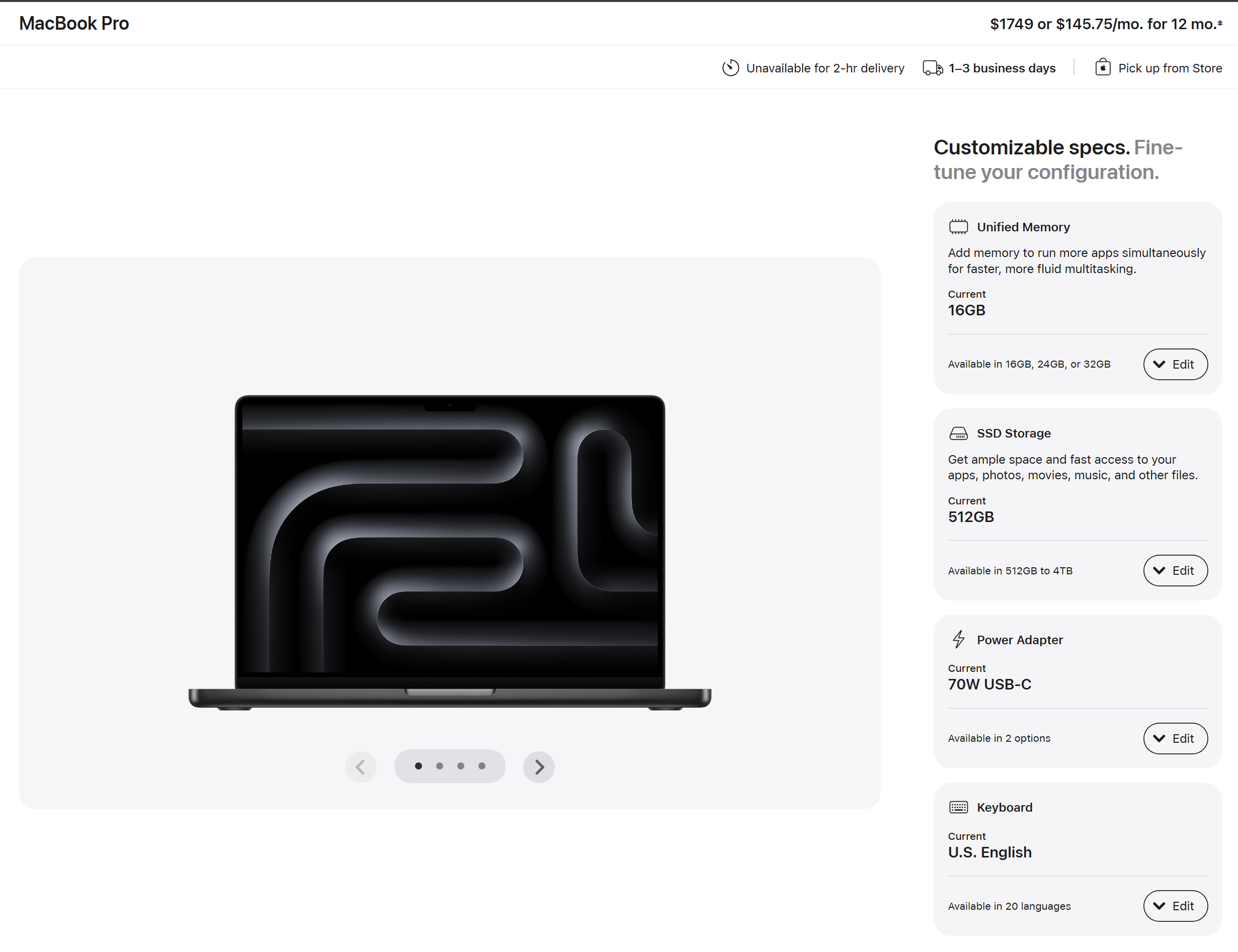
The options are the same as before, but the new layout shifts the focus to balancing budget and performance rather than choosing a preset model.
Apple's hardware architecture supports this modular approach. Since the M1 series introduced Apple Silicon's unified memory (shared by the CPU, GPU, and Neural Engine), the company can scale configurations from the same die design without changing the product line's core engineering.
A unified configurator kind of fits neatly into, especially when some SoCs like the M4 Pro and Max standardize around 24GB of RAM as their baseline. However, it's more of a surprise coming from Cupertino to add the kind of build customization we're accustomed to see from the likes of Dell.

Analysts see two practical motivations behind the redesign. First, it streamlines Apple's direct-to-consumer sales funnel, giving the company more flexibility to adjust component pricing, particularly as memory and NAND flash costs fluctuate through 2026.
Second, the interface may be laying groundwork for even finer build-to-order control once M5 Pro and M5 Max MacBook Pro models arrive later this year. Those chips are rumored to extend customization to the silicon level, potentially letting buyers select CPU and GPU core counts, a feature somewhat common in PC workstation markets but unprecedented for Apple laptops. If that option materializes, the new web interface would already be structured to accommodate such fine-grained selections.

Third-party retailers like Amazon and Best Buy are unlikely to see immediate disruption. Apple will almost certainly continue producing the most common configurations for boxed retail sale, where some Mac models are usually offered at a deeper discount – but this change does give a new edge to ordering direct from Apple's store.
Still, the balance between mass-market and custom-built models may tilt further toward the latter, perhaps signaling a broader rethink of how Apple packages and markets its professional hardware.