What just happened? The modern gaming PC demands energy in short, intense bursts – something inexpensive AA batteries were never designed to deliver. YouTube creator ScuffedBits decided to test that boundary, replacing a desktop computer's conventional power supply with dozens of household batteries to see just how far they could get. The result was less a success story and more a demonstration of electrical reality.
The system in question was modest by desktop standards: an entry-level Intel processor, two sticks of RAM, and a 2.5-inch SATA SSD running Windows 10. The hardware drew its power through a CX430 450-watt supply – until ScuffedBits swapped it for a custom ATX plug purchased online. The adapter allowed 12-volt leads to route into any power source, which in this case began as a small pack of AA cells wired in series.
Each AA battery delivers only 1.5 volts under light load, so eight in series barely reach the 12 volts needed to power a motherboard.

But when ScuffedBits connected the first pack and probed the current draw, the multimeter showed only 0.06 amps – a fraction of what even a low-power x86 system demands. The PC's fan spun once, then everything went dark.
Further attempts stacked more eight-cell packs to boost the current capacity, but the result was unchanged. Switching from carbon-zinc batteries to higher-output alkaline variants briefly improved current handling but still couldn't sustain startup.
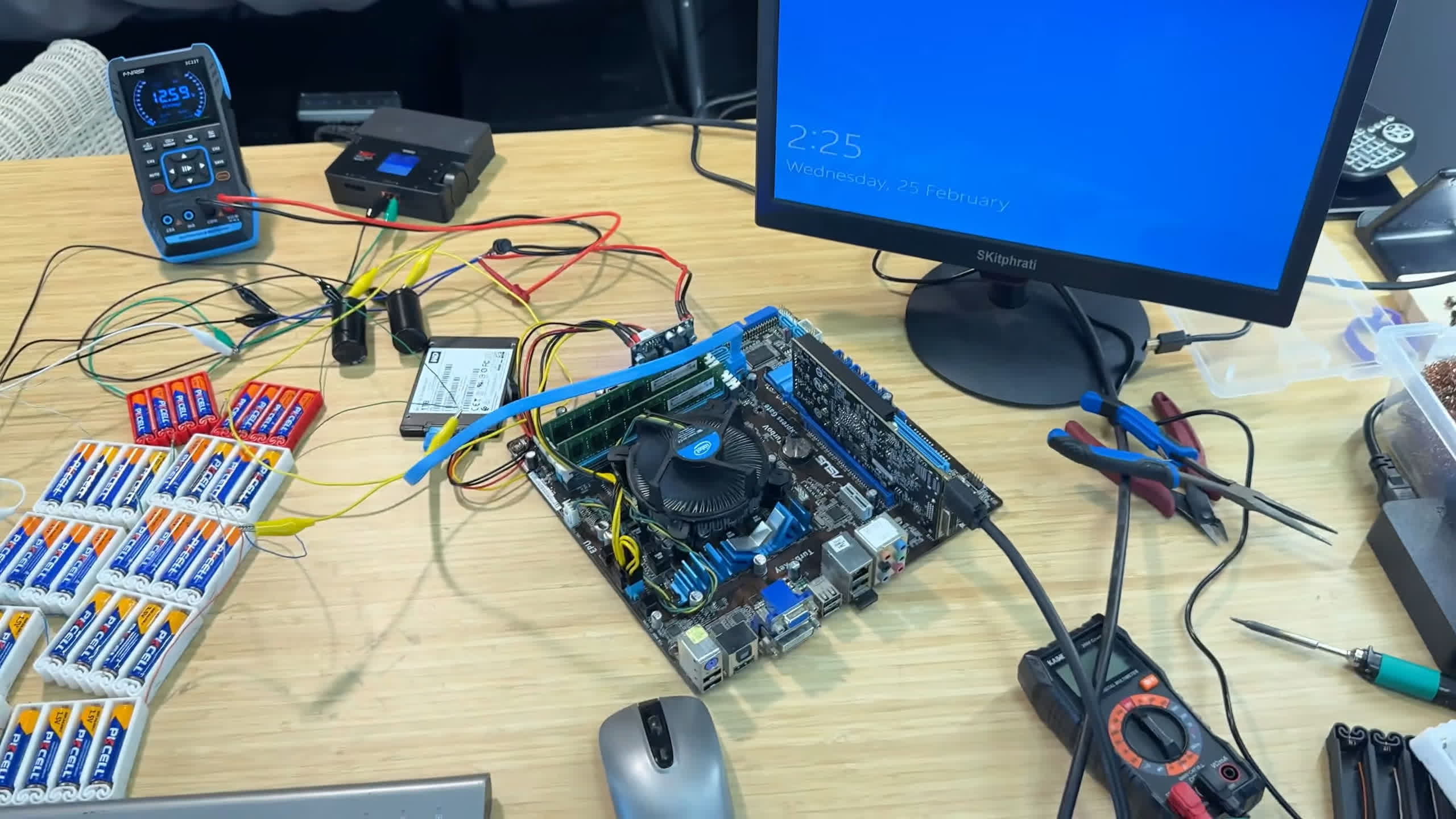
The problem, as later analysis showed, wasn't voltage or configuration so much as physics: AA batteries aren't built for high transient loads. When a desktop system powers on, it demands a sudden surge – sometimes several times its nominal operating current. Thin wires used to link the batteries simply couldn't handle the instantaneous power demand.
To address this problem, ScuffedBits reworked the setup with thicker cabling and installed large capacitors to buffer the startup surge. By this point, the project had grown to a 56-battery array occupying most of a desk. Using an external power supply to jump-start the motherboard, he was able to switch over to battery power after Windows loaded. For a brief moment, the desktop ran entirely on AA batteries.
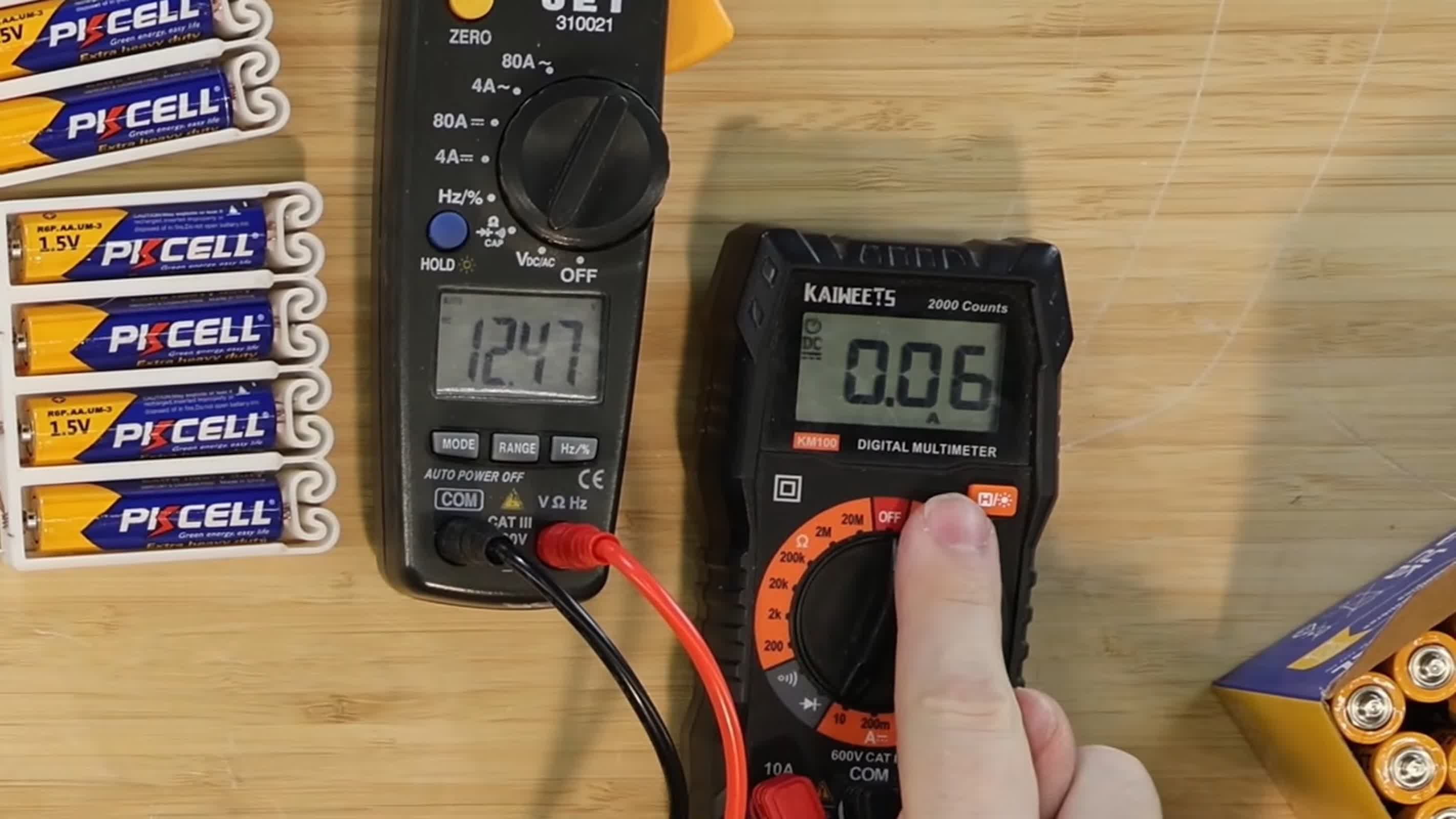
That moment, however, was measured in seconds. Launching Steam overloaded the cells and killed the system after 52 seconds. Reducing the demand to a minimalist indie title like A Short Hike lasted about five seconds. Even a casual round of Minesweeper required careful management – enough to run the game for four and a half minutes before both the PC and its power source expired simultaneously.
ScuffedBits didn't stop there. He extended the experiment by converting the monitor's power input to run on eight rechargeable AA cells, joining a wireless keyboard and mouse already powered by their own batteries. The all-AA setup managed two minutes and fourteen seconds – short-lived but technically functional. A final test added a discrete GPU, which ran for an optimistic nine seconds before collapsing under load once again.
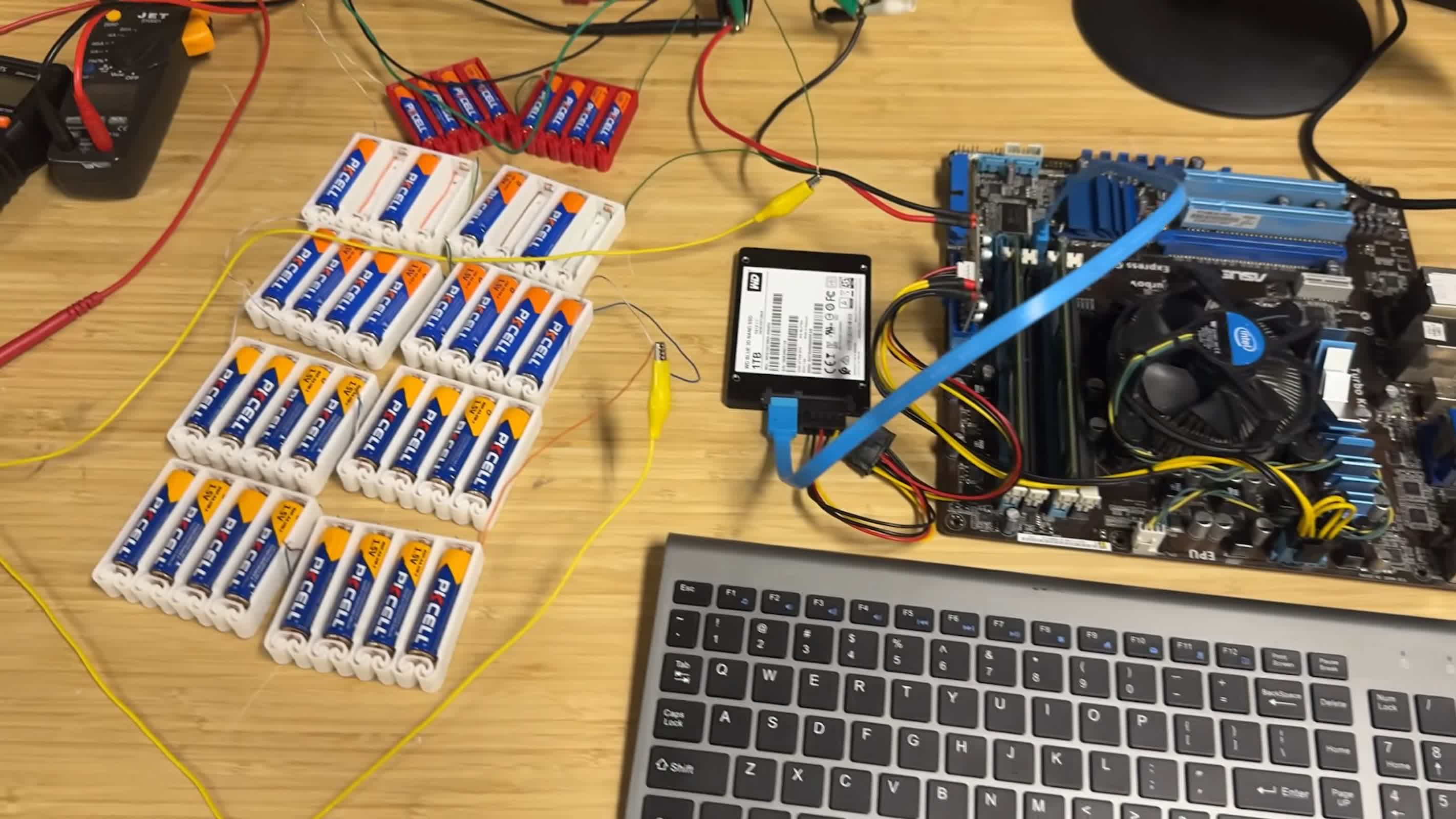
The results were predictable but interesting to see. Alkaline batteries can store a fair amount of energy, yet they deliver it slowly. A desktop computer, even a modest one, needs steady and rapid current flow measured in amps, not milliamps. The mismatch between those power profiles explains why portable systems today rely on densely packed lithium-ion cells engineered for high discharge rates and why AA-powered PC gaming remains a novelty that makes for a good YouTube video.