
After sharing the first basic details about its next Xbox console earlier this month, Microsoft has revealed more about the platform's technology this week at the Game Developers Conference. The company confirmed that "Project Helix" will focus on neural rendering, advanced ray tracing, and closer interoperability with Windows PCs.
Microsoft also confirmed that developers will receive alpha versions of the next-generation Xbox hardware in 2027, suggesting the console could launch later that year or sometime in 2028. The company previously stated that the system will support both Xbox and Windows PC games.

Microsoft explained that it co-designed Project Helix with AMD around next-generation versions of Microsoft's DirectX graphics API and AMD's FSR upscaling technology. Upscaling, neural rendering, and other machine learning-driven techniques will become central components of the DirectX rendering pipeline going forward.
Jack Huynh, AMD's VP of graphics, announced FSR Diamond, which will make ML-based upscaling, multi-frame generation, and neural rendering native to Project Helix. Prominent tipster Kepler claims that, for PC users, FSR Diamond will be exclusive to RDNA 5 hardware, likely including the next generation of AMD's graphics chips.
– Jack Huynh (@jackhuynh) March 11, 2026
Nvidia has popularized ML-based upscaling through its DLSS suite over the past several years, enhancing game performance by lowering resolutions at often minimal loss in image quality. More recently, the company has pushed ML frame generation, which interpolates frames to sidestep CPU bottlenecks (to more varying results), and is developing ML technology to compress textures and slash memory consumption. Helix's take on the method, which incorporates DirectStorage, is called Deep Texture compression.
AMD has been working to close the gap in these areas. The company collaborated with Sony to develop the PSSR upscaler used in the PlayStation 5 Pro. At GDC, AMD and Microsoft confirmed plans to build on this work for FSR Diamond and this will likely permeate to the PC gaming world.
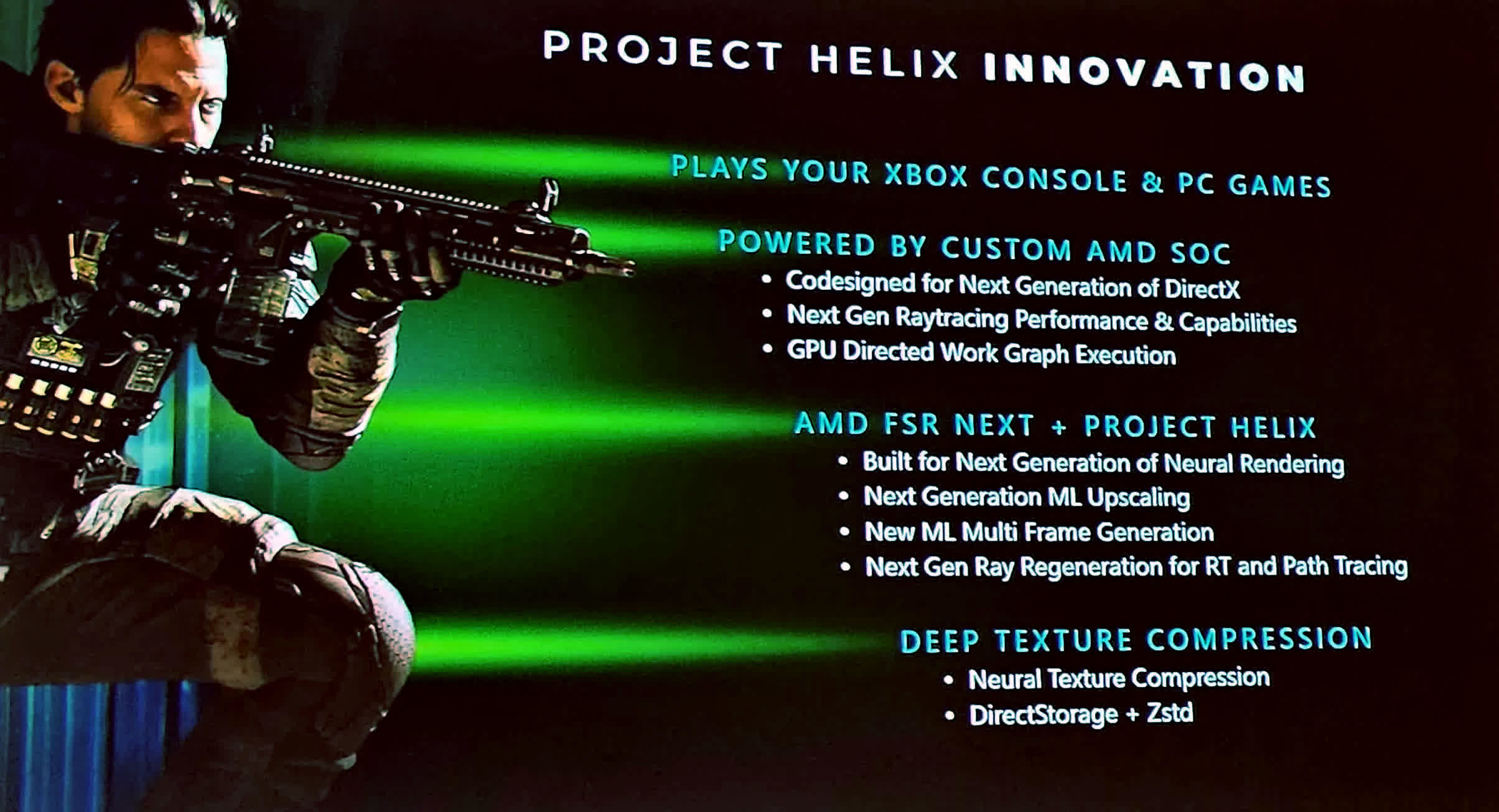
FSR Diamond will also incorporate Ray Regeneration, AMD's ML-based denoising to support Helix's ray tracing improvements and enable path tracing. Microsoft claims the new console will deliver ray tracing performance up to an order of magnitude higher than the Xbox Series X.
During another GDC session, Xbox VP Jason Ronald explained that Helix and DirectX will also support GPU-directed work graph execution, allowing GPUs to generate and manage their own workloads in real time rather than waiting for instructions from the CPU. According to Ronald, this could enable larger real-time environments with more simulations, resulting in more complex and dynamic game worlds.
Microsoft also emphasized Windows compatibility throughout its presentation. The company plans to apply lessons from the Xbox platform to Windows 11, introducing new features intended to streamline PC gaming over the coming months.

One of those changes is the controller-friendly Full Screen Experience UI, now called "Xbox Mode" which will begin rolling out to Windows 11 devices in select regions as soon as next month. Microsoft also advised developers to approach Project Helix development much like PC development, suggesting that next-generation Xbox titles will effectively be PC games.
Project Helix will run on a custom AMD SoC. Prior leaks indicated that the chip, codenamed Magnus, is based on AMD's upcoming RDNA 5 and Zen 6 architectures. Its performance may resemble or surpass Nvidia's RTX 5080, which could also make Helix significantly more expensive than the PlayStation 6.