
Crunching the OLED Figures: The number of OLED displays on the market is steadily increasing. Manufacturers are promoting their latest products with aggressive pricing strategies, while users continue to enjoy the technology's benefits for both content consumption and professional work.
According to TrendForce's latest data, shipments of OLED monitors saw massive growth in 2025. Manufacturers shipped a total of 2.7 million units, marking a 92% increase compared to the previous year. The consulting firm noted that the impressive momentum has been largely sustained by substantial promotional campaigns from major industry brands.
TrendForce's latest estimates largely reflect the market trends that emerged during the third quarter. Despite potential burn-in concerns, both gamers and professionals are increasingly adopting OLED technology in their setups. 27-inch models featuring a 240Hz refresh rate and QHD resolution have become particularly popular, offering an attractive price-to-performance ratio. Newer QHD models with higher refresh rates (280Hz) are expected to further reinforce this trend.
The firm reported that Asus maintains its market-leading position, capturing 21.6% of total OLED shipments in 2025. The Taiwanese manufacturer leverages several OLED monitors across its three main product lines, targeting gaming (ROG), professional creativity (ProArt), and mobile productivity (ZenScreen) segments.
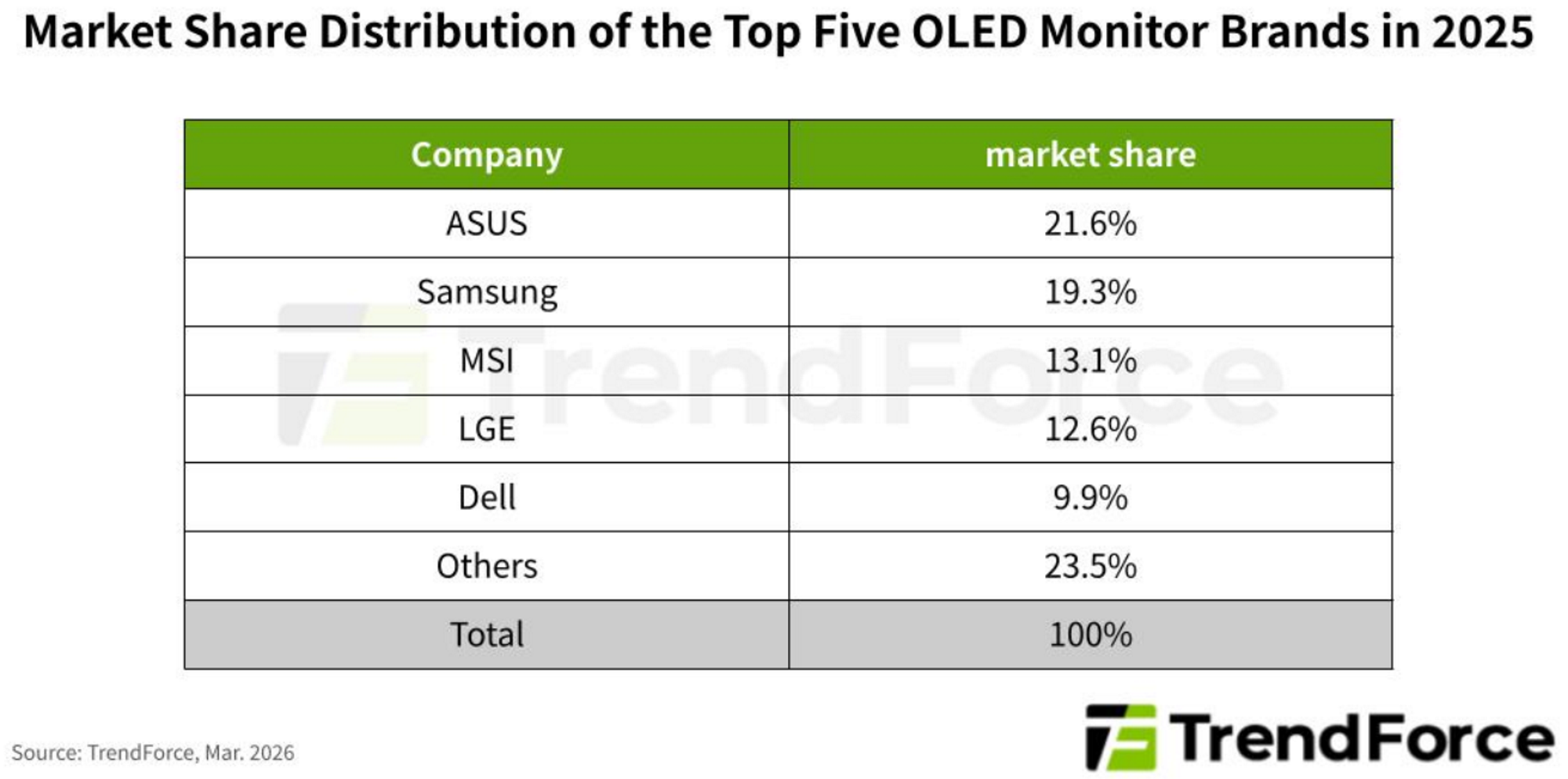
After being overtaken by Asus in the third quarter, Samsung still retained its second-place position by year's end. The Korean giant captured a 19.3% market share, bolstered by strong offerings in the 27-inch, 180Hz segment and year-end promotions for massive 49-inch Ultra HD models. Samsung continues to exert competitive pressure across both mainstream and high-end segments, suggesting it could eventually reclaim the top spot.
After actively expanding its market presence, MSI secured third place with 13.1% of total OLED shipments. The Taiwanese OEM offers a diverse lineup covering multiple price points, primarily targeting gamers with both mainstream and high-end models.
LG Electronics took fourth place with 12.6% of the market, largely thanks to its high-quality UltraGear line. TrendForce highlights that the Korean company holds a quasi-monopolistic position in the 39-inch and 45-inch segments, which helps drive strong sales despite the higher-than-average price tags.
Finally, Dell ranked fifth with a 9.9% market share. The US manufacturer primarily sells OLED displays through its Alienware gaming brand but is also targeting the mainstream market with new models featuring a 120Hz refresh rate.
Other manufacturers accounted for the remaining 23.5% of the market, TrendForce reported. The firm expects OLED displays to continue growing in popularity in the near future, projecting an estimated 51% year-over-year growth rate in 2026.