
In context: The H.264 video compression standard, also known as AVC, has been around since 2003. Even though it's been superseded by newer codecs like H.265 and AV1, it remains the most popular option because of its widespread compatibility – platforms continue to fall back on H.264 to make sure content actually plays for everyone. But now, streaming royalties associated with the standard could become an issue.
H.264 has so far carried a flat annual cap of $100,000 for large subscription platforms. That may sound like a lot, but for these companies, the numbers are so small that most of them probably forgot it even existed on their balance sheet. Well, that comfortable arrangement just got a lot less comfortable.

H.264 licensing has so far been managed by Via Licensing Alliance, a patent pool administrator. As of the start of 2026, the body swapped out that flat cap and replaced it with a tiered fee structure. At the top of the tiers lies a whopping $4.5 million-per-year fee, which is a 45x jump from where things were.
The tiers are broken down by platform type and size. The $4.5 million figure applies to OTT services with 100 million or more subscribers. It also applies to FAST platforms pulling in 100 million-plus daily users, social media services with over a billion monthly active users, and cloud gaming platforms crossing 15 million monthly active users.
Next up are the Tier 2 and Tier 3 fees, which come in at $3.375 million and $2.25 million, respectively. Only the smallest platforms – those Via classifies as "small or nascent" – get to keep the old $100,000 rate.
Codec performance
| Performance vs to H.264 |
Encoding Complexity (Speed) | Encoding Quality |
|---|---|---|
| H.264 | Baseline | Baseline |
| VP9 | 2-15x | ~35% |
| HEVC | 2-15x | ~35% |
| AV1 | 15-30x | ~50% |
Suitability for different functions
| Codec Suitability | Live Origination | Live Transcode | Low Latency | 4K | HDR |
|---|---|---|---|---|---|
| H.264 | Excellent | Excellent | Excellent | Poor | Poor |
| VP9 | Poor | Poor | WebRTC | Excellent | Poor |
| HEVC | Good | Good | Nascent | Excellent | Excellent |
| AV1 | Good | Good | WebRTC | Excellent | Getting there |
That said, there are exceptions to who this new tiered list applies to. Companies that already held an active AVC license by the end of 2025 get to keep their original terms. The new pricing only targets previously unlicensed implementers looking to sign on in 2026 or later.
As reported by Streaming Media, Via reportedly reached out to unlicensed media companies throughout 2025 to give them a heads-up and a chance to lock in the old rates, but the firm never issued a public announcement. Anyone who missed the outreach is now staring down the new structure.
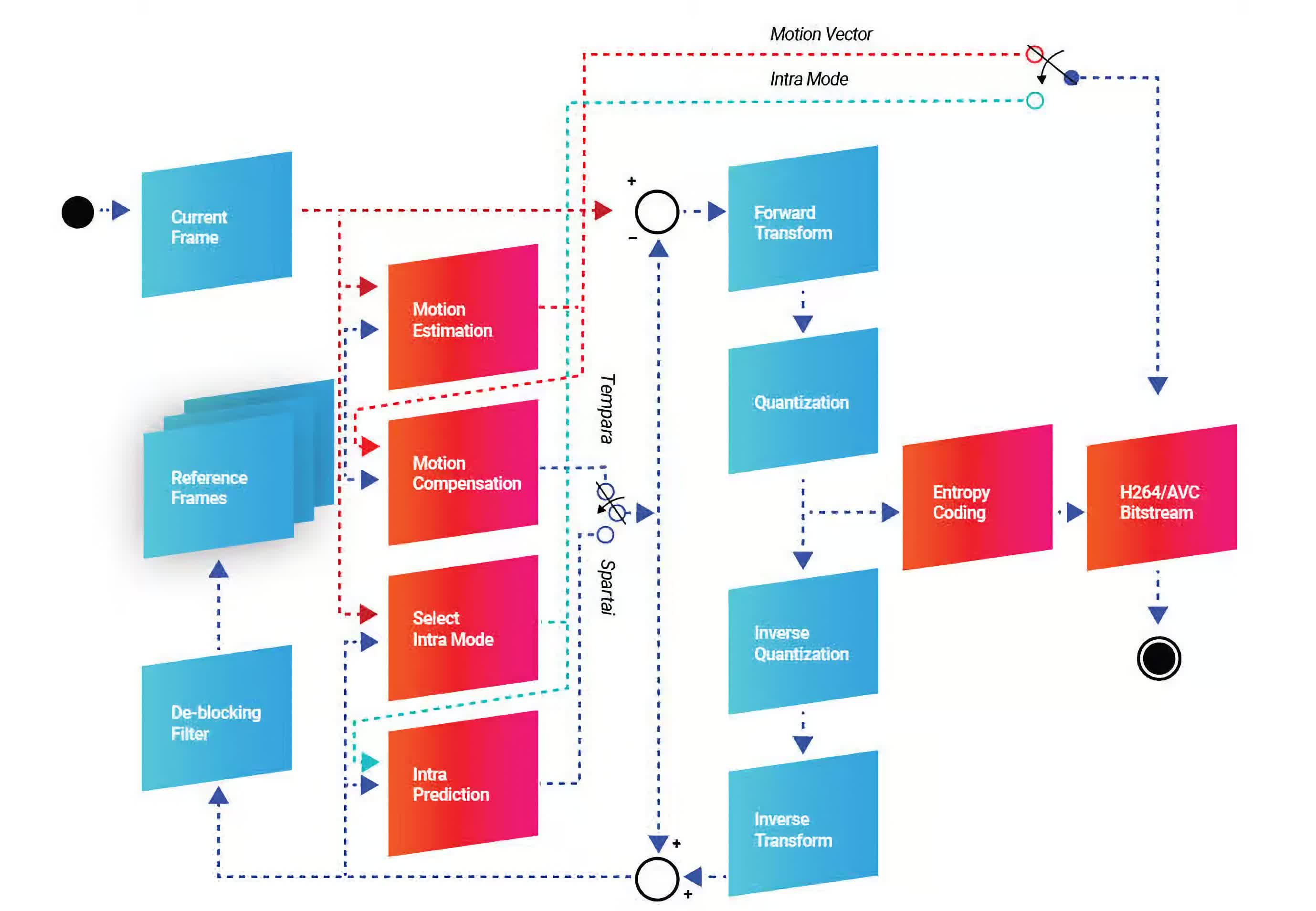
The broader codec licensing environment has been getting increasingly aggressive over the past couple of years. Nokia has already gone after streaming services over HEVC patents. Two other licensing pools, Access Advance and Avanci, have also entered the picture with their own rate cards.
Those cover a whole range of codecs, from AVC and HEVC to VP9, VVC, and AV1. Taken together, major streaming platforms could be looking at, and major streaming platforms could be looking at nine-figure annual licensing bills.