What just happened? AMD has hit another x86 CPU milestone, with Mercury Research figures showing the company now holds 38.1% of overall market revenue. That sounds like another win for Team Red, especially given its huge gains in servers, but there is a surprising caveat: AMD actually lost ground in desktop PCs during the first quarter.
Mercury Research's Q1 2026 numbers show AMD reaching 46.2% of x86 server CPU revenue, a new record for the company. Its server unit share climbed to 33.2%, underlining how Epyc continues to gain traction in cloud, enterprise, and AI infrastructure deployments.
The gap between revenue share and unit share also suggests AMD is doing especially well in higher-value server chips, rather than simply shipping more lower-cost parts.
That helps explain why AMD's overall x86 revenue share keeps climbing. The company has spent years eating into Intel's most profitable markets, and the AI boom has only made high-core-count, high-margin server processors more important. Intel still leads the x86 server market overall, but AMD is now much closer than it has been at any point in the modern Epyc era.
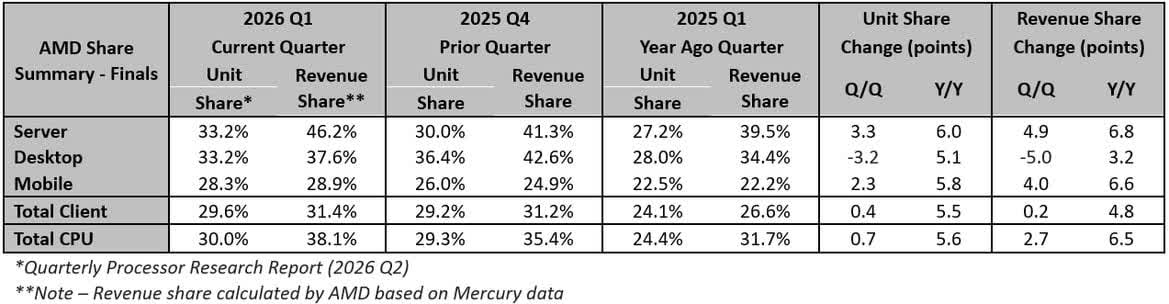
Client CPUs were more of a mixed bag. AMD's overall client unit share rose to 29.6%, up from 29.2% in Q4 2025 and 24.1% a year earlier. That still leaves Intel with 70.4% of the consumer PC market, but the year-over-year direction is clear.
The gap between revenue share and unit share also suggests AMD is doing especially well in higher-value server chips, rather than simply shipping more lower-cost parts.
The desktop PC segment is where the numbers falter. AMD's desktop unit share fell to 33.2% in Q1, down from a record 36.4% in the previous quarter. Desktop revenue share also slipped to 37.6%, down from around 42.5% in Q4. Those are still strong results compared with the same period last year, when AMD held 28% of desktop unit share, but the QoQ decline stands out.
Laptops were a much brighter spot for Lisa Su's firm. AMD's mobile unit share rose to 28.3%, while mobile revenue share reached 28.9%, both up sequentially. That suggests the company is finally pushing further into a market where Intel has traditionally dominated.
The figures also contrast with the latest Steam survey, where AMD's CPU gains among participants stalled rather than reversed. Participants using AMD CPUs rose by just 0.01% in April, leaving it around 11% behind Intel after more than a year of steady progress. Steam is not a market-share report, of course, though the timing is interesting: gamers still love AMD's X3D chips, but Intel's Core Ultra 200 Plus arrived in March to rave reviews.