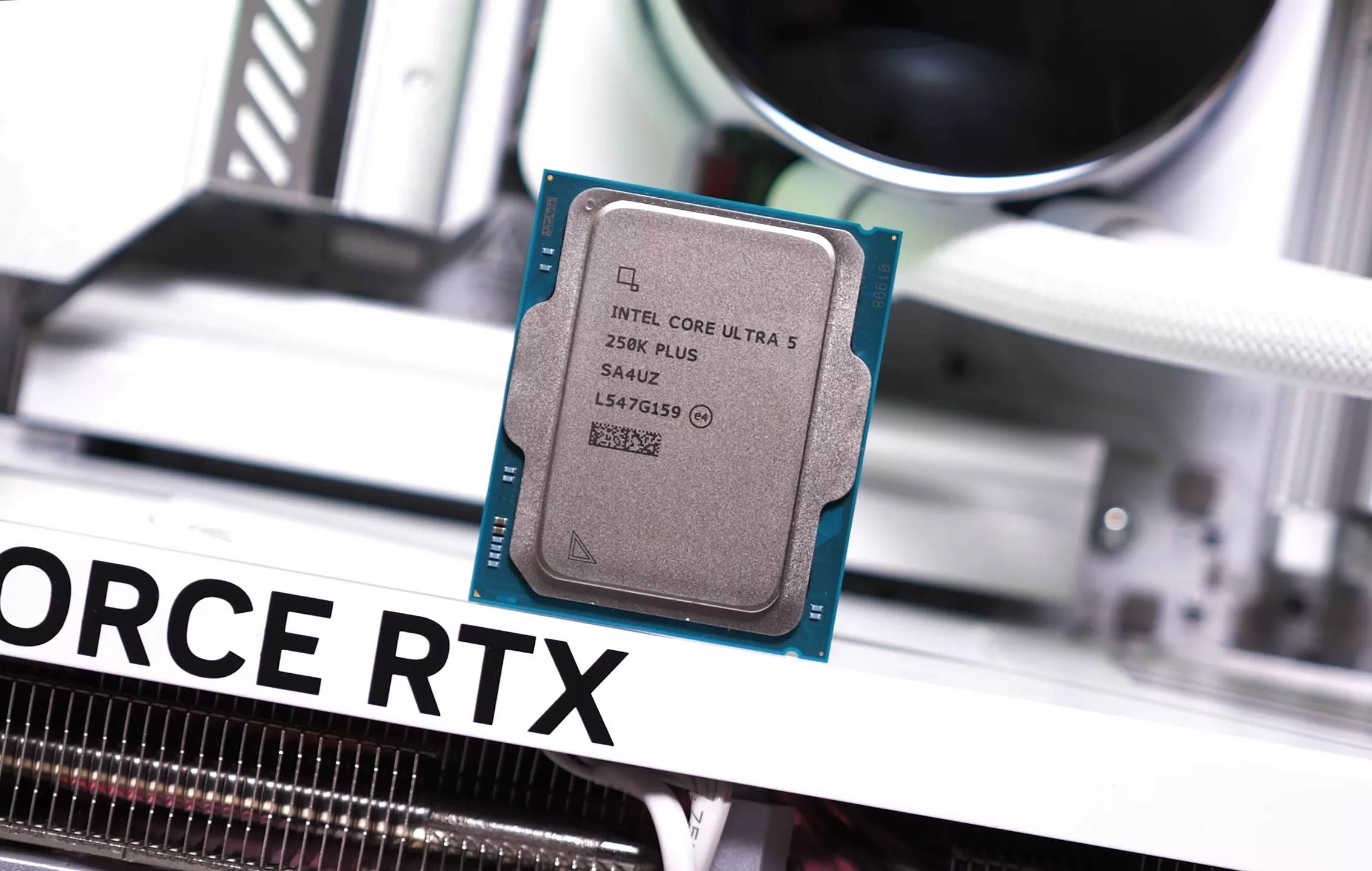
In an effort to drum up interest in the Core Ultra 200 series, Intel has released two new models, the Core Ultra 7 270K Plus and Core Ultra 5 250K Plus. In today's review, we focus on the more affordable 250K Plus, which carries an MSRP of just $200, putting it head to head with AMD's Ryzen 5 9600X.
Both are technically 6-core processors, but whereas the 9600X is a 6-core / 12-thread part, the 250K Plus features 6 P-cores and a hefty 12 E-cores, for a total of 18 threads. This should make it considerably more capable in core-heavy productivity tasks, and possibly one of the best value CPUs we have seen for these workloads.

So what exactly is the Core Ultra 5 250K Plus, beyond the unnecessarily long name? This is not merely a refreshed part as we initially suspected, but an entirely new model based on the same Arrow Lake architecture. It retains the 6 P-cores of the 245K, but increases the E-core count to match the 265K. More importantly for gaming, it also receives the same 30MB of L3 cache as the 265K.
Core clocks have also seen a few minor adjustments. The P-cores on the 250K Plus, for example, are now clocked 2% higher. There are also more significant changes: Intel has increased the die-to-die frequency to 3GHz, a whopping 900MHz or 43% uplift over the 245K. The ring clock has also been raised by 200MHz to 3.9GHz, and these tweaks should help deliver meaningful performance gains.
| Core Ultra Model | 285K | 270K Plus | 265K | 250K Plus | 245K | 225 |
|---|---|---|---|---|---|---|
| Release date | Oct 2024 | Mar 2026 | Oct 2024 | Mar 2026 | Oct 2024 | Jan 2025 |
| Release price | $600 | $300 | $395 | $200 | $310 | $240 |
| P-core (performance) | ||||||
| Cores (threads) | 8 (8) | 6 (6) | 6 (6) | |||
| Frequency | 3.7 GHz | 3.9 GHz | 4.2 GHz | 3.3 GHz | ||
| Turbo | 5.6 GHz | 5.5 GHz | 5.3 GHz | 5.2 GHz | 4.9 GHz | |
| L2 cache | 24 MB | 18 MB | 18 MB | |||
| E-core (efficiency) | ||||||
| Cores (threads) | 16 (16) | 12 (12) | 8 (8) | 4 (4) | ||
| Frequency | 3.2 GHz | 3.3 GHz | 3.6 GHz | 2.7 GHz | ||
| Turbo | 4.6 GHz | 4.6 GHz | 4.6 GHz | 4.4 GHz | ||
| L2 cache | 16 MB | 12 MB | 8 MB | 4 MB | ||
| L3 cache | 36 MB | 30 MB | 24 MB | 20 MB | ||
| Power | ||||||
| Base | 125 W | 65 W | ||||
| Max Turbo | 250 W | 159 W | 159 W | 121 W | ||
In addition, official DDR5 support has increased from an "up to" rating of DDR5-6400 on the original models to DDR5-7200 for these updated Plus versions. Intel is also expanding CUDIMM support by introducing CQDIMM, or 4R CUDIMM, to the 200S Plus series.
The 4R designation stands for 4-rank, meaning the memory module contains four distinct ranks of memory chips on a single stick. This enables extremely high memory densities, currently up to 128GB per module. As a result, using just two DIMM slots, a consumer-grade motherboard can support up to 256GB of memory – though in the current market, it might be cheaper to buy a house.

With that in mind, we will not dive deeper into this technology here, as it is something we plan to cover in more detail when it becomes more relevant.
One important update Intel has introduced for the 200S Plus processors is the Intel Platform Performance Package, which can be thought of as an all-in-one platform software solution. This software is essential for proper scheduling, core parking, idle power behavior, and overall performance. Since it functions similarly to AMD's Ryzen chipset driver, we made sure to install it for all of our testing.

Speaking of testing, for all Core Ultra series processors we have used DDR5-8200 CUDIMM memory. We will also include some memory scaling data using slower, more affordable configurations. There is a lot of data to go over, so we should get started.
Test System Specs
| CPU Motherboard Memory |
AMD Ryzen 9000 AMD Ryzen 7000 |
Gigabyte X670E Aorus Master [BIOS F41] G.Skill Trident Z5 RGB 32GB DDR5-6000 CL30-38-38-96 |
| AMD Ryzen 5000 | MSI MPG X570S Carbon MAX WiFi [BIOS 7D52v1D1] G.Skill Ripjaws V Series 32GB DDR4-3600 CL14-15-15-35 |
|
| Intel Core Ultra 200S [Intel Default Profile] |
MSI Z890 Tomahawk WiFi II [BIOS 7E32v1B12] G.Skill Trident Z5 CK 32GB DDR5-8200 CL40-52-52-131 CUDIMM |
|
| Intel Core 14th-gen [Intel Default Profile] |
MSI MPG Z790 Carbon WiFi [BIOS 7D89v1H] G.Skill Trident Z5 RGB 32GB DDR5-7200 CL34-45-45-115 |
|
| Graphics Card | Asus ROG Astral RTX 5090 32GB OC Edition | |
| Power Supply | Kolink Regulator Gold ATX 3.0 1200W | |
| Storage | TeamGroup T-Force GE PRO M.2 PCIe Gen5 NVMe SSD 4TB | |
| GPU Driver | GeForce Game Ready 595.79 WHQL | |
Benchmarks
All-core Cinebench Workload
Before we jump into the bar graphs, here's a quick look at how the 250K Plus behaves under an all-core workload in Cinebench. We saw an average P-core frequency of 5GHz and an average E-core frequency of 4.4GHz.
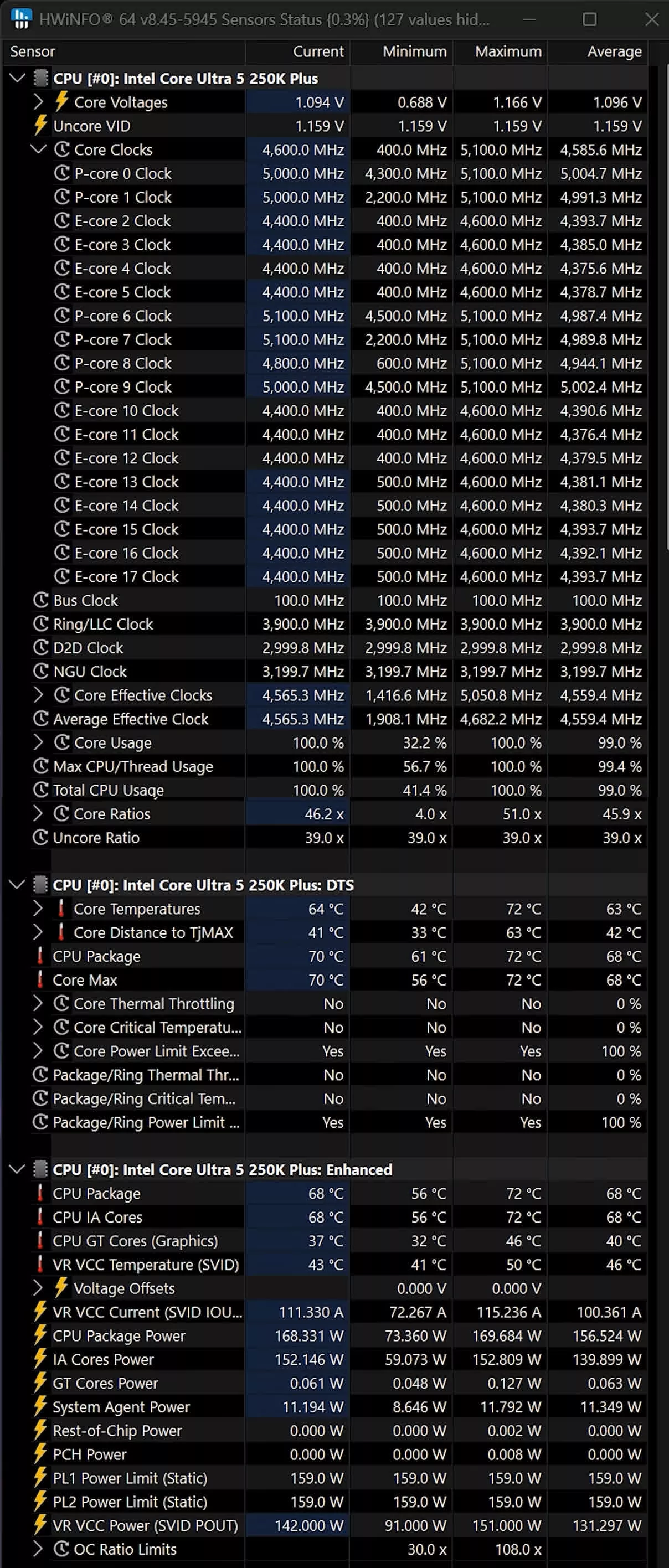
The ring was clocked at 3.9GHz, the die-to-die frequency at 3GHz, and the uncore at 3.2GHz. With a 360mm AIO installed, peak operating temperature hit 72C, and for those wondering, under the exact same test conditions the 245K maxed out at 70C.
Cinebench 2026 Multi
This is our first look at what makes the 250K Plus a strong offering for $200 – that being its productivity performance. Cinebench 2026 might represent a best-case scenario for Intel's E-cores, but even so, when they're utilized well the results are mighty impressive.

In this example, the 250K Plus is a whopping 85% faster than AMD's Ryzen 5 9600X. We're also looking at a 25% increase over the 245K and 27% over the 14600K. In fact, it's just 10% slower than the 265K – so a very impressive result overall.
Cinebench 2026 Single
Even single-thread performance is very strong, with the 250K Plus beating the 14900K and 265K. It was also 6% faster than the 9600X and 9% faster than the 245K.

Blender
Blender confirms what we saw in the Cinebench multi-core test. Here, the 250K Plus is a massive 86% faster than the 9600X, as it was able to match the 265K. That also makes it a hefty 45% faster than the 245K.

7-Zip File Manager
For more common productivity tasks like file compression and decompression, the 250K Plus also performs well. For compression, it was 65% faster than the 9600X and 21% faster than the 245K – so AMD is again getting crushed in this workload.

The same is true for decompression performance, where the 250K Plus is 50% faster than the 9600X and 28% faster than the 245K.

Adobe Photoshop
As impressive as the 250K Plus has been so far, it won't dominate every workload. Photoshop is a good example – here, the 9600X is able to beat the 250K Plus by a comfortable 21% margin. The new Intel CPU, on the other hand, is just 5% faster than its predecessor, the 245K.

Adobe Premiere
The 250K Plus fares better in Premiere Pro, though the margin is modest. It is 7% faster than the 9600X while offering just a slight performance increase over the 245K.

Gaming Benchmarks
Rainbow Six Siege X
Time for the gaming benchmarks, starting with Rainbow Six Siege. The results here aren't amazing relative to the Ryzen competition, as the 9600X was 19% faster – so that's a bit disappointing. However, the 250K Plus is a big step up from the very underwhelming 245K, boosting performance with the medium settings by 28%. As a result, it was even 8% faster than the 265K.

Battlefield 6
The Battlefield 6 results, though, are very impressive. Here, the 250K Plus is able to match the 14900K, which means only the Zen 4 and Zen 5 X3D processors are faster. Using the medium settings, the 250K Plus was also 11% faster than the 9600X in average frame rate, but more crucially, an impressive 33% faster in the 1% lows.

Arc Raiders
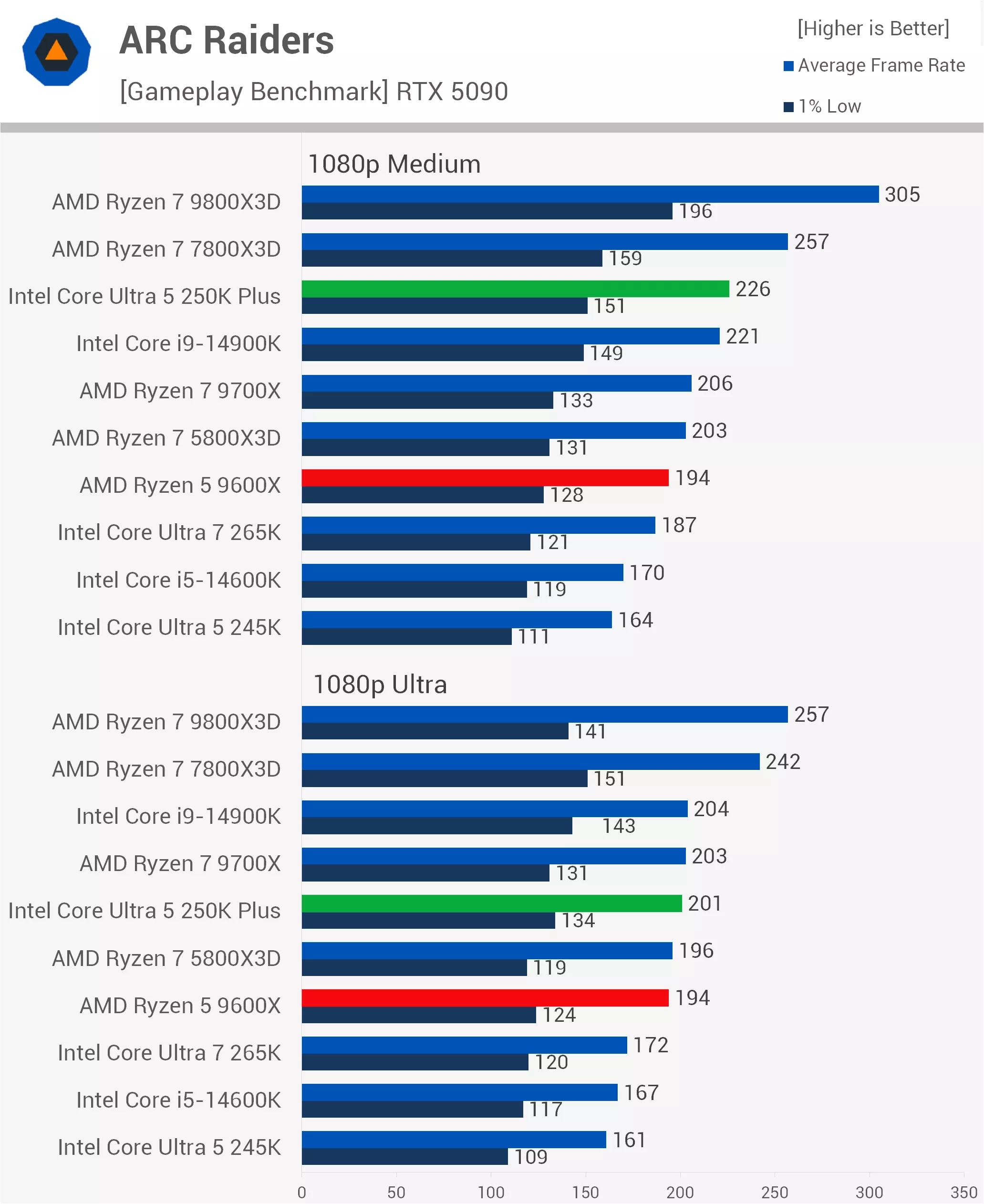
The 250K Plus was also very impressive in ARC Raiders, particularly with the medium quality settings, where it managed to edge out the 14900K while offering a 16% boost over the 9600X. The results shift with the Epic settings. While the game is not heavily GPU-limited – judging by the X3D results – the added CPU load brings the 250K Plus and 9600X closer together, with the Intel CPU now just 4% faster.
Borderlands 4
Borderlands 4 is mostly GPU-limited when testing with modern CPUs, so the 250K Plus and 9600X are very evenly matched. The biggest margin appears with the medium settings, though even then the Intel CPU was just 4% faster.

Marvel Rivals
Intel has the advantage in Marvel Rivals. Here, the 250K Plus was 12% faster than the 9600X using the medium preset and 15% faster with Ultra. It was also 18% faster than the 245K on medium settings, marking a solid upgrade.

Baldur's Gate 3
Moving on to Baldur's Gate 3, both the 250K Plus and 9600X are evenly matched overall. However, with the medium settings, we did see consistently stronger 1% lows from the Intel CPU. The 250K Plus was also up to 29% faster than the 245K in this test.

Cyberpunk 2077: Phantom Liberty
The Cyberpunk 2077: Phantom Liberty results are quite interesting. At first glance, performance looks very competitive, with the 9600X and 250K Plus neck and neck using medium settings. However, the 1% lows reveal the Intel CPU is 16% faster. Moving to ray tracing ultra, that 16% advantage in 1% lows remains, while the 250K Plus is also 13% faster in average frame rate.

Counter-Strike 2
The 245K was relatively weak compared to other modern CPUs in Counter-Strike 2, and the 250K Plus goes a long way toward fixing that. Performance improves by 17% with the medium preset and 12% using very high settings. This allows the 250K Plus to trade blows with the 9600X, with overall performance being quite similar.

Space Marine 2
Next up is the CPU-heavy Space Marine 2. Here, the 250K Plus was just 3% faster than the 9600X using medium settings, but 8% faster with Ultra. It was also a solid upgrade over the 245K, delivering around 10% more performance.

Mafia: The Old Country
In Mafia: The Old Country, the 250K Plus again performs well, beating the 9600X by 8% using medium settings, or 13% when looking at the 1% lows. We're also seeing a similar improvement over the 245K.

Assetto Corsa Competizione
Unfortunately, the 250K Plus isn't as impressive in ACC, offering only a 7 – 10% uplift over the 245K. This leaves the 9600X around 17% faster with medium settings and 22% faster using Epic, giving Ryzen a clear advantage in this title.

Spider-Man 2
The opposite is true for Spider-Man 2. Here, the 250K Plus was 9% faster than the 9600X using medium settings and then an impressive 24% faster with the ultimate ray tracing preset.

Horizon Zero Dawn Remastered
The 250K Plus also performed well in Horizon Zero Dawn Remastered, beating the 9600X by 7% using medium settings and 9% with very high. It was also faster than the 265K in both cases, resulting in up to an 11% improvement over the 245K.

The Last of Us Part II Remastered
Finally, we have The Last of Us Part II Remastered. Here, the 250K Plus wraps up the gaming benchmarks on a high note, beating the 9600X by 14% in average frame rate with medium settings. More notably, it delivered an incredible 32% uplift in 1% lows, and we see much the same trend with the very high preset.

14 Game Average
Across the 14 games tested, the Core Ultra 250K Plus was on average just 2% faster than the Ryzen 9600X when looking at the medium quality data, or 3% faster using the Ultra settings.
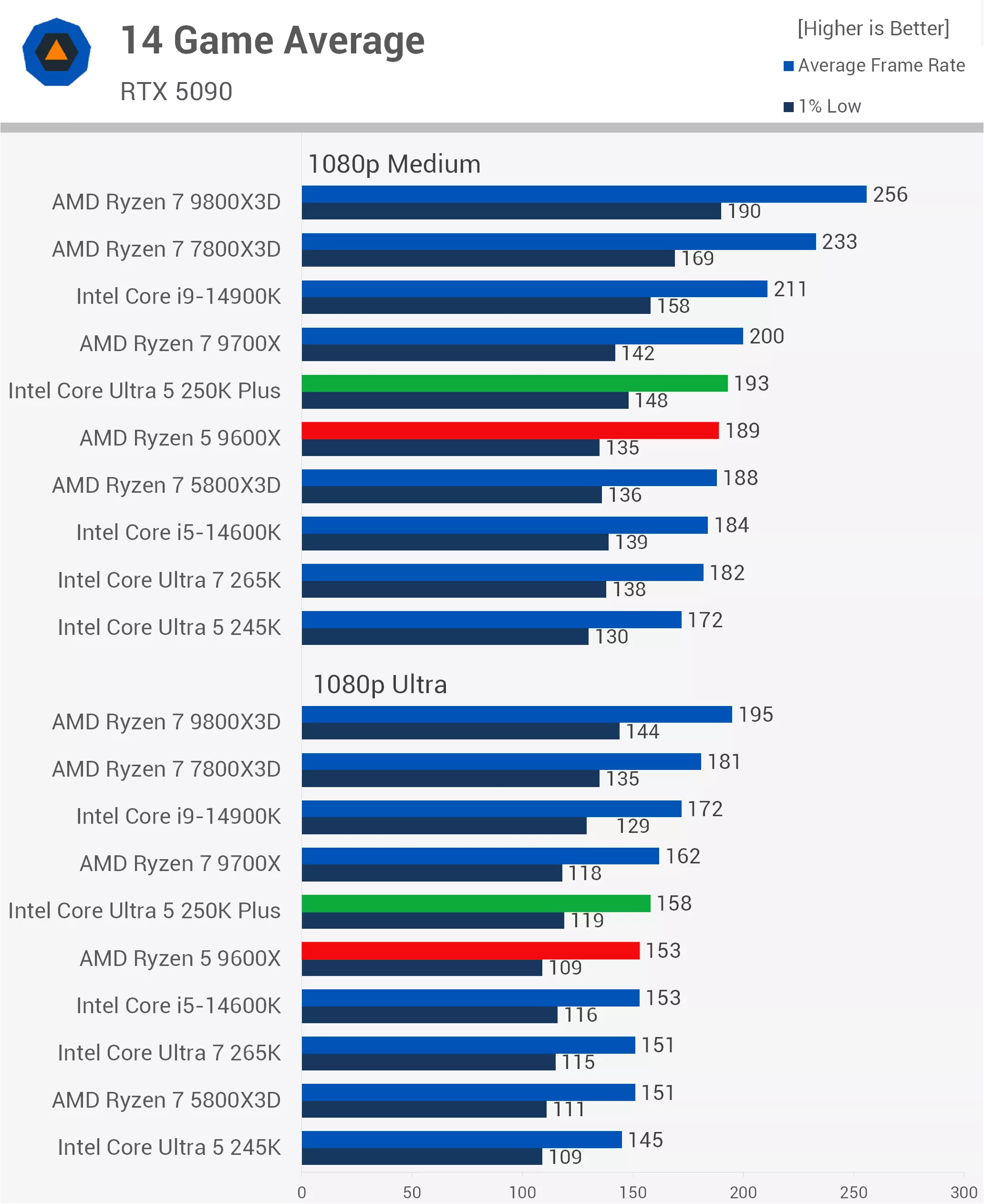
That makes it 4% slower than the 9700X and 9% slower than the 14900K, but also 6% faster than the 265K and an impressive 12% faster than the 245K.
Overall, in terms of gaming performance, the new 250K Plus and 9600X appear to be neck and neck.
Power Consumption
Now here's a look at CPU power consumption, starting with the Cinebench results. Under full load, the 250K Plus consumed 154W – a modest 7% increase over the 245K for a 25% increase in performance.
When compared to the Ryzen 5 9600X, the 250K Plus consumed 57% more power, but it was also a whopping 85% faster. So for this particular workload, the Intel CPU is clearly more power efficient.

For gaming, we're seeing similar power usage between the 250K Plus and 9600X in Cyberpunk 2077.

We're also seeing identical power draw – 91W for both parts – in Space Marine 2. That's an impressive result for Intel, given the 250K Plus was faster here.

It was also faster in Spider-Man 2, though it consumed 11% more power. Still, given it was 24% faster using these quality settings, that's another strong result.

One-click Overclocking
Like the previous Core Ultra 200 series models, these updated parts support 200S Boost which is Intel's one-click overclocking feature, similar to AMD's PBO. Typically, these features don't offer much, but we decided to take a look anyway.
Starting with Horizon Zero Dawn Remastered, enabling 200S Boost on the 250K Plus does virtually nothing. This mirrors what we saw with PBO on the 9600X. The 245K did see a small 3 – 6% boost in our testing, but even with a 6% gain, the 250K Plus was still 5% faster using the Very High settings.

Marvel Rivals delivered mixed results, though one thing remained consistent – the 250K Plus showed no meaningful gains with 200S Boost enabled. Meanwhile, PBO boosted the 9600X by just 2% using medium settings and up to 5% with Ultra. The 245K saw up to a 6% improvement, but it still lagged well behind the stock 250K Plus.

Finally, in Rainbow Six Siege, we see more of the same. 200S Boost does little to nothing for the 250K Plus, despite boosting the 245K by 4 – 6%. Even then, those gains aren't enough to close the gap to the newer 250K Plus.

DDR5 Scaling
The gaming performance we've seen from the 250K Plus has been very strong, particularly for a $200 processor. The good news is that ultra-premium CUDIMM memory isn't required to achieve those results.

In fact, in most of the games we tested, a similar level of performance was achievable using DDR5-6000 CL30 memory. For example, in Horizon Zero Dawn Remastered, we're looking at no more than a 3% performance drop, which still leaves the 250K Plus ahead of the 9600X.

We did see up to a 5% loss with DDR5-6000 in Marvel Rivals, but even then, the 250K Plus remained faster than the 9600X when both CPUs were using the same spec memory.

In Rainbow Six Siege, the performance hit with DDR5-6000 was less than 2% compared to DDR5-8200. However, in this case, the 250K Plus was already trailing the 9600X.
What We Learned
The Core Ultra 5 250K Plus is a highly efficient, blisteringly fast productivity CPU with gaming performance that rivals AMD at the same price point. When compared to the Ryzen 5 9600X, it's fair to say the 250K Plus is the better $200 offering. It's simply better at almost everything, and that's also what makes it a bit frustrating.
It's frustrating because technically speaking there's nothing new here: the 250K Plus is essentially a reconfigured 200 series processor, based on the same Arrow Lake architecture. There's no major breakthrough driving these gains, Intel has simply done a much better job of getting the formula right this time.
When compared to the Ryzen 5 9600X, it's fair to say the 250K Plus is the better $200 offering.

For example, looking back to late 2024, the Core Ultra 5 245K launched at $310 while the 265K came in at $400. Productivity performance was solid, but gaming performance was underwhelming, and we already knew there would be no future CPU architectures on the LGA 1851 socket.
Today, using that same architecture, Intel is delivering a 6% gaming performance uplift over the 265K... at roughly half the price. We're also seeing, on average, 12% better gaming performance than the 245K, despite that part launching at a 55% higher price. And it's not just gaming: productivity performance is around 25% stronger than the 245K, while coming in just 10% behind the 265K – again, at about half the cost. That makes the 250K Plus a considerably better overall offering.

In many ways, this is the product Intel should have launched a year and a half ago. Had they done so, the Core Ultra 200 series might not have been viewed as such a disappointment. As it stands, this feels like a case of too little, too late. For those building a budget productivity system, the 250K Plus should be a go-to option. For gaming, it's also a strong value choice, though at the same price the 9600X remains competitive – and offers a real upgrade path, whether to an existing X3D chip if prices drop, or to a future Zen 6 processor.
The 250K Plus makes the most sense for those planning a full platform upgrade or building a new system. Even then, committing to what is effectively a dead platform is a tough call. That said, for heavy productivity workloads, it can still make sense, as matching its performance on AMD's side often requires stepping up to something like the 9900X, which is nearly twice the price.

Of course, there's also the elephant in the room – DRAM and NAND pricing. If you don't already have DDR5 memory, which is likely if you're considering this upgrade, you're currently looking at around $400 for a 32GB kit – twice the cost of the 250K Plus. At that point, spending more on a CPU for features like long-term platform support becomes a smaller concern.
Still, setting all that external noise aside, if the choice simply comes down to a system with the 9600X or one with the 250K Plus, we would pick the 250K Plus every time. And that gives us some optimism for Intel's next-generation Nova Lake CPUs, expected later this year, though that precisely highlights again just how poorly timed these updated models are.