
What just happened? The internet has passed a very unwelcome milestone: for the first time in history, bots have surpassed human traffic online. The announcement came from Cloudflare CEO and co-founder Matthew Prince, who said the rapid growth of agentic internet traffic is responsible.
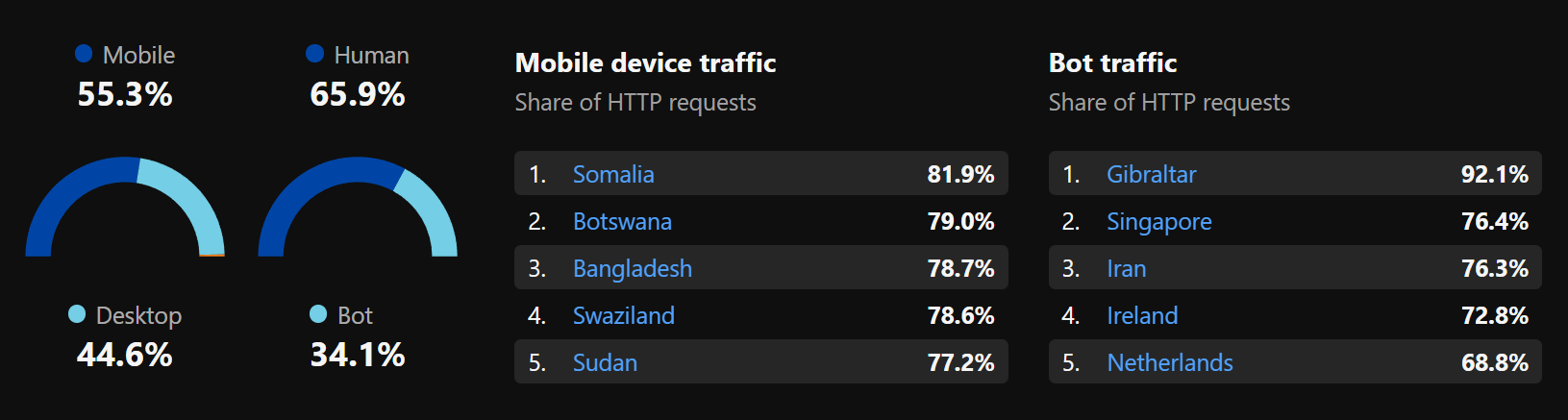
Prince said that while he had predicted bot traffic would surpass humans, he believed it would happen toward the end of 2027. Cloudflare Radar shows bots currently make up around 56% of all traffic, though that figure has been as high as 62% over the last week. The CEO said the crossover from human to bot domination happened over the last few months, but it's only now becoming obvious.
– Matthew Prince 🌥 (@eastdakota) June 3, 2026
Cloudflare's regional breakdown shows that bot traffic is far from evenly distributed. Gibraltar currently has one of the most extreme splits, with more than 90% of HTTP requests from the British Overseas Territory classified as automated.
Singapore and Iran also sit high on the list, each with bot traffic making up more than three-quarters of requests. Those figures don't mean the regions are filled with bot operators; they're more likely a reflection of hosting infrastructure, routing, VPN use, and other factors that can make automated traffic appear to originate from specific locations.
In 2024, Akamai wrote that bots made up 42% of overall web traffic, 65% of which were malicious. Since then, the proliferation of AI agents that carry out web-based tasks on behalf of humans has changed the internet landscape rapidly.
Cloudflare started classifying traffic based on newer types of automated visitors last year, including signed agents and verified bots, which is why the company's charts don't go back very far. Unlike old-school search crawlers or the usual fraud bots, agentic traffic can look more like a person using the web, only much faster and at far greater scale.
The problem is that a single human request can generate a huge number of automated visits. Prince previously used online shopping as an example: a person looking for a camera might visit five websites, but an AI agent completing the same task could visit 5,000. Apply that across millions of people asking AI tools to research products, compare flights, summarize articles, or gather data, and the result is an internet increasingly used by bots talking to bots.
Not all of this activity is malicious. Some bots index pages, monitor services, fetch data for assistants, or perform useful tasks. But even legitimate agents create real server load, distort analytics, and impact business models built around human visits, ad impressions, and subscriptions.
Publishers are especially exposed to this sort of bot activity, as illustrated by a Pew analysis last year that found Google users were almost 50% less likely to click a traditional search result when an AI Overview appeared.
The news has seen claims that Dead Internet Theory is no longer a theory. But it is worth remembering that Cloudflare's figures measure HTTP requests rather than attention, time spent, or actual people. Humans still account for most of the time spent watching videos, scrolling feeds, posting, shopping, and arguing with strangers online.
But that's not to say things aren't changing rapidly. The open web is now being swamped by AI agents that move faster than humans, consume more pages than humans, and increasingly decide what humans see. More than 10% of AI summaries are citing AI-generated content. And the recent failed relaunch of Digg due in part to bots and AI flooding the site doesn't bode well for the web's fleshy inhabitants.