
The takeaway: SpaceX has revealed that its Starlink satellite Internet service now has more than 12 million active customers across 160+ countries and territories around the globe. And according to CEO Elon Musk, that's just the start of what the space company has planned over the near term.
In a recent post on X, Musk noted that Starlink V3 satellites have more than 10 times the bandwidth of their predecessors, and that they will be launched at a rate of more than 10x. Effectively, Musk said, this will result in greater than 100x the available bandwidth compared to what is possible right now. Depending on how you look at it, Version 3 is 10-20 times more capable than Version 2, he said.
As of mid-May, there were just over 10,000 active Starlink satellites in orbit.
Musk added that the satellites altitude will be reduced from 550km to 350km, which should cut latency in half.
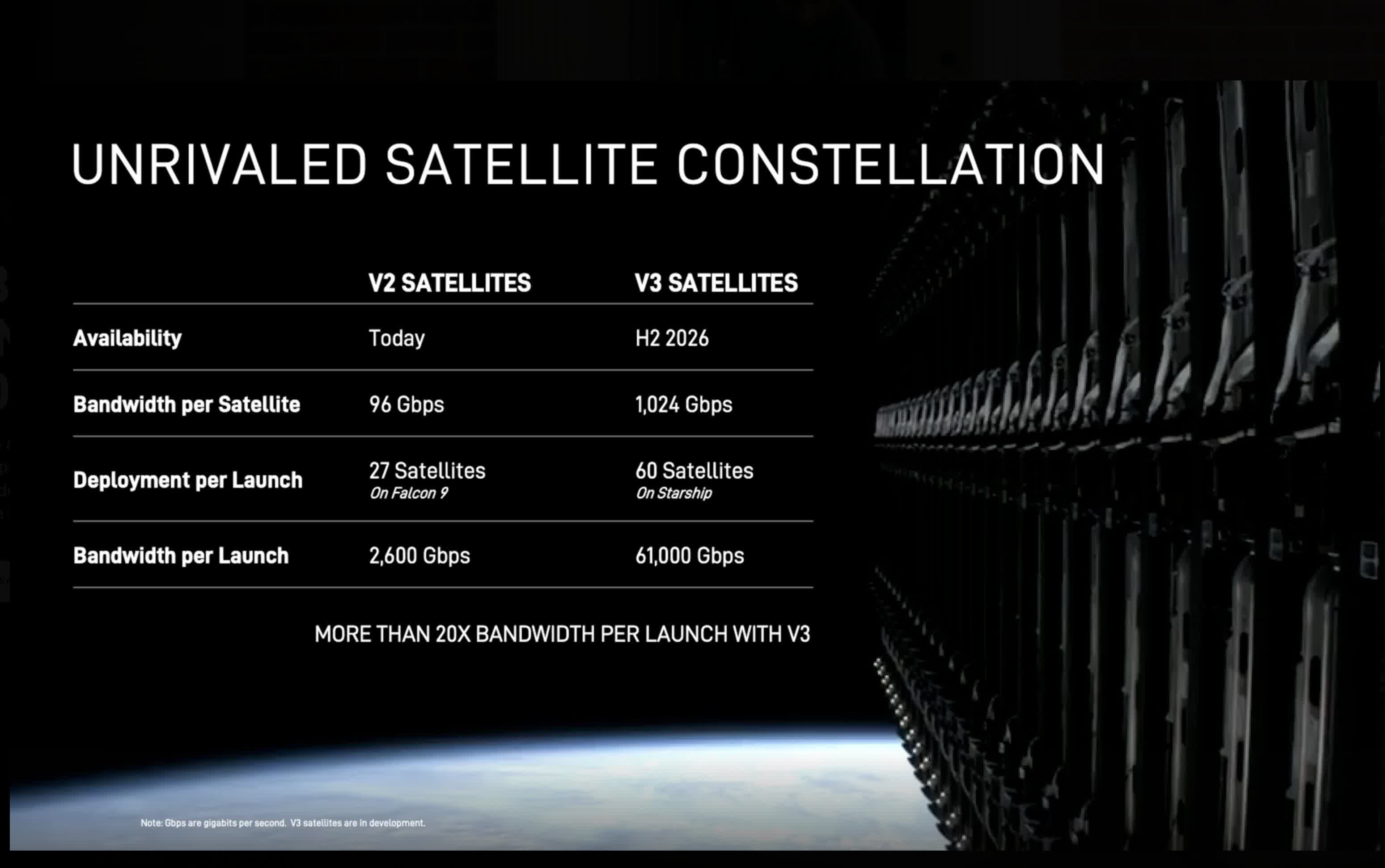
The boost in bandwidth and reduction in latency could be a critical stepping stone in communications. "The future of AI and robots is actually going to require a lot more bandwidth than we currently use," Musk said during a chat with JP Morgan CEO Jamie Dimon as part of his company's recent IPO pitch to investors.
Earlier this week, SpaceX set its IPO price at $135 per share. The company will offer 555.6 million shares as part of its initial public offering, valuing the company at $1.76 trillion. If successful, SpaceX would raise around $75 billion and become the most successful IPO in history.
Starlink will be a key cog in SpaceX's business plan moving forward. According to a recent regulatory filing, the division accounted for 60% of SpaceX's total revenue of $18.7 billion in 2025. Multiplying the available bandwidth by many multiples is likely to attract additional customers and generate even more income.
Significant hurdles still remain, however, as SpaceX continues to field complaints from concerned citizens, astronomers, and various environmental groups regarding matters like light pollution and overpopulating Earth's orbit with man-made material. And actually getting its satellites into space remains a hurdle as well.