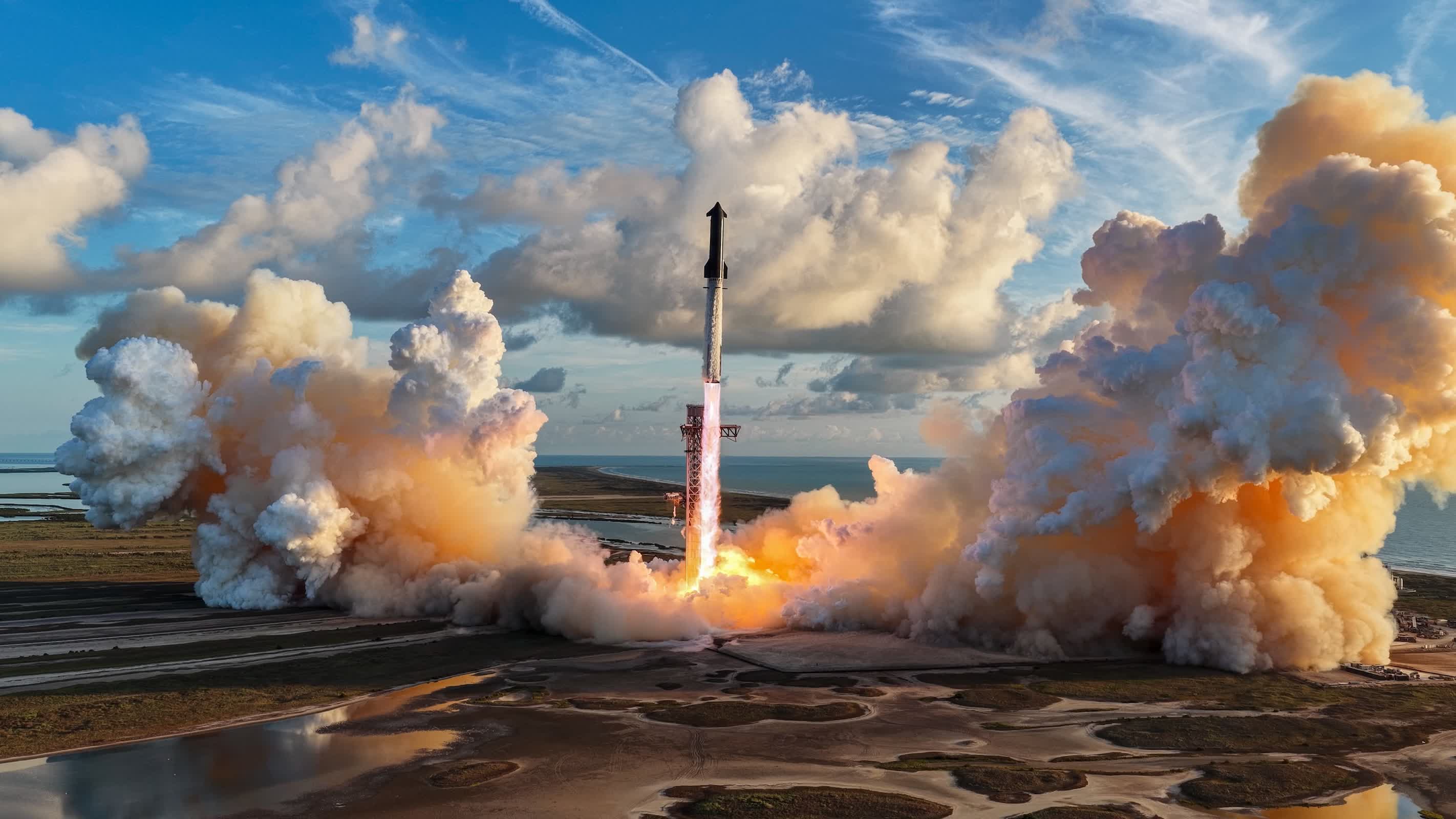
What just happened? SpaceX's Starship reached orbit for the first time Monday and released 26 of the company's newest Starlink satellites, a milestone that gives the rocket a direct role in expanding SpaceX's broadband network. The flight was Starship's 14th test mission and its first to complete a full orbital insertion. It also marked the first time SpaceX placed commercial-grade Starlink V3 satellites into orbit. The spacecraft are too large for Falcon 9, making Starship essential to their deployment.
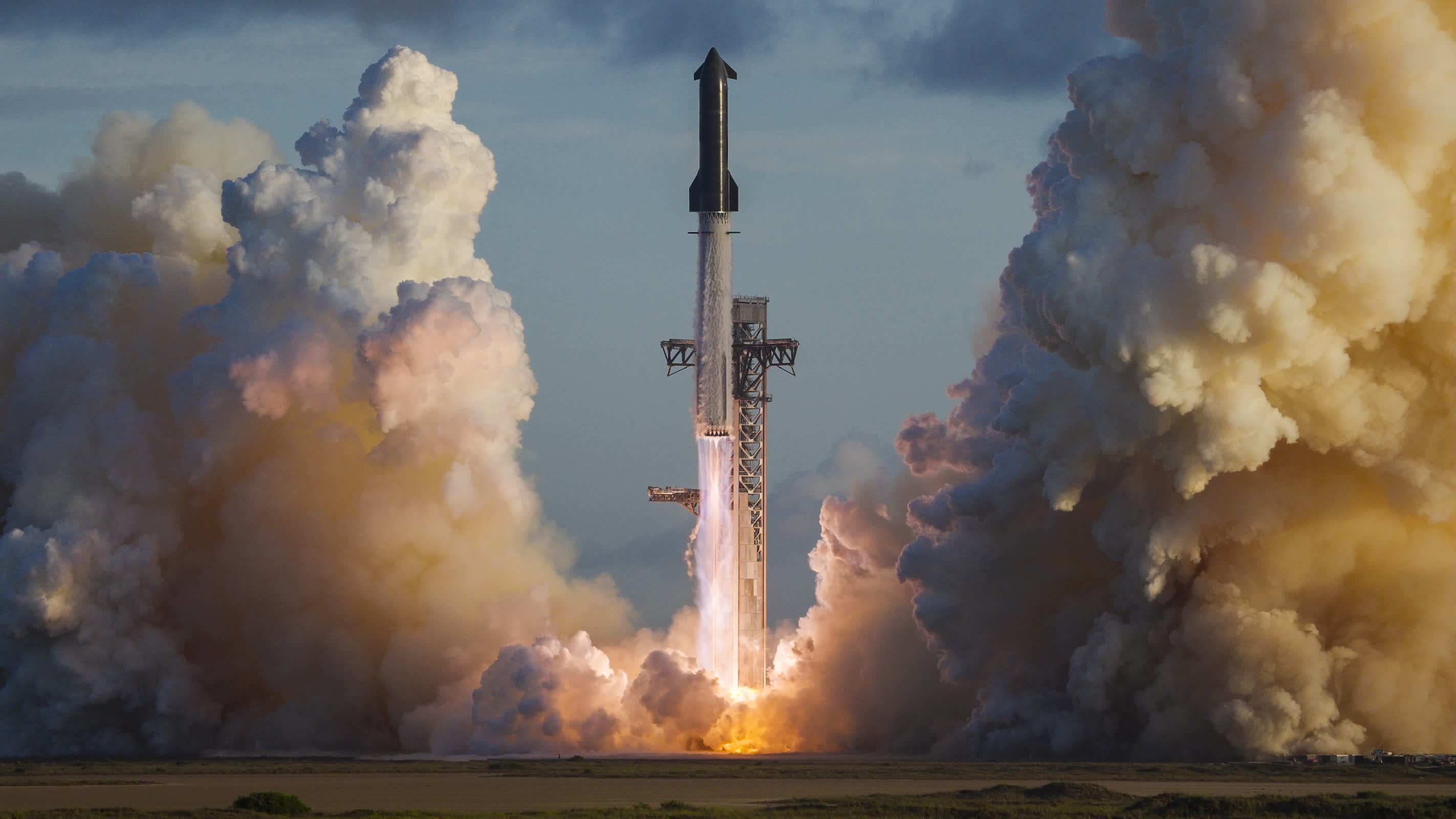
Starship lifted off from SpaceX's Starbase facility in South Texas as its Super Heavy booster, powered by 33 Raptor engines, sent the 407-foot rocket east over the Gulf of Mexico. The booster separated from Starship and turned back toward the Texas coast, later splashing down in the Gulf.
Starship continued into space, but the launch was not without trouble. One of the six Raptor engines on the upper stage shut down early. Two engines on Super Heavy also appeared to fail, one during ascent and another during the booster's return.
The upper stage had enough momentum to follow the suborbital path SpaceX had used on earlier tests. Reaching orbit, however, required restarting a Raptor engine after the main ascent burn. SpaceX paused before committing to the maneuver while controllers reviewed the engine issue.
One of Starship's Raptor engines restarted for 19 seconds, adding about 204 mph to the vehicle's speed. That was enough to place Starship into an orbit about 171 miles above Earth.
The orbit was important because it let SpaceX deploy the payload. Starship released 26 Starlink V3 satellites through a cargo-bay deployment system that pushed the flat-packed spacecraft out one at a time. SpaceX said it contacted all 26 satellites after separation.
The V3 satellites are significantly larger than the Starlink spacecraft Falcon 9 carries today. Each weighs about 2 metric tons at launch and includes larger solar arrays and upgraded antennas. SpaceX says each can add 1 terabit per second of network capacity, about 10 times the capacity of older Starlink satellites.
Starship can eventually carry as many as 60 V3 satellites on one mission. Falcon 9 cannot launch them because they do not fit inside its payload fairing.
The new spacecraft are expected to expand broadband capacity and strengthen Starlink's direct-to-device service. Future V3 satellites could also support Starshield, SpaceX's government-focused satellite business.
SpaceX flew Starlink V3 satellites on a previous Starship test in July, but that mission followed a suborbital course. The satellites reentered soon after their release. Monday's launch was the first time the company could send V3 satellites into an orbit where they could join the constellation.
SpaceX said the new satellites could begin service within weeks.
– Elon Musk (@elonmusk) September 28, 2026
After deploying the satellites, SpaceX shortened the planned mission because of the engine issue during ascent. The company fired Starship's engines for a deorbit burn and targeted a pre-cleared splashdown area in the northern Pacific Ocean.
"Out of an abundance of caution given the engine issue experienced during ascent, the flight control team decided to limit the duration spent on orbit and proceeded with de-orbiting Starship to a splashdown location in the northern Pacific Ocean," SpaceX said.
Starship reentered over the Pacific and endured temperatures of up to 2,600 degrees Fahrenheit. It descended belly-first, then flipped upright for a landing burn before splashing down near Hawaii roughly three hours after liftoff. The vehicle tipped over and broke apart after reaching the water, as SpaceX expected.
The mission gave SpaceX a strong result despite the engine failures. Starship reached orbit, deployed satellites and completed a controlled deorbit and reentry. At the same time, the flight added to a growing list of issues with the Raptor 3 engine.
SpaceX has reported engine problems on all three Starship flights using Raptor 3. The newer engine is designed with fewer parts, lower mass and higher thrust. Elon Musk said the simpler design is harder to refine and repair.
– SpaceX (@SpaceX) September 28, 2026
"While deleting parts sounds easy in theory, it is actually very difficult to figure out how to do so in practice and requires many iterations," Musk wrote.
The Federal Aviation Administration will not require a formal mishap investigation, saying the flight events fell within authorized activities. SpaceX is preparing more Starship flights from Texas and is activating a new launch site at NASA's Kennedy Space Center in Florida.
The next tests are expected to include longer orbital missions, in-orbit refueling and, eventually, attempts to return Starship to Starbase for recovery by the launch tower's mechanical arms. But the vehicle's most immediate use is likely to be Starlink. SpaceX now has a way to launch the larger satellites it has been building, even as it works through the remaining Raptor issues.