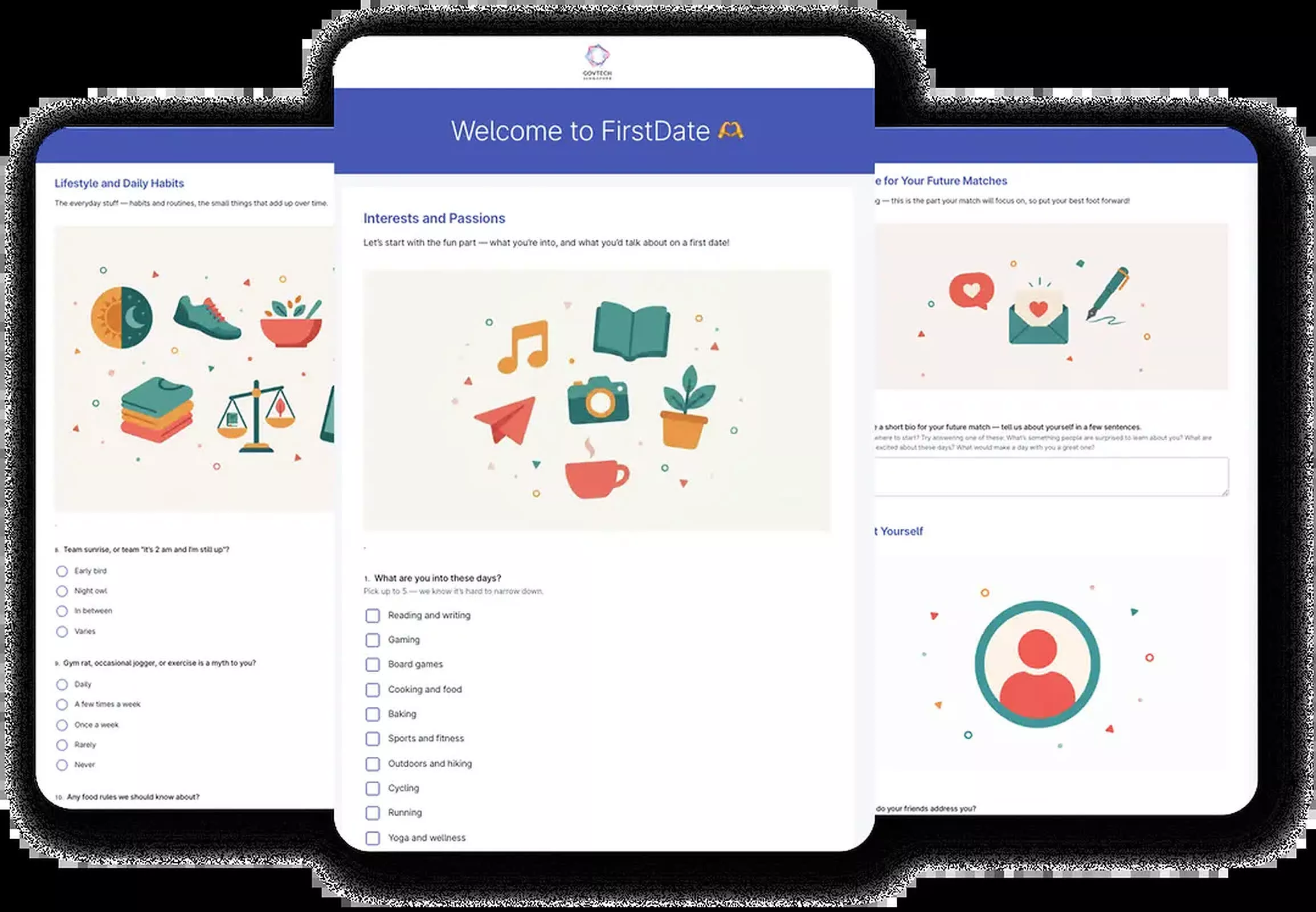
First look: Singapore's Government Technology Agency is testing a dating service that removes one of the main features of most apps: endless browsing. The pilot, called FirstDate, gives users one potential match at a time. There is no stream of profiles to swipe through and no public-facing database of people looking to date. Instead, participants fill out a questionnaire, receive a suggested match and decide within 72 hours whether they want to exchange contact details.
For now, FirstDate is limited to public officers aged 21 to 35. The project is a small test, but it shows how Singapore is applying its digital-government infrastructure to a familiar consumer problem: helping people meet in a more controlled environment than a typical dating app.
The technical core of FirstDate is the Gale-Shapley algorithm, a well-known approach to matching people based on their preferences. The method is designed to create stable pairings. In simple terms, it aims to avoid matches where two people would both rather be paired with someone else in the group.
Gale-Shapley is not new to dating technology. Variations of the method have been used in other matchmaking systems, including school admissions and medical residency programs. Dating services have also used it. What is different here is that Singapore's government is putting the system inside a tightly limited service rather than a platform built around swiping, large user pools, and constant interaction.
Users answer questions about their interests, routines, values and preferences. FirstDate then provides one match during each cycle. The match includes a compatibility score, a brief introduction and a personal note. Both users receive a text message and must decide whether to accept. They share contact details only if they both agree.

That structure gives the service a very different feel from mainstream dating products. Most apps are built to keep people looking. A user can review dozens of profiles in minutes, send messages to several people and return repeatedly to see more potential matches. FirstDate limits that activity. The system is asking users to focus on a single recommendation instead of treating dating as a continuous feed.
That does not mean the software can determine whether two people will get along. GovTech acknowledges that a compatibility score cannot predict chemistry. A strong match on interests or values may still go nowhere once two people meet. The algorithm's purpose is to make an introduction, not to promise a relationship.
The pilot also relies heavily on Singapore's national digital identity system. Each account is verified through Singpass, which is meant to reduce fake profiles and impersonation. Verification has become a major issue for dating services, where users often have little way to know whether a profile is genuine.
FirstDate adds another privacy control by keeping profiles private. A participant's information is visible only to the person selected as their match. Users are not placed in a searchable pool, and they cannot browse other members of the service.
GovTech says the information collected through the service will follow government security standards. The agency says it will not sell or share user data with third parties unless that is required or allowed by law. Participants can deactivate their accounts and request that their data be removed.
After a match, users receive a short survey that asks whether they exchanged details and met in person. Those who do meet can use "Date Quests," which are suggested activities meant to make a first meeting less awkward. The surveys could give GovTech useful information about how people respond to the service, including whether the matching system leads to actual dates rather than just accepted recommendations.
The test comes as Singapore faces a sharp drop in births. The country's total fertility rate fell to 0.87 children per woman in 2025, compared with 1.24 a decade earlier. The government has tried to support matchmaking before, including through the Social Development Unit and its successor, the Social Development Network.
FirstDate is a more technology-focused version of that effort. It combines identity verification, limited data sharing and a stable-matching algorithm in a service that favors fewer introductions over more choices. Whether it moves beyond the public service will depend on what the pilot shows.