
In context: PC gaming, especially the kind involving high-end hardware and multiple machines, is a very expensive hobby these days – even more so than before. Not only do parts cost a fortune, the electricity they consume adds to the final bill. It's why a German power company is offering a specialized tariff to customers designed specifically for gamers.
German publication ComputerBase writes that meinGAMING is the tariff name being offered to gaming households in Germany. There are three tiers available, each with its own annual energy consumption.
The first category, Casual Gamer, is aimed at those who game for 10 or more hours per week and see gaming as a way to unwind after work or at weekends. Selecting this profile sets the calculator's estimated annual household electricity consumption to 2,500 kWh.
Pro Gamer, meanwhile, targets more dedicated players with high-end setups, multiple systems, or an interest in streaming or modding. The description refers to 30 or more hours of gaming per week, alongside working from home, and the calculator defaults to 3,500 kWh per year.
The final category, Gaming Households, is aimed at families or shared homes with two or more active gamers. Its description refers to 50 or more hours of gaming per week across devices such as PCs and consoles, with a default annual household electricity consumption estimate of 5,000 kWh.
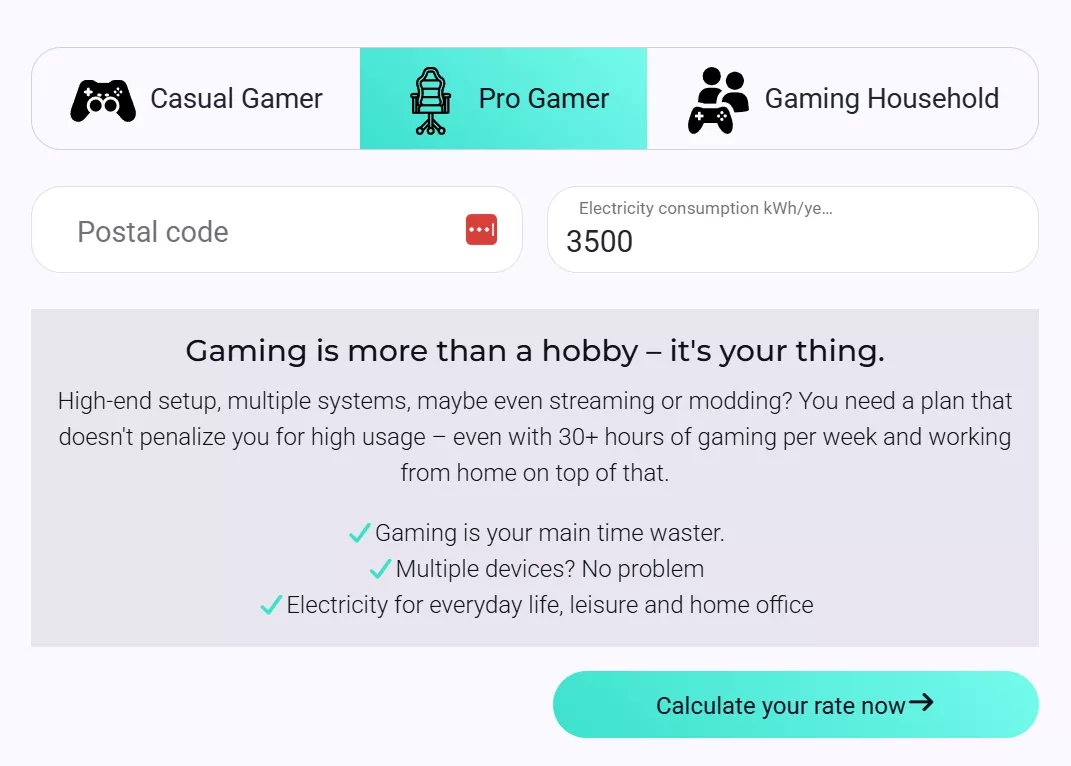
The idea here is that gamers who use a lot of electricity might benefit from this tariff. The fixed charge is relatively high, but the price per kWh is lower, so whether it makes sense depends on your household's annual electricity usage (beyond just gaming). Those who use enough could save money compared to their current tariff. The website claims there's an energy price guarantee of up to 24 months, too.
SWK ENERGIE, Krefeld's municipal utility company, provides meinGAMING's electricity. It writes that 100% of this comes from renewable energy, which is a nice extra.
It is interesting to see an electricity tariff targeting gamers. A gaming PC with an RTX 5090 and a Core Ultra 9 285K being used for gaming 30 hours per week could use roughly 1,100 kWh per year. Include the monitor, and that could rise to more than 1,200 kWh/year, illustrating why the electricity company sees this demographic as a prime potential customer.