Today, we've got something new for you. Well, AMD is pretending it's new, but it's really just a product they released about a year ago as a China-exclusive. We guess they weren't able to sell enough of them there, so now they're gifting the entire world their worst-binned Navi 48 silicon. Yippie. PC gaming hardware is so epic right now.
So what are we talking about? AMD has just lifted the review embargo on the new Radeon RX 9070 GRE. Because apparently the "Golden Rabbit Edition" naming scheme is here to stay, even though we're now a couple of years removed from the Year of the Rabbit. GRE also has to be one of the least cool arrangements of letters you could possibly come up with for a graphics card designed for PC gaming.

Anyway, positioned just below the standard RX 9070, it's supposed to be AMD's highly competitive answer to Nvidia's RTX 5070, as well as the now heavily overpriced RTX 5060 Ti 16GB. AMD is pitching it as the new mid-range value champion for 1440p gamers.
Of course, it's not technically a new product, but it is new to the global retail market. That means if you live outside China, it will become a new GPU option. So for those unaware, let's go over what the 9070 GRE actually is.

As we just noted, the 9070 GRE is based on the same Navi 48 silicon as the RX 9070 and 9070 XT. That's why AMD classifies it as a 9070-series product, but really it's more of a 9060. The current 9060 models should probably be called 9050s, but AMD boxed itself into a corner here and it's all a bit of a mess.
Anyway, it's still Navi 48 silicon, just a heavily cut-down, heavily binned, featuring only 48 compute units. That's 14% fewer than the standard RX 9070 and 25% fewer than the XT model. Along with that reduction, the GRE also drops from 64MB of Infinity Cache on the 9070 and 9070 XT to just 48MB, a 25% cut. Worse still, the original 256-bit memory bus has been reduced to 192-bit, resulting in less VRAM and lower memory bandwidth.

GDDR6 capacity has been reduced from 16GB to just 12GB, a 25% reduction in memory capacity. Meanwhile, memory bandwidth has been slashed by 33%, down to 432 GB/s. That's not only because of the narrower memory bus, but also because memory speed has been reduced to 18 Gbps.
AMD Radeon RX 9070 Series Specs
| Radeon | RX 9070 XT | RX 9070 | RX 9070 GRE | RX 7900 XTX | RX 7900 XT | RX 7900 GRE |
|---|---|---|---|---|---|---|
| Price (MSRP) | $600 | $550 | $550 | $1000 | $900 | $550 |
| Release Date | March 2025 | March 2025 | May 2025 (China), June 2026 |
Dec 13, 2022 | Dec 13, 2022 | Feb 27, 2024 |
| Process | TSMC N4P | TSMC N5 (GCD) / TSMC N6 (MCD) | ||||
| Die Size (mm2) | 357 mm2 | 529 mm2 | ||||
| Core Config | 4096 : 256 : 128 | 3584 : 224 : 128 | 3072 : 192 : 96 | 6144 : 384 : 192 | 5376 : 336 : 192 | 5120 : 320 : 192 |
| L2 Cache (MB) | 64 MB | 48 MB | 96 MB | 80 MB | 64 MB | |
| GPU Boost Clock | 2970 MHz | 2520 MHz | 2790 MHz | 2500 MHz | 2400 MHz | 2245 MHz |
| Memory Capacity | 16 GB | 12 GB | 24 GB | 20 GB | 16 GB | |
| Memory Speed | 20 Gbps | 18 Gbps | 20 Gbps | 18 Gbps | ||
| Memory Type | GDDR6 | |||||
| Bus Type / Bandwidth | 256-bit, 640 GB/s | 192-bit, 432 GB/s | 384-bit, 960 GB/s | 320-bit, 800 GB/s | 256-bit, 576 GB/s | |
| Total Board Power | 304W | 220W | 220W | 355W | 315W | 260W |
In other words, the 9070 GRE has been chopped off enough that, in our opinion, it's no longer worthy of the 9070 branding. Despite that, AMD is looking to charge 9070-like money. In fact, believe it or not, the GRE's MSRP has been set at $550, which is the same launch MSRP the RX 9070 carried a year ago.
Of course, today the Radeon RX 9070 costs closer to $600, so we guess that's the new effective MSRP. The XT model has also drifted toward $700, though you can occasionally find it for less. Still, $550 for an RX 9070-class product that, on paper, should be at least 15% slower while offering 25% less VRAM doesn't look particularly compelling. Keep in mind that at $550, you're saving less than 10% compared to the RX 9070.
If we're being completely honest, that looks like a pretty terrible deal from AMD and makes the 9070 GRE feel like a complete waste of time. But hey, maybe it's not as bad as we're expecting. So let's fire up the GPU test system and take a look at the results.
Benchmarks
Spider-Man 2
First up, we have Spider-Man 2 using the Very High preset. Compared to the previous-generation 7900 GRE, the new 9070 GRE isn't much of an upgrade. In fact, it's basically the same thing in this example, delivering just 5% higher performance at 1440p and a mere 2% at 4K.

Compared to the RTX 5070, we're also looking at similar performance at both tested resolutions, making the 9070 GRE 24% faster than the RTX 5060 Ti 16GB at 1440p and 33% faster at 4K.
Against the RX 9070, performance drops by 18% at 1440p and 17% at 4K. As a result, the 9070 GRE was also 12-16% slower than the 7900 XT.
Forza Horizon 6
Moving on to Forza Horizon 6 using the Extreme Quality preset. Compared to the previous-generation 7900 GRE, the 9070 GRE once again isn't much of an upgrade, delivering just 8% higher performance at 1440p and only 3% at 4K.

Against the RTX 5070, we're looking at virtually identical performance at both tested resolutions, making the 9070 GRE 29% faster than the RTX 5060 Ti 16GB at 1440p and 31% faster at 4K.
Compared to the RX 9070, we're looking at a very modest 2% performance deficit at 1440p and 7% at 4K. As a result, the 9070 GRE was also 11-13% slower than the 7900 XT.
Marvel Rivals
Next up, we have Marvel Rivals using the Medium Quality preset. Here, the 9070 GRE actually takes a surprising step backward, underperforming the older 7900 GRE by around 4% at 1440p and 11% at 4K.

Compared to the RTX 5070, the 9070 GRE also falls behind, trailing by roughly 11% at 1440p and 12% at 4K. It does, however, maintain a solid lead over the RTX 5060 Ti 16GB, coming in 19% faster at both 1440p and 4K.
Looking at the rest of the stack, the gap between the 9070 GRE and the standard RX 9070 is quite noticeable in this title, with the GRE trailing by 16% at 1440p and 19% at 4K. It's also worth noting that Nvidia's RTX 5070 Ti takes the top spot at 1440p, narrowly outperforming the flagship RX 9070 XT.
Resident Evil Requiem
Moving to Resident Evil Requiem at Max Quality, the 9070 GRE delivers a respectable generational improvement over the 7900 GRE, offering 11% higher performance at 1440p and an 18% uplift at 4K.

Against Nvidia's RTX 5070, however, it falls slightly behind, trailing by 6% at both resolutions while remaining comfortably ahead of the RTX 5060 Ti, leading by 20% at 1440p and 23% at 4K.
Compared to the RX 9070, we're looking at a 17% performance deficit at 1440p and 18% at 4K. That left the 9070 GRE roughly 3-9% slower than the older 7900 XT.
Pragmata
For Pragmata, we're using the Max Quality preset. Compared to the previous-generation 7900 GRE, the 9070 GRE once again offers only a marginal improvement, delivering just a 2% gain at 1440p and roughly 4% at 4K.

Matched against the RTX 5070, the 9070 GRE delivers virtually identical performance at 1440p, edging ahead by a single frame. At 4K, however, the RTX 5070 pulls ahead, leaving the 9070 GRE about 7% slower.
Compared to the RTX 5060 Ti 16GB, the 9070 GRE maintains a comfortable lead, delivering 33% higher performance at 1440p and 27% more at 4K.
We also see a substantial gap between the 9070 GRE and the standard RX 9070. The GRE trails the standard model by 19% at 1440p and 22% at 4K.
Crimson Desert
In Crimson Desert with ray tracing disabled and the Cinematic Quality preset enabled, things take a bizarre turn. The 9070 GRE actually performs worse than its predecessor, coming in 11% slower than the 7900 GRE at 1440p and 10% slower at 4K.

It also struggles against the RTX 5070, trailing by 7-10%, though it remains 19-20% faster than the RTX 5060 Ti.
Stepping up to the RX 9070 yields 14-16% more performance than the GRE variant. Consequently, the 9070 GRE ends up a substantial 21-23% slower than the 7900 XT.
Cyberpunk 2077: Phantom Liberty
Testing Cyberpunk 2077: Phantom Liberty using the Ultra Quality preset reveals another underwhelming result. The 9070 GRE is 3% slower than the previous-generation 7900 GRE at 1440p and effectively tied at 4K.

Compared to the RTX 5070, the Radeon GPU is 8-9% slower at both resolutions, though it still comfortably outpaces the RTX 5060 Ti by roughly 29-32%.
Against the RX 9070, we see a consistent 17% performance deficit at both 1440p and 4K, which leaves the GRE 15-16% slower than the 7900 XT.
Indiana Jones and the Great Circle
Looking at Indiana Jones and the Great Circle using the Supreme preset, the 9070 GRE claws back some ground, beating the 7900 GRE by a respectable 7% at both tested resolutions. However, it can't quite catch the RTX 5070, coming in 9% slower at 1440p and 11% slower at 4K, while remaining 16-20% faster than the RTX 5060 Ti.

Against the RX 9070, performance drops by 18% at both resolutions. Ultimately, the 9070 GRE landed 11-12% behind the 7900 XT.
Borderlands 4
Next up is Borderlands 4 using the Very High preset. Here, the 9070 GRE and RTX 5070 are essentially dead even, trading minor blows across both tested resolutions.

Against the 7900 GRE, it's basically a wash, delivering 2% higher performance at 1440p while slipping 3% behind at 4K. It does, however, boast a massive 33-36% lead over the RTX 5060 Ti.
Stepping up to the RX 9070 nets 16% more performance at 1440p and 20% more at 4K. As for the 7900 XT, the newer GRE was roughly 12-15% slower.
Cities: Skylines II
Cities: Skylines II using the High Quality preset remains a notoriously demanding title, with no GPU in the chart managing to crack the 60 fps barrier.

Rather than improving on the 7900 GRE, the 9070 GRE goes in the opposite direction, trailing the older model by roughly 7% at 1440p and 8% at 4K.
Against the RTX 5070, however, the 9070 GRE flips the script and takes the lead, coming in roughly 12% faster at 1440p and 4% faster at 4K. It also maintains a strong advantage over the RTX 5060 Ti 16GB, delivering 31% higher performance at 1440p and 14% more at 4K.
Looking further up the stack, the GRE trails the standard RX 9070 by about 12% at 1440p and 11% at 4K.
Star Wars Outlaws
In Star Wars Outlaws at Ultra Quality with Native TAA enabled, the 9070 GRE ekes out a narrow win over the 7900 GRE, delivering 4% higher performance at 1440p and 8% at 4K.

It trails the RTX 5070 by a modest 4-6%, but delivers a healthy 30-35% performance advantage over the RTX 5060 Ti.
The standard RX 9070 extends its lead by 16-17%, leaving the 9070 GRE sitting 7-13% behind the aging 7900 XT.
Starfield
Starfield at Ultra Quality is another tough outing for the new GRE. Not only does it fail to improve on the 7900 GRE, it actually falls behind by 10% at 1440p and 7% at 4K.

The RTX 5070 also comes out ahead by 7-9%, though the GRE still comfortably outmuscles the RTX 5060 Ti by 20-28%.
The gap widens significantly when looking at the higher-tier GPUs. The 9070 GRE is 20-22% slower than both the RX 9070 and RX 7900 XT, which happen to deliver identical performance in this title.
Delta Force
For Delta Force, we're using the Ultimate Quality preset. The 9070 GRE once again struggles to justify its existence, coming in 3-4% slower than the 7900 GRE.

Things don't improve against the RTX 5070 either, with Nvidia's offering handing the GRE a fairly heavy beating: 15% faster at 1440p and a substantial 20% faster at 4K. Even so, the GRE still clears the RTX 5060 Ti by 18-21%.
Moving up to the RX 9070 yields a steep 22-23% performance uplift, while the 7900 XT remains 12-14% faster than AMD's latest GRE model.
Warhammer 40,000: Space Marine 2
For Warhammer 40,000: Space Marine 2 at Ultra Quality, the 9070 GRE delivers practically zero generational uplift over the 7900 GRE, edging it out by just 1% at 1440p and tying it exactly at 4K.

Things look less favorable when lined up against the RTX 5070, with the GRE trailing by roughly 19% at 1440p and 17% at 4K, though it still manages to stay 10% and 16% ahead of the RTX 5060 Ti at those respective resolutions.
Stepping up to the standard RX 9070 reveals a 15% performance gap at 1440p and an 18% gap at 4K. Consequently, the 9070 GRE also trailed the older 7900 XT, sitting about 14-15% behind across the board.
Call of Duty: Black Ops 7
Shifting gears to Call of Duty: Black Ops 7 on the Extreme Quality preset, we find a title that heavily favors Radeon hardware.

Against the 7900 GRE, the new 9070 GRE is only 1% faster at 1440p, though that lead grows to 6% at 4K. It also commands a solid lead over its direct competitor, the RTX 5070, outperforming it by 14% at 1440p and 10% at 4K, while absolutely crushing the RTX 5060 Ti with a massive 47% performance advantage at both tested resolutions.
Compared to the RX 9070, we're looking at a 9% performance deficit at 1440p, widening to 14% at 4K. That ultimately left the 9070 GRE trailing the 7900 XT by roughly 10-13%, depending on the resolution.
15 Game Average
Looking at the 15-game average, the overall picture becomes crystal clear. Compared to the previous-gen 7900 GRE, the new 9070 GRE offers absolutely no improvement in raw average frame rates, delivering identical performance with 84 fps at 1440p and 48 fps at 4K.
Against Nvidia's RTX 5070, the Radeon GPU falls slightly behind on average, trailing by roughly 5% at 1440p and 6% at 4K. It does, however, outpace the RTX 5060 Ti by a comfortable 25-26% across both tested resolutions.
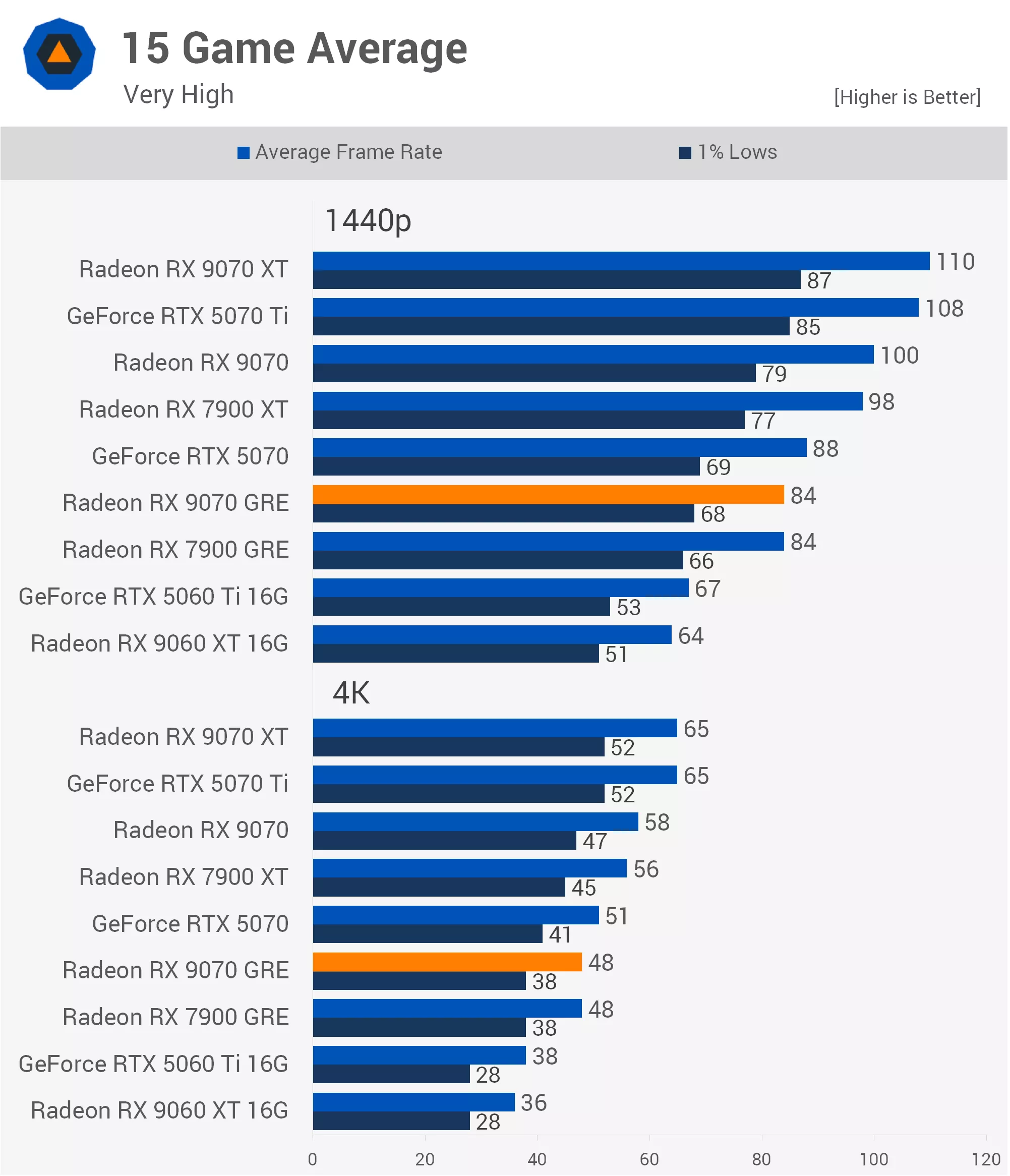
The comparison with the RX 9070 is where things start to look particularly ugly. The 9070 GRE trails the standard model by 16% at 1440p and 17% at 4K, despite being priced only modestly lower.
As a result, the 9070 GRE also firmly trails the older 7900 XT, ending up roughly 14% slower across both resolutions. When all is said and done, AMD has essentially repackaged 7900 GRE-level performance into a new product, while somehow making it slower than the RTX 5070 on average and significantly slower than the RX 9070. That's a difficult product to get excited about.
Ray Tracing Benchmarks
Spider-Man 2
This is where the data gets alarming for the 9070 GRE. Under the Ultimate Ray Tracing preset, it completely collapses. The GRE is 13% slower than the 7900 GRE at 1440p and 19% slower at 4K.

Against the RTX 5070, it gets decimated, trailing by more than 30% at both resolutions. Most surprisingly, the 9070 GRE is actually beaten by the much lower-tier RTX 5060 Ti 16GB, coming in 13% slower at 1440p and 19% slower at 4K.
Spider-Man 2 is extremely demanding on VRAM, and AMD's memory management doesn't appear to be as effective as Nvidia's in this scenario, which likely explains why the 12GB 9070 GRE struggles so badly.
Cyberpunk 2077: Phantom Liberty
Cyberpunk 2077: Phantom Liberty is one of the few bright spots for the 9070 GRE. Here, it delivers a massive 24% uplift over the 7900 GRE at 1440p and an 18% improvement at 4K.

However, despite those strong generational gains, it still can't catch the RTX 5070, trailing by 10% at 1440p and 15% at 4K.
Marvel Rivals
In Marvel Rivals, the 9070 GRE manages a modest 5% win over the 7900 GRE at 1440p, but completely loses that advantage at 4K, where it ends up 14% slower than the older GPU, likely due to its reduced VRAM capacity.

It also fails to catch the RTX 5070 at either resolution, trailing by 4% at 1440p and 13% at 4K, though it remains comfortably ahead of the RTX 5060 Ti 16GB.
Forza Horizon 6
Testing Forza Horizon 6 with the Extreme + RT preset enabled, we see the 9070 GRE continue to struggle, effectively serving as a generational downgrade.

It comes in roughly 9% slower than the 7900 GRE at both 1440p and 4K. Against its main competitor, the RTX 5070, the 9070 GRE also falls short, trailing by 10% at 1440p and 13% at 4K.
The gap to the standard RX 9070 is also quite noticeable, with the GRE delivering 11% lower performance at 1440p and 16% lower performance at 4K.
Resident Evil Requiem
Next up is Resident Evil Requiem. Here, the 9070 GRE essentially ties the older 7900 GRE at 1440p but falls 4% behind at 4K.

Against Nvidia's RTX 5070, the 9070 GRE trails by 6% at 1440p and a more noticeable 13% at 4K. It does, however, maintain a healthy 14-22% lead over the RTX 5060 Ti 16GB.
Pragmata
Finally, in Pragmata, things normalize somewhat. The 9070 GRE effectively ties both the 7900 GRE and RTX 5070 at 1440p, though at 4K it slips about 5% behind both GPUs. It maintains a strong 30%+ lead over the RTX 5060 Ti 16GB across both resolutions.

Interestingly, as a side note, the standard RX 9070 and the 7900 GRE post identical average frame rates in this title.
Crimson Desert
Testing Crimson Desert with the Cinematic preset enabled, the RX 9070 GRE continues to struggle, acting as yet another generational downgrade relative to the older RX 7900 GRE. It falls behind the previous-generation GPU by roughly 11% at 1440p and 12% at 4K.

Against its direct competitor, the RTX 5070, the 9070 GRE again trails by 11% at 1440p and 12% at 4K. The gap to the standard RX 9070 widens significantly, with the GRE delivering 17% lower performance at 1440p and a substantial 20% lower performance at 4K.
Ray Tracing Performance Summary
Looking at the overall seven-game ray tracing average, the Radeon 9070 GRE manages to match the performance of its predecessor, the RX 7900 GRE, at 1440p with an identical 82 fps average. At 4K, however, it falls behind by roughly 7%. Against its primary competitor, the RTX 5070, the 9070 GRE comes up short at both resolutions, trailing Nvidia's GPU by 10% at 1440p and 14% at 4K.

The comparison with the standard RX 9070 is particularly ugly. The 9070 GRE delivers a tier of performance that is 17% slower at 1440p and 22% slower at 4K, despite carrying a much smaller price reduction than those numbers would suggest.
Power Consumption
Starfield
Now for a quick look at power consumption. Please note that we're combining GPU and CPU power usage here, as Nvidia GPUs tend to place a slightly heavier load on the CPU than Radeon GPUs. We feel that combining CPU and GPU power draw provides a more accurate picture of total system power consumption.

Looking at Starfield, we see that the RX 9070 GRE consumed 348W, which is essentially identical to the previous-generation RX 7900 GRE.
The bigger issue for AMD in this title is Nvidia's efficiency. The RTX 5070, for example, consumed just 301W, meaning the 9070 GRE used roughly 16% more power.
Star Wars Outlaws
In Star Wars Outlaws, the RX 9070 GRE shows a modest generational improvement in power efficiency, drawing 332W under load. This allows it to run slightly leaner than its predecessor, the RX 7900 GRE, which consumed 345W.

It also goes toe-to-toe with its primary competitor, the RTX 5070, beating Nvidia's card by a negligible 5W margin.
Compared to the rest of AMD's lineup, the GRE consumed 11W less than the standard RX 9070 and a massive 111W less than the power-hungry RX 9070 XT.
Cost per Frame
1440p
Now for the all-important cost-per-frame data, which is the quickest and easiest way to assess the value proposition of the RX 9070 GRE. Based on the 1440p data, it doesn't look terrible. It's certainly a better value than a $450 RX 9060 XT, but more importantly, it's still worse value than the existing RX 9070 models. And that's really the problem.

The 9070 GRE has less VRAM than the RX 9070 and 9070 XT, it's slower, and it simply isn't cheap enough to justify those compromises. Based on these results, we don't think it can reasonably cost more than $500. Realistically, given the reduction in VRAM capacity, something closer to $450 would make far more sense. Of course, we'd also argue that the RX 9060 XT 16GB shouldn't cost $450 either, but that's the market we're dealing with right now.
Even taking current market conditions into account, the GRE needs to be a $500 product at most. Anything above that and the value proposition falls apart. At that point, you're better off spending a little more and buying the standard RX 9070.
4K
The 4K data is slightly less favorable, as there were several instances where the 9070 GRE began to run into VRAM limitations, hurting performance relative to the 16GB models. The GRE also suffers from reduced memory bandwidth, which tends to become a more significant bottleneck at 4K.

Once again, at $550, this simply isn't a product that many buyers need to consider. The standard RX 9070 remains the far more compelling option, while the GRE ends up occupying an awkward middle ground where the compromises outweigh the savings.
1440p Ray Tracing
Finally, when analyzing cost per frame based on the 7-game ray tracing average at 1440p, we once again see that the RX 9070 GRE fails to move the needle generationally. At $550, it matches the older RX 7900 GRE almost exactly, offering essentially the same level of value.

Against its main competitor, the RTX 5070, the 9070 GRE does provide a slight value advantage, coming in roughly 8% cheaper per frame. However, the GRE's biggest problem once again comes from within AMD's own current-generation lineup.
The standard RX 9070 at $600 delivers significantly better value, coming in 10% cheaper per frame. That makes the step-up model the far more sensible purchase despite the slightly higher upfront cost.
Temperatures
The last thing we'll look at briefly is the operating characteristics of the Gigabyte Gaming OC and Sapphire Pulse versions of the RX 9070 GRE.
The Gigabyte model reached a peak GPU hot-spot temperature of 75°C in our testing, while the Sapphire card was nearly identical at 74°C. Memory temperatures on the Sapphire card climbed to 72°C, whereas the Gigabyte model never exceeded 66°C. That said, the Gigabyte card was slightly louder, with its fans spinning at 1,300 RPM, while the Sapphire Pulse was nearly silent at just 950 RPM.
The Gaming OC also maintained noticeably higher clock speeds, typically operating 7% faster than the Pulse at 3,080 MHz versus 2,890 MHz.
The RX 9070 GRE's Biggest Rival is the RX 9070
So there you have it. In terms of performance, the Radeon RX 9070 GRE slots neatly between the RX 9060 XT and RX 9070. As we've said throughout this review, it probably should have been called the 9060 XT, and the current 9060 XT should probably be something like a 9050 XT. But the names are the names. What really matters is price and performance, and that's where the 9070 GRE runs into trouble.
Launching at the same MSRP the RX 9070 was supposed to sell for doesn't make much sense when you can currently buy an RX 9070 for around $600, just $50 more than the GRE.
We're talking about a 9% price premium, or just $50 extra, for roughly 20% more performance and 33% more VRAM. At those prices, the RX 9070 is the obvious choice.

At $500, the GRE is potentially worth entertaining. It would technically offer slightly better cost per frame than the RX 9070, though it would still carry the disadvantage of having less VRAM.
A strong argument could still be made for spending the extra $100, but for buyers whose budget tops out at $500, the GRE could at least be considered a reasonable option.
At $550, though, it's a waste of time. We don't really have much more to say about the 9070 GRE. It's a year-old product that's finally making its way into the broader retail market, and it's doing so at an entirely uninteresting price. So, as we said at the start of this review, yippie for PC gaming.

As a side note, we did run into what appear to be a few AMD Radeon Adrenalin driver issues while testing the 9070 GRE.
We lost countless hours trying to get ReLive, AMD's recording software, working on two different test systems and never managed to get to the bottom of it. ReLive works perfectly on our main PC using an RX 9070 XT, but for whatever reason neither of the AM5 test systems would cooperate. One of them was even running a fresh Windows installation, so we're not entirely sure what's going on there.

We also were unable to tinker with overclocking. Both Adrenalin and MSI Afterburner were unable to adjust the core clocks on either our Gigabyte or Sapphire samples. We could increase memory frequency, which boosted performance by a few percent, but core clock adjustments simply wouldn't work.
Again, we're not entirely sure what the issue is. AMD has confirmed that overclocking is working correctly on its end, so there appears to be some sort of bug with our test setup that we'll need to investigate further.

Finally, for the ray tracing portion of our testing, we had to drop Indiana Jones and the Great Circle because the game wouldn't expose the path tracing settings when the 9070 GRE was installed.
AMD says it is aware of the issue and that the problem lies with the game rather than the driver. According to AMD, the game will need to be updated to properly support the GRE. Hopefully that's something that gets resolved soon and may even be fixed by the time you're reading this review.
And that's going to do it for our review of AMD's "new" RX 9070 GRE. Not exactly an exciting launch, we know. Fingers crossed we get some genuinely next-gen GPUs... in the next few years.