No AI, Thanks: Despite Microsoft's utmost efforts, Bing still ranks way below Google in search market share. Now, though, the Redmond corporation is trying to boost its web service's popularity a bit by offering a new way to manage results generated by AI.
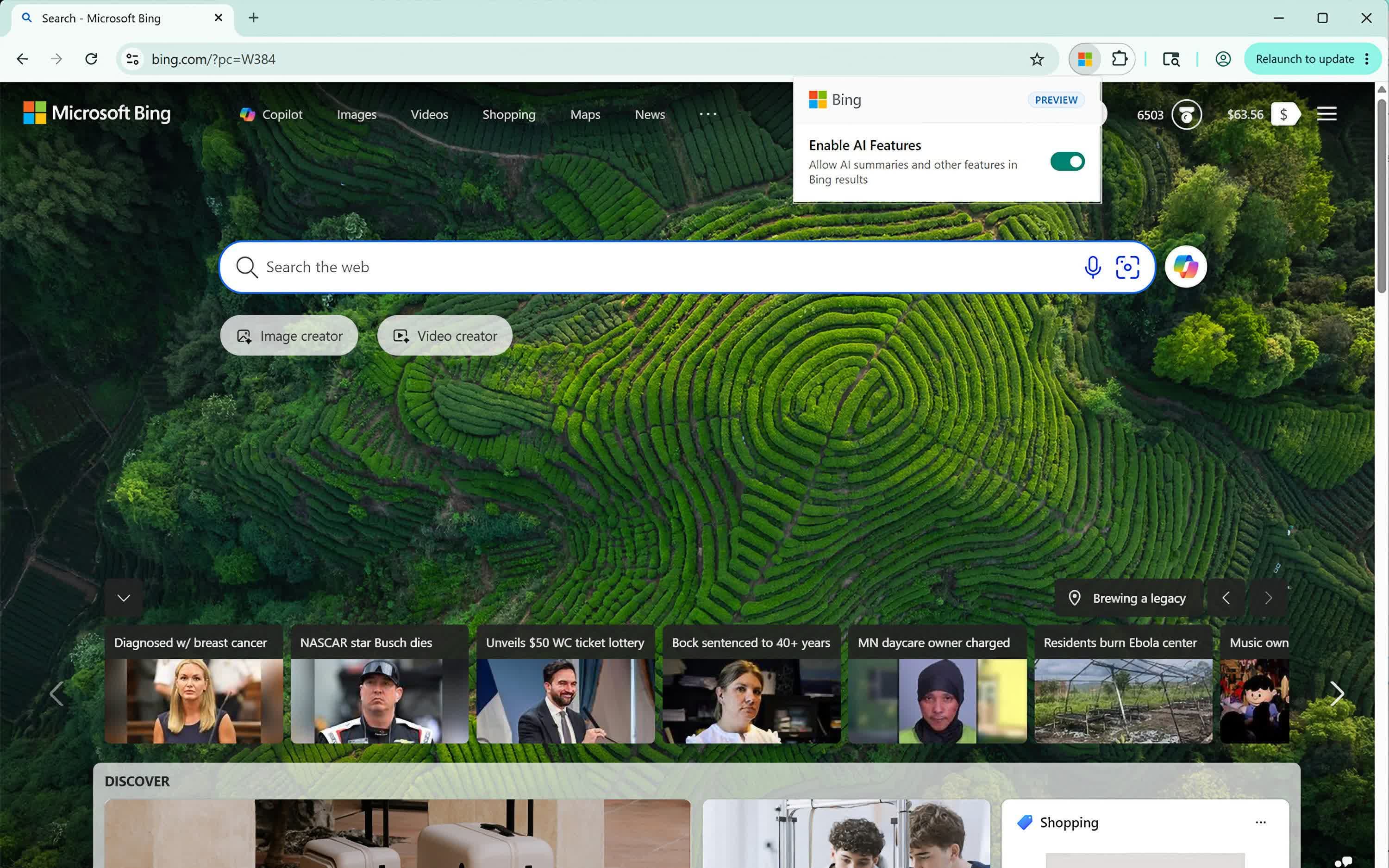
After being among the first to incorporate ChatGPT-style AI answers on Bing, Microsoft has acknowledged that some people don't want to deal with AI's answers in their web searches. The company has now unveiled a browser extension designed to give users a choice between "full" AI-powered search results and traditional SERPs with no GenAI in sight.
Like every other Big Tech player these days, Redmond is deeply involved in the AI industry, with massive capital expenditures going into data center expansion plans. And yet the Azure corporation dares to say that Bing users should have a choice in how their web search experience actually works.
The new "Microsoft Bing AI Search Choice" extension works with both Chrome and Edge, the latter being built on the same Chromium foundation as Chrome. Once installed, the add-on offers a quick and easy way to enable or disable AI summaries in Bing searches. With the "no AI" mode enforced, results should include no AI features at all, as far as Microsoft's service is concerned.
Users who would rather not install browser add-ons can also get the "no AI" experience by adding the "-ai" operator to a Bing query. That option could be seen as impractical for most compared to the add-on, but it doesn't have to be typed in manually every time: users can set up a custom search engine in their browser's settings that appends the operator automatically.
The company claims to be "proud" of the AI-powered experience it is building in Bing, but it is also willing to cater to the growing number of netizens who are unhappy with the direction all these GenAI features are taking the web in.
Meanwhile, research shows Google is going all in on AI search anyway. An analysis commissioned by the NY Times estimated that AI Overviews produce tens of millions of wrong answers every hour, though Google says the study has "serious holes."
The company, which holds roughly 90% of the search market, is also pushing US schools to accept AI or lose Google Search on student accounts, but some schools say they don't want Gemini in either case.