The AMD Ryzen 5 8400F isn't new, but it might be new to you. Originally released in April last year as an OEM-only chip, it quietly flew under the radar – until now. For months, it's been showing up on sites like AliExpress for a fraction of the price of AMD's mainstream processors. That raises a simple question: is the 8400F actually worth buying, and does it perform anywhere near what its name suggests?
To find out, we picked up not only the 8400F but also the 7400F – a China-focused spin on the 7500F that's essentially a cut-down version of the same silicon. Both will be stacked against the 7500F, 7600, 7600X, and 9600X to see how AMD's budget Ryzen 5 lineup really compares for gaming.

At first glance, the Ryzen 5 8400F sounds like it should be newer than the 7600X or the rest of the Ryzen 7000 series. It isn't. AMD often rolls out new series built on existing architectures – like the Zen 4-based Ryzen 7000 line – and then follows up about a year later with what looks like a successor. In this case, the Ryzen 8000 series still runs on Zen 4, not Zen 5.
What's changed is the silicon. The new chips integrate more capable RDNA3 graphics, but CPU-wise, they actually take a step back: less L3 cache and downgraded PCI Express support, both in version and lane count. In other words, the Ryzen 8000 series is technically newer, yet on the CPU side, it's a downgrade from the 7000 series – a naming choice that most would agree is misleading at best.

AMD's first Ryzen 8000 desktop chips were the 8700G and 8600G. The 8700G packs eight cores and 16 threads, while the 8600G offers six cores and 12 threads. The 8700G includes a 12-CU RDNA3 GPU; the 8600G has eight. Then, about six months ago, AMD quietly slipped out the 8400F – essentially an 8600G with its integrated GPU removed, which eliminates the feature that made the 8600G interesting in the first place. Alongside it came the 8700F, a GPU-less 8700G.
| Ryzen 9600X | Ryzen 7600X | Ryzen 7600 | Ryzen 7500F | Ryzen 7400F | Ryzen 8400F | |
|---|---|---|---|---|---|---|
| Release date | Aug 2024 | Sep 2022 | Jan 2023 | Jul 2023 | Jan 2025 | Apr 2024 |
| Release price | $280 | $300 | $230 | $180 | China | OEM |
| Cores / Threads | 6 / 12 | |||||
| Base Clock | 3.9 GHz | 4.7 GHz | 3.8 GHz | 3.7 GHz | 4.2 GHz | |
| Boost Clock | 5.4 GHz | 5.3 GHz | 5.1 GHz | 5.0 GHz | 4.7 GHz | |
| L3 Cache | 32 MB | 16 MB | ||||
| Process | TSMC N4X FinFET (N6 FinFET I/O die) | TSMC N5 FinFET (N6 FinFET I/O die) |
TSMC 4 nm FinFET | |||
| Core Config | 1 × 6 | |||||
| Chiplets | 1 × CCD, 1 × I/OD | N/A | ||||
| PCIe Mode | 5.0 | 4.0 | ||||
| PCIe Lanes | 28 | 20 | ||||
| Box Cooler | N/A | Yes | ||||
| TDP | 65 W | 105 W | 65 W | |||
Despite what its name implies, the 8400F isn't an upgrade. Both the 8400F and 7400F boost to 4.7 GHz, but the 7400F has twice the L3 cache (32 MB versus 16 MB) and supports PCI Express 5.0 with 28 lanes, compared with the 8400F's PCIe 4.0 and 20 lanes. After reserving four lanes for chipset communication, that leaves the 8400F with just 16 usable.
The 8400F wasn't meant for retail... AMD often channels its less consumer-friendly hardware through OEMs, whether because of awkward specs or confusing branding. But as usual, the chip eventually filtered into the open market. We picked ours up from AliExpress for $165 AUD delivered.

For context, the 7400F cost $190, the 7500F $230, the 7600 and 7600X about $290, and the 9600X $330. All share the same silicon, just binned differently. Each is unlocked, meaning it's technically possible to overclock a 7400F to match 7600X-level performance – though, as always, that depends on silicon quality and a bit of luck.
So, for gamers trying to stretch their budget on AM5, which Ryzen 5 chip makes the most sense? We tested all of them across a dozen games using the same motherboard and memory setup. Here's what we found.
Test System Specs
| CPU |
AMD Ryzen 5 9600X
AMD Ryzen 5 7600 AMD Ryzen 5 7400F AMD Ryzen 5 7600X AMD Ryzen 5 7500F AMD Ryzen 5 8400F |
| Motherboard | MSI MPG X870E Carbon WiFi [BIOS 7E49v1A64] - ReBAR enabled |
| Memory | G.Skill Trident Z5 RGB DDR5-6000 [CL30-38-38-96] |
| Graphics Card | Asus ROG Astral GeForce RTX 5090 |
| ATX Case | MSI MEG Maestro 700L PZ |
| Power Supply | Kolink Regulator Gold ATX 3.0 1200W |
| Storage | TeamGroup T-Force Cardea Z44Q 4TB |
| Operating System | Windows 11 24H2 |
| Display Driver | Nvidia GeForce Game Ready Driver 581.42 |
Benchmarks
Marvel Rivals
Starting with Marvel Rivals, we see that the 9600X delivers 188 fps when using the medium settings at 1080p. This makes it just 5% faster than the 7600X, 8% faster than the 7600, 11% faster than the 7500F, 17% faster than the 7400F, and a substantial 34% faster than the 8400F. That margin drops to 27% with the Ultra settings, where most of the 6-core 7000 series parts perform similarly. For example, the 9600X is only 15% faster than the 7400F, meaning the only notable drop-off here is from the 8400F.

Rainbow Six Siege X
The performance margins in Rainbow Six Siege are even more pronounced. The 8400F trails far behind the full 32 MB L3 cache parts, though overall performance remains excellent, easily exceeding 200 fps at all times. Still, the 7400F was roughly 30% faster using both the medium and ultra settings. This title also highlights the advantages of Zen 5, as the 9600X was 17% faster than the 7600X using the medium settings, or 11% faster with Ultra+.

The 7600X, 7600, and 7500F are tightly grouped, while the 7400F trails by about 5 – 6% compared to the 7500F.
Assassin's Creed Shadows
Assassin's Creed Shadows is heavily GPU-limited and does not place much demand on the CPU. As a result, any modern processor will likely be bottlenecked by the GPU. Even with the RTX 5090, all six CPUs delivered nearly identical performance.

Horizon Zero Dawn Remastered
Next, in Horizon Zero Dawn Remastered, we see a slightly more CPU-demanding title than Assassin's Creed Shadows, though these modern 6-core, 12-thread CPUs still handle it easily. Even with the medium preset, the 9600X was only 12% faster than the 7400F and 7% faster than the 7500F. Those gaps nearly disappear when using the very high preset. The 8400F falls behind slightly, but performance overall remains solid, with the 7400F maintaining a 15% advantage.

Cyberpunk 2077: Phantom Liberty
In Cyberpunk 2077, we found mixed and somewhat unexpected results. Using the medium preset, the 9600X roughly matched the 7600, coming in slightly slower than the 7600X. The 7600X was 6% faster than the 7500F and 10% faster than the 7400F. The 8400F performed better than expected, averaging 145 fps, though that still placed the 7600X almost 20% ahead.

Switching to the more demanding ray tracing preset quickly makes the game GPU-limited, even with the RTX 5090. Although these settings technically increase CPU load, the tested CPUs are powerful enough that we hit the GPU limit first.
Space Marine 2
Space Marine 2 is very CPU-intensive, but in our testing, the average frame rates for the 7400F, 7500F, 7600, and 7600X were nearly identical, with only minor differences in 1% lows. The 9600X gained up to 6% thanks to Zen 5 improvements, while the 8400F was clearly slower due to its smaller L3 cache. For example, with the medium quality preset, the 7400F produced 16% higher 1% lows and a 14% higher average frame rate.

The Last of Us Part II Remastered
In The Last of Us Part II Remastered, performance from the 7400F through to the 9600X was very similar. The 9600X was only 6 – 8% faster than the 7400F, while the 7400F still managed to outperform the 8400F by about 15%.

Spider-Man 2
Spider-Man 2 was tested with ray tracing enabled, but before we get to that, let's look at the medium preset results. This is another example where Zen 5 shows a small performance gain, with the 9600X up to 6% faster than the 7600X. Meanwhile, the 7600X was just 5% faster than the 7500F, so the 6-core, 12-thread 7000 series chips perform similarly in this title.

The 8400F didn't fare too badly, with the 7400F only 9% faster using the medium settings and 11% faster using the ray tracing ultimate preset. However, we did observe a 25% improvement in 1% lows, showing that the 8400F struggled slightly in that area.
Mafia: The Old Country
Mafia: The Old Country was especially harsh on the 8400F, particularly in 1% lows. The 7400F was 41% faster with the medium preset and 21% faster with ray tracing enabled. The 32 MB L3 cache parts, on the other hand, performed almost identically, with the 9600X just 10% faster than the 7400F using the medium settings.

Assetto Corsa Competizione
Assetto Corsa Competizione is very sensitive to cache size, so it's not surprising to see the 8400F lagging behind. The Zen 5-based 9600X performs well here, outperforming the 7600X by 8% with the medium preset and by 12% using the more CPU-demanding "Epic" settings.

We also found that the 7600X was 13 – 15% faster than the 7400F, while the 7400F was a significant 25% faster than the 8400F with the medium preset and 14% faster using the Epic settings.
Baldur's Gate 3
Despite being a demanding title, Baldur's Gate 3 produced competitive results across the board. The 9600X led slightly using the medium preset, outperforming the 7600X by 11%. Beyond that, the 7600X was just 9% faster than the 8400F, although the margin widened to 16% with the ultra settings.

Counter-Strike 2
Finally, in Counter-Strike 2 using a pro replay, the 9600X stands out, performing notably better than the Zen 4 chips. It beat the 7600X by 16% with the medium preset and by 8% with the very high preset. The 7400F was also 19 – 22% faster than the 8400F, giving the 32 MB model a clear performance advantage.

12 Game Average
Here's a look at the 12-game average data. Starting from the top, we see that depending on quality settings, the 9600X is up to 6% faster than the 7600X when using the medium settings, and 3% faster with the very high settings. Meanwhile, the 7600X is only 2 – 3% faster than the 7600, while the 7600 is just 2% faster than the 7500F.
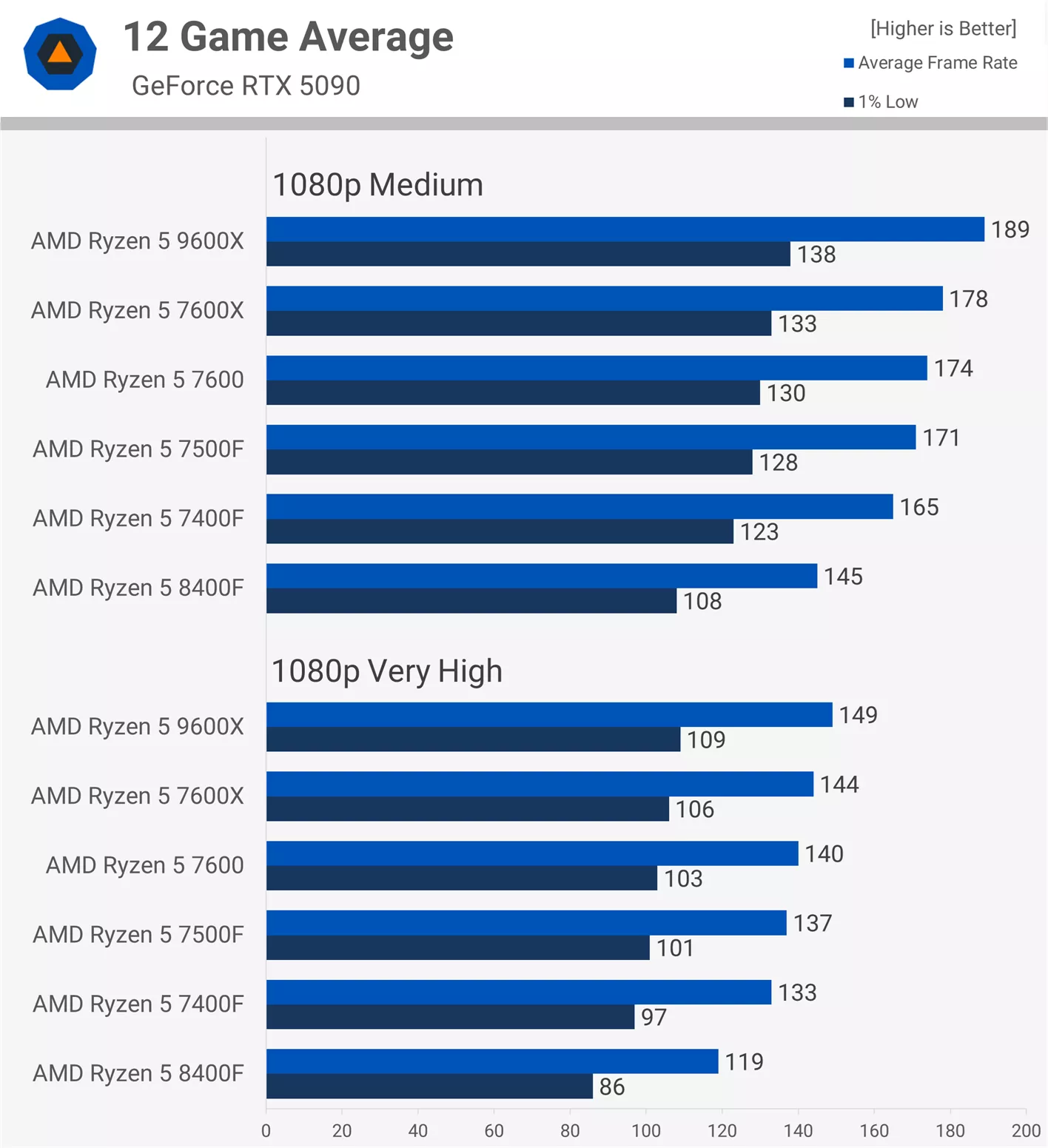
The 7500F was 3-4% faster than the 7400F, and the 7400F was 12 – 14% faster than the 8400F. So, the CPU you might expect to be the second fastest based on its name is actually the slowest by a wide margin. Good job, AMD.
Cost per Frame
United States
Here's a quick look at the cost-per-frame data. Keep in mind that not all of these parts are readily available in North America. The 7400F and 7500F often need to be imported from China, and additional taxes may apply. Tariffs aside, this is what each model typically costs.

Based on this pricing data, the 8400F offers the best value for budget gamers. Despite the confusing naming, it's actually a strong value option, assuming it can be purchased for around 24% less than the 7400F and 7500F. The 7600, 7600X, and 9600X all deliver similar value, so it would make sense to simply go for the 9600X.
Australia
Based on Australian pricing, and keeping in mind that buyers here will also need to source the 8400F, 7400F, and 7500F from AliExpress as we did, the 7400F comes out as the best value option. Although the 8400F is technically better value than the 7500F, we would pay the premium to get the 7500F and its full 32 MB L3 cache. Still, at these prices, the 8400F remains a solid value choice.

Shader Compilation
Marvel Rivals
Before wrapping up, here's a look at shader compilation performance. We've included the 9800X3D for reference since we already have the data. For building shaders in Marvel Rivals, the 9600X and 7600X performed very similarly, with the 7400F coming in 11% slower than the 7600X and the 8400F 17% slower.

The Last of Us Part I
The 9600X was slightly faster than the 7600X in shader compilation for The Last of Us Part I, reducing render time by about 3%. The 7400F took noticeably longer than the 7500F and was around 15% slower than the 7600X overall, which aligns roughly with the clock speed difference. The 8400F was significantly slower, taking 34% longer to complete the same task.

Stalker 2: Heart of Chornobyl
Finally, in Stalker 2, the margins are similar to what we saw in the other two titles. The 7400F was 13% slower than the 9600X and 11% slower than the 7600X, while the 8400F lagged behind by 24%.

Good Value, Strange Branding, Familiar Results
In the end, AMD's naming strategy for the 8400F – and the 8000 series as a whole – feels confusing at best. Yet, despite the odd branding, the 8400F turns out to be a surprisingly reasonable chip. At around $165 Australian, delivered to your door, it's an affordable and efficient entry point into the AM5 platform. That's not something we could say about the 8600G, which launched at $380, or even now when it still sells for around $300. At that price, the 8600G remains a weak option.
Even so, we'd still lean toward the Ryzen 5 7400F. In Australia, it costs only about 15% more, and that small premium gets you twice the L3 cache and better PCIe support. For budget-conscious gamers, the 7400F is a no-brainer, this is what budget gamers should be on the look out for.

The 7500F remains another reliable option, but beyond that, you're into familiar territory with the Ryzen 5 7600. Given current pricing, though, it's hard to justify either the 7600 or the 7600X when the newer 9600X is available.
But keep in mind, the 9600X comes at a steep cost: about 74% more than the 7400F for only a 15% gaming performance boost on average – and that's in mostly CPU-limited scenarios. In everyday use, the gap will likely be even smaller. The 7500F has long been the best-value AM5 processor, and that hasn't changed. What's new is that the 8400F adds a second, slightly cheaper alternative – one that's worth considering, provided you don't mind ordering through retailers like AliExpress.