Apple M5 Max MacBooks are getting surprisingly close to real gaming PCs

Daniel Sims

Posts: 2,460   +74
Staff
In context: Apple Silicon chips have long excelled at AI workloads, synthetic benchmarks, creative tasks, and per-watt efficiency, but still lag behind dedicated graphics cards in gaming performance. However, recent benchmarks demonstrate that the latest MacBook Pro laptops have narrowed the gap more than ever.

Since Apple introduced new MacBook Pro models featuring the M5 Pro and M5 Max processors earlier this month, YouTuber Andrew Tsai has analyzed their performance in dozens of high-end PC games. Although MacBooks are not traditionally seen as gaming devices, Tsai's results suggest that the latest models can handle numerous demanding games in 1440p or 4K at 60 frames per second without dipping below medium graphics settings.
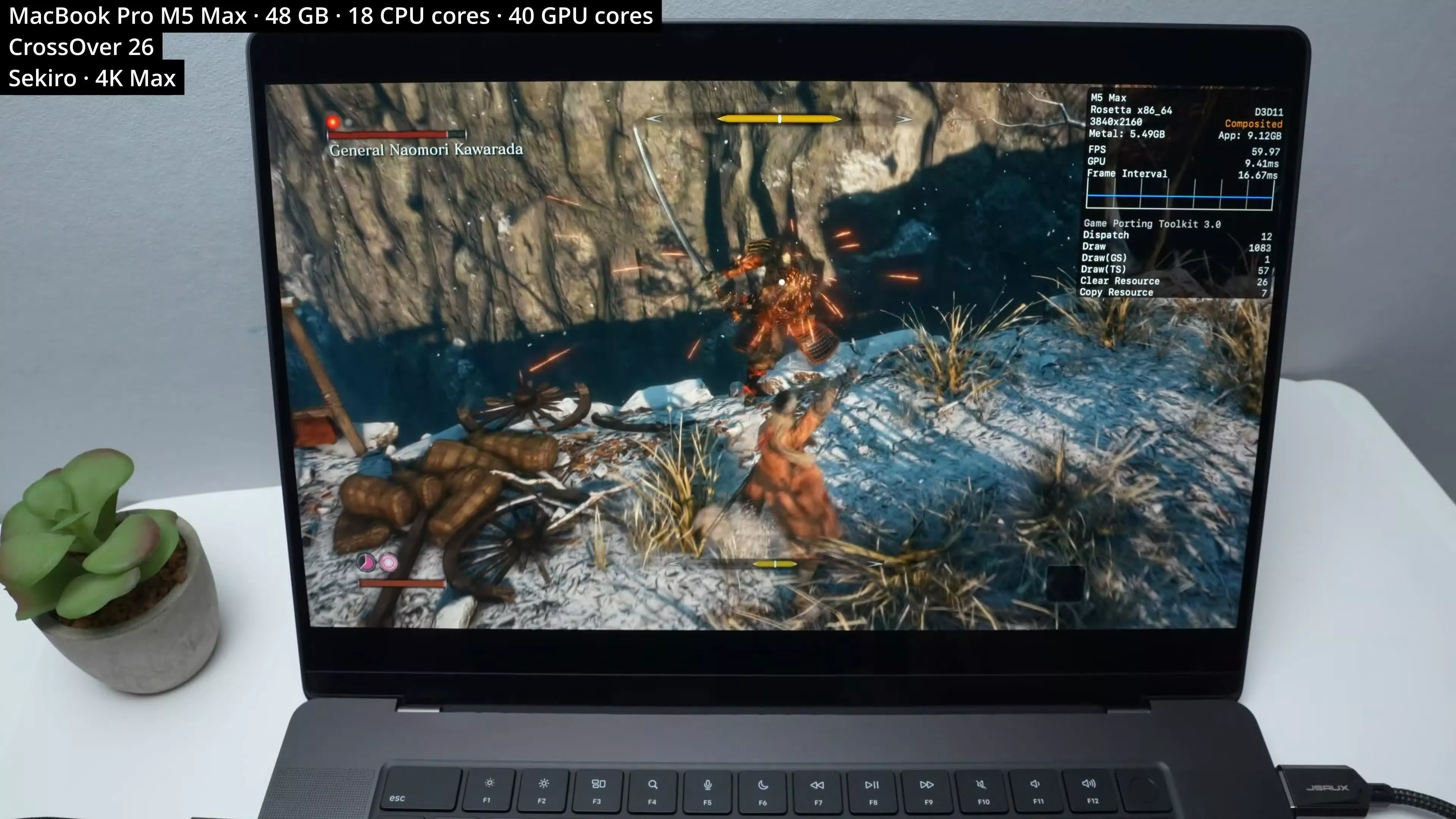
For example, Cyberpunk 2077, likely the most demanding native Apple Silicon game currently available, achieves approximately 60fps in upscaled 1440p at high settings on the M5 Pro's 20-core GPU. Meanwhile, the 40-core M5 Max maintains similar performance in upscaled 4K. Baldur's Gate 3 is another impressive Apple-native performer, maintaining 60fps at maximum settings in native 4K, even in the game's notoriously demanding third act.

However, even many recent high-end Windows titles post respectable results on the two processors despite the performance penalties traditionally associated with compatibility layers. Furthermore, recent advances have expanded the range of games that support Crossover, one of the most popular compatibility layers. For example, Resident Evil 9 and the Pragmata demo run smoothly in 1440p on the M5 Pro.

Additionally, a new graphics API hack allows the M5 chips to run some Vulkan-only titles, such as Doom 2016, Wolfenstein, and the Windows version of No Man's Sky. While Doom 2016 maintains a locked 60fps in native 4K at maximum graphics settings on the M5 Max, Apple's SoC still does not support later Vulkan games, such as Doom Eternal, Doom: The Dark Ages, and Detroit: Become Human.

Meanwhile, Death Stranding 2 normally fails to boot under Crossover due to certain DirectX 12 requirements, but a recently released mod circumvents the issue. The M5 Max achieves 60fps in upscaled 1440p, although water currently does not render correctly.

Helldivers 2's legacy version is a rare multiplayer title that runs extremely well on the M5 Max. Although users might need to check compatibility databases for game-specific quirks, other games that have become playable include Star Wars Jedi: Survivor, Black Myth Wukong, Kingdom Come Deliverance II, and Elden Ring. However, ray tracing remains Apple's primary weakness, as activating it in Elden Ring tanks performance.

Permalink to story:

 
The only bad thing is that it requires the Max chip which is one of their most expensive chips they have. However, if we follow the progression of how powerful their M-series of chips have gotten over the years, by the time that the M6 chip is released, the M6 Pro will be as powerful as the M5 Max is today.

And when that happens... look out nVidia.
 
I'll confess when Apple decide to abandon Intel and start using their own bespoke chips I was highly skeptical. It was a strange gamble since there were already several well established players in the CPU space.

Clearly this has paid off big time. It might be one of the most brilliant (luckiest?) ideas this company has come up with since the iphone.
 
Last week Apple is winning because no one spends more than $600 on their laptop and this week it’s because their $3000+ laptops can hit “respectable results” in some games.

If their best GPU wasn’t decent it would be tragic they switched away from other brands.

The limit is software less friendly to gaming than linux from what I can tell.
 
I mean, I would hope that them buying the most state-of-the-art node for their chips to use on their high-end macbooks would perform well...
 
I'll confess when Apple decide to abandon Intel and start using their own bespoke chips I was highly skeptical. It was a strange gamble since there were already several well established players in the CPU space.

Clearly this has paid off big time. It might be one of the most brilliant (luckiest?) ideas this company has come up with since the iphone.
It probably demonstrates the current relationship between CPUs and DRAM - Realising Transmeta's aims. Whereas in previous iterations of CPU emulation having a much faster CPU was the rule for comfortable emulation. Now, I guess, the pipeline is so hierarchical and well buffered that emulation contained to the core can match the DRAM caching performance of native code. Albeit at a higher power consumption.
 
I mean, I would hope that them buying the most state-of-the-art node for their chips to use on their high-end macbooks would perform well...
Node =! Performance.

A 9800x3d playing a game rendered on just it's CPU cores would also be an achievement, as that is not what the cores were designed to do.

The M series were never meant as gaming chips. Their render pipeline does not operate in the same order nor fashion as Nvidia or AMD hardware. They don't support the same PC apis. The operating system was not meant for gaming. Despite all that, they can still run these games. THAT is what is impressive.
 
Node =! Performance.

A 9800x3d playing a game rendered on just it's CPU cores would also be an achievement, as that is not what the cores were designed to do.

The M series were never meant as gaming chips. Their render pipeline does not operate in the same order nor fashion as Nvidia or AMD hardware. They don't support the same PC apis. The operating system was not meant for gaming. Despite all that, they can still run these games. THAT is what is impressive.
Having the most state-of-the-art node (2nm) certainly helps performance and efficiency. What are you even saying?

I'd love to see Apple squeeze out this performance on a 5nm node lol
 
Having the most state-of-the-art node (2nm) certainly helps performance and efficiency. What are you even saying?

I'd love to see Apple squeeze out this performance on a 5nm node lol
I'm not sure what part of "just being on a node does not guarantee performance, these chips were not designed to game, thats why them being able to do so is impressive" is hard for you to understand, but may I suggest a basic English class so you can learn the language and hopefully gain an understanding of the context in which comments are made?
 
I'm not sure what part of "just being on a node does not guarantee performance, these chips were not designed to game, thats why them being able to do so is impressive" is hard for you to understand, but may I suggest a basic English class so you can learn the language and hopefully gain an understanding of the context in which comments are made?
As in, you can't admit that my point makes sense, so you can only be disingenuous and deflect.

At no point did I imply node size was everything, and yet you built your strawman.
 
As in, you can't admit that my point makes sense, so you can only be disingenuous and deflect.

At no point did I imply node size was everything, and yet you built your strawman.
Broadcom could bypass Apple and jump to 1nm, but their modems aren’t designed to play games, so guess what, it might be on the latest node, but it still doesn’t play cyberpunk very well.

That’s what he’s getting at, Apple never designed the M5 Max to play games, but it does it surprisingly well.

Checking benchmarks, you’ll see the M5 Max does exceedingly well in professional workloads though like blender.
 
Broadcom could bypass Apple and jump to 1nm, but their modems aren’t designed to play games, so guess what, it might be on the latest node, but it still doesn’t play cyberpunk very well.

That’s what he’s getting at, Apple never designed the M5 Max to play games, but it does it surprisingly well.

Checking benchmarks, you’ll see the M5 Max does exceedingly well in professional workloads though like blender.
That would be like saying Apple never made their chip with GPU computations in mind, a ridiculous comparison.

Why are we pretending that this is an apples to oranges comparison? It is a PC chip designed to run a full fledged OS, with the best advantages (2nm) over even an Nvidia GPU (5nm). I HOPE that they can get surprisingly close to real gaming PCs knowing how similar the demands are...

Yes, some of those games aren't built for Mac OS natively, but lets not pretend that Apple hasn't been working on some level of gaming compatibility on the side. It's not like no games can run properly on Apple silicon and this is some miracle as this thread is ridiculously implying.......

Edit: Clarifying some of those games are running native.
 
Last edited:
As in, you can't admit that my point makes sense, so you can only be disingenuous and deflect.

At no point did I imply node size was everything, and yet you built your strawman.
Your point doesn't make sense and your rebuttals have been made in complete disregard to any information provided.

You said
I mean, I would hope that them buying the most state-of-the-art node for their chips to use on their high-end macbooks would perform well...
Seems to be implying that node size should mean good performance. That is your comment no?
 
Your point doesn't make sense and your rebuttals have been made in complete disregard to any information provided.

You said
Seems to be implying that node size should mean good performance. That is your comment no?
Tell me, would a core built for a 5nm chip be expected to perform as well as an "identical" core built for a 2nm chip?

And don't beat around the bush. Give me the obvious theoretical answer.

Because that's what my point is. They have more performance headroom. They better not be squandering it. It's ridiculous that on a tech forum I have to even point this obvious advantage out and have people like you act disingenuous towards such a simple point.
 
Tell me, would a core built for a 5nm chip be expected to perform as well as an "identical" core built for a 2nm chip?
At no point did I imply node size was everything, and yet you built your strawman.
A hypocrite looks in the mirror! Take your own advice.

I simply said that being on an advanced node does not guarantee performance. there is more involved then that. You created a strawman about 5nm then created this new one about identical core design.

Apple GPUs are not designed for gaming. Their rendering pipeline does not work in the same order as nvidia or AMD, nor does it use vulkan. That makes the performance they manage to achieve all the more impressive.
And don't beat around the bush. Give me the obvious theoretical answer.
Go pound sand.
Because that's what my point is. They have more performance headroom. They better not be squandering it. It's ridiculous that on a tech forum I have to even point this obvious advantage out and have people like you act disingenuous towards such a simple point.
And my point was that simply being on an advanced node does not guarantee performance. This simple fact has led to you violently crashing out and contradicting yourself.

go touch grass.
 
2 MAJOR problems with gaming on apple M chips:

-Performance is inconsistent, game-to-game or one particular game. Optimization can be not as good as Win or even linux, so there's a number of 1 and 0.1 drops, all around. The same game, same particular moment/location/cutscene. But truth to be told, it can be opposite when Win version of a game has stutter in one particular moment while Mac doesn't.

As for the former - it's like you would never guess or estimate the performance of another game because of this "variance". For example, if we take three titles and even mac and win hardware, more or less the same performance - then you get every single RE game run flawlessly on Macs, Pro chip on par with 5060Ti, Cyberpunk runs worse than 4060, Frostpunk 1 is just plain horrible, gt1030 level. And yes, better looking games run better, cause y'know, "more effort"

- Image quality sometimes is much worse for the same graphics preset. Something like devs turning off post processing, effects, high texture quality, etc. Some low-level stuff with M chip, Metal API or shader architecture that gimps or bottlenecks the performance, with something plain and simple, last thing you can think of when gaming with radeon or geforce. Like particle quality or raster global illumination, things where geforce is being barely hit, M chip drowns.
 
A hypocrite looks in the mirror! Take your own advice.

I simply said that being on an advanced node does not guarantee performance. there is more involved then that. You created a strawman about 5nm then created this new one about identical core design.

Apple GPUs are not designed for gaming. Their rendering pipeline does not work in the same order as nvidia or AMD, nor does it use vulkan. That makes the performance they manage to achieve all the more impressive.

Go pound sand.

And my point was that simply being on an advanced node does not guarantee performance. This simple fact has led to you violently crashing out and contradicting yourself.

go touch grass.
Couldn't even give an honest theoretical answer in that poor deflection. Says more about you than me that you couldn't even give an inch. The answer? Yes, theoretically. How hard to concede my point that it plays an important role (and not just pretend that it might). The horror!

But I guess we're done here. You've managed to crash out on yet another "debate" where you get called out on being disingenuous, and you can only deflect and make up things that didn't happen.
 
The only bad thing is that it requires the Max chip which is one of their most expensive chips they have. However, if we follow the progression of how powerful their M-series of chips have gotten over the years, by the time that the M6 chip is released, the M6 Pro will be as powerful as the M5 Max is today.

And when that happens... look out nVidia.
Not just max chips. People were able to play games on Neo laptop which has a weaker, probably older chip. But one thing is obvious, their chips are becoming a lot better for gaming. I always thought that AMD will be the first company to offer budget gaming laptops without dedicated GPU. But now, Apple is even closer. Something tells me they will be selling a lot more laptops priced between 600-900 if they can play all popular PC games on medium settings.
 
Apple hardware is impressive, for a work laptop - the MacBook pro crushes similarliy priced laptops with Windows.
But, other manufacturers are catching this - There's a reason why we're seeing "Medusa Halo" entering the market with a similar approach. Windows PC's with increasily more powerful SoC's will be making a huge impact going forward.
Medusa Halo will allow you to play most games on a laptop that will be used primarily for work - but is also starting to blur the lines.

Current game laptops are power hungry beasts, so I reckon we'll only see "very high end" gaming laptops with any sort of dedicated GPU in the future.
 
Any M Pro or Max or Ultra is only worth of people buy them for work; anything else would require AAA gaming compatibility.

My Samsung S25 Ultra thought Gamenative is more compatible than all M stuff. Apple could do so much more...b but they don't as long as the industry is not locked in
 
Not just max chips. People were able to play games on Neo laptop which has a weaker, probably older chip. But one thing is obvious, their chips are becoming a lot better for gaming.
That's good, because if you ask me, nVidia really needs to be served an @ss kicking. And it would be ironic as all hell if said @ss kicking was delivered by Apple.
 
That would be like saying Apple never made their chip with GPU computations in mind, a ridiculous comparison.

Why are we pretending that this is an apples to oranges comparison? It is a PC chip designed to run a full fledged OS, with the best advantages (2nm) over even an Nvidia GPU (5nm). I HOPE that they can get surprisingly close to real gaming PCs knowing how similar the demands are...

Yes, some of those games aren't built for Mac OS natively, but lets not pretend that Apple hasn't been working on some level of gaming compatibility on the side. It's not like no games can run properly on Apple silicon and this is some miracle as this thread is ridiculously implying.......

Edit: Clarifying some of those games are running native.
I don't think you understand how node shrinks work and you’re mixing a few different things together here.

Apple absolutely does design their chips with GPU workloads in mind, but not the same kind of GPU workloads as high end PC gaming. Apple’s GPUs are optimized for efficiency, unified memory, and workloads like video, UI rendering, and some compute, not sustained, high power, discrete gaming performance.

The “2nm vs 5nm” point also doesn’t really prove what you think it does. Process node helps efficiency and density, but architecture and power budget matter way more. A desktop GPU pulling 300–400W with massive cooling and dedicated VRAM is playing a completely different game than a mobile SoC trying to stay under ~30 to 60W.
 
Any M Pro or Max or Ultra is only worth of people buy them for work; anything else would require AAA gaming compatibility.

My Samsung S25 Ultra thought Gamenative is more compatible than all M stuff. Apple could do so much more...b but they don't as long as the industry is not locked in
That’s just not how any of this works.

Saying M Pro/Max/Ultra are “only worth it” if they have AAA gaming is like saying workstation GPUs are useless unless they’re good at Fortnite. These chips are built for throughput, efficiency, and pro workloads, not chasing peak gaming performance at 300W+.

The S25 Ultra comparison is even worse. Mobile games are designed for a completely controlled ecosystem with scaled down graphics and standardized APIs. Of course compatibility is higher, that’s literally the point of mobile platforms. That tells you nothing about how Macs stack up against PC gaming.

Macs can already run games better than people give them credit for. They’re just not, and were never meant to be, drop in replacements for dedicated gaming PCs.

If your entire definition of a chip’s value is “can it run AAA games natively,” you’re missing about 90% of what these chips are actually designed to do.
 
Back