China now home to half the world's industrial robots as the US falls further behind

midian182

Posts: 11,726   +177
Staff member
In a nutshell: The increasing number of highly advanced industrial robots appearing in US factories has long brought concerns about human job losses. It's certainly a worry for American workers, and it's a situation mirrored in China, which is home to around half of the world's 4.6 million operational robots. It's also a stark indication of how quickly the Asian nation is outpacing its US rival in this area.
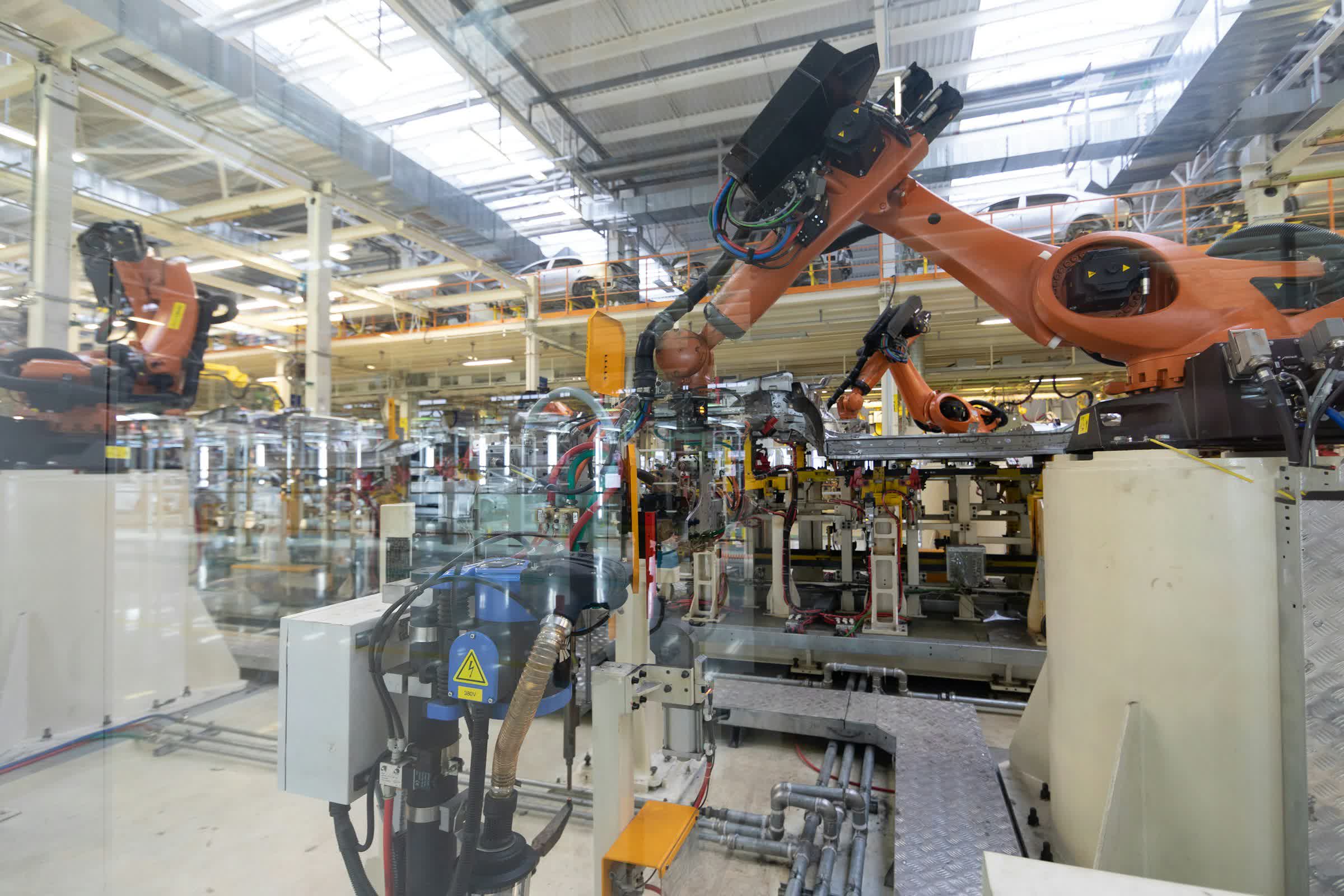
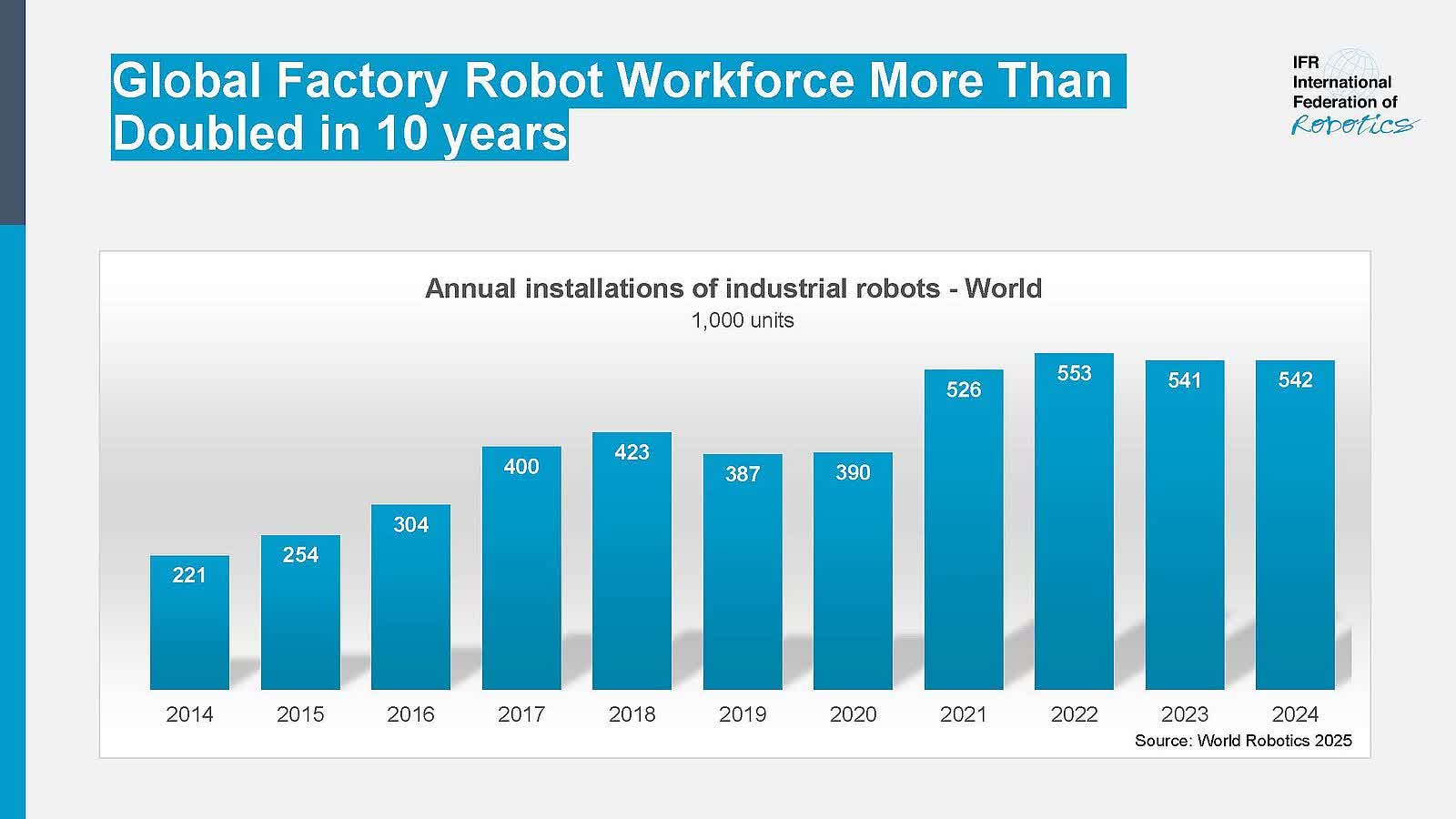
The speed at which industrial robots are being deployed isn't slowing down. In 2024, 542,000 were deployed globally – the second-highest annual total on record - marking the fourth year in a row that the figure exceeded half a million, writes the International Federation of Robotics (IFR). The report also notes that more than twice as many of these robots were deployed in 2024 compared to 10 years ago.

The majority of last year's robot deployments – 54% – came from China. Just under 300,000 of these machines were deployed in the country in 2024. For comparison, the US installed 34,000, or just over 10% of China's total, a decline of 9%. Japan (4%), Germany (5%) and South Korea (3%) also saw their total installations drop year-on-year.
China is the world's largest industrial robot market: its operational robot stock exceeded the 2 million mark a year ago. That's almost half of the world's 4.66 million industrial robots.

China's seemingly insurmountable lead in this area comes as little surprise. Dominating the robotics industry is an aspect of the Made in China 2025 campaign. Launched a decade ago, the movement aims to lessen the nation's reliance on imported goods. Incentives and help from Beijing in the form of investments, grants, and low-interest loans for businesses have played a major role in the efforts.

Related reading: Ex-Google CEO Eric Schmidt says work-from-home culture means US struggles to compete with China

According to a New York Times article from April, state-controlled banks lent an extra $1.9 trillion to industrial borrowers in China over the past four years. New factories are being built all the time while older ones are being upgraded with robots and automation.

Another reason why China is surging ahead in this field is its abundance of skilled programmers and electricians who can install the robots. While demand for skilled electricians is entering a boom cycle in the US, there remains a shortage of programmers.

The IFR predicts that Chinese manufacturing will increase 10% every year until 2028, driving demand for more of these industrial robots.

Another difference between the robotics market in the US and China is the former's focus on humanoid robots from the likes of Agility Robotics, Tesla, and even Meta. With specialist components for such machines harder to procure in China, they aren't as important in the country – they're not counted in IFR data – but China is stepping up investment in this area and the associated AI tech, creating human-like robots that are usually much cheaper than US alternatives.

Permalink to story:

 
Why is this a surprise? The U.S. business elite decided a long time ago that there was not ENOUGH profit in manufacturing, and we could become a service economy. By supplying various services to the world, we could forego the inconvenience of having to build things. Henceforth, who needs industrial robots.

It was only recently that we discovered by outsourcing making things to hostile countries, we could be held hostage for much needed goods and materials.

China has rare earths, pharmaceuticals, steel and factories that we used to do here. Canada subsidized their aluminum producers to put ours out of business and take over that market, and we wanted to go 100% green at all costs, so we mostly gave up producing oil to the Middle East.

We've only just started to get some of this back.
 
Last edited:
we wanted to go 100% green at all costs, so we mostly gave up producing oil to the Middle East.
US has never "given up" producing oil and produces more oil than any country since 2018

The United States produced more crude oil than any nation at any time, according to our International Energy Statistics, for the past six years in a row. Crude oil production in the United States, including condensate, averaged 12.9 million barrels per day (b/d) in 2023, breaking the previous U.S. and global record of 12.3 million b/d, set in 2019. Average monthly U.S. crude oil production established a monthly record high in December 2023 at more than 13.3 million b/d.

The crude oil production record in the United States in 2023 is unlikely to be broken in any other country in the near term because no other country has reached production capacity of 13.0 million b/d. Saudi Arabia’s state-owned Saudi Aramco recently scrapped plans to increase production capacity to 13.0 million b/d by 2027.

Together, the United States, Russia, and Saudi Arabia accounted for 40% (32.8 million b/d) of global oil production in 2023. These three countries have produced more oil than any others since 1971 (counting production in the Russian Federation of the Soviet Union prior to 1991), although the top spot has shifted among them over the past five decades. By comparison, the next three largest producing countries—Canada, Iraq, and China—combined produced 13.1 million b/d in 2023, only slightly more than what was produced in the United States alone.


https://www.eia.gov/todayinenergy/detail.php?id=61545
 
For comparison, all numbers have roughly been flat since 2019, and in China it's been flat since 2022. This is how many installations they've had over the past few years (according to the IFR):
  • 2024 - 295,000
  • 2023 - 276,288
  • 2022 - 290,258
  • 2021 - 243,300
  • 2020 - 168,400
  • 2019 - 140,500
Separately, the IFR reports on non-industrial robots as service robots. These include transportation/logistics (ie. Amazon), medical/healthcare (ie. diagnostic testing), agriculture (harvesting bots), and professional cleaning (ie. for floors) and only include proper bots (not other machines).
 
Last edited:
Why is this a surprise? The U.S. business elite decided a long time ago that there was not ENOUGH profit in manufacturing, and we could become a service economy. By supplying various services to the world, we could forego the inconvenience of having to build things. Henceforth, who needs industrial robots.

It was only recently that we discovered by outsourcing making things to hostile countries, we could be held hostage for much needed goods and materials.

China has rare earths, pharmaceuticals, steel and factories that we used to do here. Canada subsidized their aluminum producers to put ours out of business and take over that market, and we wanted to go 100% green at all costs, so we mostly gave up producing oil to the Middle East.

We've only just started to get some of this back.
We are still the largest oil producer in the world but what people don't understand is that we are also the largest consumer of oil in the world.

People like to talk I'll of China, but are putting us to shame right now and no amount of US propaganda will solve that problem. The world needs to decentralize manufacturing, we should be building factories instead of data centers, but even if we started tomorrow it takes decades to properly train a workforce.
 
There isn't a prize for having more industrial robots in your country.

Especially when cheaper robots do less things so the total number isn't even a good comparison.

Cranking out more cheap crap for Amazon and your own giant populace does not make one a powerhouse to be feared.... Well until the machines rise up on August 29, 1997.


US has never "given up" producing oil and produces more oil than any country since 2018

The United States produced more crude oil than any nation at any time, according to our International Energy Statistics, for the past six years in a row. Crude oil production in the United States, including condensate, averaged 12.9 million barrels per day (b/d) in 2023, breaking the previous U.S. and global record of 12.3 million b/d, set in 2019. Average monthly U.S. crude oil production established a monthly record high in December 2023 at more than 13.3 million b/d.

The crude oil production record in the United States in 2023 is unlikely to be broken in any other country in the near term because no other country has reached production capacity of 13.0 million b/d. Saudi Arabia’s state-owned Saudi Aramco recently scrapped plans to increase production capacity to 13.0 million b/d by 2027.

Together, the United States, Russia, and Saudi Arabia accounted for 40% (32.8 million b/d) of global oil production in 2023. These three countries have produced more oil than any others since 1971 (counting production in the Russian Federation of the Soviet Union prior to 1991), although the top spot has shifted among them over the past five decades. By comparison, the next three largest producing countries—Canada, Iraq, and China—combined produced 13.1 million b/d in 2023, only slightly more than what was produced in the United States alone.


https://www.eia.gov/todayinenergy/detail.php?id=61545

That's the other problem with the younger generation, the world started around the year 2000 at earliest. :)

When the Middle East OPEC countries got together, they put together gas lines, prices, and shortages that we never imagined. Having said that, the 2008 oil shortage did have it's share of fun as well. I got a sweetheart deal on a 2008 Mustang convertible for my wife when gas was above $5 a gallon. Anything with a V8 like Suburbans were being practically given away.

Please spare me the line that we've always produced our own oil. And besides, building refineries for gasoline and other fuels is going to be our next problem. Even Newsom is trying to backtrack on CA regs to keep refineries open and keep them in the state.

While 2016 saw the government change policies on drilling and such, we still have a few things to do to be insulated from the rest of the world on energy.
 
We are still the largest oil producer in the world but what people don't understand is that we are also the largest consumer of oil in the world.

People like to talk I'll of China, but are putting us to shame right now and no amount of US propaganda will solve that problem. The world needs to decentralize manufacturing, we should be building factories instead of data centers, but even if we started tomorrow it takes decades to properly train a workforce.

?????? That's my point. We WERE decentralized. We were one of the largest manufacturing centers in the world. Someplace along the way, we decided as a country to let others take over while we concentrated on services.

As for when to start the sooner the better. How long doesn't matter...it needs to be a question of when and not if in order to maintain our lifestyles, advantages and position as a leader and major player in the world to keep from being a satellite of China.
 
For comparison, all numbers have roughly been flat since 2019, and in China it's been flat since 2022. This is how many installations they've had over the past few years (according to the IFR):
  • 2024 - 295,000
  • 2023 - 276,288
  • 2022 - 290,258
  • 2021 - 243,300
  • 2020 - 168,400
  • 2019 - 140,500
Separately, the IFR reports on non-industrial robots as service robots. These include transportation/logistics (ie. Amazon), medical/healthcare (ie. diagnostic testing), agriculture (harvesting bots), and professional cleaning (ie. for floors) and only include proper bots (not other machines).

What your saying is: China is building industrial robots to make things, but don't worry, We'll still have a ton of industrial robots to help sell and move all of goods made in China.

Only problem with that will be that the robots we're using are probably made in China in the first place.
 
What your saying is: China is building industrial robots to make things, but don't worry, We'll still have a ton of industrial robots to help sell and move all of goods made in China.

Only problem with that will be that the robots we're using are probably made in China in the first place.
I don’t think I said that at all. I gave more context for China’s growth and pointed out there was more to the report than the article shows.

The reason I looked deeper is that Amazon has 750k robots alone but the IFR lists the US as having fewer industrial robots in total. The reason is because the IFR would consider those service robots (since it’s logistics).

The IFR probably did that because they’re less comparable. Roombas are a great example. The report says there were 20 million consumer service robots added last year.
 
That's the other problem with the younger generation, the world started around the year 2000 at earliest. :)
that's the problem with the stupid generation, they don't know when they are talking to people older than them, smarter than them, and know a whole more about history than them
 
?????? That's my point. We WERE decentralized. We were one of the largest manufacturing centers in the world. Someplace along the way, we decided as a country to let others take over while we concentrated on services.

As for when to start the sooner the better. How long doesn't matter...it needs to be a question of when and not if in order to maintain our lifestyles, advantages and position as a leader and major player in the world to keep from being a satellite of China.
We didnt let anyone take over.

CEOs and companies in the name of capitalist profit decided to move manufacturing overseas as it was pennies to the dollar and increase their profit margins while fleecing Americans.

The USA didnt move anything. Companies and CEO's made a conscious effort to do it in the name of profit. Profit at any cost, thats our life.

Our current wealth distribution problem makes the guilded age look like childs play and somehow folks are duped into thinking its good for them.
 
Back