In a nutshell: The increasing number of highly advanced industrial robots appearing in US factories has long brought concerns about human job losses. It's certainly a worry for American workers, and it's a situation mirrored in China, which is home to around half of the world's 4.6 million operational robots. It's also a stark indication of how quickly the Asian nation is outpacing its US rival in this area.
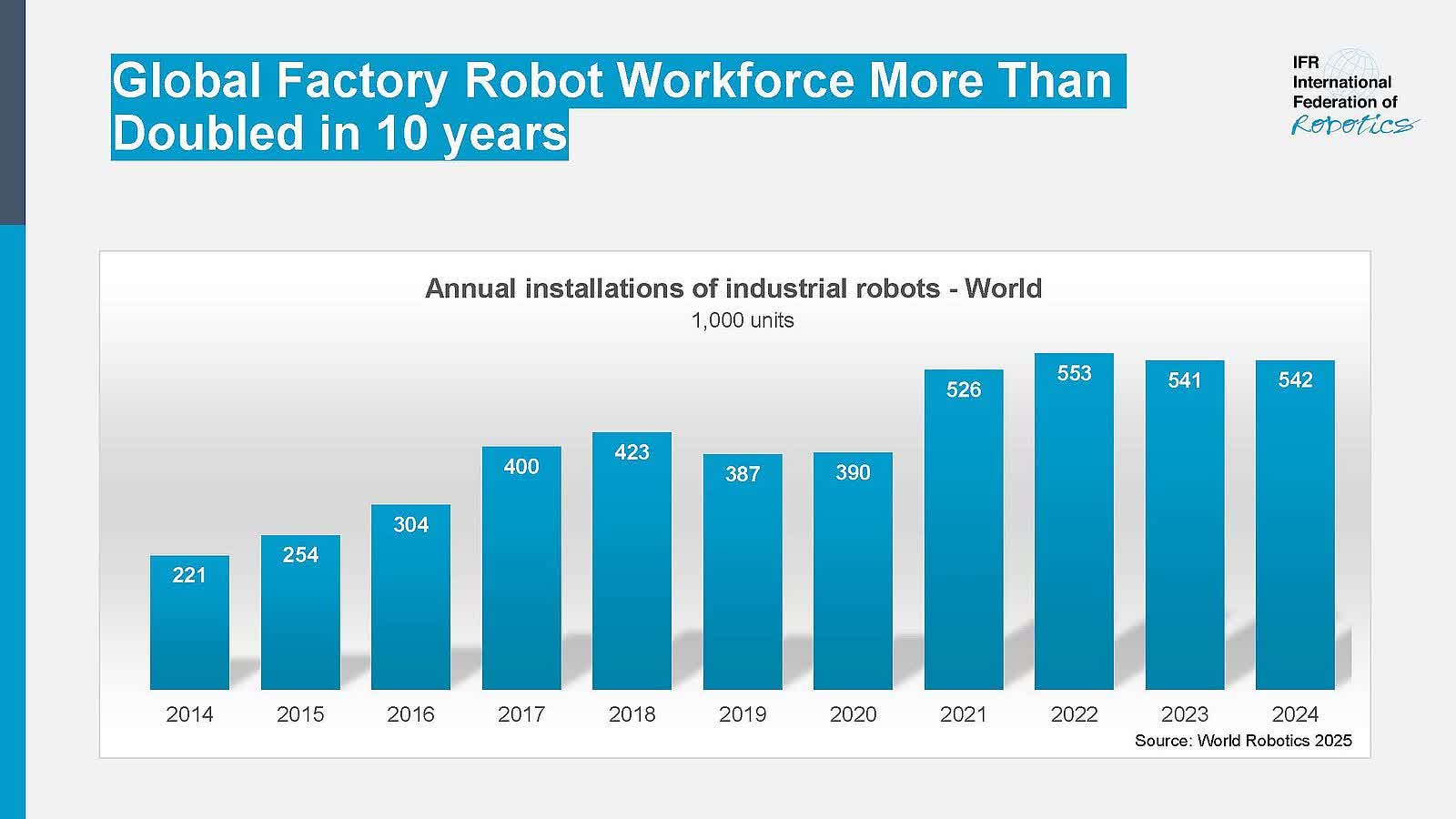
The speed at which industrial robots are being deployed isn't slowing down. In 2024, 542,000 were deployed globally – the second-highest annual total on record - marking the fourth year in a row that the figure exceeded half a million, writes the International Federation of Robotics (IFR). The report also notes that more than twice as many of these robots were deployed in 2024 compared to 10 years ago.
The majority of last year's robot deployments – 54% – came from China. Just under 300,000 of these machines were deployed in the country in 2024. For comparison, the US installed 34,000, or just over 10% of China's total, a decline of 9%. Japan (4%), Germany (5%) and South Korea (3%) also saw their total installations drop year-on-year.
China is the world's largest industrial robot market: its operational robot stock exceeded the 2 million mark a year ago. That's almost half of the world's 4.66 million industrial robots.
China's seemingly insurmountable lead in this area comes as little surprise. Dominating the robotics industry is an aspect of the Made in China 2025 campaign. Launched a decade ago, the movement aims to lessen the nation's reliance on imported goods. Incentives and help from Beijing in the form of investments, grants, and low-interest loans for businesses have played a major role in the efforts.
Related reading: Ex-Google CEO Eric Schmidt says work-from-home culture means US struggles to compete with China
According to a New York Times article from April, state-controlled banks lent an extra $1.9 trillion to industrial borrowers in China over the past four years. New factories are being built all the time while older ones are being upgraded with robots and automation.
Another reason why China is surging ahead in this field is its abundance of skilled programmers and electricians who can install the robots. While demand for skilled electricians is entering a boom cycle in the US, there remains a shortage of programmers.
The IFR predicts that Chinese manufacturing will increase 10% every year until 2028, driving demand for more of these industrial robots.
Another difference between the robotics market in the US and China is the former's focus on humanoid robots from the likes of Agility Robotics, Tesla, and even Meta. With specialist components for such machines harder to procure in China, they aren't as important in the country – they're not counted in IFR data – but China is stepping up investment in this area and the associated AI tech, creating human-like robots that are usually much cheaper than US alternatives.