
A hot potato: A top economist has said that AI will not destroy most of the world's jobs, and his rationale seems totally logical: doing so would simply be far more expensive than employing humans. He also believes that this expense is what will prevent AI from becoming a freely available miracle machine that will remove the need for money from society, a vision espoused by Elon Musk.
Steve Hanke, a professor of applied economics at Johns Hopkins University and a former senior economist on President Ronald Reagan's Council of Economic Advisers, doesn't buy into a lot of the AI hype – both the good and the bad.
One of the biggest concerns about AI is its impact on jobs. We've already seen tens of thousands of layoffs in the last few years that came as a direct or indirect result of the technology, but Hanke told Business Insider that a complete apocalypse that leaves most people unemployed is just a fantasy for a very practical reason.
"Businesses will not be firing everybody and replacing them with AI," he said, because this would cost companies more money than hiring humans. Hanke said it's the same reason why the idea that the most advanced AI will be free to use and almost costless to run will never happen.
"This belief is based on a disconnect from reality, as well as a good dose of idiotic economic reasoning," he said. "AI is incredibly costly; it is very resource-intensive," Hanke continued. "It requires huge amounts of water, power, and physical capital."
Hanke also took aim at some the AI industry's so-called visionaries, labelling them "charlatans and hucksters." He said that when they liken AI to software, it's an "apples and oranges" comparison, given that AI continuously costs money to run whereas in most cases, software doesn't incur additional costs for customers after being developed.
Credit: Financial Times
As for how far the "AI revolution" will go and whether, or when, the bubble will burst, Hanke believes that will be decided by the "cost of scarce resources that are gobbled up by AI."
The professor's view contrasts with those of AI evangelists such as Nvidia boss Jensen Huang, who have long argued that the astronomical price of AI hardware and operations will decrease as efficiency gains are made.
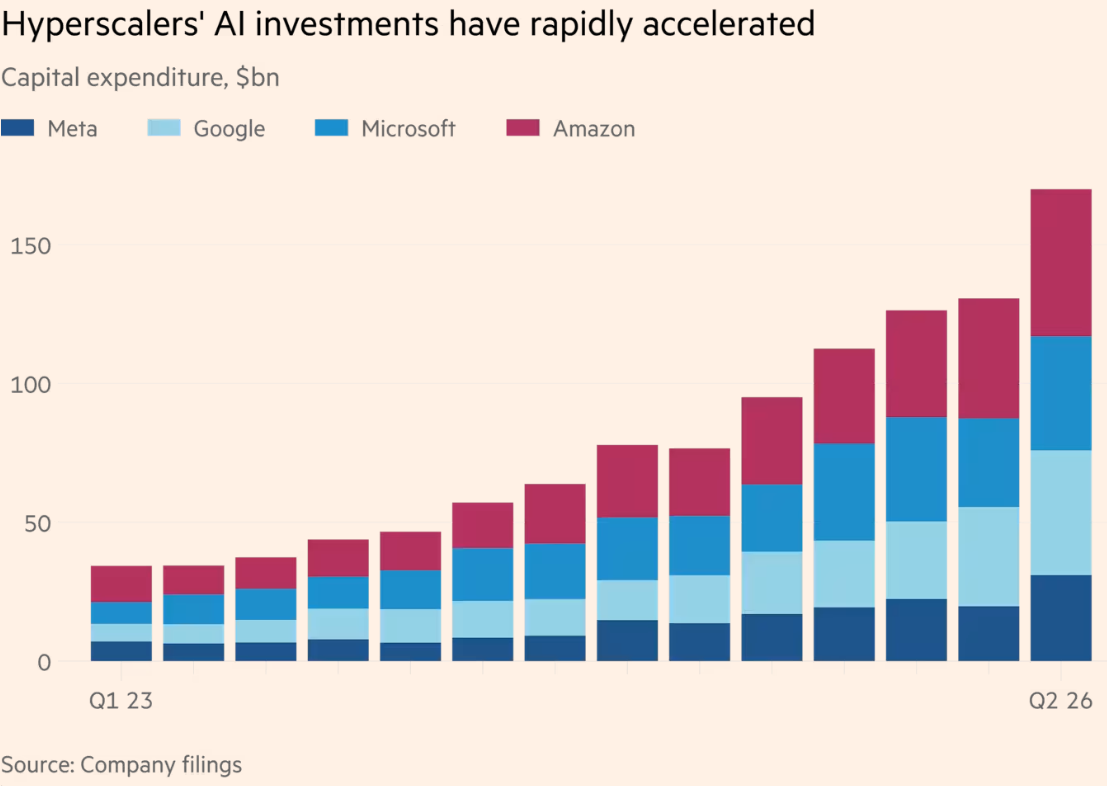
The amount of money being poured into AI and its infrastructure is now counted in the hundreds of billions. Google and Tesla are two companies spending so much on the technology that they just recorded negative cash flows – it was the first time Google experienced this since it went public more than two decades ago.
In July, SoftBank's founder and largest shareholder, Masayoshi Son, said developing and deploying AI for society at large would cost $5 trillion a year through 2040, yet he was quite adamant that there was no AI bubble. Adata chairman Chen Li-bai, meanwhile, said an AI bubble should not even be discussed seriously until 2040 or even 2050.
Musk, meanwhile, believes people should stop saving for retirement as "money won't matter" in a decade or two, as AI will have taken most jobs and we will all be living off a universal high income handed out by the government.
As for jobs, there have been recent signs to support Hanke's view. An increasing number of companies, such as Ford and Klarna, are rehiring laid-off workers after discovering the systems that replaced them perform worse.
In June, it was reported that multiple studies showed more employers rehiring workers for recently eliminated positions after overestimating AI's productivity gains and cost savings – or, at the very least, regretting the decision.
Economist Steve Hanke says AI won't destroy most jobs because it costs more than hiring humans


