France is ditching Zoom and Microsoft Teams for a homegrown video platform

Skye Jacobs

Posts: 1,913   +58
Staff
What just happened? France's public sector is preparing for a digital shake-up as the government phases out US-made video-conferencing platforms, replacing them with a state-built system designed to keep data inside Europe's borders. The move, announced by David Amiel, France's delegated minister for the civil service and state reform, reflects a growing European push toward what Brussels calls "technological sovereignty."
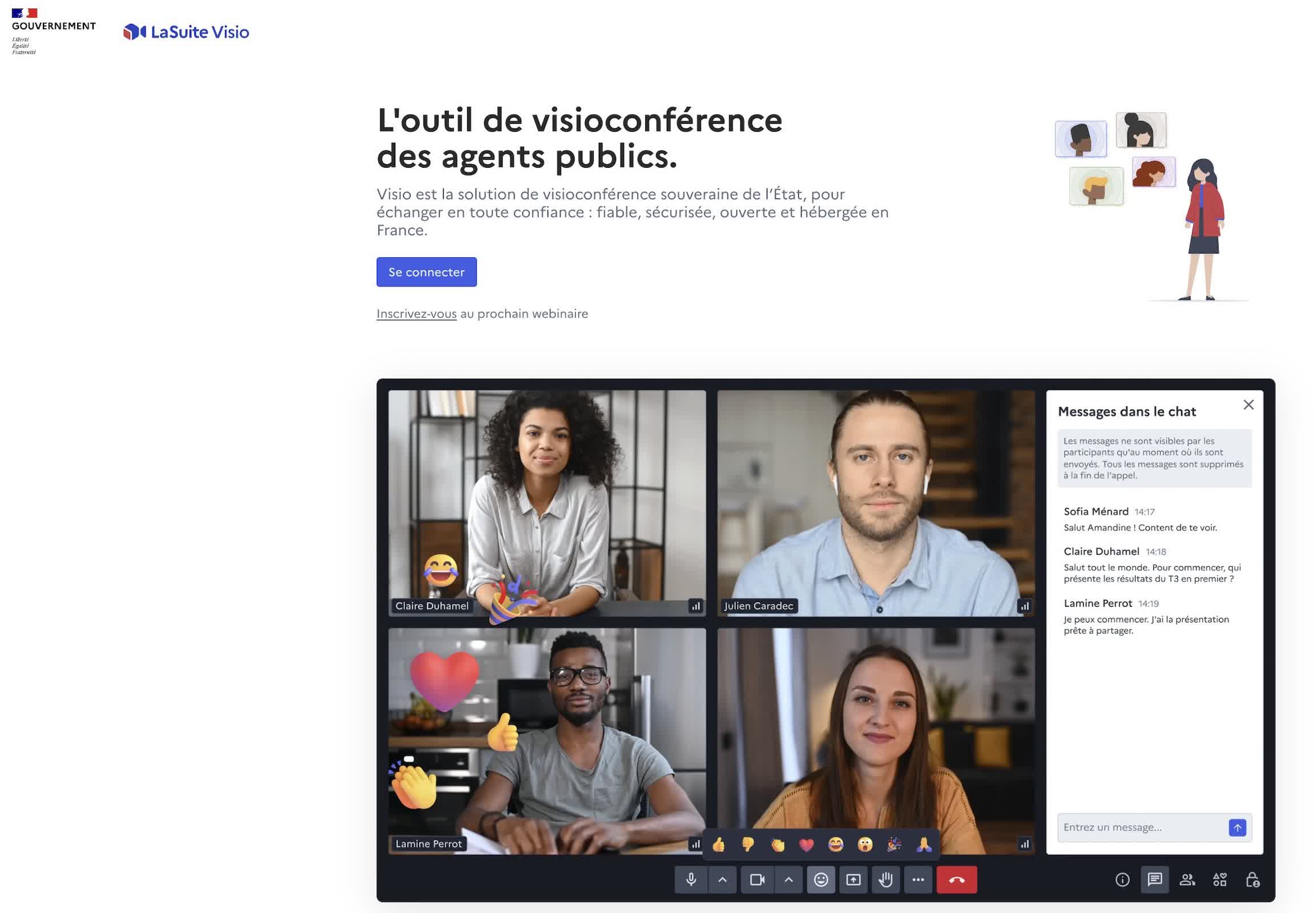
The new system, called Visio, is the product of a government-backed development program meant to ensure security and confidentiality in official communications. After a successful pilot last year, it is now being extended to about 200,000 civil servants across multiple departments.

Officials estimate that dropping foreign software licenses will save roughly €1 million ($1.19 million) per year for every 100,000 users, partly by reducing dependence on recurring commercial licensing costs with companies like Zoom and Microsoft.

Behind the rollout lies more than cost-cutting – it is about control. France's effort coincides with mounting political support across Europe for reducing reliance on American infrastructure that underpins much of the region's digital operations. Last week, the European Parliament passed a resolution urging member states to narrow their dependence on non-EU suppliers for technologies ranging from semiconductors to artificial intelligence and cloud hosting.

That reliance remains deep. More than 80 percent of Europe's digital infrastructure and software originates outside the European Union, with Amazon Web Services, Microsoft Azure, and Google Cloud commanding nearly 70 percent of the region's cloud market.
Lawmakers warn this creates both strategic and legal exposure, citing the US CLOUD Act, which allows American authorities to access data stored by US-based companies even when the servers are located abroad. The law, they say, means that European governments' most sensitive data could still fall within US jurisdiction.

The French government's local alternative, though modest compared with Microsoft's scale, is being positioned as a blueprint for European self-reliance. Amiel described Visio as a "sovereign tool" designed to protect public communications from foreign oversight.

Politicians pushing for digital independence have framed the issue as an urgent security challenge. "If we do not act now to reduce Europe's technological dependence on foreign actors, we run the risk of becoming a digital colony," said Michal Kobosko, a member of the European Parliament's Renew Europe group.

For France, that warning has become policy. As Visio takes root across government agencies, the project signals a test of whether Europe's ambition for digital sovereignty can extend beyond resolutions and rhetoric to tangible, working technology – built, operated, and stored within its own borders.

Permalink to story:

 
Sounds good. Trump is exposing deep cracks in the Post War Order and it's high time everyone went their own way.

Give it 10-15 years tops, hopefully no major war with a ton of deaths, and everyone will suddenly "rediscover" free trade and the whole idea that everyone's quality of life goes up while the cost of products and goods goes down when everyone does what they're good at and sells it to everyone else.
 
France got to laugh at the rest of NATO because it stuck to its own defensive kit.

They're in control of their own nukes and jets, completely independent of the US and they're now the second largest arms exporter in the world (yes, bigger than China and Russia)

Hopefully lesson learned for the rest of the world and they'll do the same with tech like this instead of just France doing it again.
Reliance on the US for anything as is very clear now is not a good idea.
 
France got to laugh at the rest of NATO because it stuck to its own defensive kit.

They're in control of their own nukes and jets, completely independent of the US and they're now the second largest arms exporter in the world (yes, bigger than China and Russia)

Hopefully lesson learned for the rest of the world and they'll do the same with tech like this instead of just France doing it again.
Reliance on the US for anything as is very clear now is not a good idea.
They weren't so independent during WW2.
Whoever the president of the US is, we still share same or similar values.
And in times of trouble, it counts a lot more that quarrels about tariffs.

On the other hand, I see how we grow further away based on the main values that many Western countries are quickly adopting. I feel like in 50 years, we might be complete strangers to each other, both racially and ideologically.
 
France got to laugh at the rest of NATO because it stuck to its own defensive kit.

They're in control of their own nukes and jets, completely independent of the US and they're now the second largest arms exporter in the world (yes, bigger than China and Russia)

Hopefully lesson learned for the rest of the world and they'll do the same with tech like this instead of just France doing it again.
Reliance on the US for anything as is very clear now is not a good idea.

Yeah, but how many times has France been taken over by other countries? It's one of the reasons they don't allow fireworks at France Disneyworld. Once the boom booms start, every window in France would open and white surrender sheets would start flying. /sarcasm 🤣
 
The lack of major software companies in Europe has always been puzzling.
Lack of silicone valley mentality. European investors aren't willing to sink millions into random ideas and keep investing even when there's no clear profit model.
Along with simply an early headstart for things like windows and office. Plenty of skilled software developers in Europe just no companies that can take risks.

Imo the EU should poor some money into opensource development. Get a EU Linux going to standardize things, turn Sailfish OS into a mobile OS competitor and demand that phones in the EU are sold with unlocked bootloaders.
Make sure things like Blender, Krita, Gimp, Libre Office and PostgreSQL keep getting development and are the standard that's used for all government work within the EU. Taxpayers can get the improved software for free themselves, everyone wins
 
Lack of silicone valley mentality. European investors aren't willing to sink millions into random ideas and keep investing even when there's no clear profit model.
Along with simply an early headstart for things like windows and office. Plenty of skilled software developers in Europe just no companies that can take risks.

Imo the EU should poor some money into opensource development. Get a EU Linux going to standardize things, turn Sailfish OS into a mobile OS competitor and demand that phones in the EU are sold with unlocked bootloaders.
Make sure things like Blender, Krita, Gimp, Libre Office and PostgreSQL keep getting development and are the standard that's used for all government work within the EU. Taxpayers can get the improved software for free themselves, everyone wins
The Dream
 
Need to do the same thing with US Social Networks. Platforms such as Facebook, Instagram, X, Truth Social etc are so toxic. (sidenote: if a platform puts words like truth in it's title you know it's a crock of sh1t - bit like Pravda in Russia).
 
In the good ol' times, people used to first develop Protocols for Applications, then implement compatible Applications.
All Applications properly implementing a Protocol were Inter-operable.
These days, try to call a Zoom meeting from your Teams app, or vice versa... or that Visio (not Microsoft (TM) thing?)
 
Need to do the same thing with US Social Networks. Platforms such as Facebook, Instagram, X, Truth Social etc are so toxic. (sidenote: if a platform puts words like truth in it's title you know it's a crock of sh1t - bit like Pravda in Russia).
Hear, Hear, I'm glad somene said that.
 
Back