Google Pixel 10's 100x zoom often beats Samsung - but are the photos real?

Daniel Sims

Posts: 2,574   +77
Staff
Why it matters: Pro Res Zoom is one of the Google Pixel 10 Pro's signature features, employing generative AI in the company's race against Samsung to create the best ultra-long-distance smartphone camera. However, the results have their limitations and could stretch the definition of a photograph. Samsung's AI-enhanced zoom encountered similar controversy two years ago.

Since Google launched its Pixel 10 series smartphones last week, users have been testing the limits of its camera, which utilizes generative AI to fill in details in photos taken at 100x zoom. Some results look impressive, but implementing generative AI raises questions regarding authenticity.

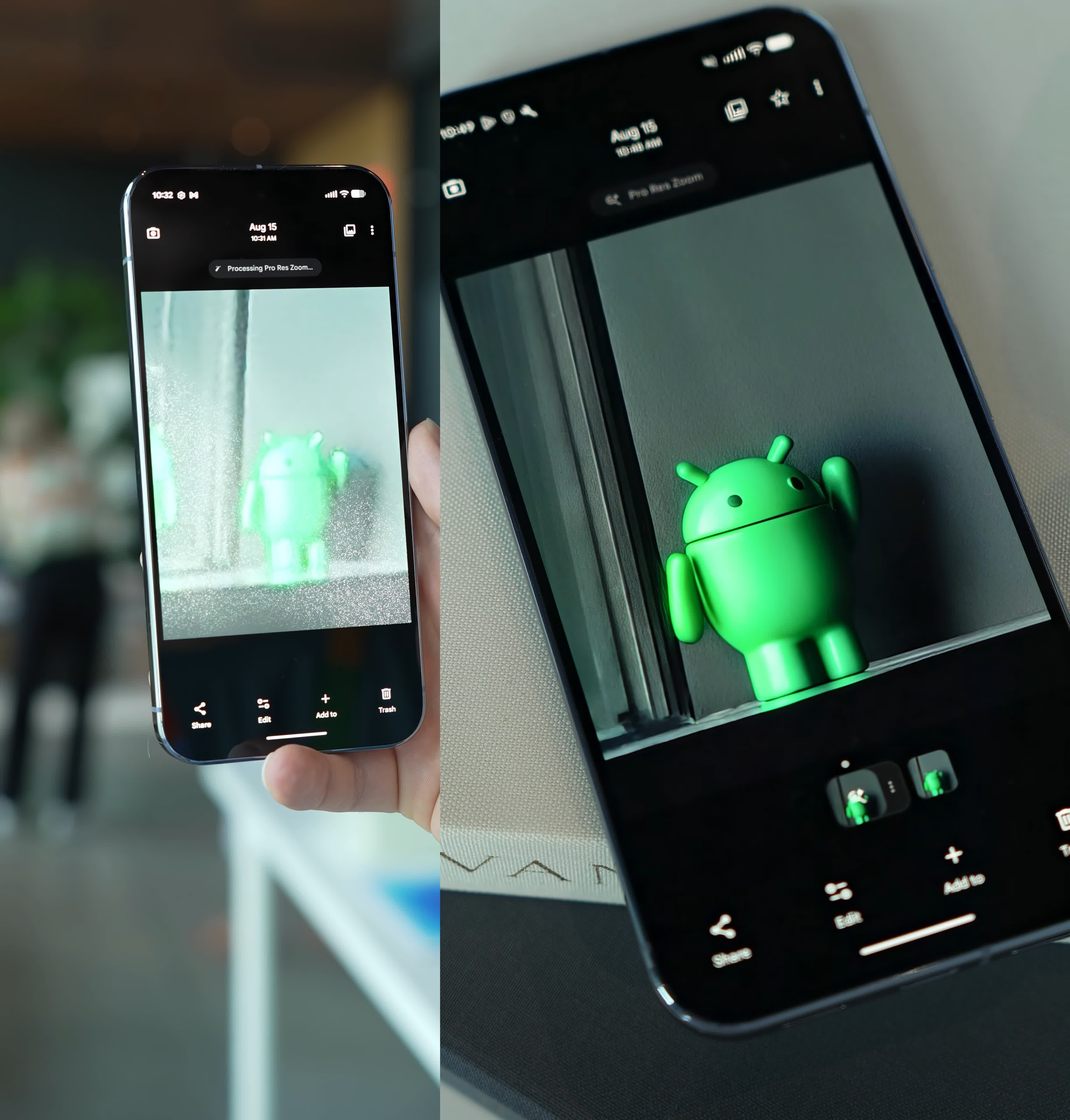
YouTuber Parker Burton demonstrated an ideal result by photographing an Android mascot doll from across the room in a recent video. What initially appears to be full of typical digital blur becomes a sharp image of the doll, clearly rendering the wall texture behind it.
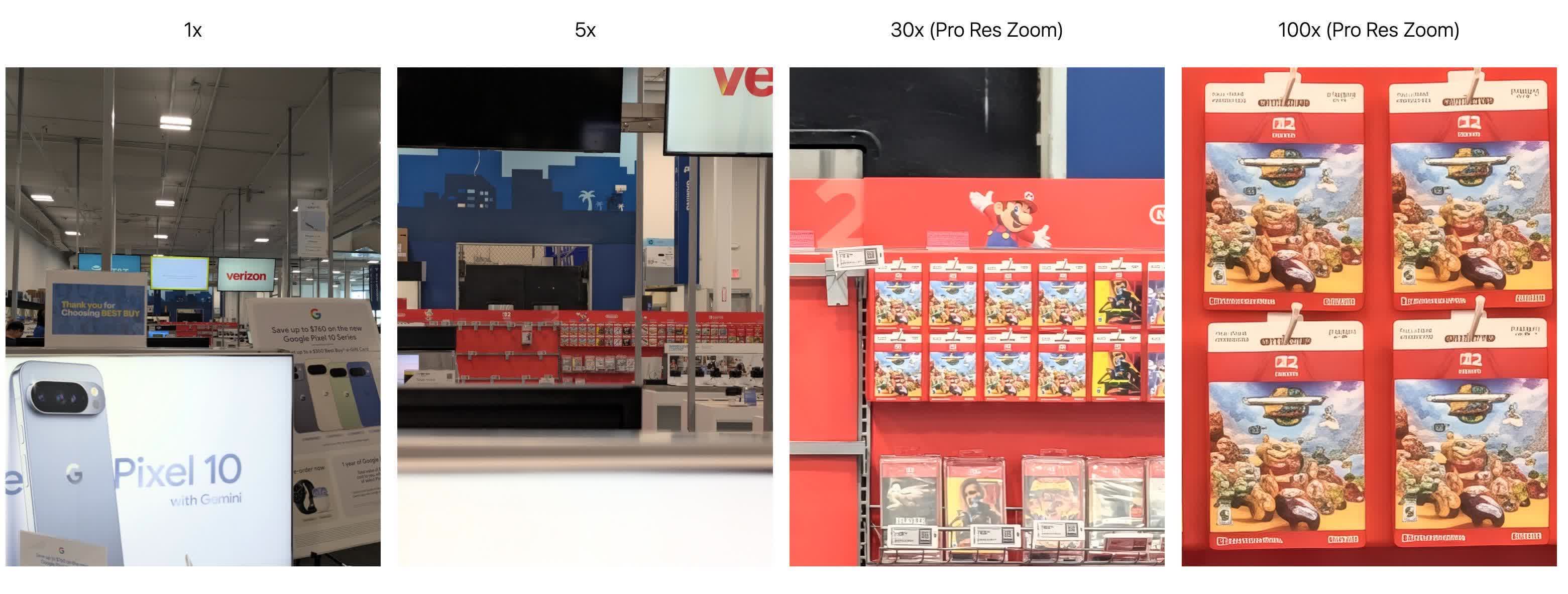
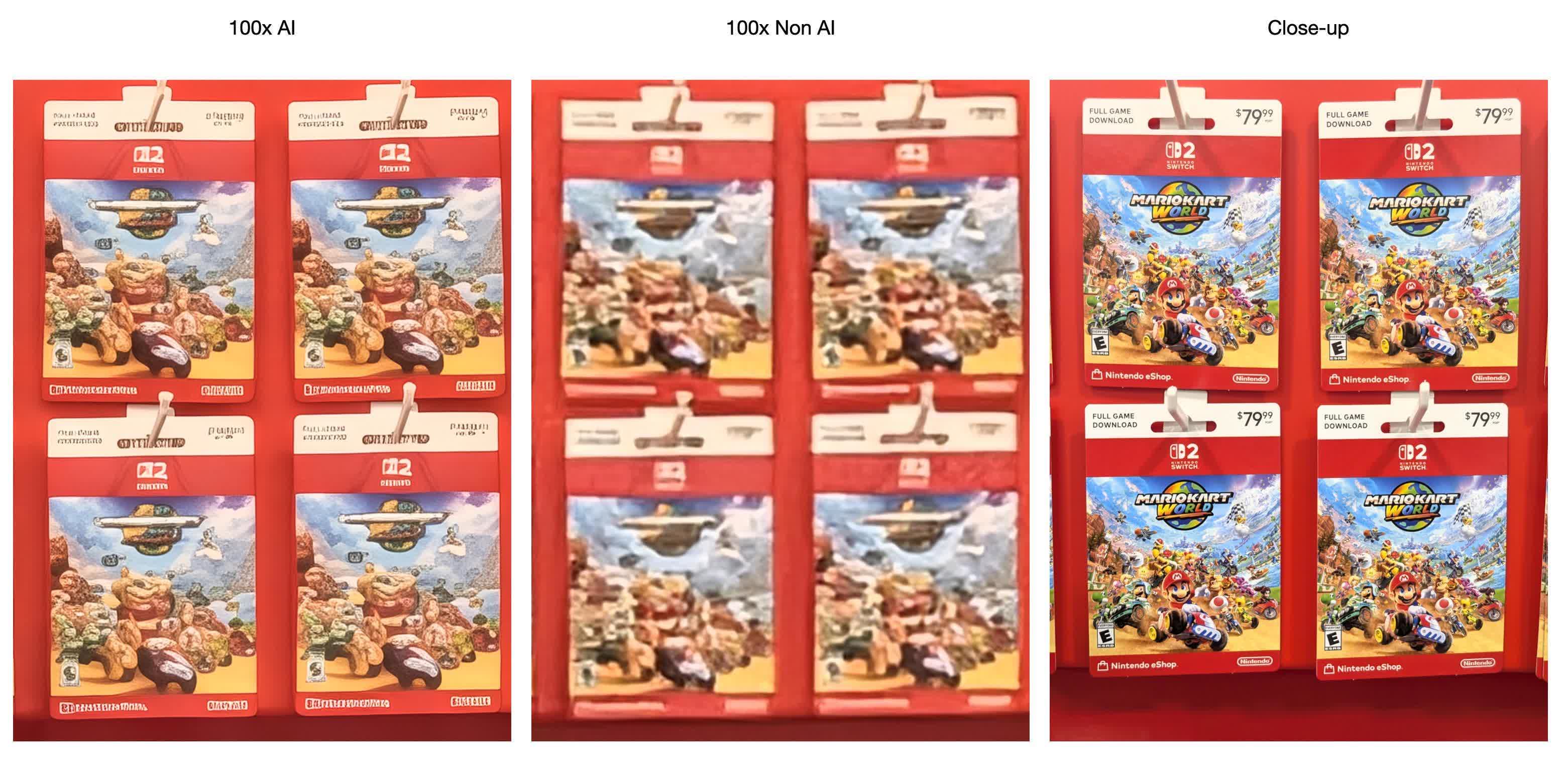
However, Redditor Dry_Astronomer3210 proved that Google's Gemini AI collapses when attempting to resolve artwork and fine text at similar distances. It fails to capture anything recognizable when aimed at a row of Mario Kart World download cards on a store shelf.

Google admits that users shouldn't consider its AI-enhanced photos completely authentic. The Pixel 10 Pro deliberately avoids applying Gemini to images of people and retains an unaltered copy of each photo.
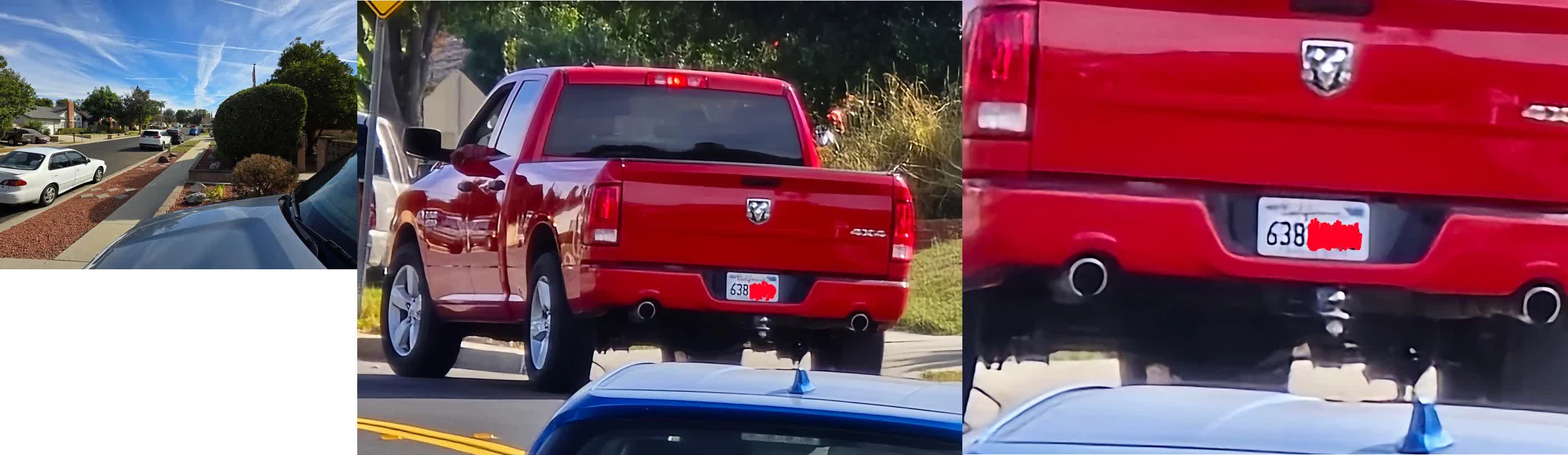
Meanwhile, Samsung's Galaxy S20 series phones employ a 100x zoom function that utilizes AI super resolution, compositing numerous photos to recover lost detail. Although the results might not match the Pixel 10 Android doll photo, Samsung's camera still relies almost entirely on optics and can often resolve text at long distances. In one example, Redditor 911jason managed to photograph a truck at 100x zoom with the license plate legible enough that they had to censor it when sharing the results.

The company had to explain its process in 2023 after users accused the Galaxy S23 of planting existing images of the Moon in photos of the celestial object. Although Samsung's Galaxy AI is trained on pictures of the Moon, it enhances photos with other AI models without generating new details.
While users still claim that Galaxy S20 phones produce fake images of certain objects, Google could be accused of faking everything Pixel 10 Pro phones capture at high zoom levels.

Permalink to story:

 
The weird shape it turned Mario on kart into is hilarious.

Looks like my full frame camera with tele lens still has a purpose until AI can break the laws of physics and gather enough photons across a tiny fraction of a tiny sensor for fine details.
 
This is a defense lawyers wet dream... now they can claim cell phone content is fake in a trial and point right to this. al they need to do is convince a single juror out of 12 that the photo/video '''might''' not fully authentic .. bam! reasonable doubt .. no conviction, double jeopardy then applies.
 
The weird shape it turned Mario on kart into is hilarious.

Looks like my full frame camera with tele lens still has a purpose until AI can break the laws of physics and gather enough photons across a tiny fraction of a tiny sensor for fine details.

100% I'll take my d-slr over a phone camera ANY day.
I do not get people thinking they are going to get a quality telephoto shot, from a SUPER TINY image sensor that uses DIGITAL zoom in an attempt to make the photo zoom in, not to mention stuffing 50-100
megapixels onto that super tiny sensor, THEN using "AI" to create the photo.
When you stuff that many pixels on a tiny sensor the data lines are already VERY close together. In the case of a lower than nominal lighting condition, the sensor increases the gain, in hopes of capturing what little light, which creates "noise" (signal to noise ratio) and then once again the post processing software will try to remove it, which usually results in an "off" photo.
The other thing that gets to me is if 100-200 megapixels is such a good idea, how come my d-slr tops out at 26 megapixels? It's not the NUMBER of pixels, it's the SIZE of the pixels, along with that heavy glass on the front of the telephoto lens.
 
I've recently gotten back into photography myself. Dump the phone camera and back to some great quality. Mirrorless has made it an easy transition, so much power in a compact form. Also, I want to split my battery life use.
Yes, the mirrorless quality is much better and still fits in a small bag.
 
100% I'll take my d-slr over a phone camera ANY day.
I do not get people thinking they are going to get a quality telephoto shot, from a SUPER TINY image sensor that uses DIGITAL zoom in an attempt to make the photo zoom in, not to mention stuffing 50-100
megapixels onto that super tiny sensor, THEN using "AI" to create the photo.
When you stuff that many pixels on a tiny sensor the data lines are already VERY close together. In the case of a lower than nominal lighting condition, the sensor increases the gain, in hopes of capturing what little light, which creates "noise" (signal to noise ratio) and then once again the post processing software will try to remove it, which usually results in an "off" photo.
The other thing that gets to me is if 100-200 megapixels is such a good idea, how come my d-slr tops out at 26 megapixels? It's not the NUMBER of pixels, it's the SIZE of the pixels, along with that heavy glass on the front of the telephoto lens.
Yes, there is no replacement for sensor size. You can see it in the action cam and drone markets where they keep making the sensors bigger and bigger.

The one cool thing AI can do is line up a bunch of consecutive handheld phone images into essentially a long exposure on a tripod image. But that only works for things that are moving. Still I wouldn't mind that feature in my real camera.

Mirrorless and dslr cameras now top out at 60+ MP, because the former limitation that caused noise to increase with MP has largely been overcome. The new limit is file size. The more MP the harder it is to capture a burst of photos without running out of camera memory and the longer everything takes in saving and later processing your images. My Sony a7r III is 42MP and I wouldn't want any bigger files. The free digital zoom by crop to 12MP in post is nice tho.

Still 100+ MP on a phone sensor is bonkers and requires AI denoising from the start.
 
Back