Intel could be developing Arc B770 with 16GB VRAM, multi-frame generation

Daniel Sims

Posts: 2,416   +73
Staff
What we know so far: Intel recently confirmed plans to continue developing dedicated desktop graphics cards despite failing to penetrate the market so far. Now, new clues have emerged regarding the company's near-future products. Intel might introduce a new GPU within the next few months, and the company is likely developing a multi-frame generation solution.
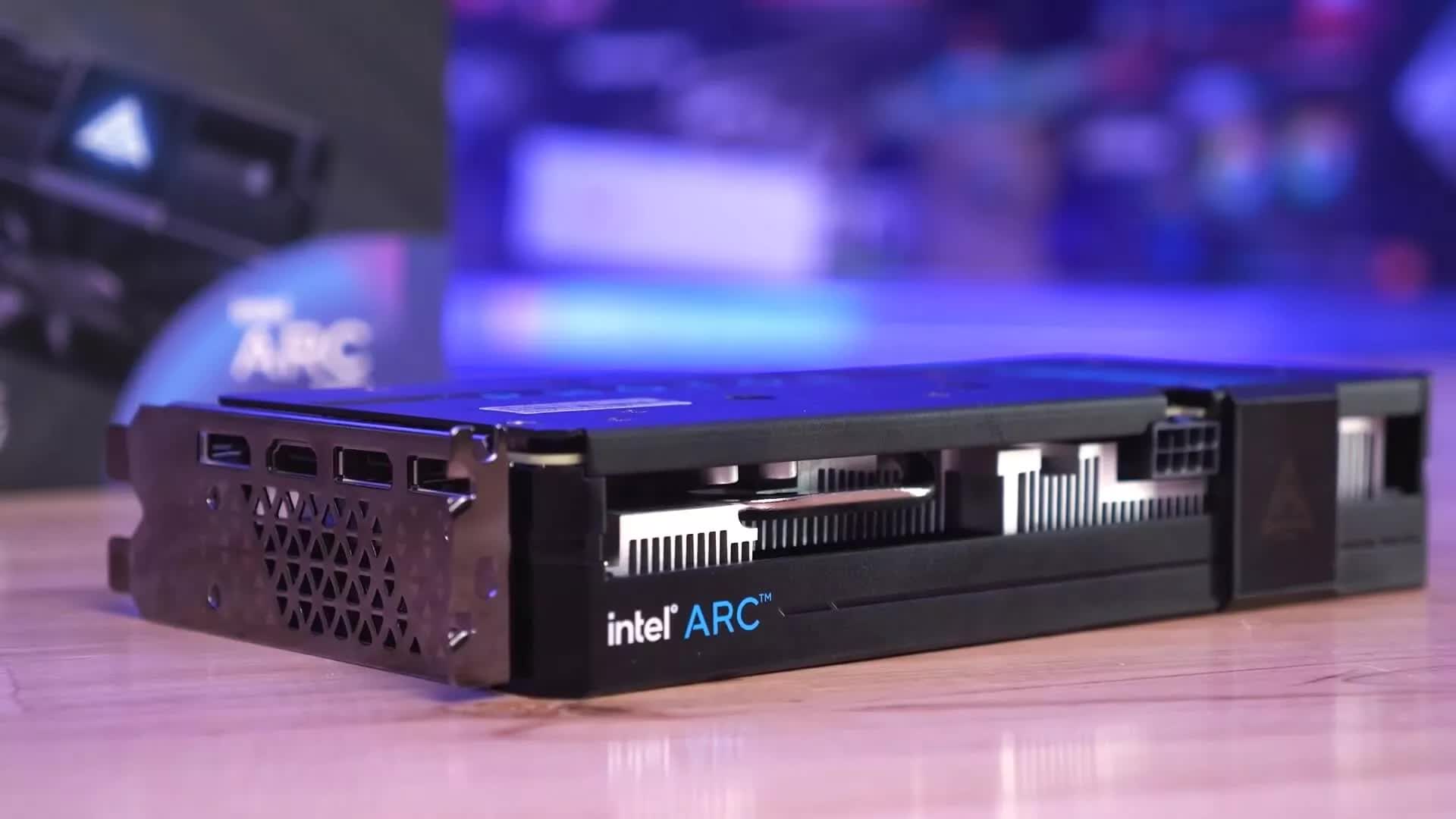
Recent data mining suggests that Intel is developing a new Arc Battlemage graphics card as well as the next stage of its XeSS frame generation technology. A recent job listing also referenced an unspecified high-end GPU.

Leaker Tomasz Gawroński spotted a reference in Intel's driver code to a Battlemage card with 16GB of VRAM. The most powerful product in the current lineup, the Arc B580, features 12GB, so the description of a 16GB GPU likely refers to a theoretical B770.

Moreover, Intel is still hiring talent for designing desktop graphics cards. An opening at the company's Haifa, Israel, office (first shared by Haze on Twitter) describes a "high-end" desktop gaming SoC.

What the company considers "high-end" remains unclear. Intel has released entry-level GPUs such as the $250 Arc B580, alongside mainstream-tier products like the $330 A770. The B770 would be the company's most powerful GPU yet, but it would likely just be a successor to the A770, perhaps competing with Nvidia's RTX 5060 or AMD's Radeon RX 9060. Nothing indicates plans for a traditional high-end graphics card to match the RTX 5080 and RX 7900 XT.

Another possibility is that the job listing refers to Intel's upcoming Arc Celestial series.

Driver Built XeSS Frame Generation Might be on the way.
byu/Organic-Bird-587 inIntelArc

Meanwhile, Redditor Organic-Bird recently uncovered Intel driver code mentioning multi-frame generation, which is currently only available in Nvidia's RTX 50 series GPUs. The references include a line of code and an icon that appears to depict three overlaid screen frames.

Nvidia's multi-frame generation interpolates up to three frames between every rendered frame, potentially quadrupling the perceived framerate. However, the technique can impact input latency, so it is only useful on high-refresh-rate displays in games that already run smoothly.

Intel recently confirmed that it will not abandon Arc GPUs following the announcement of a partnership to develop SoCs that combine its CPUs with Nvidia graphics chips. The company's current dedicated desktop GPU market share is under 1 percent.

Permalink to story:

 
Government investment in Intel and Micron is there to hedge against the possibility of China taking Taiwan and controlling the chip market. But Intel GPU products are way behind Nvidia - virtually no one wants them.

Intel's real goal should be creating CPU with integrated RTX graphics. Let Nvidia do what they do best.

Then we'll have cheap netbooks/tablets and laptops with DLSS, Ray Tracing, AI upscaling and high FPS gameplay.
 
Then we'll have cheap netbooks/tablets and laptops with DLSS, Ray Tracing, AI upscaling and high FPS gameplay.
There are notebooks with nVidia GPUs for years.
They are
- with (relatively) high fps but not cheap
- cheaper but not capable of high fps when using anything over light RT efects
- one way or other way they lack VRAM to do tricks with RT, RR, FG, MFG

I doubt iGPU chiplet will make things different.
It only replaces the cheapest dGPU.
 
Government investment in Intel and Micron is there to hedge against the possibility of China taking Taiwan and controlling the chip market. But Intel GPU products are way behind Nvidia - virtually no one wants them.

Intel's real goal should be creating CPU with integrated RTX graphics. Let Nvidia do what they do best.

Then we'll have cheap netbooks/tablets and laptops with DLSS, Ray Tracing, AI upscaling and high FPS gameplay.
The concern is there, but China won't take Taiwan as they need chip fabs and profits from products manufactured by TSMC. But if it happens that'll be the least of anyone's worries, and it'll make the chip shortage during covid look like a minor shipping delay.

And I don't expect notebooks with Intel+Nvidia to be cheap, the cheap ones would probably have graphics barely better than an iGPU,as they always have. The investment and partnership isn't anything good for Intel Arc surviving, or AMD having a chance at competing in the laptop and SoC mini PC market. Nvidia already has a lot of influence on the laptop market, I expect this will get them to monopolize it even further.
 
There are notebooks with nVidia GPUs for years.
They are
- with (relatively) high fps but not cheap
- cheaper but not capable of high fps when using anything over light RT efects
- one way or other way they lack VRAM to do tricks with RT, RR, FG, MFG

I doubt iGPU chiplet will make things different.
It only replaces the cheapest dGPU.

My guess is they will target the AI MAX+ 395. and last I checked the entry level for that is around $1500 for a mini pc with no display. Asus has versions well north of $2k. I seriously doubt that Nvidia will create anything that sells for less. The bigger question is that the AI MAX seems to throttle down quite well to allow some battery life when the heavy guns aren't needed, Nvidia doesn't seem too power friendly without a separate igpu to use. And will sell for more money and snapped up faster than they can be produced because it says NVIDIA on the box.

I picutre an Intel 5090M, less memory and slower raster than the MAX 395. With DLSS, MFG, etc., etc. allowing it to run slightly faster with frame grabs that look slightly better than FSR 4. The press will decleare that it's worth $500 more because of the nice frame grabs and laptops that use it will sell for around $3k, thus preserving the $5k 5090 dgpu market.
 
Last edited:
Back