Intel's new Core i5-110 appears identical to a 2020 Comet Lake chip

Alfonso Maruccia

Posts: 2,511   +935
Staff
WTF?! Intel is reportedly relaunching one of its older CPUs under a new name. The Core i5-110 appears strikingly similar to a Comet Lake chip released five years ago. Could this simply be a rebranding mistake from a company increasingly seen as inconsistent?
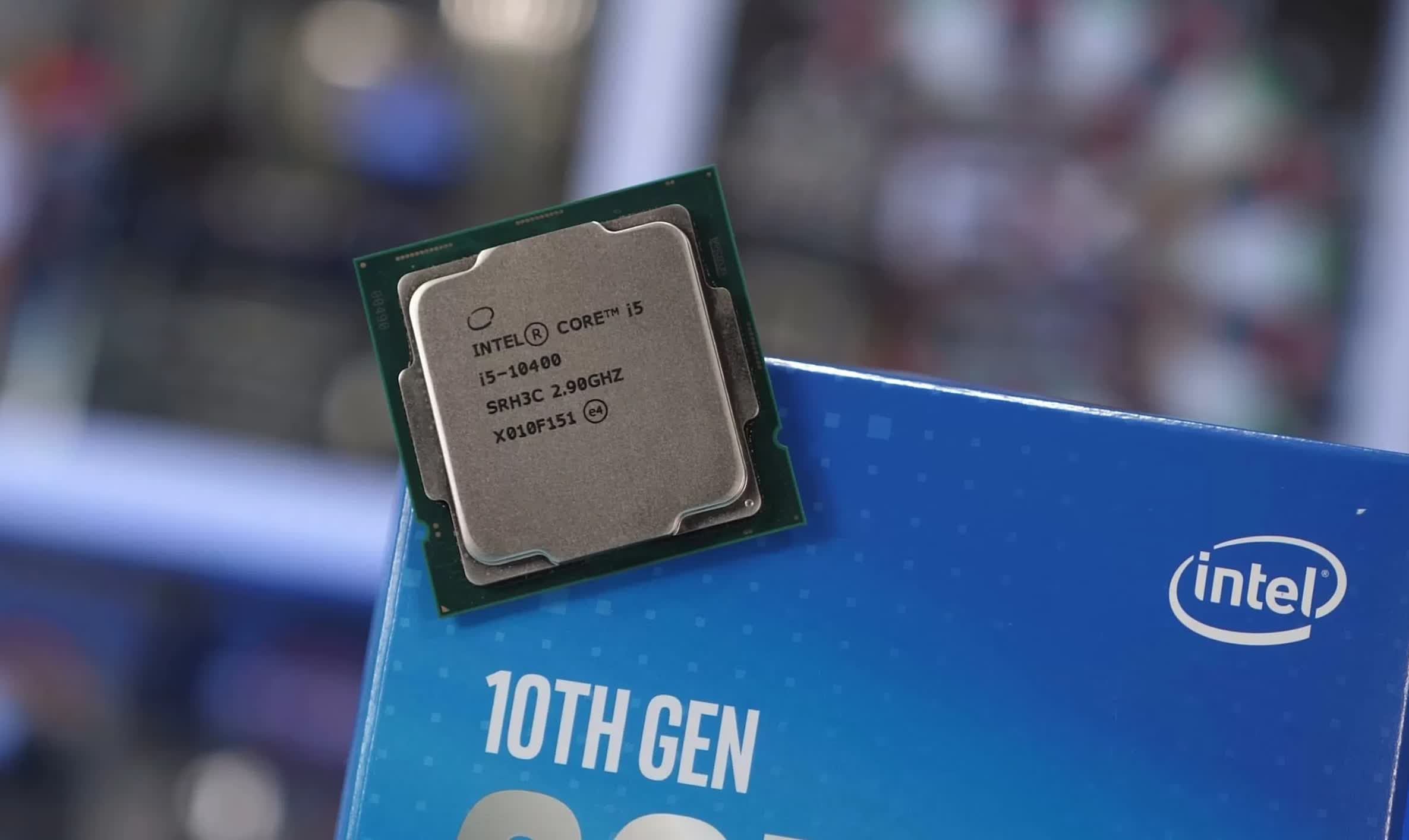
Intel's online CPU database recently added the Core i5-110, an oddly branded processor that uses five-year-old technology for reasons known only to the semiconductor giant. Intel confirms the CPU's codename was formerly "Comet Lake," and its hardware specifications appear to be essentially identical to the Core i5-10400.

The US chipmaker first released the 14nm Comet Lake family in 2020, with the Core i5-10400 launching in Q3 of that year. The original processor featured six cores and 12 threads, a maximum turbo frequency of 4.30 GHz, and a 65W TDP. The Core i5-110 matches these specs exactly, and a side-by-side comparison confirms that these are effectively the same processor marketed under different names.

Both chips carry the same suggested price ($200), even though the Core i5-10400 is now available on auction sites for a fraction of that cost. They also use the same LGA 1200 socket, meaning you cannot pair the "new" CPU with modern motherboards.

Comet Lake was part of Intel's 10th generation Core lineup and relied on a revised Skylake microarchitecture dating back to 2015. Intel has since shifted to a "Core Ultra" branding scheme, which drops the initial "I" moniker. Yet the Core i5-110 doesn't fully follow this new nomenclature, raising questions about Intel's branding decisions.

Why Intel chose to relaunch a Comet Lake-era CPU under a reshuffled brand remains unclear. Some speculate it may be a documentation or archiving issue, but the database entry explicitly notes the model was formerly known as Comet Lake, suggesting this is intentional rather than a clerical error.

Intel, once known as "Chipzilla," appears willing to experiment with unusual marketing and branding moves as it navigates a competitive and challenging semiconductor landscape. At this point, surprises from Santa Clara headquarters should hardly be unexpected.

Permalink to story:

 
They probably got a request from some OEM for a part like this in pre built systems and they ended up making more than the order called for. I bet this was "we need a part with these specs and a new name" and this name is just for marketing purposes from the OEM. Intel wouldn't have made a point of pointing out the old architecture if they were trying hide old parts as a rebrand. I bet HP or Dell would. Lenovo has also been pretty honest about their PCs due to their business focus.

We have schools and business that are suddenly all going to be forced to upgrade to windows 11 by buying new PCs come October, we'll see what prebuilts these end up being in.
 
They probably got a request from some OEM for a part like this in pre built systems and they ended up making more than the order called for. I bet this was "we need a part with these specs and a new name" and this name is just for marketing purposes from the OEM. Intel wouldn't have made a point of pointing out the old architecture if they were trying hide old parts as a rebrand. I bet HP or Dell would. Lenovo has also been pretty honest about their PCs due to their business focus.

We have schools and business that are suddenly all going to be forced to upgrade to windows 11 by buying new PCs come October, we'll see what prebuilts these end up being in.
Suddenly? MS announced the windows11 requirements in june of 2021. That was over 4 years ago. The oldest CPUs that are officially supported were widely available in late 2017. So not only did these schools/businesses not plan ahead, but they are running PCs over 8 years old with no replacement plan.

Any school district that hasnt planned for this already is run by fools and those fools need replaced. Any business foolish enough to not invest in their infrastructure deserves the financial pain.
 
Suddenly? MS announced the windows11 requirements in june of 2021. That was over 4 years ago. The oldest CPUs that are officially supported were widely available in late 2017. So not only did these schools/businesses not plan ahead, but they are running PCs over 8 years old with no replacement plan.

Any school district that hasnt planned for this already is run by fools and those fools need replaced. Any business foolish enough to not invest in their infrastructure deserves the financial pain.
I'm not saying they didn't plan for it. They could have said we can use these for 6 more years before we start replacing then and we need some minimum level of performance. The business talks to a rep from an OEM, the OEM looks for SKUs of parts that fit the requirement and if they need something they can goto Intel or AMD and say "we need 100,000 parts with these requirements". They make, say ,120,000 and the rest end up on eBay or even on some sites like Amazon or Newegg from third party sellers.

Customs SKUs aren't uncommon. Also, Intel might be trying to make a product on its older, higher yield nodes to fill gaps in their supply chain from the lower yield on their new nodes.
 
I'm not saying they didn't plan for it.
You said "We have schools and business that are suddenly all going to be forced to upgrade to windows 11 "

There is nothing sudden about a requirement announced nearly half a decade ago. To be "sudden" would require they did not plan at all.
They could have said we can use these for 6 more years before we start replacing then and we need some minimum level of performance. The business talks to a rep from an OEM, the OEM looks for SKUs of parts that fit the requirement and if they need something they can goto Intel or AMD and say "we need 100,000 parts with these requirements". They make, say ,120,000 and the rest end up on eBay or even on some sites like Amazon or Newegg from third party sellers.
OK, but again, if they had a 6 year cycle, they would be fine. You would need to be running 9 year old PCs to be beyond the cutoff date. There is no business out there running 10 year replacement cycles on their PCs, if there was, I'm pretty sure they would sync said upgrades to Windows releases specifically to avoid this problem.

The longest lifecycle standard I've seen, not counting the businesses that run-to-fail (see again - lack of planning) was 6 years. Usually that is when BIOS updates stop being issued for security issues.

No major business is still running Haswell or Skylake hardware today, at least anything plugged into the internet. Some schools that dont have a lifecycle plan may still be using them, but again, that is on them for not planning for eventual replacement.
Customs SKUs aren't uncommon. Also, Intel might be trying to make a product on its older, higher yield nodes to fill gaps in their supply chain from the lower yield on their new nodes.
If intel's supply issues are so bad they have to revive 14nm chips, they just need to throw in the towel. that is a BAD sign. 10nm was made the desktop node 6 years ago. Where are they pulling all this 14nm production from?
 
If intel's supply issues are so bad they have to revive 14nm chips, they just need to throw in the towel. that is a BAD sign. 10nm was made the desktop node 6 years ago. Where are they pulling all this 14nm production from?
Well, (and , feel free to correct me anywhere you feel necessary) a CPU die pattern isn't like the patterns for an F-22, which the fed has destroyed. So, there will no more "Raptors", ever.
But, CPU patterns wouldn't take up huge warehouses or hangars either. So there's no need to destroy them. In fact, if Intel hung on to them long enough, they'd make a great museum exhibit.

Most of you are confusing gamer's, hopes, dreams, compulsions, and addictions, to what businesses actually need. I mean just ask anybody here, businesses would be stupid to buy Intel anyway. Seriously, if any smart business IT technician took the time to read the endless laundry lists of game performances published here and elsewhere, they'd know that AMD is the real deal, at least for the time being. But wait, the average business will, more than likely, be using IGP, instead of RTX-5090s. People who go to work are expected to work, and not play video games all day. That's an inconvenient truth, I know. Condolences. Employees probably won't be allowed to overclock their workstations to the point where another worker has to pour liquid nitrogen into a copper cup over these CPUs, to keep them from exploding, either.

I do have a couple questions through. How often do CPUs actually go bad? Where are the boards for these CPUs coming from? ** Won't these employees be replaced with an AI server in the not too distant future? Given the data siphoning piece of sh!t that is Windows 11, won't many of these companies pay the "M$ tax", required to keep Windows 10 for a few more years? (Sorry, that was 4 questions, not, "a couple".)

** For those of you who aren't aware, Intel used to market their own branded boards. I believe they were made by Foxconn. But then again, many of their workers who remembered how to make them, may have already jumped out a 3rd floor dormitory window. (Intel discontinued these because gamers complained bitterly, that they weren't allowed to slap off into the BIOS as much as they felt was necessary).

DISCLAIMER: Any resemblance to persons living or dead mentioned in this post, was purely intentional. (Sorry, I meant "unintentional").
 
Last edited:
Back