The big picture: Park-outside recalls are becoming a bigger issue for automakers and drivers as vehicles add more electrical systems, battery technology, and software-controlled components. For drivers, the warnings can mean months of inconvenient parking habits while manufacturers work to provide repairs.
In the first seven months of 2026, the NHTSA issued 17 park-outside recall campaigns affecting about 1.7 million vehicles. Eight of those recalls were announced in June and July, including a warning covering 1 million Jeep vehicles with an electrical connection issue involving power-steering pumps.
The notices tell drivers not to park in garages or near buildings because a vehicle could catch fire after it has been turned off. In some cases, owners are also told not to charge their vehicles until repairs are available.
The problem is not limited to electric vehicles. Fire risks can involve high-voltage batteries in plug-in hybrids, but they can also come from wiring, starter relays, seat motors and other components that still carry electrical current after the engine is shut down.
"The engine is off, but the circuits are still hot, and they stay hot all the time," Frank Borris, a former NHTSA investigator who now works as a safety consultant, told the Washington Post.
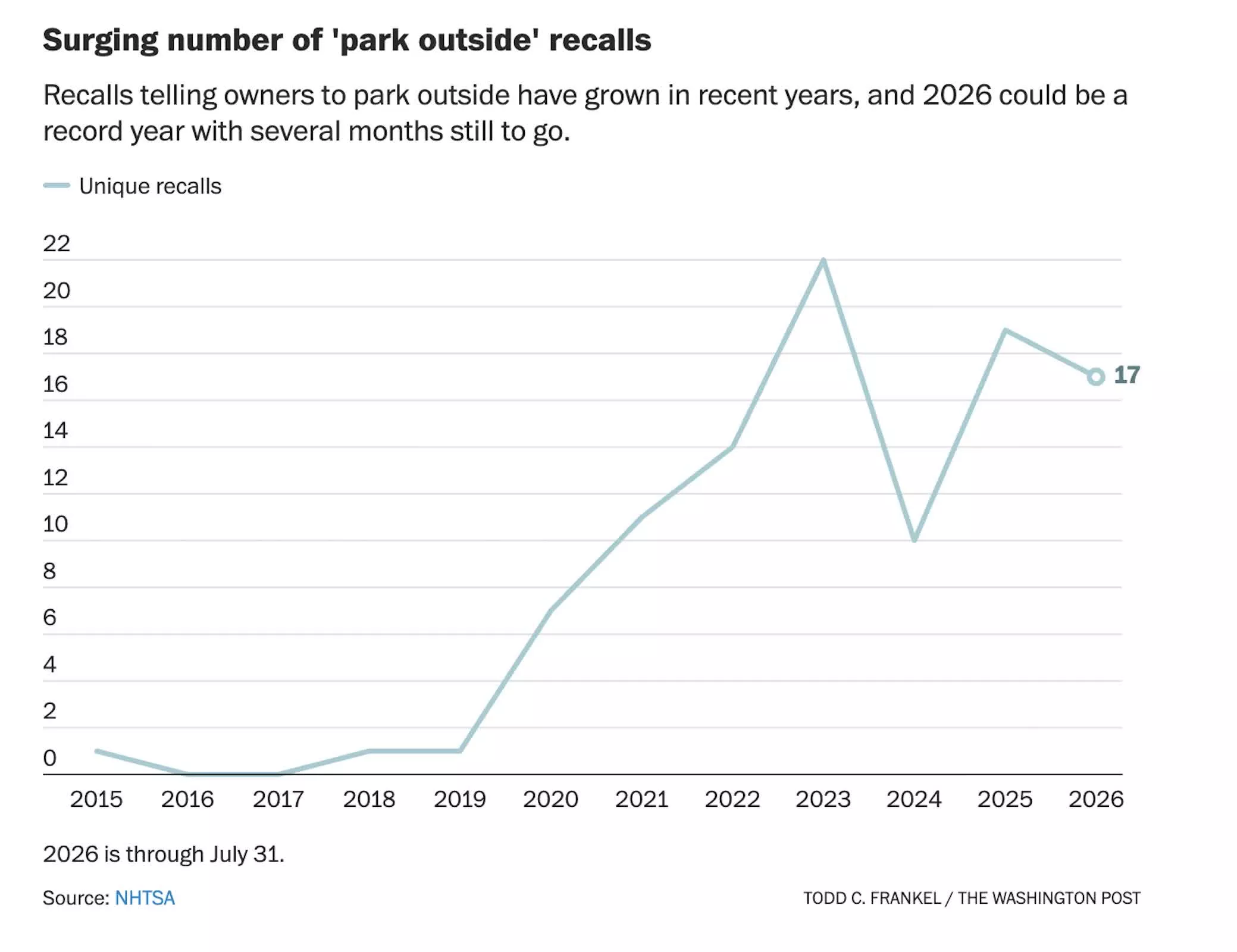
Credit: Washington Post
"There is a lot more electronics in vehicles today," he added, "and that means more stuff can go wrong."
NHTSA created the park-outside designation in 2015 to draw attention to recalls involving fire risks in or near buildings. In 2022, it added a park-outside warning box to its online recall listings to make the notices easier for consumers to spot.
Carfax estimates that about 3.2 million vehicles nationwide currently have an unresolved park-outside recall. The notices can leave owners in a difficult position because repairs and replacement parts may not be immediately available.
"For consumers, there seems to be no easy choices," said Sean Kane, president of Safety Research and Strategies, an auto-safety analysis firm. "Where are you going to park it?"
That issue is especially difficult for people who live in apartments, condos or other buildings with enclosed parking. "What if you live in a condo with a parking garage? What are you going to do?" Kane said.
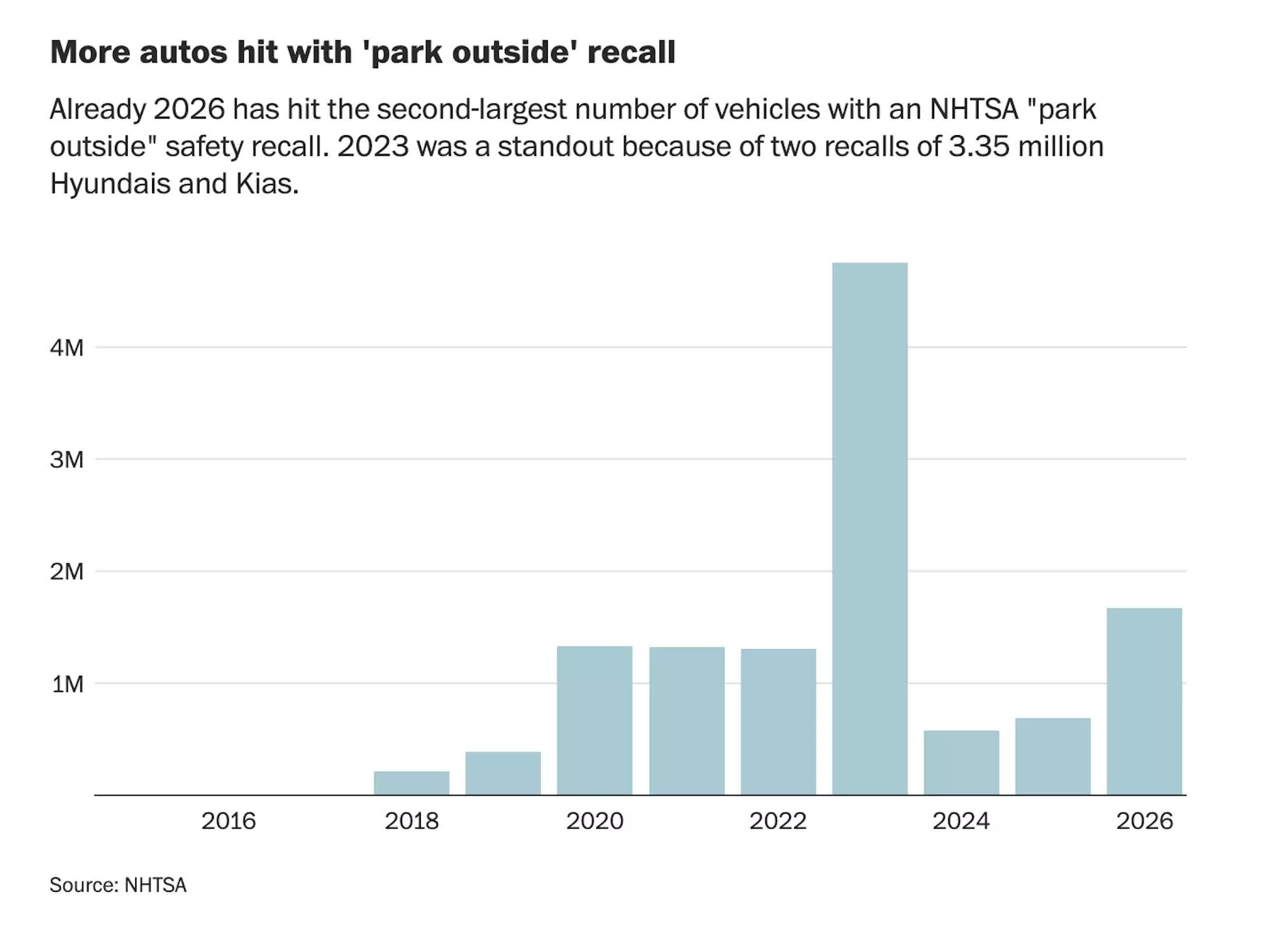
Credit: Washington Post
The Jeep plug-in hybrid recall shows how serious the risk can be. More than 320,000 Jeep Wrangler and Grand Cherokee plug-in hybrid vehicles were recalled because of a high-voltage battery fire risk. Owners were told to park outside, away from structures, and not charge their vehicles until the fix was completed.
Sarah Lammersen received the recall notice for her 2022 Jeep Wrangler plug-in hybrid late last year. She texted her dealership, "I hope the car doesn't catch on fire while we wait to schedule an appointment." According to a lawsuit, the Jeep caught fire days later while her daughter was driving it. No one was hurt, but the vehicle was destroyed.
In another case, a man in Fargo, North Dakota, found his parked Hyundai Santa Fe on fire in his garage in December. He later learned that the vehicle had been subject to a park-outside recall. NHTSA has said it is aware of several injuries in recent years that appeared to be tied to similar vehicle fires.
"It can be a giant disaster when cars catch fire and no one is there to see it," said Michael Brooks, executive director of the Center for Auto Safety.
Some owners face another problem: security. Millions of Hyundai vehicles have received park-outside recalls in recent years, including some models that lacked anti-theft technology and were widely targeted by thieves.
Kane said owners have described the choice as difficult. "I don't want my house to burn down," he recalled them telling him. "But I don't want my car to get stolen. What am I supposed to do?"
Millions of cars are under recall for catching fire while parked


