
In brief: Undersea cables carry 95% of the world's internet traffic, which makes the recent increase in acts of sabotage against them so worrying. NATO and the EU have been exploring methods to detect vessels or divers near these cables, and several companies are turning to acoustic sensing as a potential solution.

Suspected attacks against undersea cables have increased since Russia's invasion of Ukraine in 2022, including several incidents in the Baltic Sea. The UN takes these acts of sabotage very seriously and formed an international organization to protect the cables in December.
AP Sensing, a German developer and manufacturer, created the distributed fibre-optic sensing (DFOS) technology, which could alert officials to impending attacks on undersea cables.
As reported by the BBC, when pulses of light travel along a fibre optic strand, tiny reflections sometimes bounce back along that line. The reflections are affected by acoustic vibrations, as well as factors including temperature and physical disturbance to the cable itself. A change in temperature along part of a buried cable could reveal that it had become unburied, for example.
"The acoustic energy which travels through the fibre is basically disturbing our signal. We can measure this disturbance," said Daniel Gerwig, global sales manager at AP Sensing.
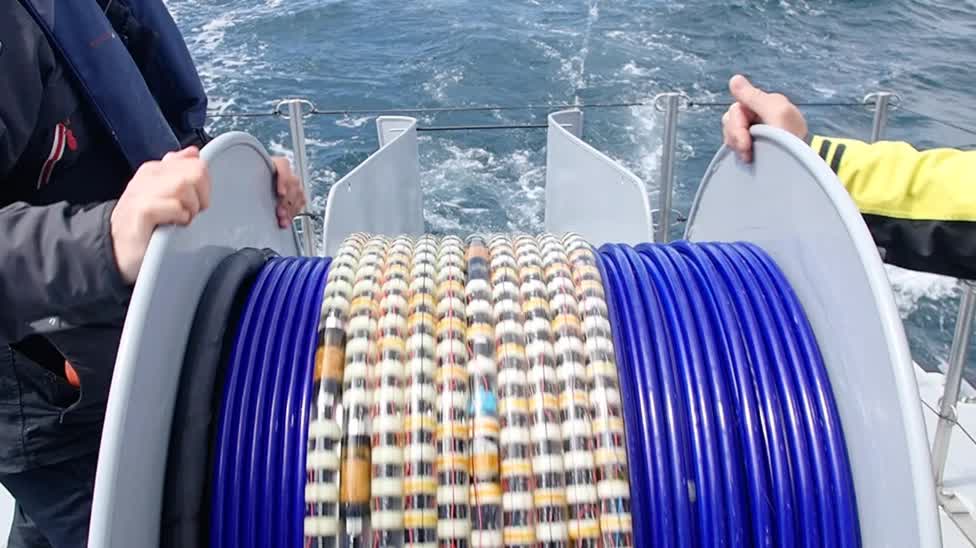
By using this technology, it's possible to determine the approximate size of a vessel passing above a subsea cable, as well as its location and, in some cases, the direction it is traveling. It could also detect if a diver touches the cables, an anchor dropping nearby, and the location of damage when it occurs.
The firm said that the monitoring capabilities could be added to existing fiber optic cables if an unused fiber is available or if a lit fiber has sufficient free channels.
There are limits to the system. It can detect vibrations only within a range of a few hundred meters, rather than several kilometers, and listening stations (interrogators) need to be installed approximately every 100 kilometers (62 miles).
AP Sensing said the technology is currently deployed in the North Sea and it will soon begin testing a monitoring cable installed somewhere on the floor of the Baltic Sea.
In August, NATO warned that Russia could target undersea cables and GPS to disrupt vital communication and navigation systems. The organization later formed HEIST (Hybrid Space-Submarine Architecture Ensuring Infosec of Telecommunications), which aims to develop strategies to protect global internet traffic and create alternative pathways in case the global undersea cable network – spanning approximately 1.2 million kilometers – becomes compromised. The cables facilitate an estimated $10 trillion in daily financial transactions and carry encrypted defense communications.
New acoustic sensing technology could detect and help prevent undersea cable sabotage


