Survey finds Americans worry about AI data centers, but still want the jobs

Daniel Sims

Posts: 2,469   +74
Staff
In brief: As tech giants race to build data centers to power AI models, they have faced pushback over concerns about environmental impact and rising energy costs. A recent survey indicates that, while many Americans hold negative views of data centers, they also acknowledge their potential benefits.

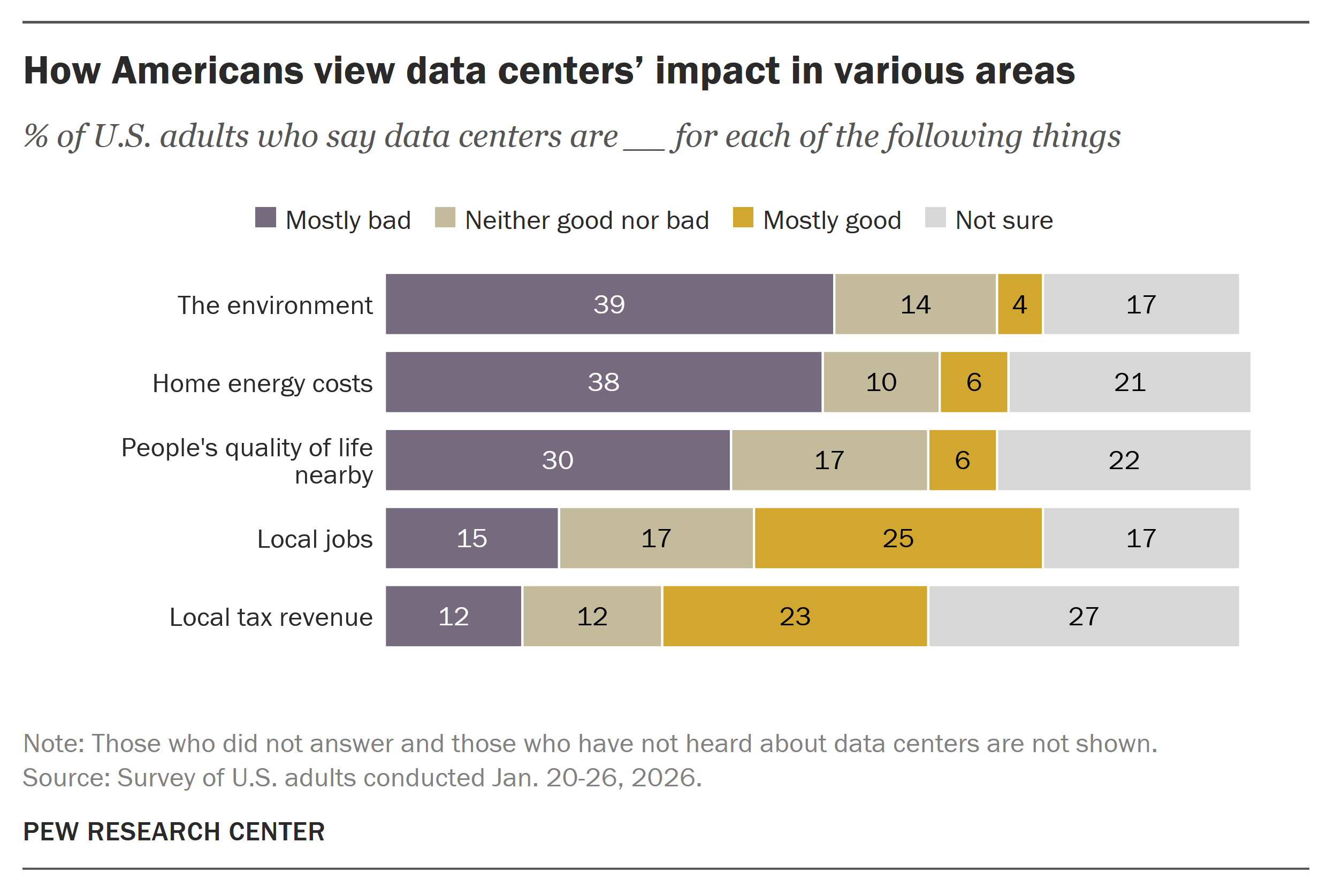
Out of 8,512 US adults surveyed in late January, more respondents expressed negative views about data centers' effects on the environment and energy costs than positive ones. However, the largest number of respondents expect data centers to have a positive impact on jobs and tax revenue, and many remain unsure about their effects on the environment, energy, jobs, or taxes.

Nearly 40% of those surveyed believe that data centers are mostly bad for the environment and home energy costs. For each topic, the remaining 60% consists of respondents who replied "neither good nor bad" or "not sure." Only single-digit percentages believe that data centers are mostly good for the environment and energy costs.
Rural communities have widely protested the rapid expansion of energy-intensive AI data centers, blaming them for rising power bills and increased strain on energy grids that were not designed to handle the extra load. Tech giants such as Google, Microsoft, Meta, Amazon, Oracle, OpenAI, and xAI recently signed a voluntary agreement with the Trump administration to cover the rising energy costs rather than pass them on to local residents.

While the companies pledged to invest in new power plants, support grid upgrades, and negotiate with local utilities, the agreement is not legally binding. It remains unclear to what extent – if at all – the AI companies will follow through.
Meanwhile, environmental concerns largely stem from potential impacts on water supplies. AI data centers require significant amounts of water for cooling, and opponents worry that they could strain or contaminate local water resources, affecting residents and farmers.

Tech giants have largely dismissed these concerns. OpenAI CEO Sam Altman called water-related worries "fake," while comparing AI energy requirements to the energy needed to train humans.

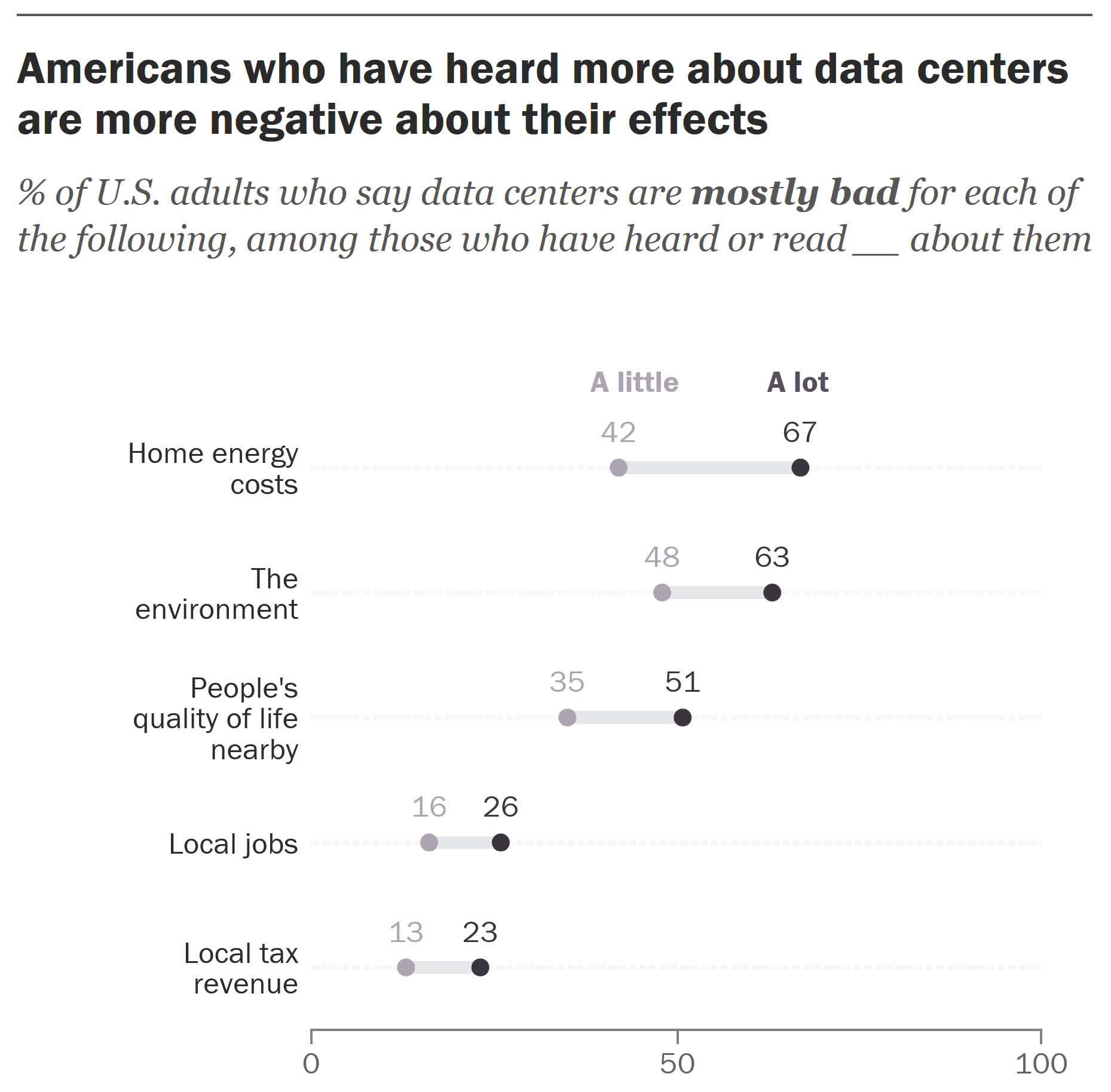
About one quarter of survey respondents say data centers will positively affect local jobs and tax revenue. A slightly larger percentage are unsure about tax revenue, and roughly one third either have no opinion or are unsure about the impact on jobs. Respondents who read or heard a lot about data centers expressed more negative opinions overall, but still anticipated positive impacts on jobs and tax revenue.

Permalink to story:

 
Once they're built they only need to be staffed by like 20 or 30 people. What jobs do people think they're creating? It takes a few months to throw up a data center if everything is coordinated right. They're definitely not talking about the construction jobs because we are short staffed and over worked as it is. April is the start of our 80-100 hour weeks until loaded off for a few months right before Christmas. We start ramping up to March and it's balls to the wall for 9 months. I actually don't mind that, I get 3 paid months off a year to do whatever I want and I mostly use that time to argue with the people reading this post right now <3
 
Once they're built they only need to be staffed by like 20 or 30 people.
Who told you this? Amazon's largest data centers employ more than 1,000 permanent, long-term employees. Google's tend to be smaller, but their Oklahoma site employs 800, while their NC site over 400. Apple's Maiden NC datacenter also employs some 400 people, while their AZ and NV centers employ in the 100-150 range.

Those are all high-paying direct employs, which can generate 2-3 times that in indirect employment, through contracting, maintenance, etc.
 
Who told you this? Amazon's largest data centers employ more than 1,000 permanent, long-term employees. Google's tend to be smaller, but their Oklahoma site employs 800, while their NC site over 400. Apple's Maiden NC datacenter also employs some 400 people, while their AZ and NV centers employ in the 100-150 range.

Those are all high-paying direct employs, which can generate 2-3 times that in indirect employment, through contracting, maintenance, etc.
I literally build data centers for a living. Security that drives the parimiter is half the staff. The endless rows of server racks are dark and there are a few offices where people monitor things like uptime, power usage temperatures. The only time anyone goes into the server rooms is when something breaks, they don't even have the lights on. They're designed to be controlled almost entirely remotely
 
""Nearly 40% of those surveyed believe that data centers are mostly bad for the environment and home energy costs.""

if utilities were not run by scumbag stockholders who refuse to upgrade infrastructure for dividend profits it would not be an issue. but thanks to team reds deregulation efforts this is where we are now.
 
if utilities were not run by scumbag stockholders who refuse to upgrade infrastructure for dividend profits it would not be an issue. but thanks to team reds deregulation efforts this is where we are now.
Unsurprisingly, you have your facts exactly backwards. Of the ten states with the cheapest electricity rates, all ten are Red states, whereas 9 of the 10 states with the most expensive electricity are Blue.

We're not talking small differences here, either: the five Blue states at the top of the list have triple the rates of the five Red states at the bottom:


I literally build data centers for a living.
Shrug; I gave you the actual employment statistics for many sites. And remember: local communities aren't as interested in these centers for the direct employees as much as they are much higher number of indirect employment they bring, as well as the massive property taxes they pay, generally millions (or even tens of millions) of dollars. per year.
 
""Nearly 40% of those surveyed believe that data centers are mostly bad for the environment and home energy costs.""

if utilities were not run by scumbag stockholders who refuse to upgrade infrastructure for dividend profits it would not be an issue. but thanks to team reds deregulation efforts this is where we are now.
A lot of what I see isn't so much just pure greed, but that is definitely part of it. It's that the grid needs upgraded and has for quite sometime. Suddenly adding 20-50% demand on already stretched thin infustructure is the straw the broke the camels back. I am seeing a missed opportunity here, though. I think many people would be a lot more welcoming if the people building the datacenters would pay to fix and improve the existing infustructure.

I've heard of "trickle down" economics all my life. Well, here is everyone's chance to prove that it works.
 
Shrug; I gave you the actual employment statistics for many sites. And remember: local communities aren't as interested in these centers for the direct employees as much as they are much higher number of indirect employment they bring, as well as the massive property taxes they pay, generally millions (or even tens of millions) of dollars. per year.
I hear this all the time and for the last 20 years it frequently gets proven to be false. We will build or modify a building because some county or municipality will negotiate some tax deal as an incentive to "build your new thing here!" The deal will last for usually 5 or 7 years and then the company will just up and leave after the length of the deal. These things are also heavily financed with debt which is not taxable. They use the debt over the length for time they plan on being there to pay less taxes. After that, it's cheaper to pack up their equipment and move to another place they negotiated a new deal with than pay their taxes. I can look at the schematics and tell that they don't plan on being there. Nothing gets bolted down, no electrical sockets built into the floor, everything is run or hanging from the ceiling. Then they try to sell or rent the building, claiming loss or depreciation so that they continue to not pay taxes. They make the building as much of a blank slate as possible to apeal to as many buyers or renters as possible.
 
These things are also heavily financed with debt which is not taxable. They use the debt over the length for time they plan on being there to pay less taxes ...
I seriously don't know where you get absurdities like this. Business property taxes are based on the value of the land, building, and (usually) equipment inside: values which aren't affected one penny by how the purchase was financed.

I've given the actual employment figures for many data centers. If you wish to continue the conversation, name one of these "major centers" you've built, and we can confirm exactly how many it employs, both directly and indirectly.
 
I seriously don't know where you get absurdities like this. Business property taxes are based on the value of the land, building, and (usually) equipment inside: values which aren't affected one penny by how the purchase was financed.

I've given the actual employment figures for many data centers. If you wish to continue the conversation, name one of these "major centers" you've built, and we can confirm exactly how many it employs, both directly and indirectly.
I feel your reading comprehension skills need some work. I said that they negotiate with munipalities, counties and states for incentives to build there and these incentives are in the form to tax deals, usually 5 to 7 years of them paying little or no taxes.

While I am under NDA, I find it curious you could somehow have access to the datacenter employment numbers of multiple different companies. But an investor such as yourself with access to such levels of information would certainly be under NDA, as well. Tell me, why have you chosen to bless me with this information? Why risk money, employment and criminal charges for a stranger on the Internet?
 
This is poison. It's too much. Humans are doing too much and have been for a long time now. How many suits? How much hair product? How fat of a salary until we finally feel like we matter for a little while? This whole situation is top-heavy with nothing to show for most of it.

When tech companies fleece communities by bedding down with local officials to manipulate the social contract, they'd better be building cancer research. Otherwise, they're completely useless long term. No amount of fabricated silver-lining arguments can crack the hard pavement of reality.
 
I feel your reading comprehension skills need some work. I said that they negotiate with munipalities, counties and states for incentives to build there and these incentives are in the form to tax deals, usually 5 to 7 years of them paying little or no taxes.

While I am under NDA, I find it curious you could somehow have access to the datacenter employment numbers of multiple different companies. But an investor such as yourself with access to such levels of information would certainly be under NDA, as well. Tell me, why have you chosen to bless me with this information? Why risk money, employment and criminal charges for a stranger on the Internet?
I wouldn't pay too much attention to his AI-gotten drivel. The origins of his "stage name" in mythology might give a clue........." a handsome Aeolian shepherd"...........LOL
 
I wouldn't pay too much attention to his AI-gotten drivel. The origins of his "stage name" in mythology might give a clue........." a handsome Aeolian shepherd"...........LOL
The crypto bros have become AI Tech Bros. They all think they're geniuses while the market is trending upward. While the trend is your friend, following a market trend doesn't make you a genius, especially if you don't have an exit strategy.
 
Once they're built they only need to be staffed by like 20 or 30 people. What jobs do people think they're creating? It takes a few months to throw up a data center if everything is coordinated right. They're definitely not talking about the construction jobs because we are short staffed and over worked as it is. April is the start of our 80-100 hour weeks until loaded off for a few months right before Christmas. We start ramping up to March and it's balls to the wall for 9 months. I actually don't mind that, I get 3 paid months off a year to do whatever I want and I mostly use that time to argue with the people reading this post right now <3
I believe, some jobs could be created in supply chain.
 
Who told you this? Amazon's largest data centers employ more than 1,000 permanent, long-term employees. Google's tend to be smaller, but their Oklahoma site employs 800, while their NC site over 400. Apple's Maiden NC datacenter also employs some 400 people, while their AZ and NV centers employ in the 100-150 range.

Those are all high-paying direct employs, which can generate 2-3 times that in indirect employment, through contracting, maintenance, etc.
And what are all these people doing? Sounds more like the propaganda they use to get it approved.
Aside from some cleaners, maintenance and security staff there's very little to do. The people doing things on the servers are likely in another state or even country not benefiting the local economy much. The money made by the servers themselves goes to the biggest tax dodgers there are (the tech giants). The servers themselves are build to minimize maintenance. Betcha trickledown economics calculations included a whole catering staff because the security staff might get a sandwich made for them.
Almost all the hardware is produced elsewhere. It's mostly a one time boon during construction and then for all the pressure it puts on local infrastructure very few actual long term jobs providing benefits within the state.
 
Last edited:
I believe, some jobs could be created in supply chain.
What supply chain? It's a warehouse that sells compute power to the cloud. It isn't like there are trucks coming and going that provide business to local gas stations and convenience stores or that they have a warehouse where people are packing and shipping goods. If you ever want to see how sparsely populated data centers really are and how little jobs they provide, just look at the size of the parking lots and how those parking lots are mostly empty on top of being TINY. What really seals it for me is when we were constructing the break rooms in these buildings. They're the size of a 2 car garage and not meant to really fit more than 20 people. Then just look at the roads going in and out of them. Something that has hundreds of people coming and going everyday isn't going to have a small 2 lane road going to it.

These data centers provide around 100 construction jobs for around 2 months and each trade isn't their for the duration. The concrete takes about 2 weeks, there is rarely any carpentry work to be done. Most of it is the electrical and networking cables for wiring these things. And while that's all nice and good, the idea that I have a 2 hour commute each way to get to the jobs site doesn't make it a particularly good job. Now, I'm used to being stationed on site for extended periods of time. For jobs like this where you have to get tons of people on site to throw something up, many people have RV's or campers that they just park on the job site because it's cheaper and easier than driving back and fourth everyday.
 
And what are all these people doing? Sounds [like] propaganda...
It's truly astonishing how some people manage to deny simple reality. People who have one computer on a desk somewhere, used 8 hours a day, see very little need for maintenance.
But when you have a billion dollars worth of computing gear running 24x7 and receiving continual upgrades and repairs, there are literally hundreds of work tickets daily.

Google's Pryor datacenter employees 800, including not just technicians and network engineers, power engineers and electrical workers, IT staff, operations managers, security, and others. It has a full-service round-the-clock cafeteria that employees three separate shifts of 6-8 people each ...who do you think they're serving? Oh, and that facility is undergoing a $9 billion expansion, one that will employee 4,400 construction workers for nearly two years, as well as boosting their permanent headcount substantially.

As for "tax dodging", prior to that datacenter being built, the Pryor Public School system had $80M in collected assets -- today, it's over $1 billion ... thanks to the increased property taxes.

 
It's truly astonishing how some people manage to deny simple reality. People who have one computer on a desk somewhere, used 8 hours a day, see very little need for maintenance.
But when you have a billion dollars worth of computing gear running 24x7 and receiving continual upgrades and repairs, there are literally hundreds of work tickets daily.

Google's Pryor datacenter employees 800, including not just technicians and network engineers, power engineers and electrical workers, IT staff, operations managers, security, and others. It has a full-service round-the-clock cafeteria that employees three separate shifts of 6-8 people each ...who do you think they're serving? Oh, and that facility is undergoing a $9 billion expansion, one that will employee 4,400 construction workers for nearly two years, as well as boosting their permanent headcount substantially.

As for "tax dodging", prior to that datacenter being built, the Pryor Public School system had $80M in collected assets -- today, it's over $1 billion ... thanks to the increased property taxes.

These AI data centers are highly homogenous in nature requiring extremely little maintenance. This isn't the data centers of old (Google's Pryor data center was operational all the way back in 2011).
Data centers to start with generate very little in long term jobs, AI data centers are even worse than that. But let's have it from the horses mouth directly, Gemini 'deep thinking' response:

The fairly unbiased query:
"How many long term jobs does a typical AI Data center generate compared to other sectors with a similar amount of investment. "
The response summary:
Gemini 'deep thinking' said:
AI data centers are the most "job-light" major infrastructure projects in modern history relative to their cost. While they represent massive capital investments, they generate significantly fewer long-term, direct jobs than manufacturing, retail, or hospitality.

The Job-to-Investment Ratio
In terms of pure efficiency, data centers are designed to be "dark" (automated), meaning they require very few human operators once the construction is finished.

Code:
Sector Jobs               Generated per $1 Billion Investment
AI Data Center            15 – 50 direct permanent jobs
Traditional Data Center   30 – 100 direct permanent jobs
Advanced Manufacturing    500 – 1,200 direct permanent jobs
Corporate Headquarters    1,500 – 4,000 direct permanent jobs
Hospitality / Retail      5,000 – 10,000+ direct permanent jobs
and of course the driving force behind them is to replace other jobs with them in the first place. There's points to be made for AI data centers, job generation is however possibly the very worst.
 
The fairly unbiased [Gemini AI] query:
"How many long term jobs does a typical AI Data center generate compared to other sectors with a similar amount of investment. "
There's something unutterably ironic about using an AI response to reject the utility of AI datacenters.

While you extract your foot from your mouth, I'll note your query is framed improperly. Local communities don't get to choose between a $9B Google datacenter vs. "a similar amount of investment" in a labor intensive factory. They're choosing between a $9B datacenter or nothing at all. Data centers add jobs. They also -- as my article link above demonstrates -- very high levels of property tax, which is the primary reason local community leaders vie so heavily for them.
 
Back