AMD's upcoming FSR 4.1 update promises clearer detail and less motion blur. We tested the new upscaler against FSR 4 and Nvidia's DLSS 4.5 to see how much image quality has improved.
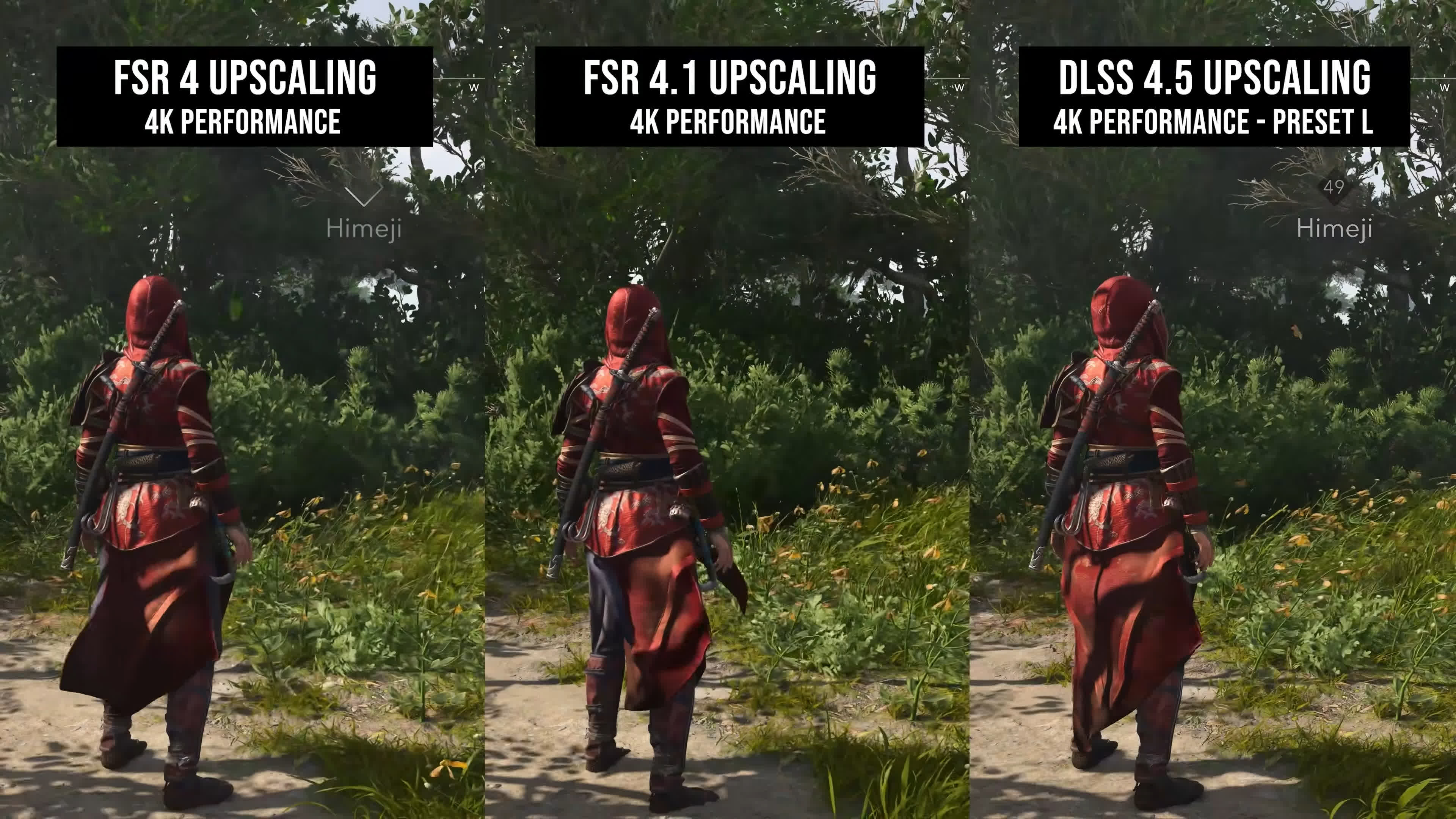
AMD's upcoming FSR 4.1 update promises clearer detail and less motion blur. We tested the new upscaler against FSR 4 and Nvidia's DLSS 4.5 to see how much image quality has improved.


Yeah, they should really do a survey where people have to pick between Native, DLSS and FSR and see what the results are. We're at the point where if someone didn't tell me I wouldn't be able to tell the difference. I know lots of people are big supporters of FSR or DLSS because they have to justify their purchase of over-priced hardware, but upscaling tech doesn't exist because it's good for the consumer. Manufacturers, Both AMD and Nvidia, are trying to sell us LESS for MORE. Upscaling helps soften the pushback from consumers against these companies from ripping us off. And while, for what I play, 8GB of VRAM would be fine, for many people it is not. If we had 60 class cards with 8GB of VRAM for under $300, it'd be fine. There are no bad products, only bad prices. The problem is people are paying a "premium" price for what is basically a lowend product. Instead of AMD and Nvidia competing with each other, and they very much can on price, they decided to just keep the profit margins and give us software solutions to a hardware problem.I have to remember to stop playing a game that supports both so I can look around, maybe put a magnification device to the screen to see the difference.
Should be fun.


Sadly most gamers are already doing that: arguing about whose upscaling "solution" is better.Yeah, they should really do a survey where people have to pick between Native, DLSS and FSR and see what the results are. We're at the point where if someone didn't tell me I wouldn't be able to tell the difference. I know lots of people are big supporters of FSR or DLSS because they have to justify their purchase of over-priced hardware, but upscaling tech doesn't exist because it's good for the consumer. Manufacturers, Both AMD and Nvidia, are trying to sell us LESS for MORE. Upscaling helps soften the pushback from consumers against these companies from ripping us off. And while, for what I play, 8GB of VRAM would be fine, for many people it is not. If we had 60 class cards with 8GB of VRAM for under $300, it'd be fine. There are no bad products, only bad prices. The problem is people are paying a "premium" price for what is basically a lowend product. Instead of AMD and Nvidia competing with each other, and they very much can on price, they decided to just keep the profit margins and give us software solutions to a hardware problem.

Woohoo, so FSR is finally very close or similar to DLSS. Great news for the 5% users... err... 5% in total... probably like 1-2% only can use it. Its only for the new cards right? Lemme fix it then
Great news for the 1-2% of gamers! Woohoo! Let's see how many % AMD gets in 2027... the trend just seems to go lower and lower. I personally don't see anything wrong with AMD cards, especially with the new FSR 4. Prices are also much better in comparison to Ngreedia. Still don't sell tho. Even I got an Nvidia card, but thats cus im a hardcore Shadowplay fanboy. I just use it too much. If I didnt make videos, AMD all the way. Why is that not the case for the majority of gamers? Who knows, and soon who cares. AMD won't be around for much longer, at least the GPU department. If they do stick around, it will be like an Intel thing. Less than 1%, which also means 0 in my book.
Sad? Yea. I guess they might continue even with 0% PC user base... cus of consoles... but if they didn't have that going for them = GG.

German web Computerbase did that few week ago.I think FSR 4.1 looks the worst. 4.0 is a little "soft", but I wouldn't notice that in regular gameplay. If you put FSR 4.0 and DLSS4.5 next to each other and didn't tell me which one I was using I wouldn't be able to tell the difference. Actually, that might make an interesting survey.
Welcome to world of rapid development.And, frankly, I think we should give more resistance to upscaling as a solution to bad development. Upscaling makes people just comfortable enough to not complain about vibe-coding developers and instead argue about what's better in comments section. I think the fighting about which tech is better takes the focus away from the real problem in the industry, games with massive budgets that are still buggy, unoptimized messes.
Intention was good (to help lower performance cards to cope) but ...Upscaling should a "nice to have" feature, not a solution to a problem. Even more so with Framegen.
Simple solution: Do not pay for anything before official release and reading some reviews.on a slightly different note, I've noticed where first 2-3 levels of a game have the best graphics and interesting storyline, but the next 75% of the game feels empty with a hollow story.
There is nothing better than personal experience.I have a 5070 and 9060 XT and compared DLSS 4.0 and FSR 4.0 (not 4.5 vs. 4.1) in a few games using the following methodology: Playing them.
...
They're both good and I use both.
I have bad news for you:Looks great, shame AMD decided I can't run it.
4k 4.1 performance preset looks better than dlss 4.5, someone needs some eye check.
Maybe you are right. Especially if review goes into details. With that in mind, even bad review can tell that something is interesting, because people...German web Computerbase did that few week ago.
Not only static images as most game reviews do, but videos too and put them on their web site (without Youtube re-compresion artifacts).
Upscaler from DLLSS pack won because it has less artifact noticeable in movement.
It would be shame to not win after 8 years of development.
Welcome to world of rapid development.
Intention was good (to help lower performance cards to cope) but ...
The road to Hell is paved with Good Intentions.
Simple solution: Do not pay for anything before official release and reading some reviews.

Better gear up with some microscope, you have to be absolutely sure about results.I have to remember to stop playing a game that supports both so I can look around, maybe put a magnification device to the screen to see the difference.
Should be fun.
Absolutely not, around 10% including iGPUs according to Steam.AMD still holds roughly a quarter of the GPU market. Research shows volume shipments for AIBs per quarter, not an overall market share.

Absolutely not, around 10% including iGPUs according to Steam.
If you isolate RDNA, things look pretty bad compared to Nvidia RTX.
NVIDIA Grabs 94% AIB GPU Market Share, AMD Falls to 5%
According to a new report from Jon Peddie Research, NVIDIA has once again increased its market share in the AIB GPU sector, reaching 94% in Q4 2025. This marks a 1.6% rise from the previous quarter and sets a new all-time high in recent reports. Meanwhile, AMD's market share has been declining,...www.techpowerup.com
The problem is that AMD don't care much for dedicated gaming GPUs as it eats away at their TSMC output which is better used for CPUs and APUs.
As long as TSMC is massively overbooked and overpriced, AMD won't spend much time on cheap gaming GPUs with little profit. They earn alot more on CPUs, enterprise AI GPUs and custom APUs (consoles mostly)
With the RAM prices exploding, they will probably spend even less time on gaming GPUs, as most people only consider buying an AMD GPU if its dirt cheap.
After all, Radeon 9000 was low to mid-end stuff. AMD officially left high-end after Radeon 7900 series.
Thats true. Steam never was too reliable but more AMD CPUs with iGPU will add to their GPU segment. Check Steams top 50 GPUs, several AMD GPUs listed which looks to be an iGPU.I just had a look on Steam, as of today AMD is showing 18.55% on steam for March 2026, including iGPU's.
Nvidia had an anomalous blip at the expense of AMD and Intel the previous month, since corrected it seems.
Viewing the period Oct '25 - March '26, AMD at around 18% is correct, and is in-line with historical trends. It's actually showing a gradual increase for AMD from 16.% in 2024, and 17.5% in 2025.