
The big picture: Researchers from the Universities of Birmingham and Warwick in the United Kingdom estimate that roughly 80 websites selling cheats for online video games generate between $12 million and $73 million annually. Although some cheats can bypass robust (and often unpopular) anti-cheating software, these tend to be more expensive.
Battlefield 6 open beta players on PC have encountered cheaters despite the game's controversial requirement that users enable Windows Secure Boot. While the situation might make strict anti-cheat solutions seem ineffective, recent research suggests they still help by increasing the cost of cheating.
The researchers analyzed public forums for Engine Owning, Sky Cheats, and numerous other cheat storefronts. They found that between 30,000 and 174,000 customers pay between $10 and $240 per month for software that gives them an unfair advantage in games such as Fortnite, Call of Duty, Rainbow Six Siege, Counter-Strike 2, Team Fortress 2, Escape From Tarkov, and other popular titles.
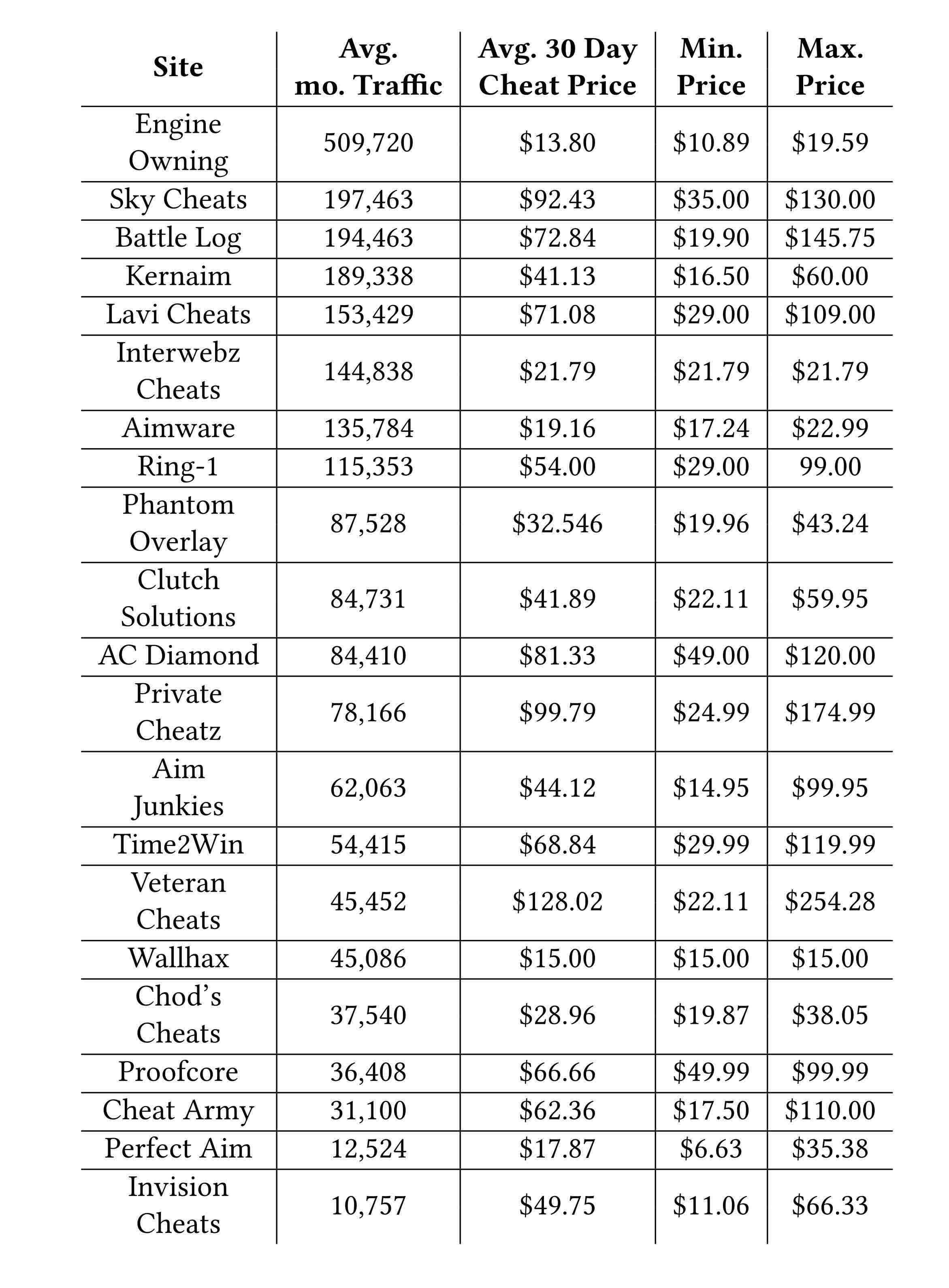
Engine Owning is the most popular, receiving around 500,000 visitors each month – likely because it offers some of the cheapest cheats, priced between $10 and $20. Notably, the difficulty of circumventing a game's anti-cheat protections has more influence on a cheat's price than the game's popularity.
This data may support the use of the strictest anti-cheat measures in upcoming titles such as Battlefield 6 and Call of Duty: Black Ops 7. Both games will require Windows Secure Boot, and Black Ops 7 will also require TPM 2.0. These methods check for anomalies upon system startup, effectively serving as kernel-level anti-cheat.
Some players oppose kernel-level anti-cheat because granting any program access to the deepest layer of a PC's operating system significantly increases the risk to users if the software is compromised or if developers make an error. The recent CrowdStrike disaster, which prompted Microsoft to reconsider allowing kernel-level security, is a notable example.
🚨CONFIRMED: Cheats are already working in Battlefield 6.
– ItsHapa (@ItsHapa) August 7, 2025
This footage proves CHEATS are FULLY FUNCTIONAL on Day 1 of Early Access Beta. pic.twitter.com/j9WSyWPEI1
Although even kernel-level anti-cheat cannot completely eliminate cheating, Battlefield publisher EA still considers it worthwhile. Players began sharing footage of cheating almost immediately after the open beta launched, but EA reported catching around 330,000 cheaters, detecting tens of thousands daily.
The company says it never intended the Secure Boot requirement to be a cure-all, and recent research suggests it may still help curb cheating by making it more costly.