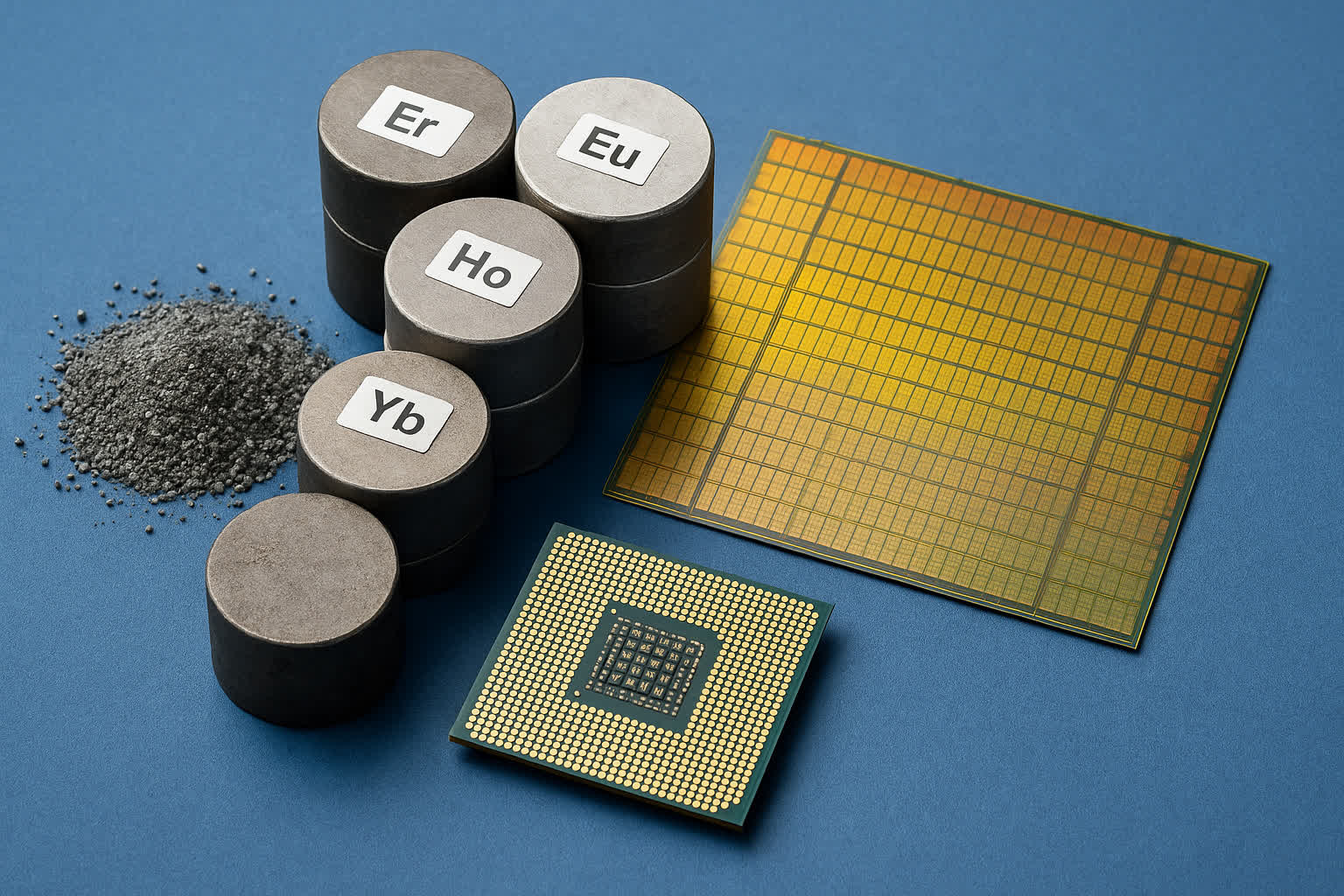
In context: Taiwan has assured the world that its chip industry will not be significantly impacted by China's new limits on rare earth exports. Its Ministry of Economic Affairs said the elements covered by China's expanded restrictions differ from those used in the semiconductor manufacturing process.
China rolled out a slew of export controls last week related to rare earth materials, the latest in a series of trade retaliations between the US and its Asian rival.
While China has previously restricted exports of rare earth elements such as dysprosium and neodymium, the new measures mark the first time semiconductor production has been directly targeted.
The announcement brought fears of another global chip shortage mirroring the Covid-era situation. But Taiwan's Ministry of Economic Affairs said (via Reuters) that the elements added to the restrictions – including erbium, europium, holmium, and ytterbium – are not used in TSMC's wafer production process. It added that most rare earth minerals used in Taiwan come from Europe, the US, and Japan, and that there was no need to worry about chip shortages at this time.
Under China's new rules, any item containing Chinese-origin rare earths can be covered by the restrictions if the amount exceeds 0.1%. Items produced using Chinese rare-earth technologies are also covered. Derivative products, technical documentation, and any end use classed as sensitive fall under the new restrictions, too. China says it will grant licenses in these cases, but it will undoubtedly slow down impacted industries, including PC components and electric vehicles.
ASML, the Dutch giant that produces the tools used by chipmakers such as TSMC, is expected to face delays due to the new restrictions. Analysts predict that products such as Apple's A18 Pro iPhone chip, Nvidia's H100 AI processor, and Samsung's ninth-generation V-NAND memory chips will also be affected.
Imitating the wording used by the US, China says the rules are in place to safeguard national security and prevent export recipients from enhancing their military potential.
President Donald Trump responded to China's move by announcing a 100% tariff on the country, along with new controls on critical software, effective November 1. Beijing has told the US it will retaliate if Trump does not back down. Trump seemed to soften his stance on Sunday, writing in a Truth Social post: "Don't worry about China, it will all be fine! Highly respected President Xi just had a bad moment. He doesn't want Depression for his country, and neither do I. The U.S.A. wants to help China, not hurt it!!!"