
Bottom line: Meta insists that it is making steady progress against fraudulent advertising. "We aggressively fight fraud and scams because people on our platforms don't want this content, legitimate advertisers don't want it and we don't want it either," spokesman Andy Stone told Reuters. Yet confidential documents show a company still calculating the costs of stronger enforcement, torn between defending trust in its platforms and preserving the ad dollars that fund its expansion.
Meta has quietly been struggling with the financial and reputational fallout from a vast online fraud economy operating through its social platforms. A cache of internal documents reviewed by Reuters reveals recurring weaknesses in Meta's systems for policing deceptive advertising and scams, even as the company invests heavily in automation and artificial intelligence to detect abuse.
In late 2024, Meta's finance and engineering teams estimated that roughly 10 percent of its yearly revenue – about $16 billion – came from ads promoting scams or banned products. One internal report from December pegged the daily volume of "higher risk" ads with signs of fraud at roughly 15 billion, generating $7 billion in annual direct revenue. These figures far exceed the company's publicly acknowledged scale of illicit content.

Meta's ad-enforcement algorithm uses probabilistic scoring to identify fraud risks. Advertisers judged to be less than 95 percent likely to be fraudulent are not blocked outright but instead face higher ad costs as a deterrent, in what the company internally calls "penalty bidding."
The company's own personalization engine compounds the problem. Users who engage with scam content are more likely to see it, reinforcing the exposure cycle. Internally, Meta sought to quantify and reduce abuse by expanding integrity teams across finance, policy, and engineering. Yet even as its AI filters improved, core enforcement issues persisted. In a May 2025 briefing, staff concluded that Meta's platforms were involved in about one-third of all successful online scams in the United States – a far greater share than Google's.

Regulators also sharpened their focus. The Securities and Exchange Commission opened investigations into Meta's ad sales practices related to financial fraud. At the same time, British regulators found that its products were linked to more than half of all payment-related scam losses in 2023. Meta's own projections acknowledged potential fines as high as $1 billion, but concluded that those penalties would be "much smaller than the revenue from scam ads" in any comparable period.
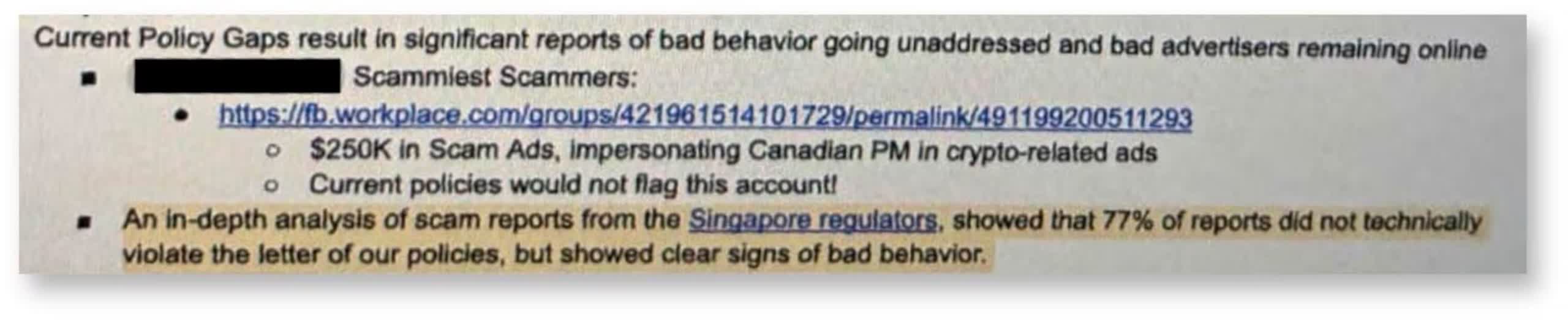
Even with stepped-up efforts to eliminate fraudulent content, technical and structural gaps remain. By the first half of 2025, Meta reported removing 134 million scam ads, yet documents show that repeat offenders often avoided bans. Safety staff even circulated internal "Scammiest Scammer" reports highlighting the worst offenders, though some high-paying advertisers continued running prohibited campaigns months after being flagged.
Layoffs tied to Meta's pivot toward virtual reality and AI initiatives thinned the ranks of the teams that police its platforms. Documents from 2023 indicated that Meta was either ignoring or misclassifying about 96 percent of users' valid scam reports. Later hiring rounds improved coverage, but enforcement capacity still lagged behind the surge in fraudulent activity.

Meta's 2024 introduction of the penalty-bidding system marked a key technical shift. The ad auction model now raises bid prices for advertisers flagged as suspicious yet not conclusively fraudulent, making scam campaigns less competitive. Meta spokesman Andy Stone said that the change produced "a decline in scam reports and a slight decline in overall ad revenue," suggesting only partial success in cleaning up the ad ecosystem.
Despite these hurdles, Meta executives have set targets to reduce scam-related ad revenue from 10.1 percent of 2024 totals to 7.3 percent by the end of 2025 and to under 6 percent by 2027. Strategy documents, however, make clear that reductions will primarily focus on markets facing imminent regulatory action rather than be across-the-board.
Meanwhile, internal communications depict an ongoing balancing act between integrity enforcement and financial performance. As Meta ramps up AI-related spending – expected to reach $72 billion this year – managers are instructed to operate within strict "revenue guardrails," limiting how much legitimate business the company can risk losing by aggressively eliminating suspect ads.
Image credit: Reuters