
The big picture: Netflix's 2025 performance reveals a company straddling two worlds: a streaming giant chasing global growth and a media-technology hybrid investing in infrastructure, machine learning, and studio capacity. Whether the all-cash plunge into Warner Bros. and AI-driven operations will reward shareholders remains to be seen. But taken together, these moves signal a platform refining not just what it streams – but how it builds the future of visual entertainment.
Netflix closed 2025 with numbers that reaffirm its dominance and signal that the company is evolving beyond streaming alone. Revenue rose 17.6 percent in the fourth quarter, reaching $12.05 billion, driven by price adjustments, ad sales, and a subscriber base that now exceeds 325 million paid users worldwide.
Yet the company's ambitions extend far beyond earnings. Its decision to pursue a full cash acquisition of Warner Bros. Discovery's studio and streaming assets, coupled with accelerated investments in artificial intelligence for global subtitle localization, positions the platform for its next era of growth.
Despite these milestones, Netflix's stock slipped more than four percent in after-hours trading, reflecting the uncertainty that often accompanies major transformations. The planned all-cash Warner Bros. transaction, valued at $83 billion, represents one of the largest media acquisitions in history and underscores Netflix's appetite for full control rather than dilution through stock issuance.
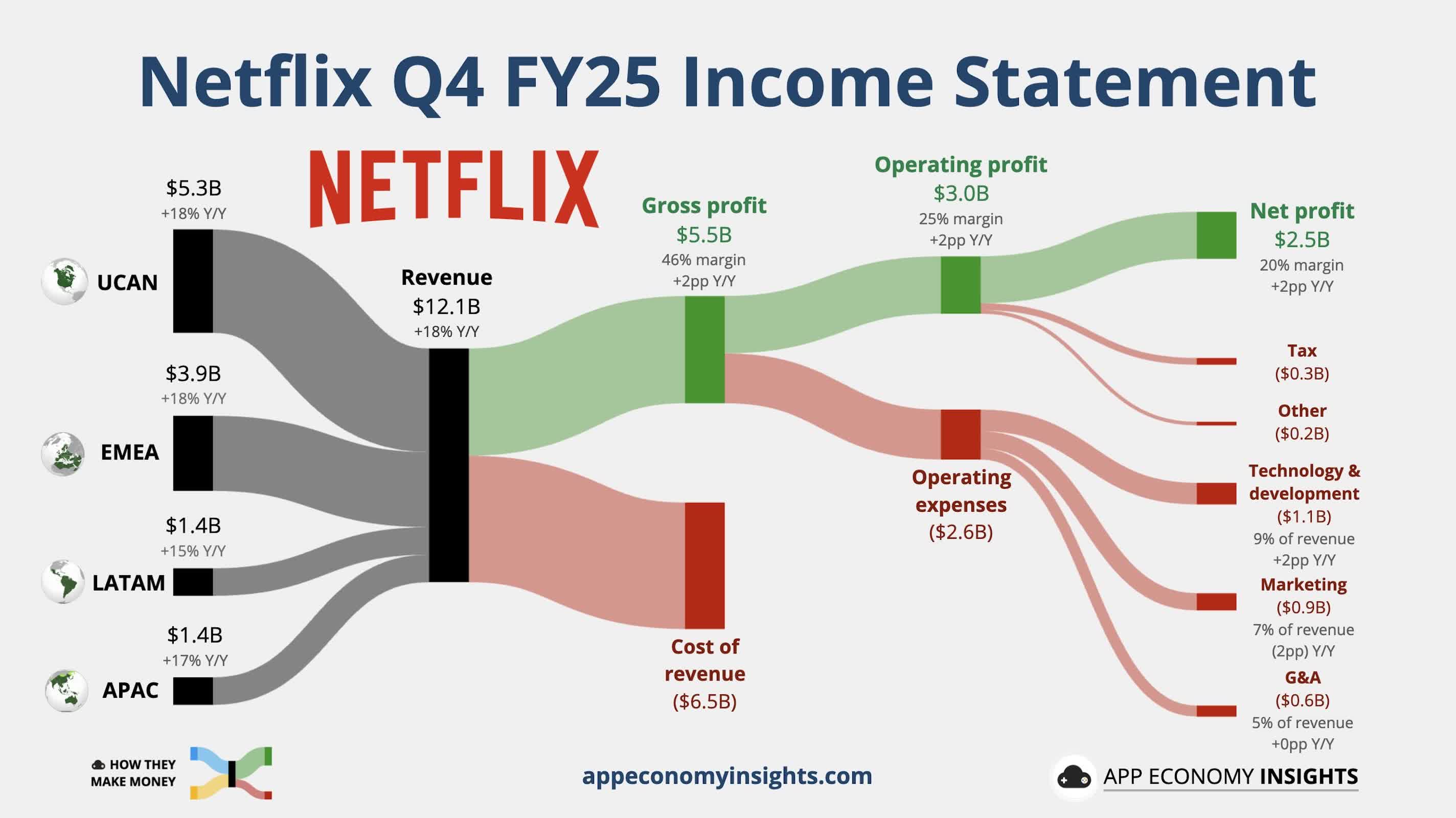
Image credit: App Economy Insights
Originally structured as a cash-and-stock deal, the Warner Bros. acquisition has been reworked into an all-cash purchase valued at $27.75 per share. By moving to cash, Netflix aims to accelerate shareholder approval and maintain deal stability amid market volatility. Warner Bros. shareholders will still gain additional value through Discovery Global, a spin-off of Warner's cable networks expected within nine months.
The deal promises to reshape Netflix's content engine, adding HBO Max and Warner Bros.' vast library to its platform. Co-CEOs Greg Peters and Ted Sarandos emphasized that the acquisition is intended to expand, rather than consolidate, production operations.
Sarandos confirmed a 45-day theatrical window for Warner films and stated that Warner's existing creative and operational teams will remain intact. Netflix views the acquisition as an opportunity to strengthen its US production base and invest in original content.
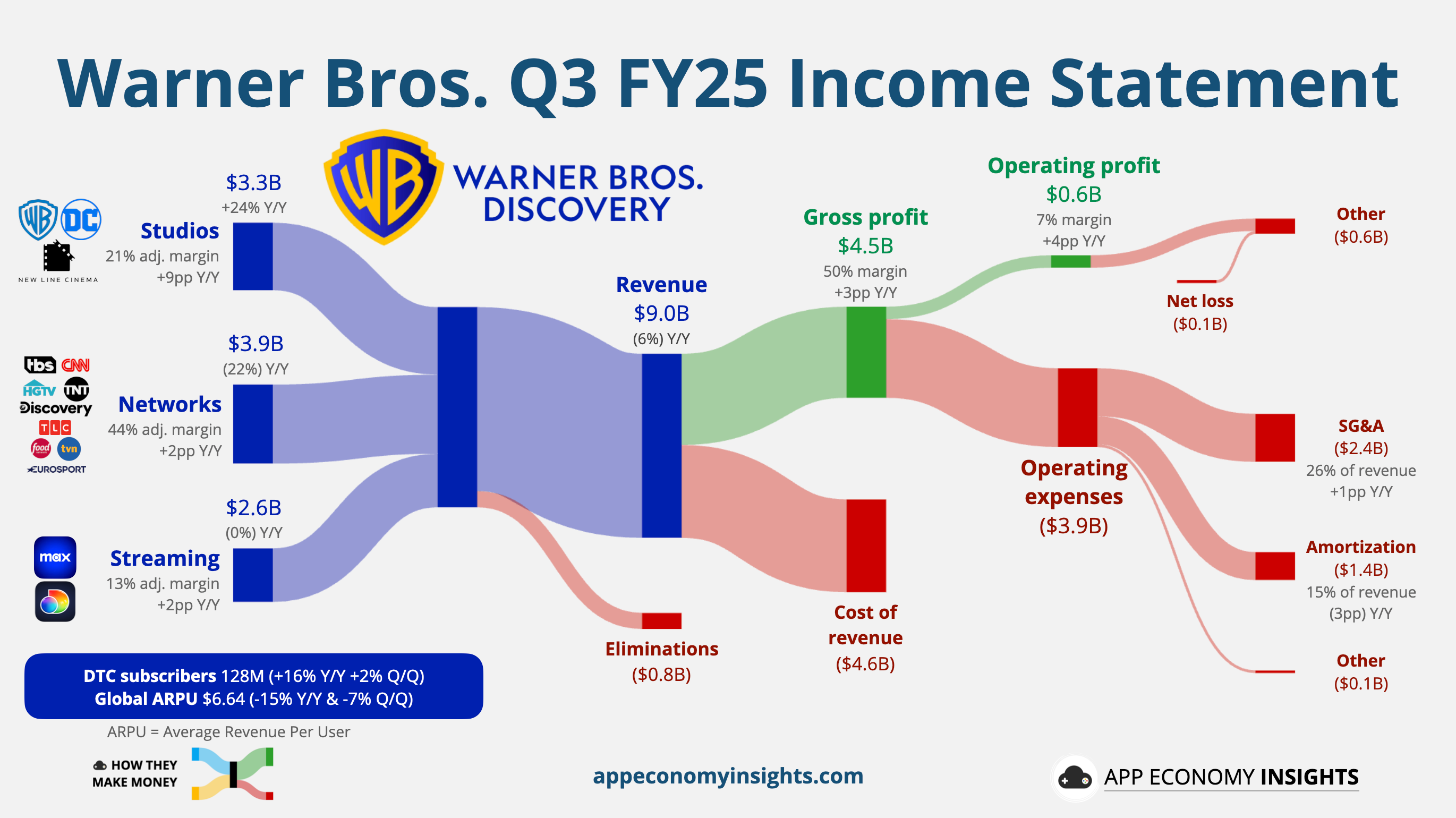
Image credit: App Economy Insights
Financing the acquisition requires a massive capital structure. Netflix has secured commitments for a $59 billion senior unsecured bridge facility, a new $5 billion revolving credit facility, and a $20 billion delayed-draw term loan. The company plans to phase out portions of the bridge facility through forthcoming bond offerings and accumulated cash on hand. Stock buybacks will remain on hold until the deal closes.
For the full year, Netflix reported $45.2 billion in revenue, up 16 percent from 2024, and $10.98 billion in net income. Quarterly operating income reached $2.96 billion, a 30 percent year-over-year increase. While the company expects more tempered growth in 2026 – with revenue projected between $50.7 billion and $51.7 billion – it reiterated its goal of maintaining steady margin improvements while reinvesting in core business units.
Netflix's statement to shareholders reflected cautious confidence. The company sees "plenty of room" for sustainable expansion, while acknowledging that the pace of margin growth will fluctuate as it balances innovation with profitability.
Image credit: App Economy Insights
Alongside its financial and strategic initiatives, Netflix plans to make artificial intelligence a central pillar of its content operations in 2026. The company is scaling its internal AI systems, first tested in 2025, to handle subtitle localization – enabling shows and films to reach a wider range of linguistic markets without sacrificing nuance or timing accuracy.
Beyond localization, Netflix is deploying AI to develop dynamic advertising and merchandising tools, generating tailored ad concepts that leverage intellectual property from its content library.
In its Q4 report, Netflix framed the technology push as part of a broader mission to "enhance the experience for members and support creative teams." The initiative mirrors wider industry trends toward developing in-house AI capabilities, particularly for video processing, dubbing, and adaptive engagement prediction.