Back to Digital Monke: Big Tech players are increasingly forcing AI into their products in every way they can. A significant portion of those affected users are understandably tired of the disrespect, and smaller internet services are beginning to carve out alternative routes to digital knowledge – ones that avoid as much AI slop and enshittification as possible.
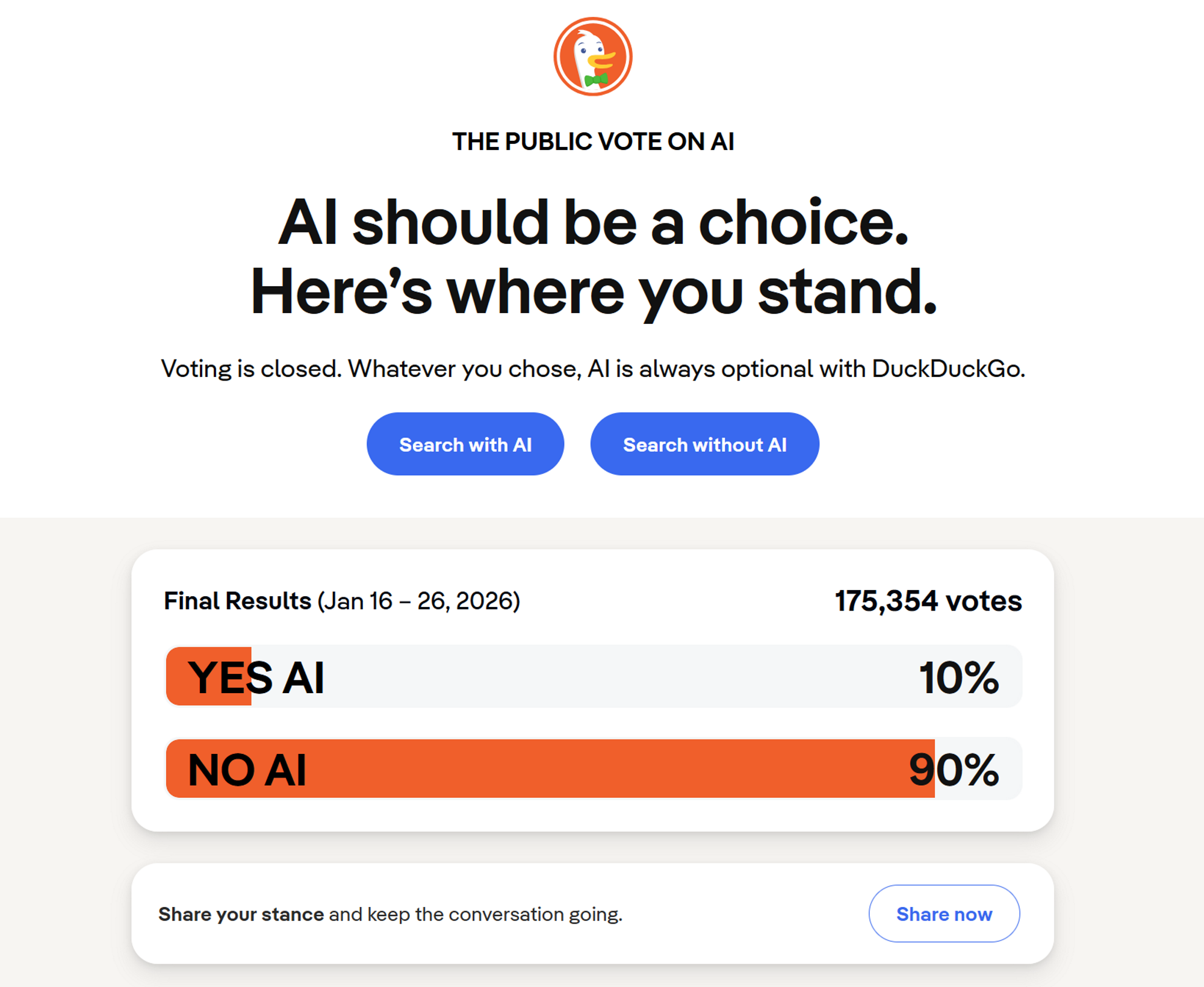
DuckDuckGo recently asked its community whether they actually wanted AI baked into their web browsing experience. The response was loud and clear: an overwhelming majority said no. Now, the company says it's going to honor that choice by offering two different versions of its search experience. Even so, power users can still tweak settings to land somewhere between "no AI" and "yes AI," depending on how much automation they're willing to tolerate.
On its Public Vote on AI page, DuckDuckGo stressed that heavy reliance on large language models and other AI technologies should always be a choice. Founder Gabriel Weinberg noted that most companies – and Big Tech in particular – are simply ignoring people who want the ability to opt out entirely.
Like other user-focused ventures trying to navigate the AI era, DuckDuckGo has been working on features that are mostly optional and easy to disable. The company launched VoteYesOrNoAI.com so its user base could cast an anonymous vote on AI adoption. In the end, 90 percent of more than 175,000 participants said they don't want to deal with any AI features at all.

DuckDuckGo, an alternative search engine handling hundreds of millions of queries each day, has long attracted users who genuinely care about online privacy. It's also likely that many of the people voting already held negative views of LLMs, chatbots, and other AI-driven tools. A DuckDuckGo representative later confirmed that the poll was run openly on the web with no tracking bots, meaning there was no practical way to separate actual DuckDuckGo users from the broader pool of voters.
In any case, DuckDuckGo has now introduced two new URLs designed to offer search with or without AI features enabled by default.
The noai.duckduckgo.com address disables Search Assist and AI links while turning on the recently introduced anti-slop image filter. Meanwhile, yesai.duckduckgo.com keeps all AI-related features active and does not filter AI-generated image clutter by default.
The shift comes as many users argue that Google search is now providing low-quality search results, with the company increasingly focused on serving AI-generated answers instead of traditional links. A search engine that delivers less AI slop could improve web browsing for millions of disgruntled netizens, even if DuckDuckGo can't guarantee a completely AI-free experience. After all, it pulls results from more than 400 different sources, excluding Google.