
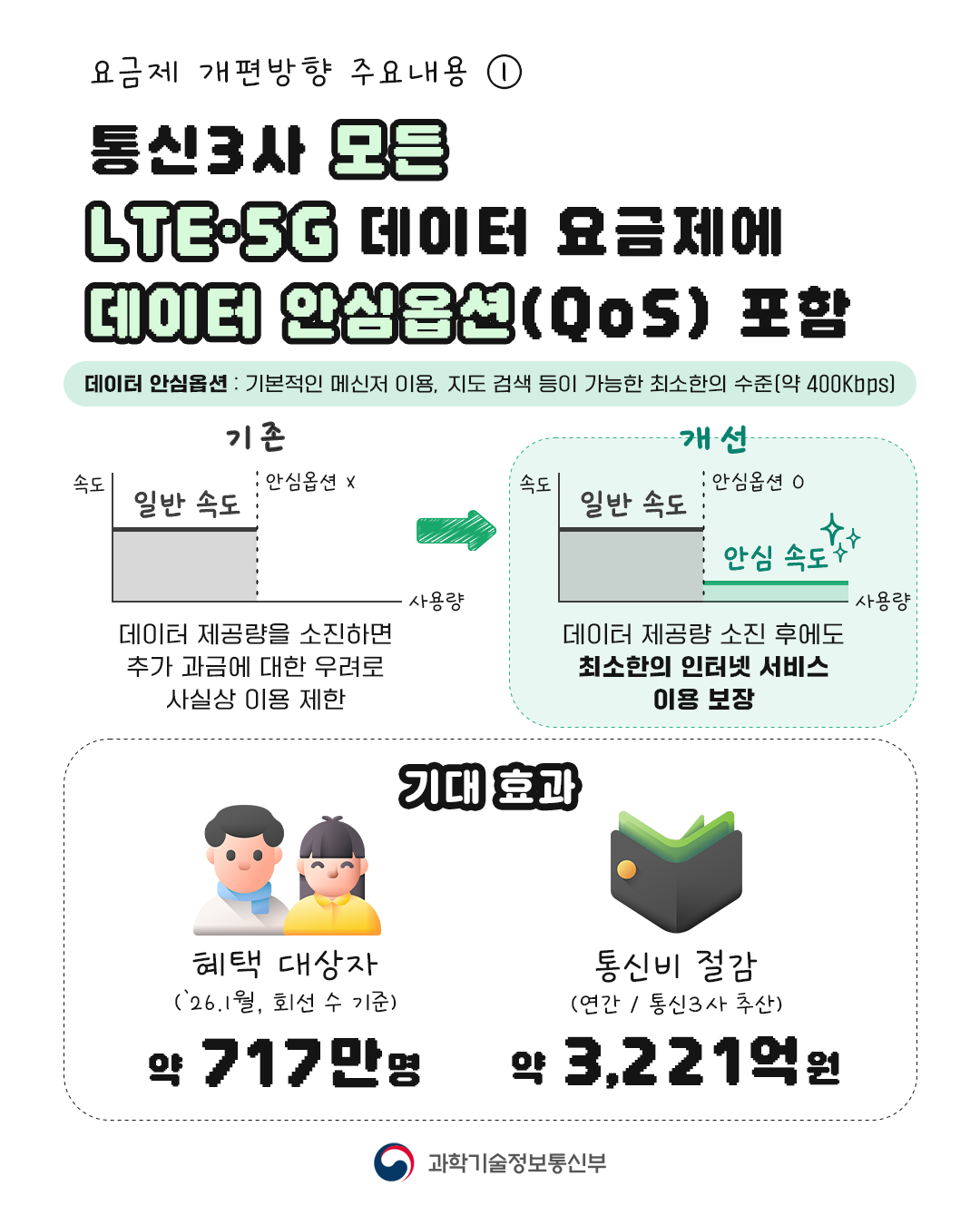
What just happened? It's often argued that having internet access is a fundamental human right. In South Korea, that belief has led to the introduction of a scheme that will give seven million mobile users unlimited data once their monthly caps run out. The caveat is that it's limited to 400 Kbps.
South Korea's Ministry of Science and ICT said that the country's three major carriers – SK Telecom, KT, and LG Uplus – have agreed to the unlimited free data initiative.
400 Kbps is obviously very slow, especially if you want to perform bandwidth-hungry activities like watching videos. But the free data is there for basic tasks such as messaging and two-factor authentication.
South Korea has some of the fastest mobile internet speeds in the world, with average download rates often ranging from 139 to 250 Mbps and 5G speeds regularly topping 400 Mbps.
Deputy Prime Minister and Minister for Science and ICT Bae Kyung-hoon said the program was being introduced because unlimited, universal access to online services falls under "basic telecommunications rights" that operators are expected to pay for themselves.
The plan is also a response to the carriers' recent security failures. SK Telecom received a $97 million fine after a lack of "basic access controls" between internet-facing systems allowed hackers to infiltrate its core systems. LG Uplus had 3TB of call records stolen, and KT deployed thousands of badly secured femtocells, exposing customers to fraud and spying.
KT was also accused of secretly installing malware on about 600,000 customers' PCs to disrupt Webhard torrent traffic, allegedly using dedicated internal teams to monitor users and alter private file transfers, prompting a police probe into possible Korean communications-law violations.
"We have now reached a critical juncture where we must move beyond mere pledges not to repeat past mistakes," said Bae. "Instead, we must respond with a level of innovation and contribution – a complete transformation – that the public can tangibly perceive."
"It is crucial to contribute to public welfare – such as by guaranteeing basic telecommunications rights for all citizens – while actively investing to lead the way toward a future defined by an AI-driven society," he added.
Another part of the telecom firms' apology for their security lapses will see them increase data and calling allowances for senior citizens, and introduce low-priced 5G plans that cost $13.50 or less. They also promised to upgrade Wi-Fi services on subways and long-distance trains.