Bottom line: SpaceX has filed for an IPO that could become the largest in history, giving investors a detailed look at a business that spans rockets, satellite networks, and AI infrastructure. The filing portrays a company growing quickly but spending heavily.
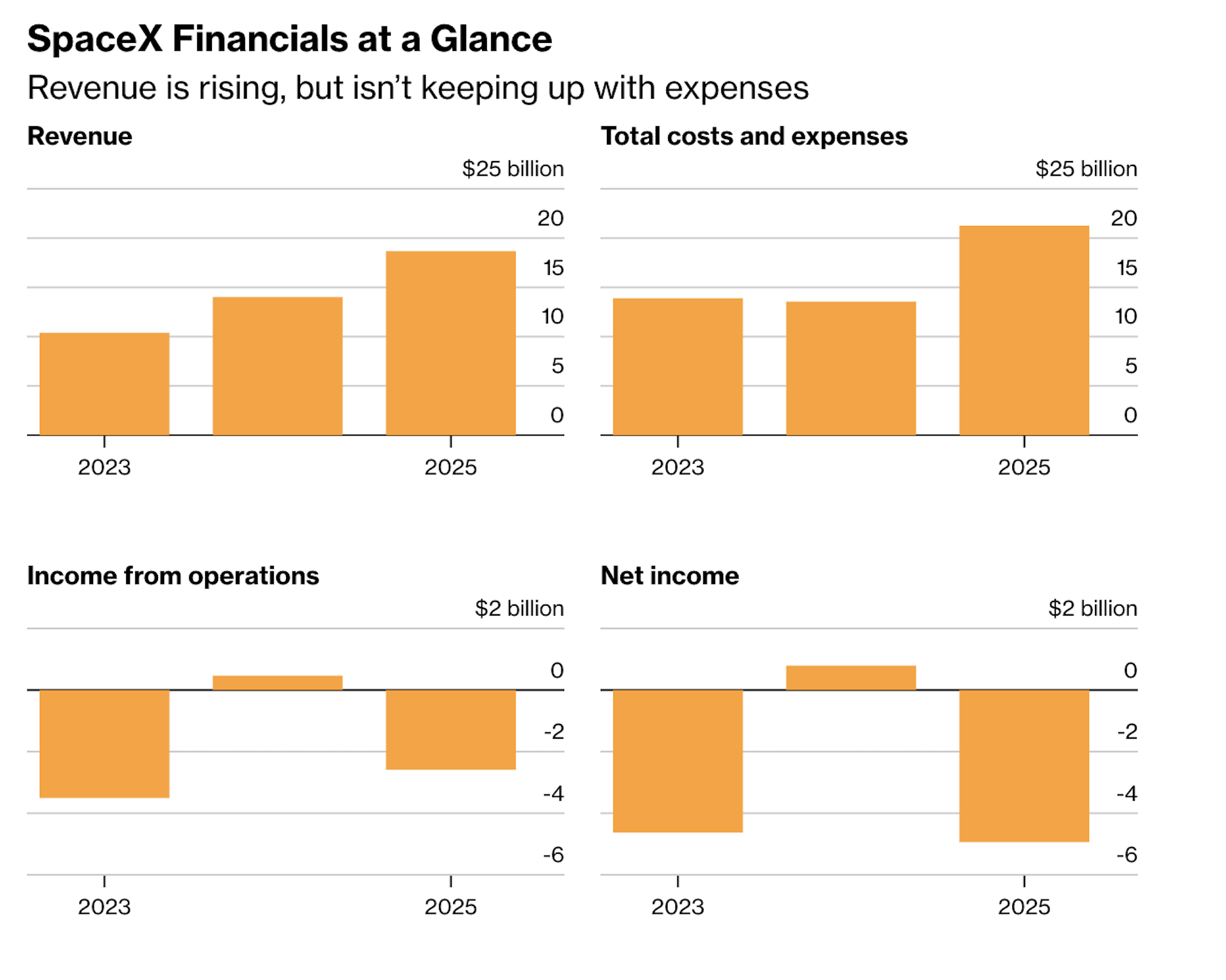
SpaceX reported $18.7 billion in revenue in 2025, up from $14 billion a year earlier, but posted a net loss of $4.94 billion after turning a profit in 2024. That trend has continued into 2026, with a $4.28 billion loss on $4.69 billion in revenue in the first quarter.
The results reflect heavy investment in AI and next-generation launch systems.
Much of that investment is tied to a push into computing. SpaceX plans to build orbital data infrastructure, including deploying 100 gigawatts of AI compute capacity each year using solar-powered satellites. The company describes this as part of a $28.5 trillion market, based on the idea that energy generation and computing can scale more efficiently in space than on Earth.
That effort accelerated following the company's acquisition of xAI. More than half of SpaceX's $20.74 billion in capital expenditures last year went toward AI-related initiatives. Losses tied to that segment climbed to $6.36 billion in 2025, up from $1.56 billion a year earlier. The company is also pursuing deals such as a potential $60 billion acquisition of AI startup Cursor, which includes significant financial penalties if terminated.
Despite the growing AI focus, SpaceX's revenue base remains heavily tied to Starlink. The satellite internet business accounted for roughly two-thirds of company revenue in the first quarter of 2026.
Despite the growing AI focus, SpaceX's revenue base remains heavily tied to Starlink. The satellite internet business accounted for roughly two-thirds of company revenue in the first quarter of 2026, fueled by subscriber growth from 2.3 million users in 2023 to 8.9 million in 2025. Revenue from Starlink reached $4.42 billion last year.
SpaceX is also developing upgraded satellites capable of connecting directly with smartphones, though those systems require more advanced launch capabilities than its current rockets can provide.
Credit: Bloomberg
That limitation makes Starship, the company's next-generation launch vehicle, more critical. Designed to be fully reusable and capable of carrying 100 to 150 tons into orbit, Starship is intended to lower launch costs and enable larger payloads, including the infrastructure needed for space-based computing. It is also central to longer-term goals, including missions to the Moon and Mars.
"The S-1 shows the launch business is loss-making, as we expected, due to heavy R&D spending. The filing points to an acceleration of Starship development which will increase the burn. Musk's goal of Starship reducing costs – to $185 a kilogram from a historical NASA average cost of $18,500 – is the key to the strategy of data centers in space and low Earth orbit satellite constellations," said George Ferguson, Bloomberg Intelligence senior defense analyst.
The IPO filing also details a governance structure that will keep control firmly in Elon Musk's hands. Through a dual-class share system, Musk holds 85.1% of the company's voting power.

Starship, however, is still in development and has faced multiple test failures, including several explosions in 2025.
The company notes that further delays or design changes could increase costs and require shifting resources across the business. Some next-generation Starlink satellites cannot be launched on current Falcon rockets, increasing reliance on Starship.

The IPO filing also details a governance structure that will keep control firmly in Elon Musk's hands. Through a dual-class share system, Musk holds 85.1% of the company's voting power, allowing him to maintain decision-making authority after the listing.
The filing outlines potential long-term incentives tied to milestones, including establishing a human settlement on Mars with at least one million inhabitants.
The offering, which could raise as much as $75 billion and value the company at up to $2 trillion, will hinge on whether investors are willing to back a business built on technologies that are still being developed. SpaceX is tying together launch, satellite connectivity, and large-scale computing, with each part depending on the others to scale.