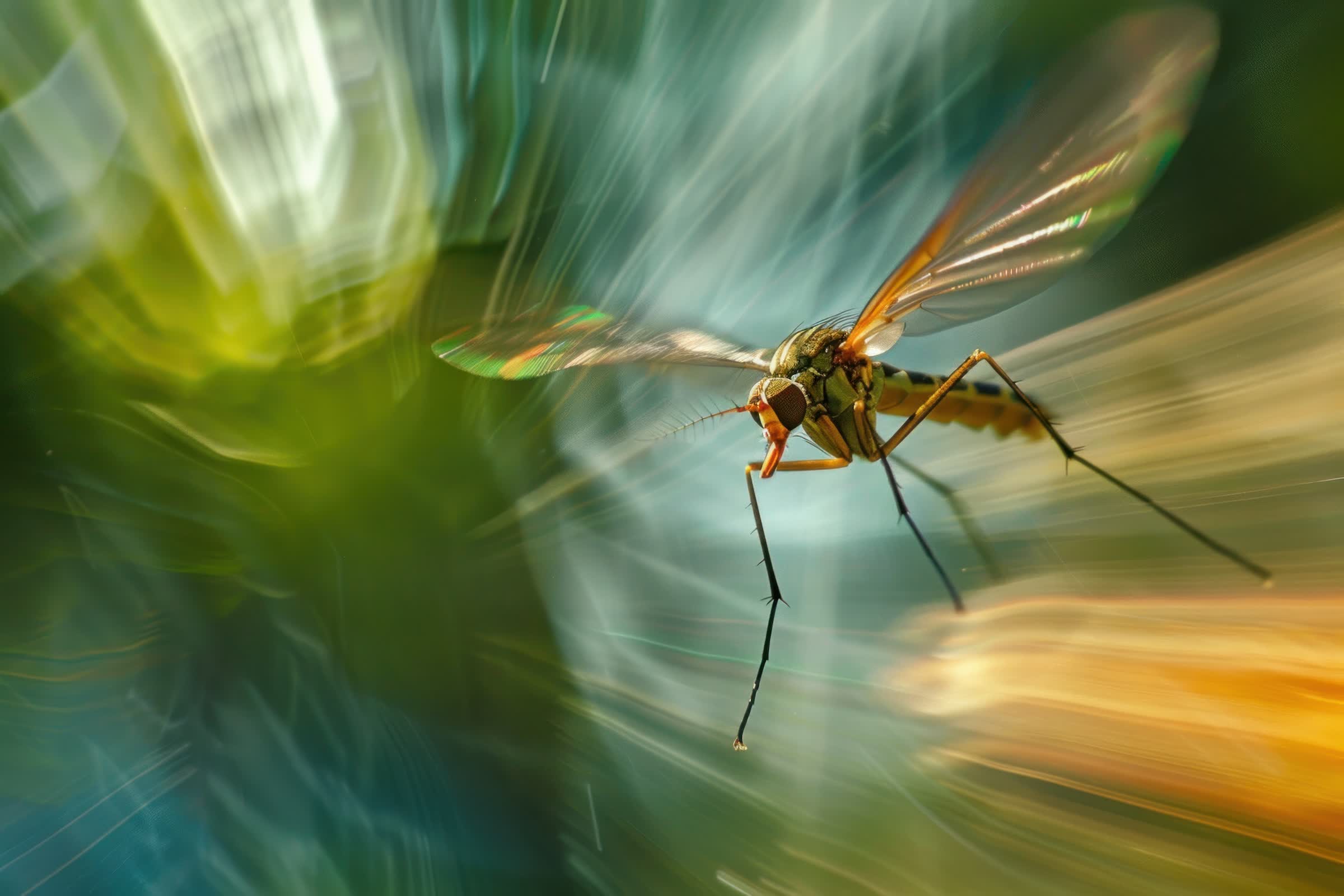
In a nutshell: A computer vision specialist has built a system that uses deep learning and a laser-based targeting setup to hunt down mosquitoes. Steven Cheng, who works in computer vision and robotics, documented the project as he developed what he calls "the ultimate mosquito killer," turning a simple household annoyance into an engineering challenge.
The foundation of the system is its visual model, which Cheng trained on a custom mosquito dataset. To do that, he relied on a DSLR camera with a high-magnification zoom lens, capturing detailed images of mosquitoes for training data. That same camera setup serves as both the training tool and the main sensor for detecting mosquitoes.
Cheng said the process of collecting this data left him with "countless mosquito bites all over my body," a reminder that even highly technical projects sometimes require getting uncomfortably up close and personal with the real world. The images he gathered were annotated and used to train a deep learning model to identify mosquitoes in flight.
Cheng noted that the process "really put my graphics card through its paces" as the system processed the data to improve detection accuracy. By the end, he said the model's performance was "quite good," suggesting it could reliably pick out mosquitoes from background noise.
With detection in place, Cheng turned to the response system. He integrated a laser that was calibrated, in his words, to "instantly turn mosquitoes into roasted ones." The laser is mounted on a high-precision industrial rotary stage, enabling it to move quickly and accurately while tracking targets identified by the vision system.
The result is a closed-loop setup: the camera identifies a mosquito, the model confirms it, and the hardware adjusts in real time to aim and fire. Unlike traditional bug zappers, which rely on passive attraction, this system actively tracks and engages individual insects.
– Steven Cheng (@stevencheng) May 28, 2026
Cheng also addressed safety by adding a second wide-angle camera to detect nearby people and flammable materials. If the system identifies any overlap between those objects and a potential target, it disables the laser. That safeguard prevents the device from firing when there is any risk of unintended damage.
After assembling and testing the system, Cheng deployed it in his home. He says that after a single night of operation, all the mosquitoes in his residence were "successfully eliminated."
While the project is experimental, it illustrates how DIY builders can now combine consumer hardware with robotics techniques. Off-the-shelf cameras, GPUs, and motion hardware now make it feasible for individuals to build real-time systems like this at home.