
Always AI's Fault: IBM took the unusual step of warning shareholders ahead of its financial results for the second quarter of 2026. Revenue is still growing slightly, but the industry's AI-driven FOMO is expected to significantly affect the company's prospects across some of its most important product lines.
In a recent letter to investors, IBM CEO Arvind Krishna explained that the company experienced some unexpected shortfalls in its latest financial performance. The former pioneer of the personal computer industry now primarily sells software, cloud services, and mainframe systems, but potential customers have recently scaled back major mainframe investments because the AI boom is pushing companies to prioritize spending on memory chips, storage drives, and GPUs instead.
According to the preliminary figures shared in Krishna's letter, IBM remains in solid shape. The company's revenue is expected to grow by 1% in the second quarter of 2026, reaching $17.2 billion. Software revenue is projected to increase by 5%, while Infrastructure revenue is expected to decline by 7%.
IBM recently prepared the launch of its new Z17 mainframe, and the company had already expected Infrastructure revenue to decline by a "low-singlet" digit percentage in the second quarter and throughout the year. However, according to Krishna, clients decided in the final weeks of June to shift corporate spending away from IBM mainframes and toward servers, storage, and memory products.
Customers were apparently pushed to secure additional hardware components before Big Tech companies and AI firms could acquire every memory chip and hard disk drive available. As SoftBank CEO Masayoshi Son recently said, the AI industry is expected to continue investing trillions of dollars in new and unprecedented data center projects, despite growing signs that the AI bubble could eventually begin to unravel.
This AI-driven shift had a significant impact on IBM's client spending patterns, Krishna said. The US company had already anticipated some supply chain-related disruptions but did not expect the scale of the change in customers' capital expenditure priorities. Other factors affecting Big Blue's mainframe (Infrastructure) business include cybersecurity concerns and the company's inability to quickly adapt to rapidly changing market conditions.
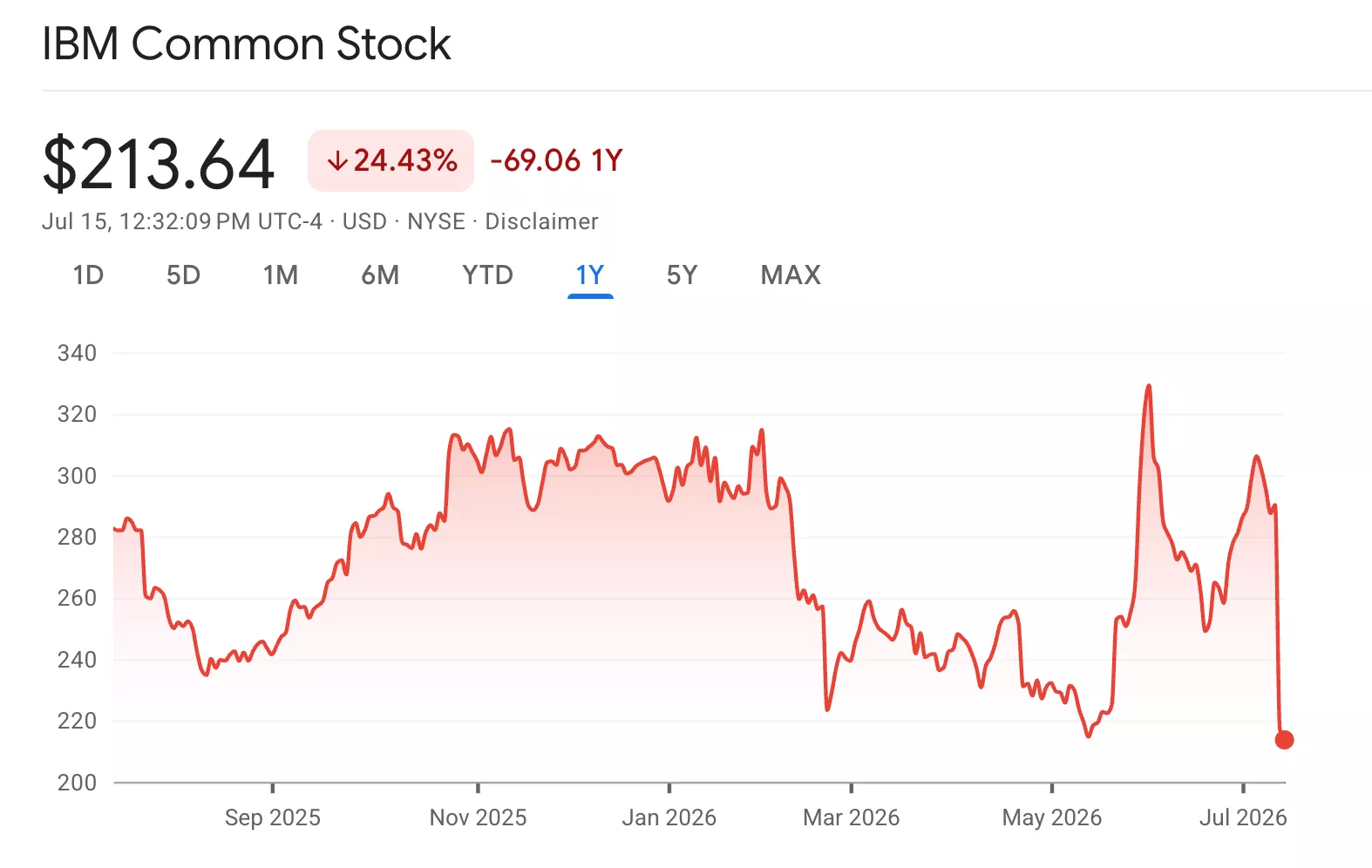
Following Krishna's letter, IBM's stock suffered a 25% decline, marking the company's worst single-day performance in history. Preliminary revenue figures came in below analysts' expectations, with analysts forecasting that the quarter would close at $17.86 billion.

At any rate, IBM is still highlighting some positive aspects of its financial results despite the overall disappointing quarter.
Big Blue's strongest-performing products include Red Hat, which is expected to grow by 11% compared with the previous quarter. The company is also launching Lightwell, a service designed to leverage Anthropic's Mythos AI frontier technology to improve open-source security. Customers will need to pay a subscription fee to access it.