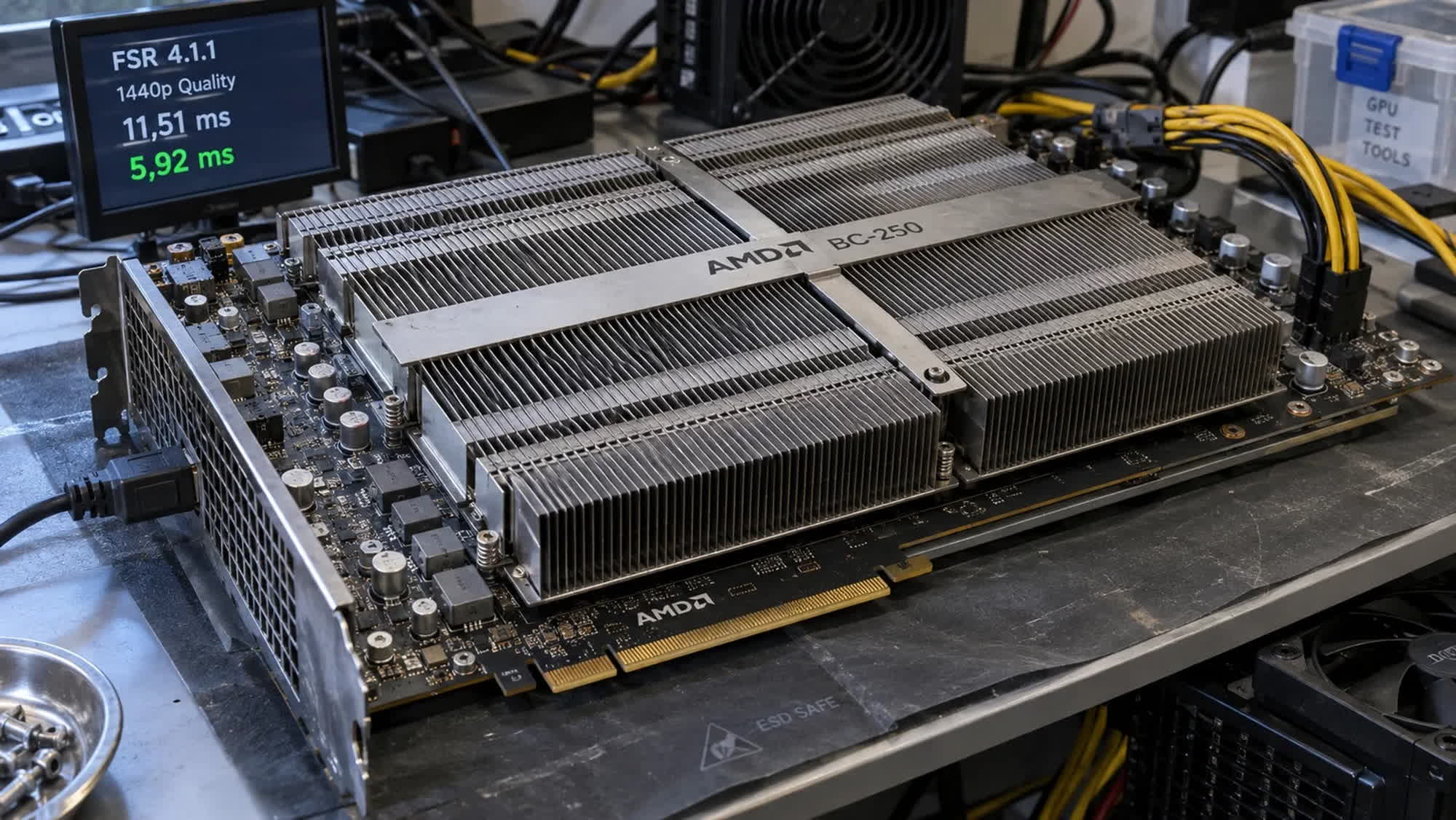
In a nutshell: Modders keep using the AMD BC-250 GPU for tasks it was never meant to perform. The graphics accelerator was quietly launched a few years ago during the cryptocurrency frenzy, but it's become a rather interesting component if you enjoy Linux, tweaking hardware and software stacks, and purchasing beaten-up GPUs from eBay.
The Linux community is laser-focused on turning the AMD BC-250 into a proper piece of gaming hardware. A recent development is even bringing AMD's frame generation and upscaling to the GPU, which was not designed to support the technologies. Indeed, the BC-250 was not designed to do any of the stuff developers are trying to use it for – but they're doing it anyway.
The AMD BC-250 first appeared in 2022 as part of an Asrock server designed for cryptocurrency mining. Now that mining is no longer fashionable, the individual BC-250 cards are a common sight on eBay and other second-hand markets. The cards are cheap – cheaper, at least, than the latest AI-focused GPUs.
The BC-250 silicon was derived from a cut-down version of the GPU used by Sony for the PlayStation 5. Code-named Oberon, the GPU is based on the RDNA 2 microarchitecture – the same tech AMD used for the Radeon RX 6000 GPU series. To put it simply, the processor is relatively powerful by today's standards.
Modders and developers have been trying to exploit the BC-250's architectural capabilities for gaming tasks for some time. The community was eventually able to access all 40 RDNA 2 compute units (CU) available on the GPU, while standard configurations only enable 24 CUs by default. Now, it's time for the BC-250's upscaling prowess to shine.
Developers had already shown how the former mining GPU could run the latest version of AMD's FidelityFX Super Resolution (FSR) upscaling and frame generation technology. More recently, a new fork of the same project has turned FSR 4 into a practical Windows x64 DLL. Users can now drop this single file into games that natively support FSR, or even use it with upscaler-juggling project OptiScaler.
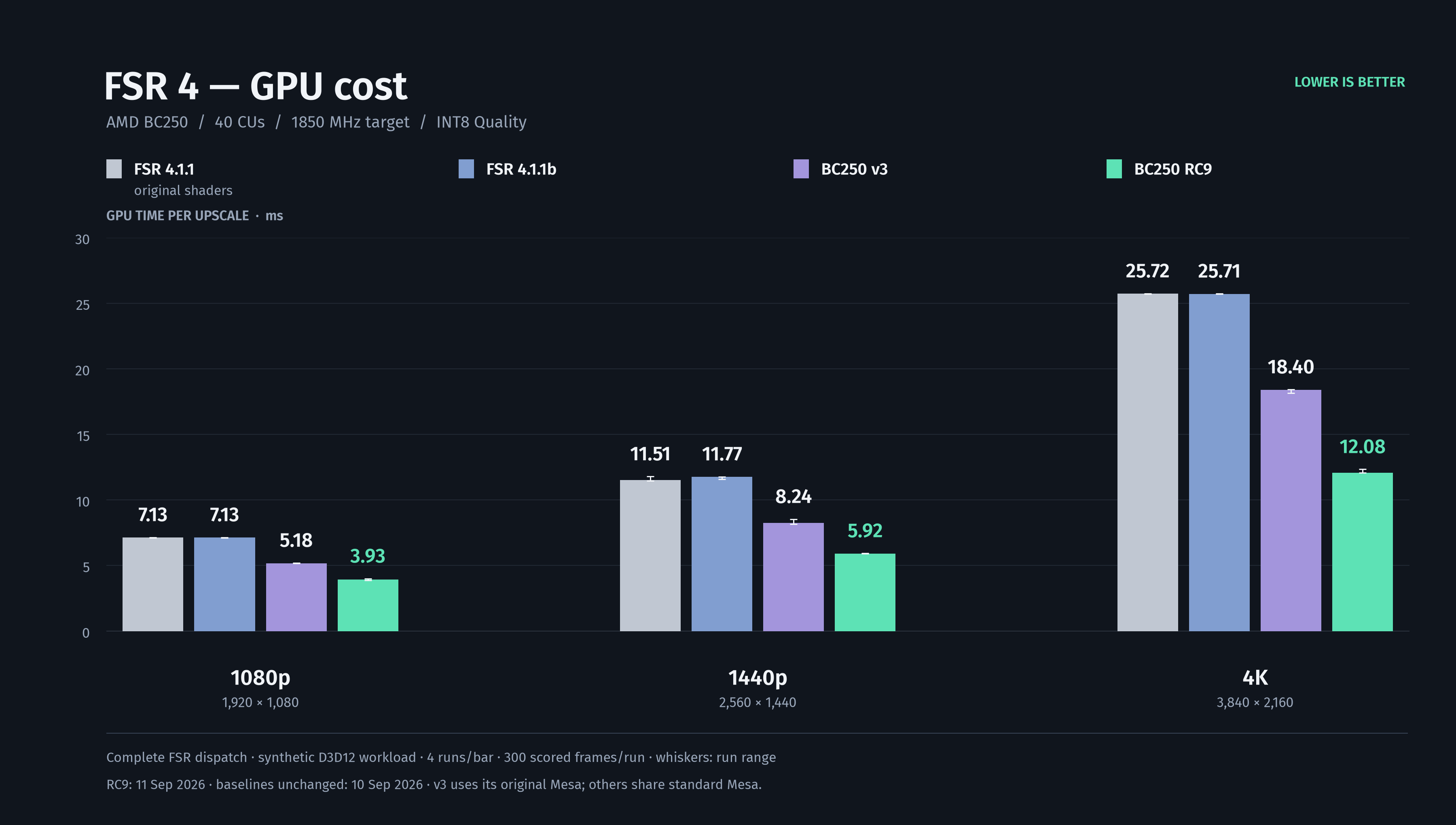
The new fork (BC250 FSR4 4.0.0-rc9) shows how FSR 4 can significantly improve performance in games running under Linux. The single DLL can reduce the "GPU cost" that comes with 3D rendering, while image quality should stay the same. Results are particularly good at a 2560×1440 resolution, using a 1706×960 "Quality" input resolution.
The developers said they tested the BC-250 FSR4 DLL under Linux, using only the upscaling part of the FSR 4 tech. Windows support and FSR's frame generation feature have not yet been tested. In any case, the new tool shows how far some coders, and likely die-hard open-source enthusiasts, are willing to go to repurpose a piece of hardware that was conceived to perform unrelated tasks.