
PC gamers have faced a challenging year, with very little positive news for anyone planning to upgrade or build a new gaming PC. From a hardware perspective, it's been mostly bad news. Thankfully, we've also received some great games this year, and that trend continues with the release of The Witcher 3: Wild Hunt Remastered.
Incredibly, this massive update is free for existing owners of the game, giving players a good reason to revisit one of the most acclaimed RPGs ever made. For those yet to play it, the update brings a lengthy list of improvements aimed at making the now 11-year-old game feel much more like a modern release.
Combat has been overhauled, the skill tree rebalanced, new finishers added, and monster behavior refined. REDengine 3 has also received substantial upgrades, enabling modern rendering techniques including ray tracing and path tracing.
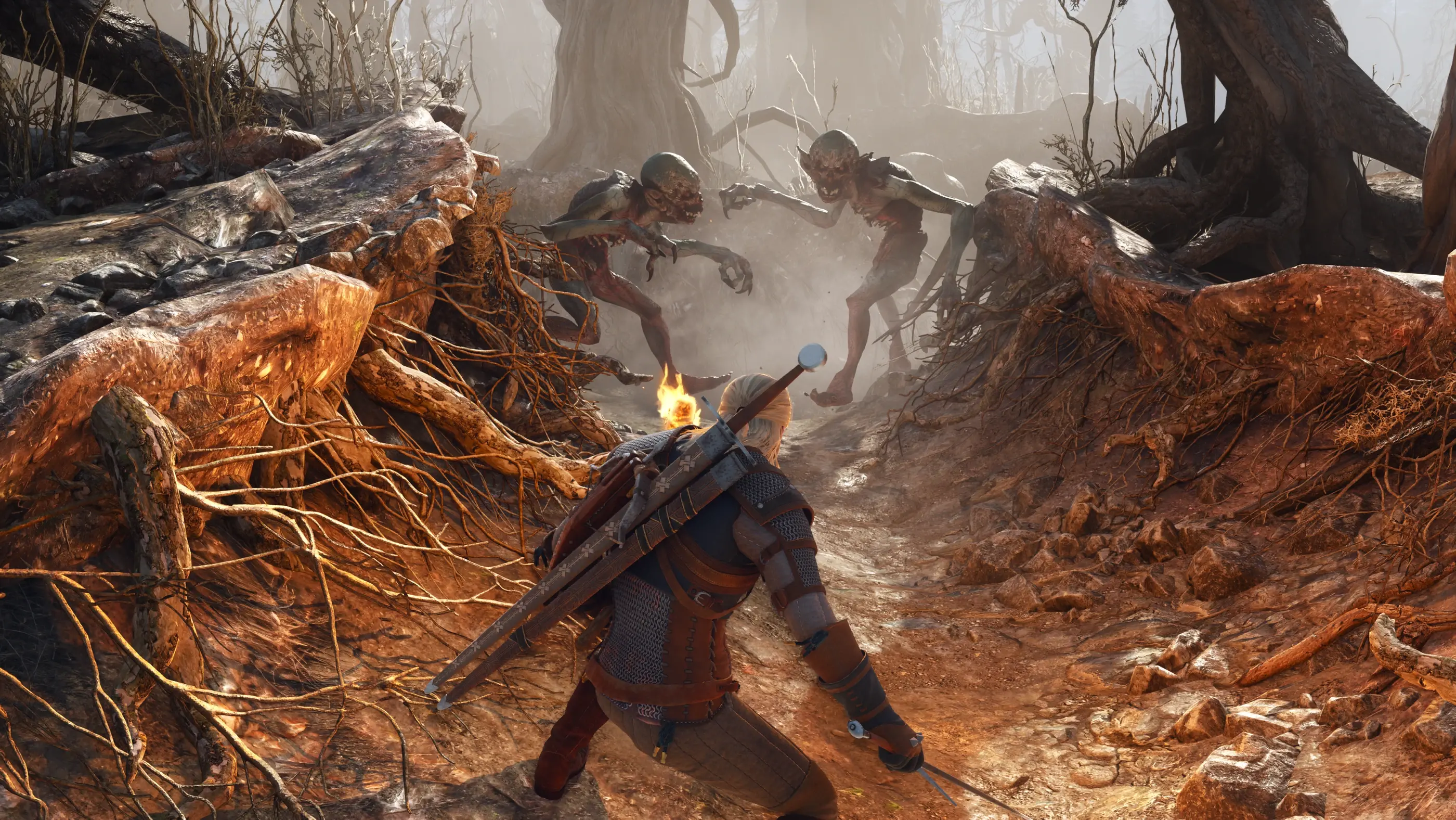
There are improved textures, major enhancements to foliage, revised lighting and shadows, and an expanded photo mode. The Witcher 3 Remastered is launching this week on modern consoles and PC. A native Nintendo Switch 2 version is also being released.
There's obviously a lot to unpack here, but our focus is PC performance. Specifically, how does the remastered version compare with the original game, and how do AMD and Nvidia's latest GPUs perform across a range of quality settings?
Normally we'd aim to test a much broader selection of hardware, but given the relatively short lead time we've settled on a smaller initial sample. You can expect The Witcher 3 Remastered to appear in future benchmarks as we add it to our regular test suite.
Test System and Benchmark Methodology
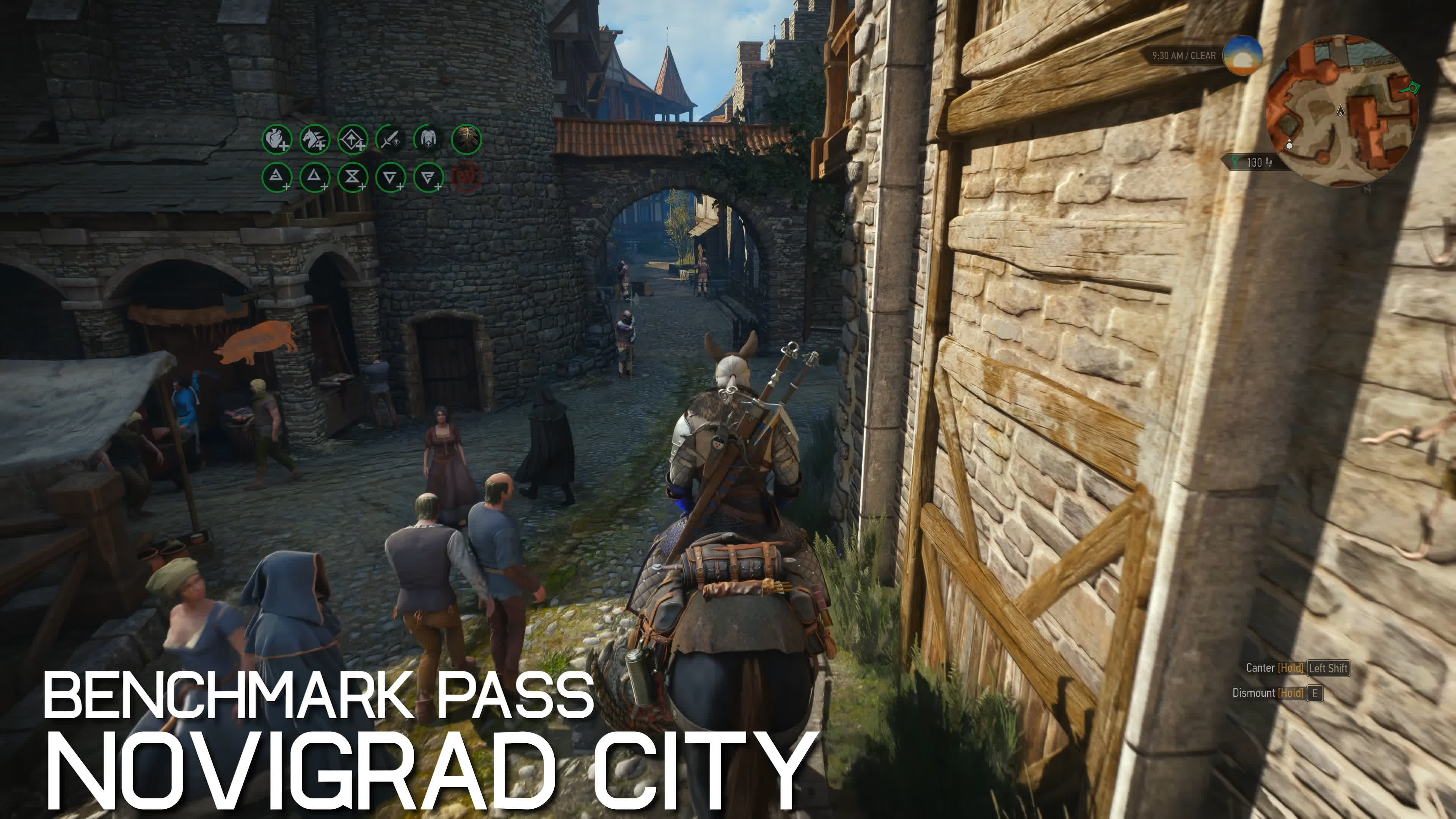
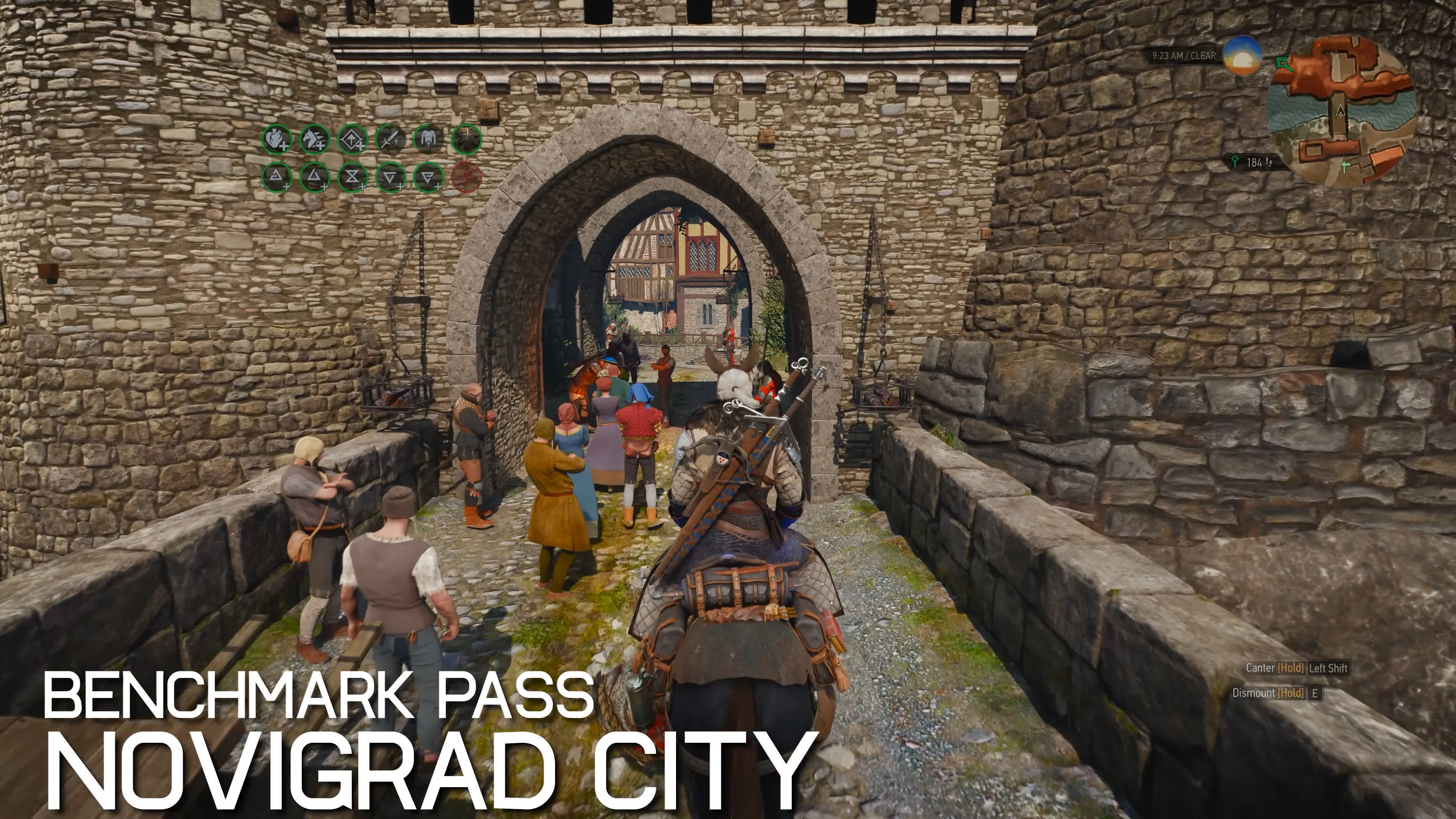
For testing we're heading back to Novigrad, as the game's city areas are among its most demanding locations. Novigrad in particular has historically placed a heavy load on both the GPU and CPU, making it a useful stress test. Our test system uses the Ryzen 7 9800X3D paired with 32GB of DDR5-6000 memory, which should help minimize CPU bottlenecks as much as possible.
One important note concerns the Radeon driver. All AMD testing was completed using a pre-release driver specifically developed for The Witcher 3 Remastered, version 26.20.15.02. The publicly available Adrenalin 26.9.1 driver was effectively unusable in our testing, producing numerous rendering glitches.
The current GeForce Game Ready driver worked without any obvious issues. Of course, that doesn't rule out future driver updates improving performance further for either vendor.
Remastered vs. Classic: Is It Actually Better Looking?
Before diving into the benchmark charts, it's worth looking at what you're getting visually. The video and screenshots below showcase this better than words...
For a better representation of image quality comparisons, check out the HUB video below:

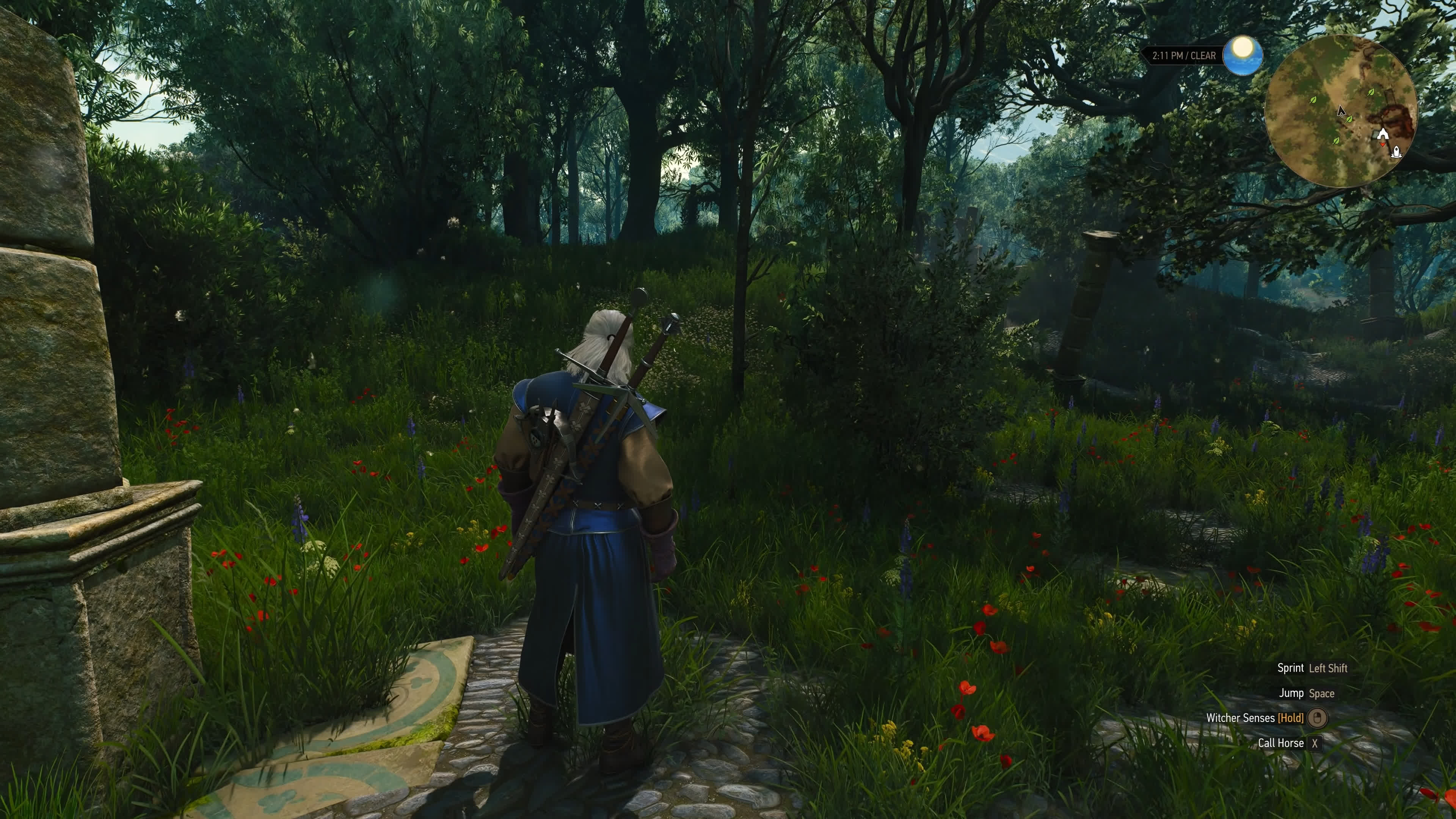
Looking first at the RT Ultra mode, the remastered version is certainly brighter than the original. This reveals more detail during the early morning benchmark sequence, and there's noticeably more lighting detail in the distance.
Whether that's actually better is more subjective. Looking at distant trees, for example, the remastered version clearly shows more lighting detail. But given that our comparison takes place very early in the morning, the darker presentation of the original arguably looks more realistic.
Both versions were tested at exactly the same time of day, around 3:44 a.m. Light bleeding through the foliage looks better in the remaster, but whether there should be quite that much light at 3:44 in the morning is another question.
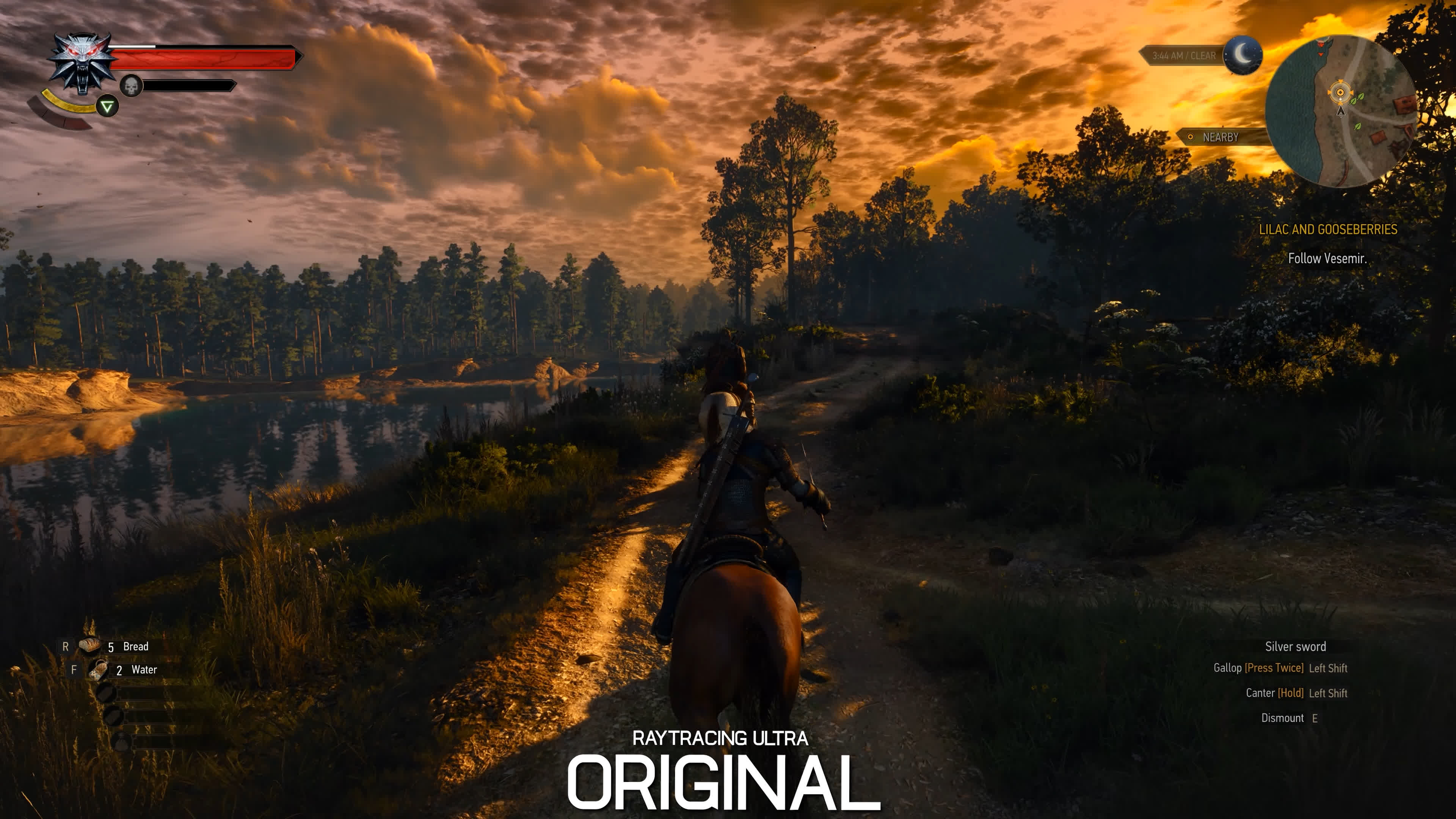
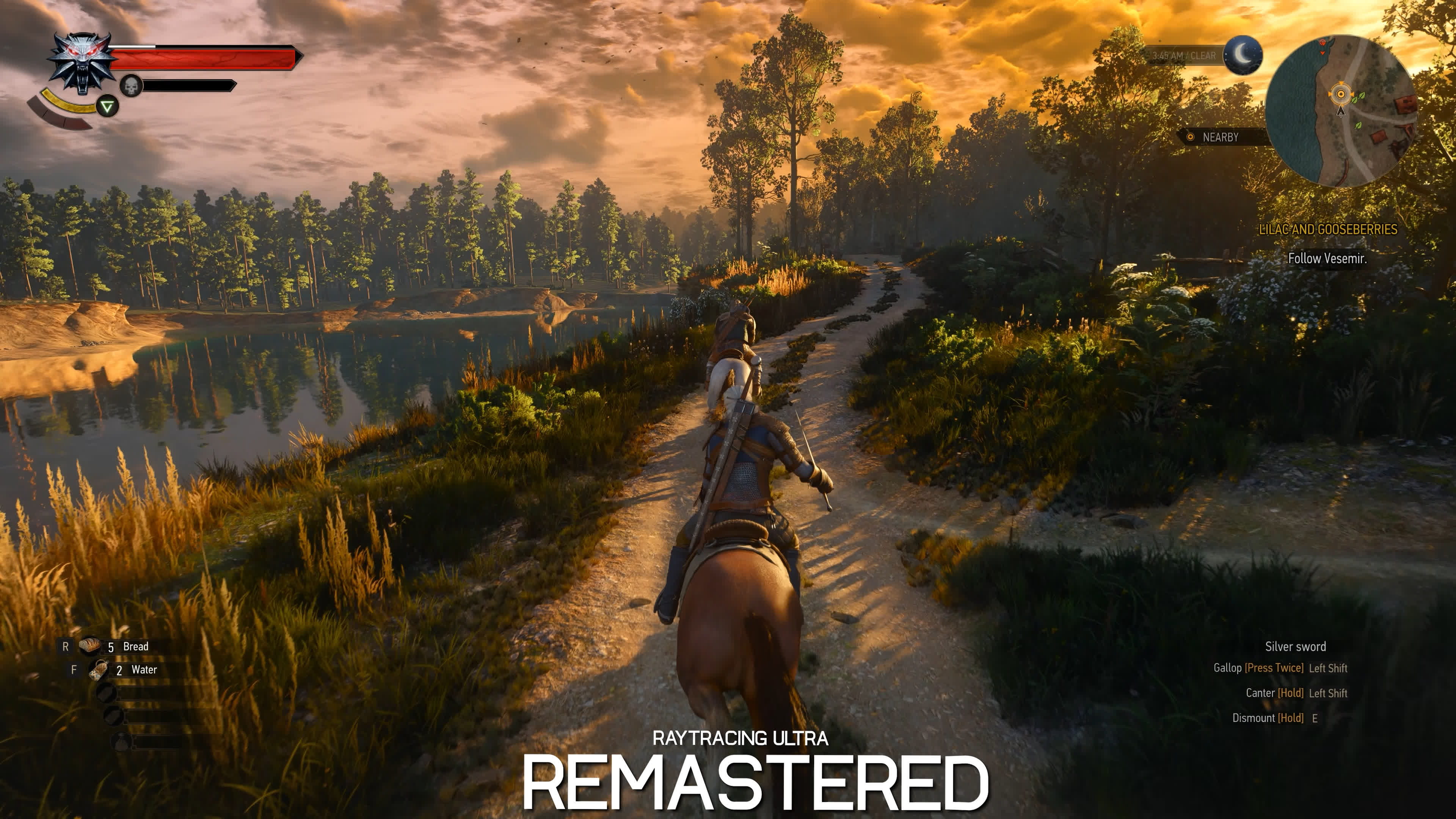
Overall, neither presentation is necessarily technically superior in every scene. They're often just different. The same applies to the standard Ultra preset. The remaster again has more powerful lighting, and to our eyes Geralt is generally better illuminated, but the difference isn't transformative.
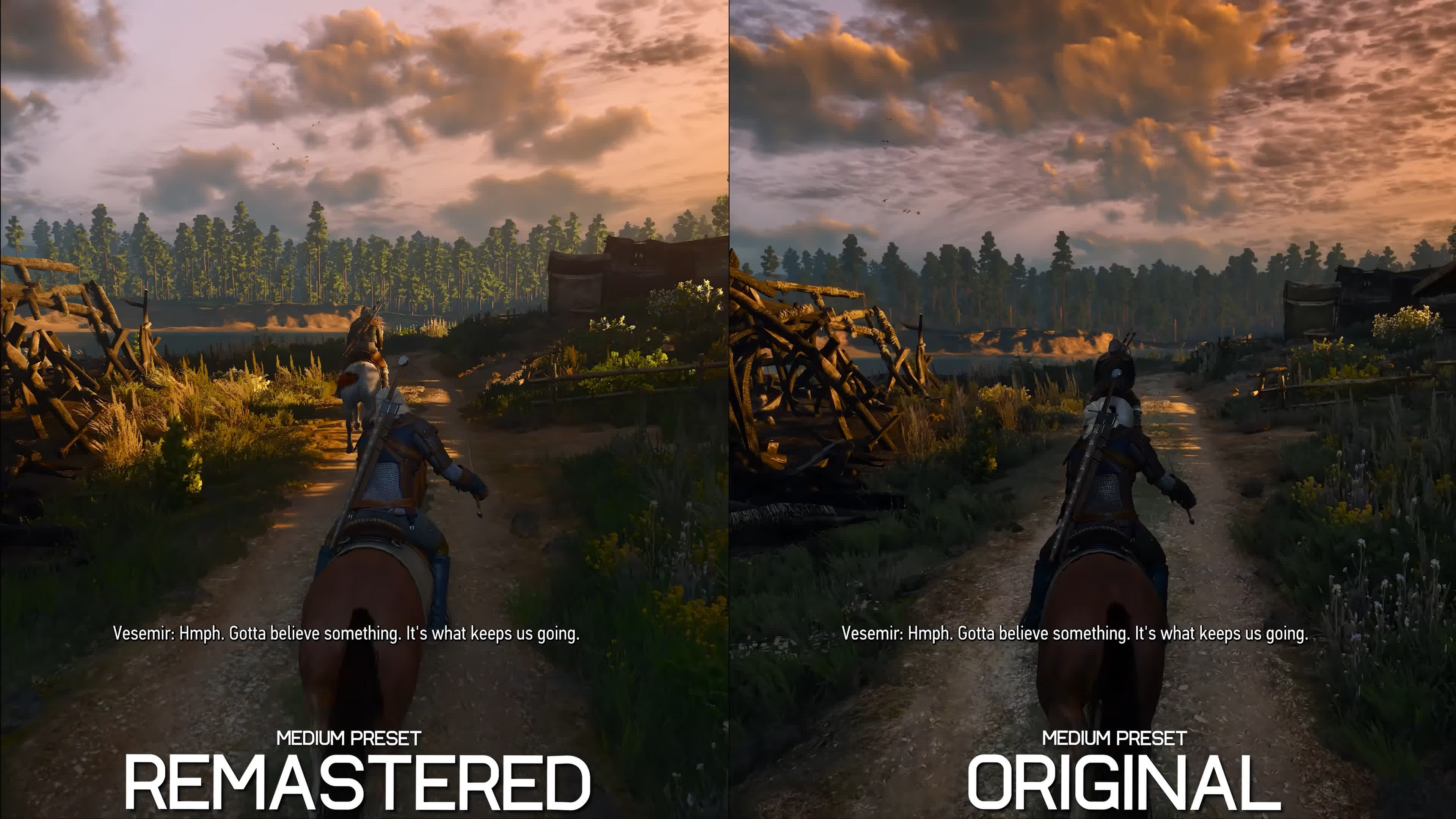
Medium quality tells a similar story. The remastered version is significantly better lit, and assuming that is the intended look, it's certainly the more visually impressive of the two.
Path Tracing Is Surprisingly Underwhelming
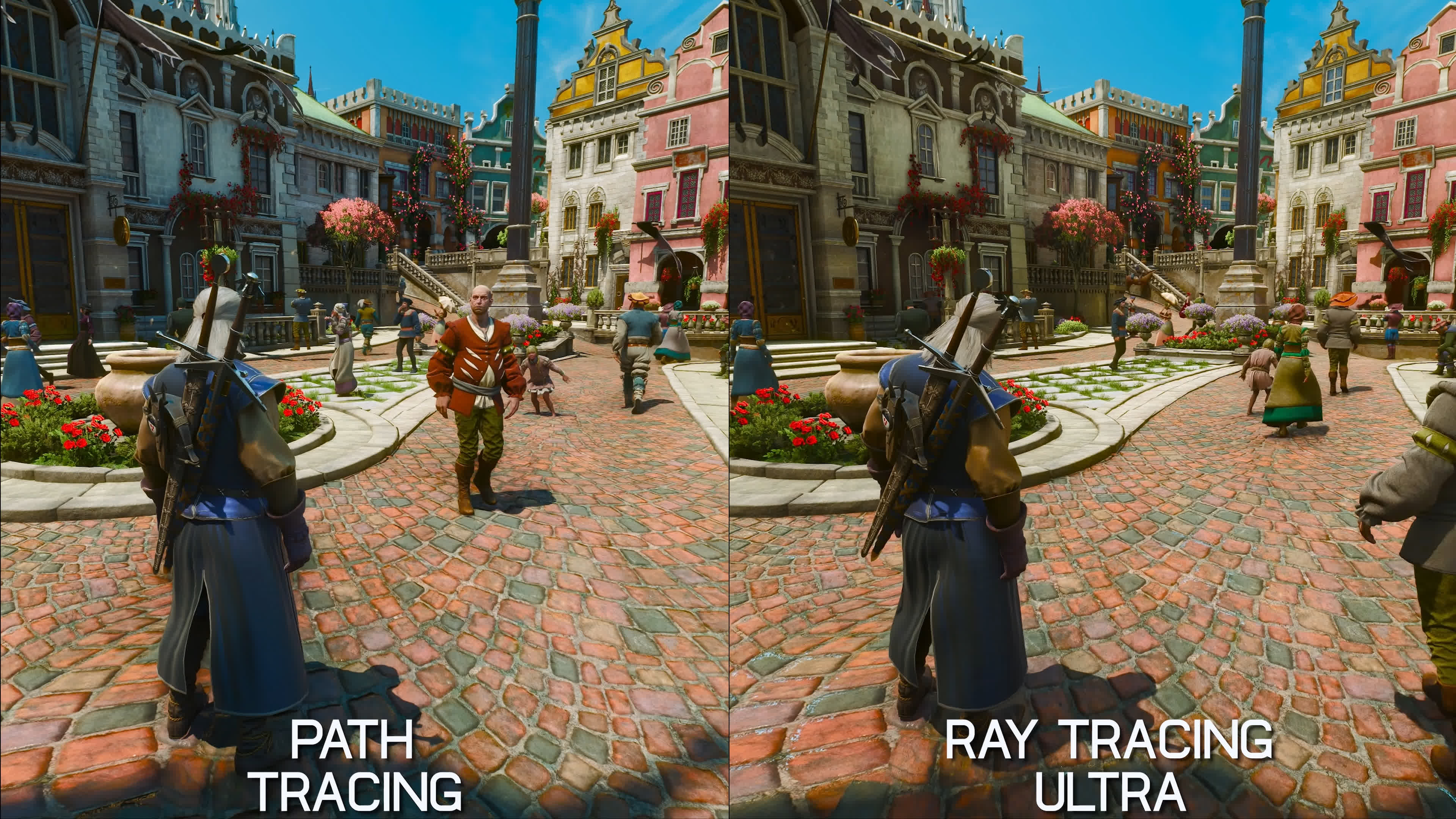
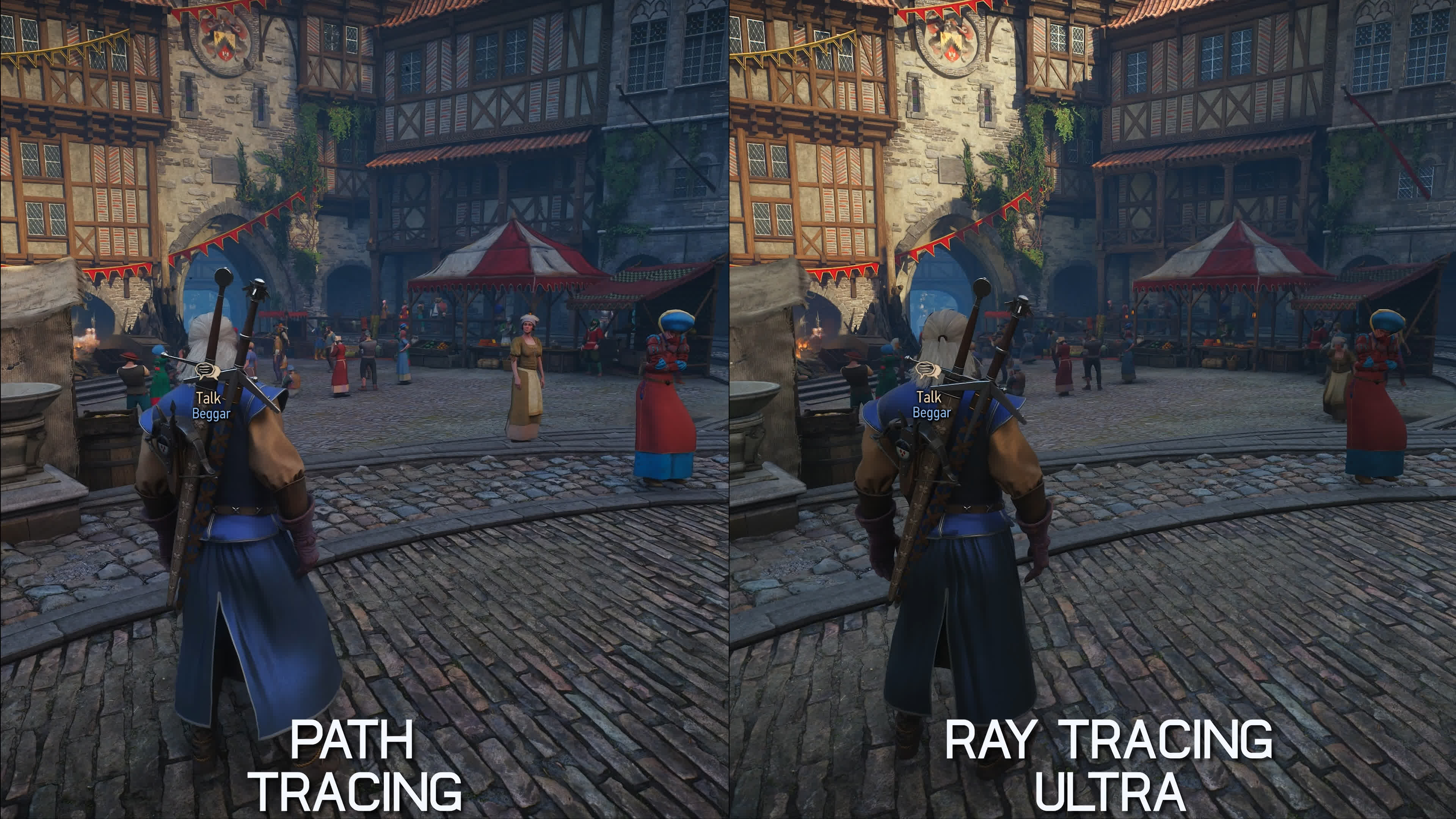
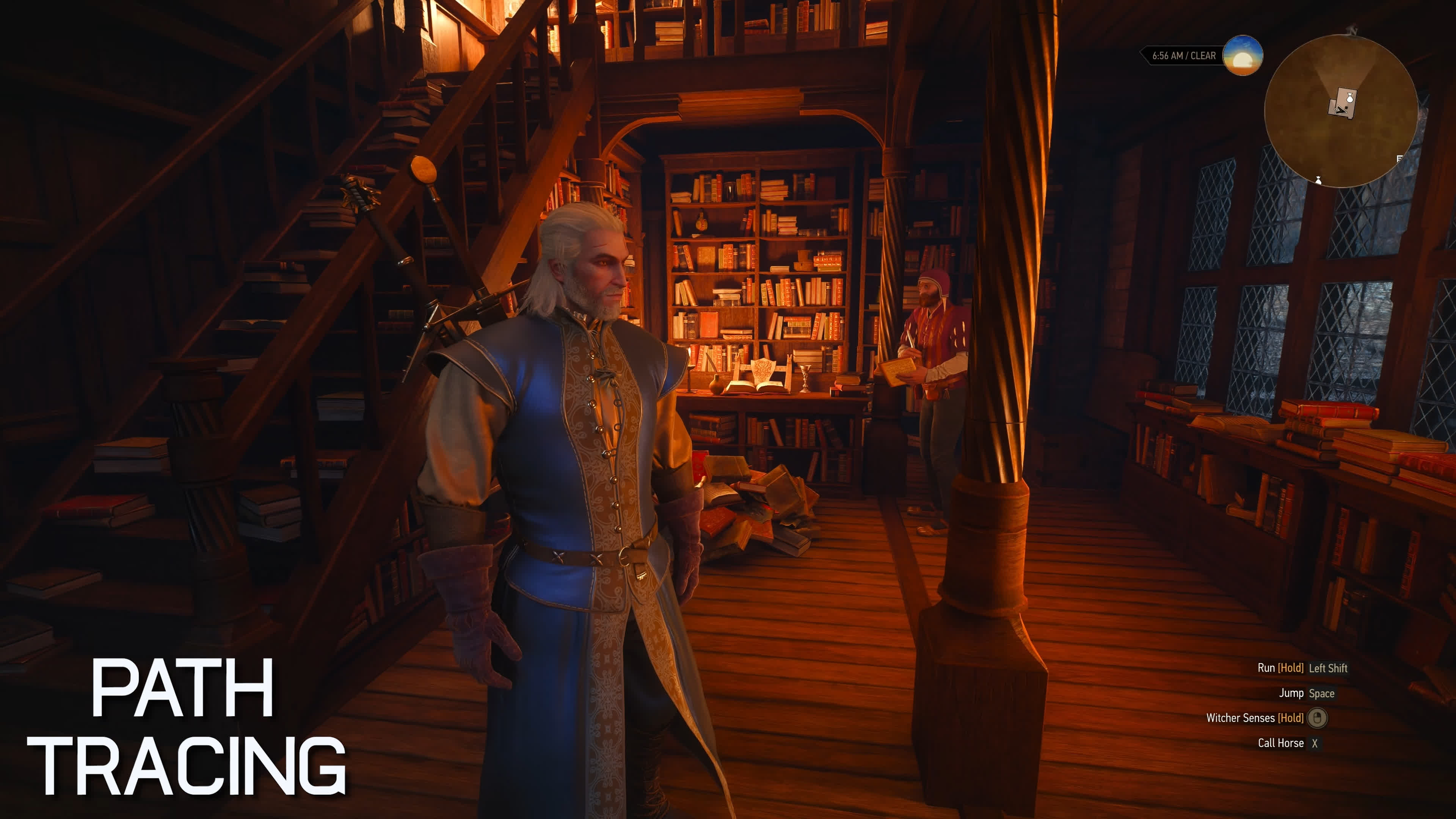
Things get more interesting when comparing ray tracing with path tracing in the remastered version. For some reason, path tracing frequently looks worse.
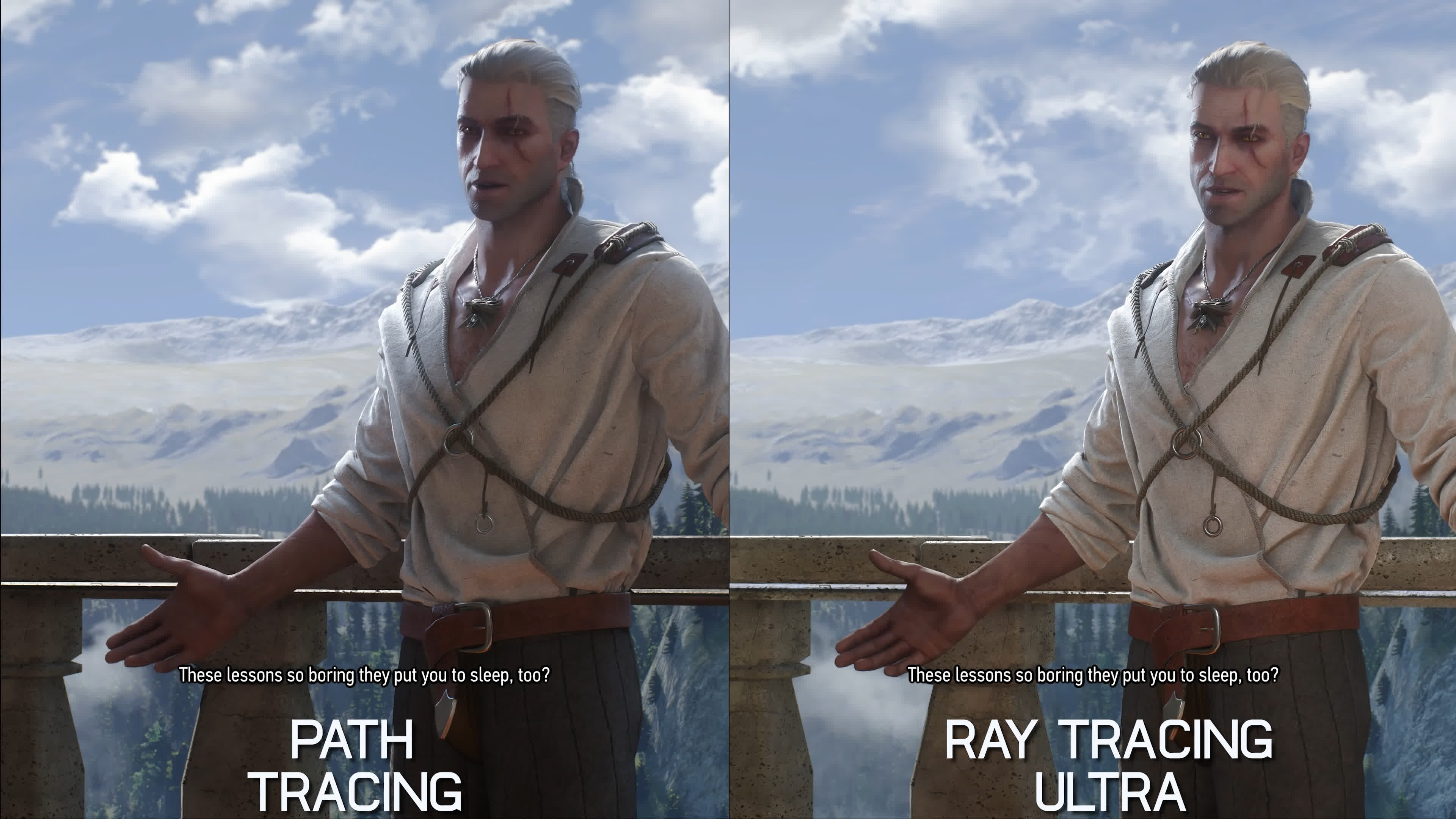
Characters can become overexposed, while other scenes take on a strange blue tint. There are certainly examples where path tracing improves the image, but more often than not we preferred the conventional ray-traced presentation.
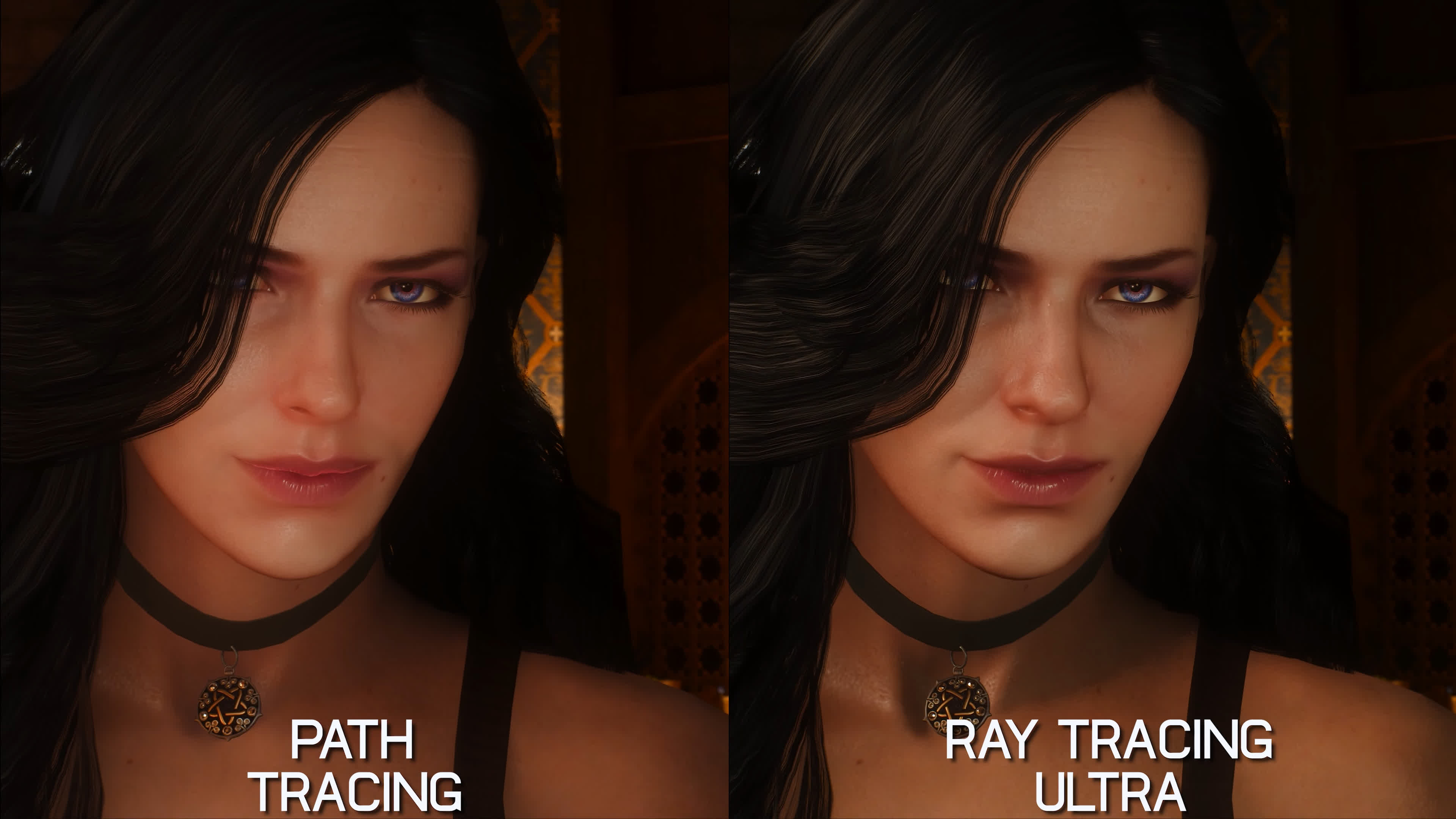
Yennefer's face is a good example. With path tracing enabled, her face can look flatter and more blown out. It's very much a mixed bag. This is subjective, of course, but after examining numerous scenes, we generally found ray tracing more visually pleasing.
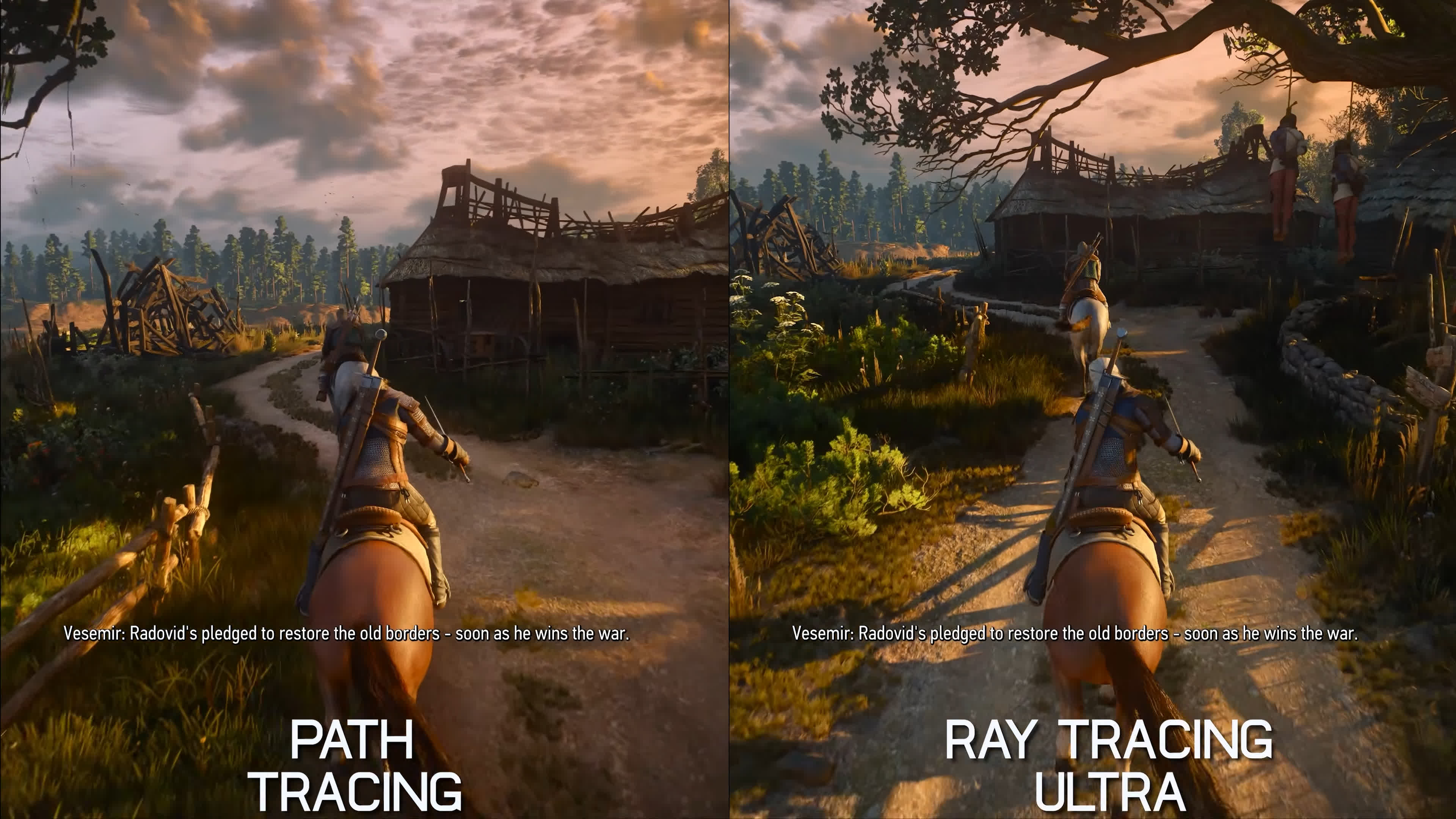
That's somewhat disappointing given the extent of the remaster, and it makes ray tracing one of the more meaningful visual upgrades available.
Remastered vs. Classic Performance
For these comparisons, we're using the GeForce RTX 5070 Ti and Radeon RX 9070 XT to see how performance has changed between the original game, now labeled Classic, and the Remastered release.
Ultra: Original vs. Remastered
At 1080p using the Ultra preset, the RTX 5070 Ti was 8% faster than the RX 9070 XT in the original version. Interestingly, that same 8% margin remained in the Remastered version when looking at average frame rates.
The 1% lows show some strange behavior, however. Radeon GPUs appear to be running into some kind of performance limitation, likely driver-related, which becomes even more obvious when testing the Medium preset.
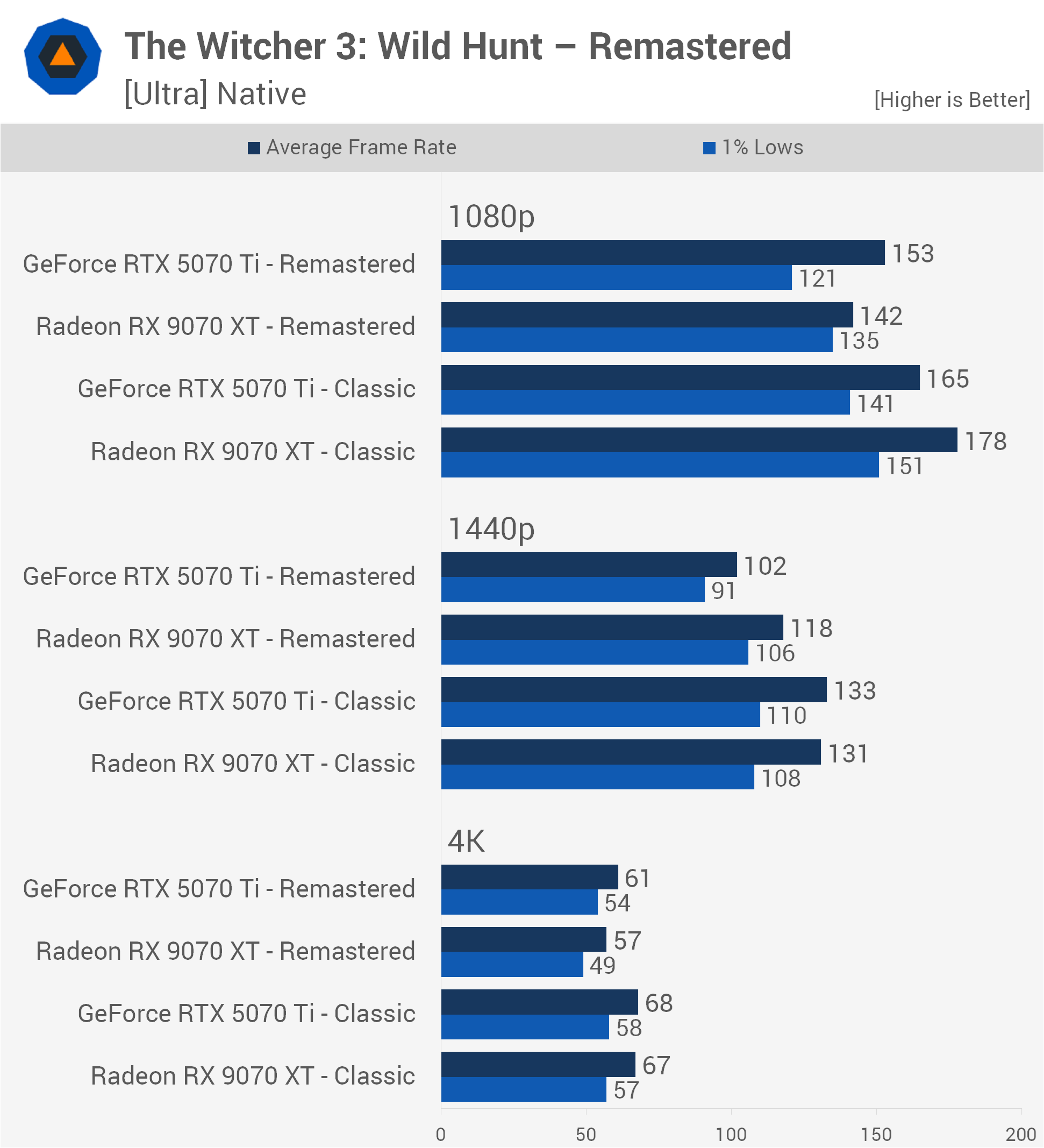
Looking specifically at the RTX 5070 Ti, the Remastered version runs just 7% slower than the original, which is impressive given the visual upgrades.
At 1440p, the situation changes dramatically. The RTX 5070 Ti and RX 9070 XT were essentially tied in the original game, but in Remastered the Radeon GPU is now 16% faster. That could change with future Nvidia driver updates, but ahead of release, this is where things stand.
The RTX 5070 Ti takes a substantial 23% performance hit moving from Classic to Remastered, while the RX 9070 XT loses just 10%. At 4K, both GPUs again delivered similar performance in the original game. With Remastered, however, the tables turn again and the RTX 5070 Ti ends up 7% faster. The GeForce GPU is roughly 10% slower in Remastered than it was in Classic at this resolution. Clearly, there's some unusual scaling going on.
RT Ultra: Original vs. Remastered
For our RT Ultra testing, we're using what we consider appropriate upscaling levels for each resolution: Quality at 1080p, Balanced at 1440p, and Performance at 4K. At 1080p, the RTX 5070 Ti was previously 16% faster than the RX 9070 XT.
Remastered eliminates that margin entirely. In fact, ray tracing performance for the RX 9070 XT remains virtually unchanged at 93 fps, while the RTX 5070 Ti loses 14% of its original performance.
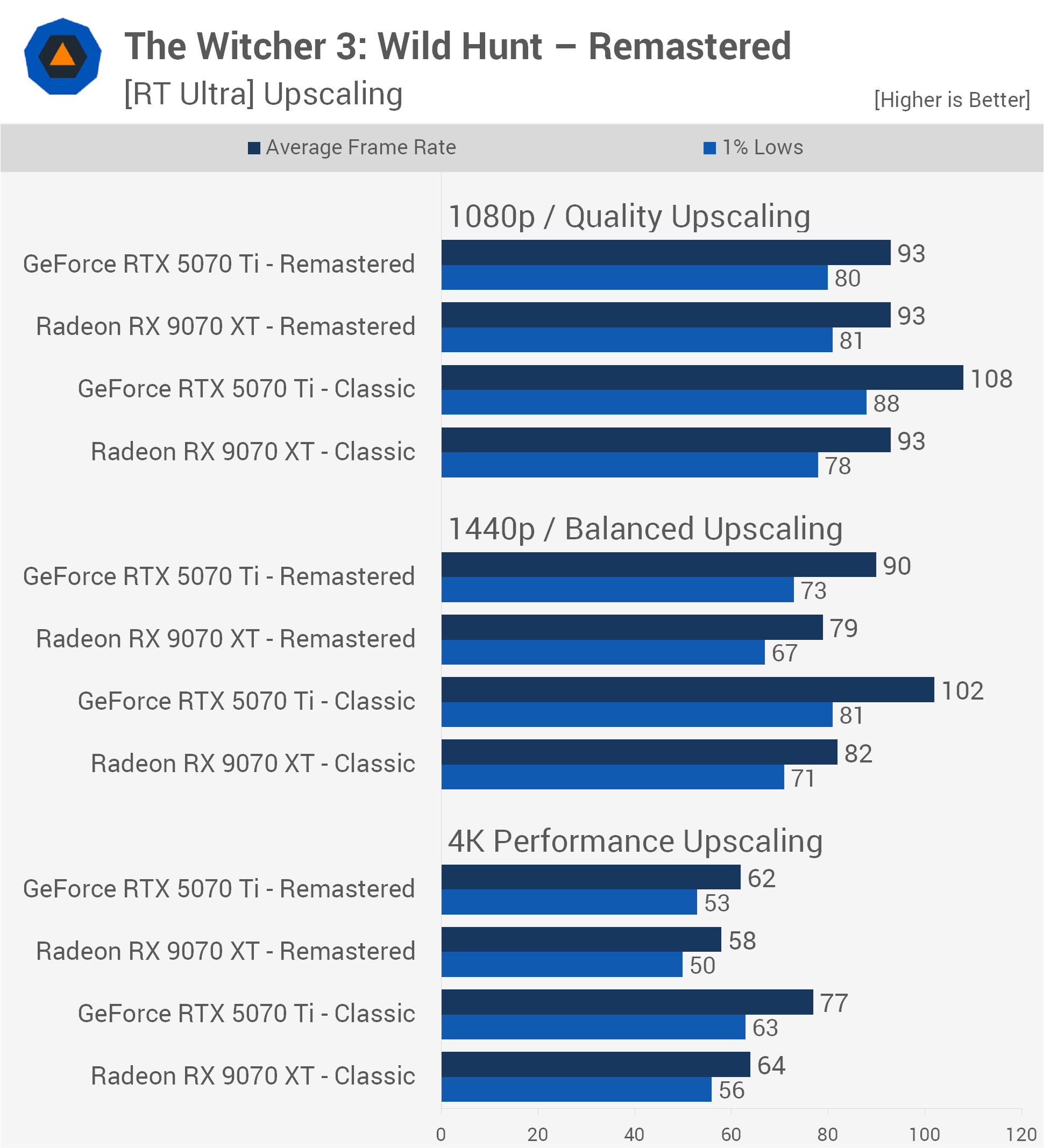
That result looked wrong enough that we retested it multiple times, but the numbers held up. The Nvidia GPUs appear to be running into some kind of bottleneck here. Even installing the RTX 5090 results in the same limitation at just over 90 fps.
At 1440p, the RTX 5070 Ti was 24% faster than the RX 9070 XT in Classic. Remastered reduces that advantage to 14%. Again, performance on the Radeon changes very little between versions, while the RTX 5070 Ti takes a 12% hit. Then at 4K, the RTX 5070 Ti's advantage drops from 20% in Classic to just 7% in Remastered.
We're not entirely sure why Radeon performs so well relative to the RTX 5070 Ti here, but it's another example of the somewhat strange scaling we're seeing in this game.
Medium: Original vs. Remastered
We also tested the Medium preset, and this is arguably the most interesting comparison of all. The Remastered version looks significantly better at Medium, yet despite the visual upgrade it can also run considerably faster.
At 1080p, we again encounter some strange Radeon behavior, likely caused by a driver-related bottleneck. In the original game, the RX 9070 XT and RTX 5070 Ti were basically neck and neck, with the GeForce GPU just 3% faster. In the Remastered version, however, the RTX 5070 Ti ends up 31% faster. Again, we believe this is primarily the result of the Radeon performance limitation.
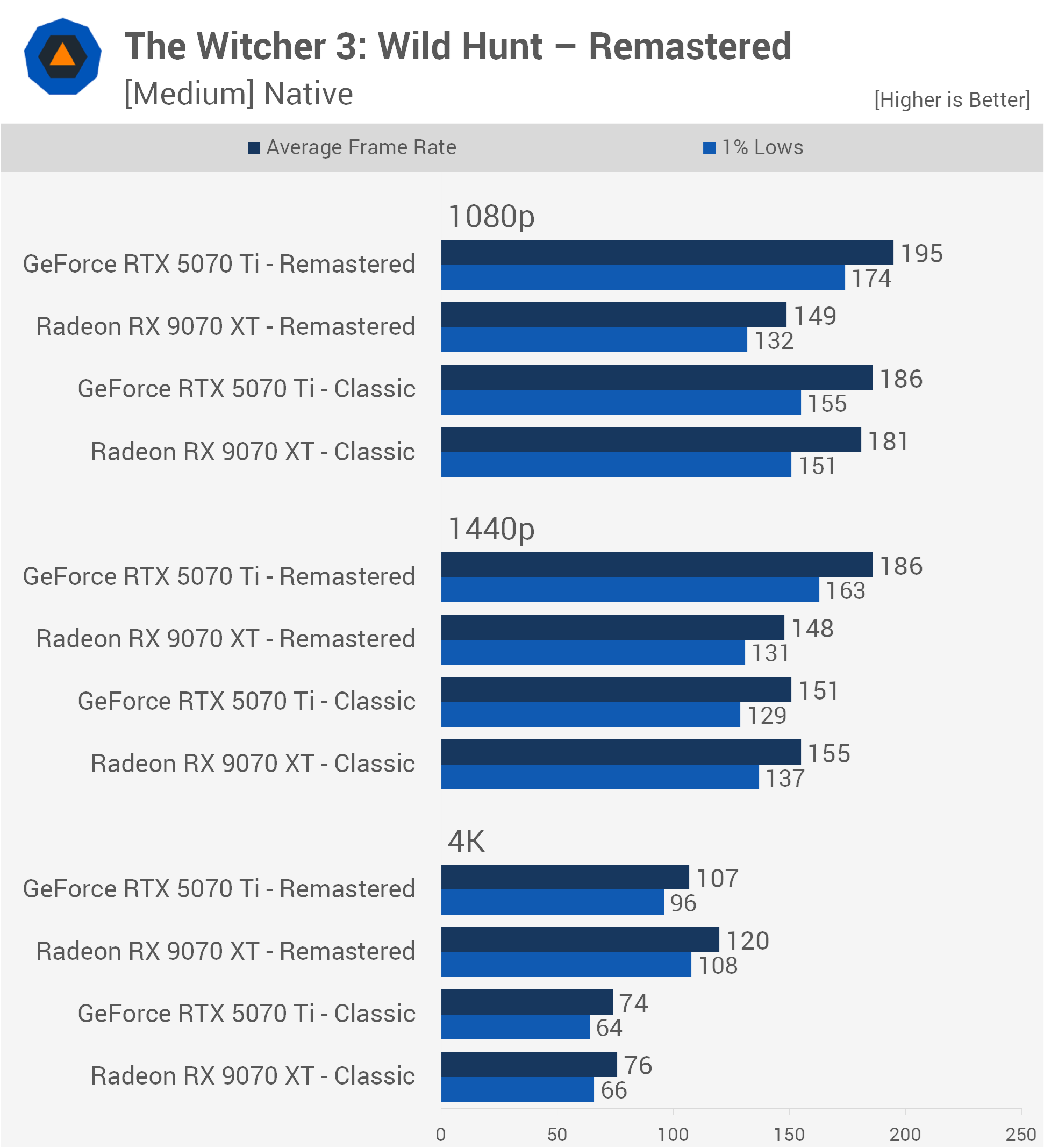
Even so, the RX 9070 XT was still good for 149 fps, and an 8GB RX 9060 XT can achieve a similar level of performance, as we'll see shortly. More interestingly, the RTX 5070 Ti was 5% faster running the much better-looking Remastered version than it was running the original game.
At 1440p, the RX 9070 XT and RTX 5070 Ti were again neck and neck in the original game. Switching to the Remastered version sees the 5070 Ti pull 26% ahead. More importantly, the RTX 5070 Ti was 23% faster running the Remastered version than the 11-year-old original.
At 4K, performance finally falls below the artificial Radeon limit of roughly 148 to 149 fps. Here, both GPUs are substantially faster in the Remastered version, with the RX 9070 XT actually beating the RTX 5070 Ti by 12%.
The scaling is certainly unusual, but one thing is clear: at Medium settings, the Remastered game not only looks significantly better, it can also run dramatically faster. In this example, performance improved by roughly 45 to 58%.
Current-Generation GPU Benchmarks
Now let's look at how the current GeForce, Radeon, and Arc GPUs perform across the various quality presets.
Ultra Quality
Starting with Ultra at 1080p, the RTX 5090 averaged 183 fps, making it just 6% faster than the RTX 5080 and 20% faster than the RTX 5070 Ti. The RTX 5070 Ti was 8% faster than the RX 9070 XT, though that margin is likely influenced by the Radeon performance limitation. You can see how compressed the average and 1% low results are across AMD's high-end GPUs.
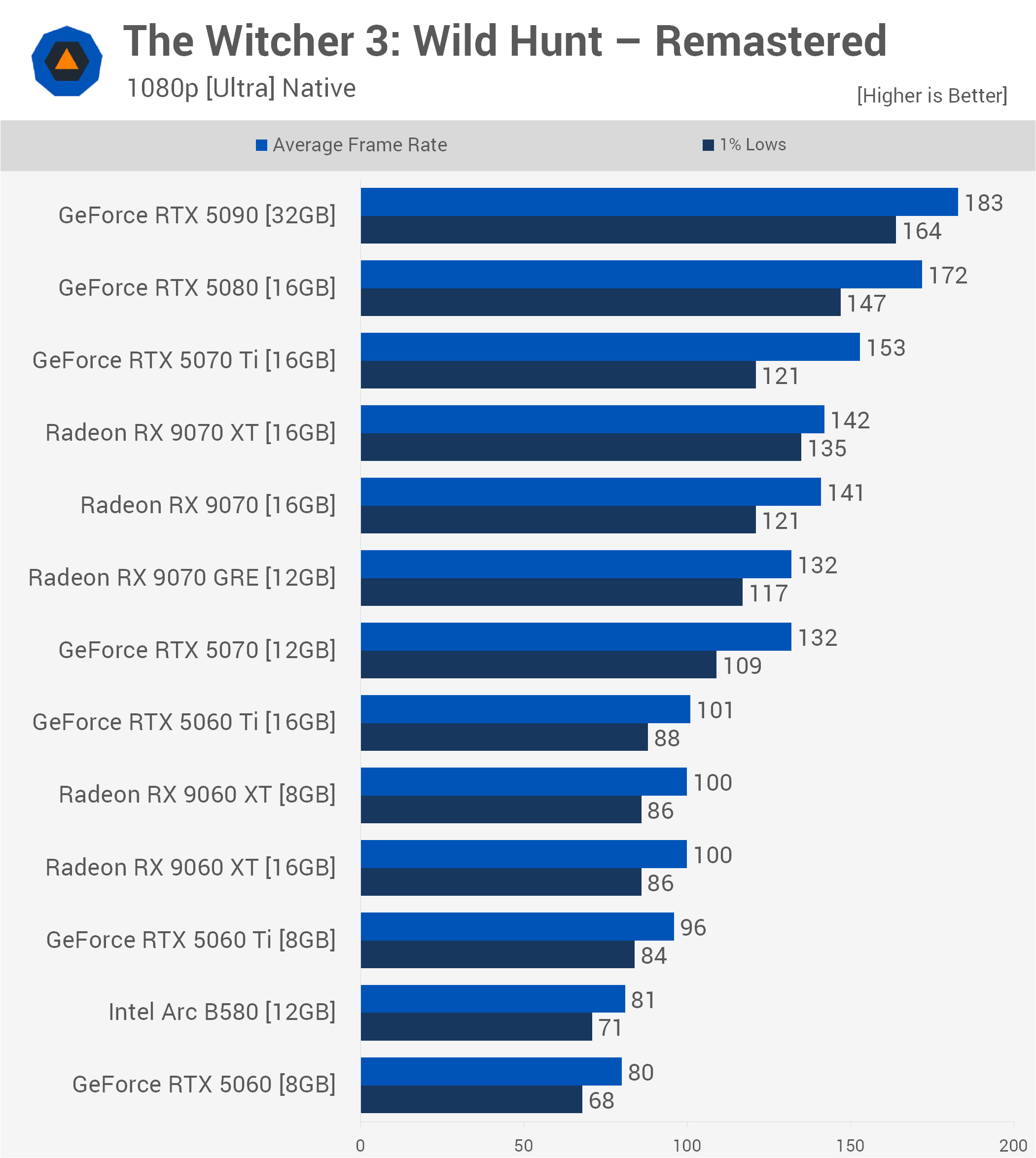
The RX 9070 XT and RX 9070 achieved the same average frame rate, despite the XT producing 12% stronger 1% lows. The RX 9070 GRE also matched the RTX 5070, while the RTX 5060 Ti and RX 9060 XT models were neck and neck.
Performance was also very similar between the 8GB and 16GB versions at these settings. Finally, the Arc B580 and RTX 5060 both delivered roughly 80 fps.
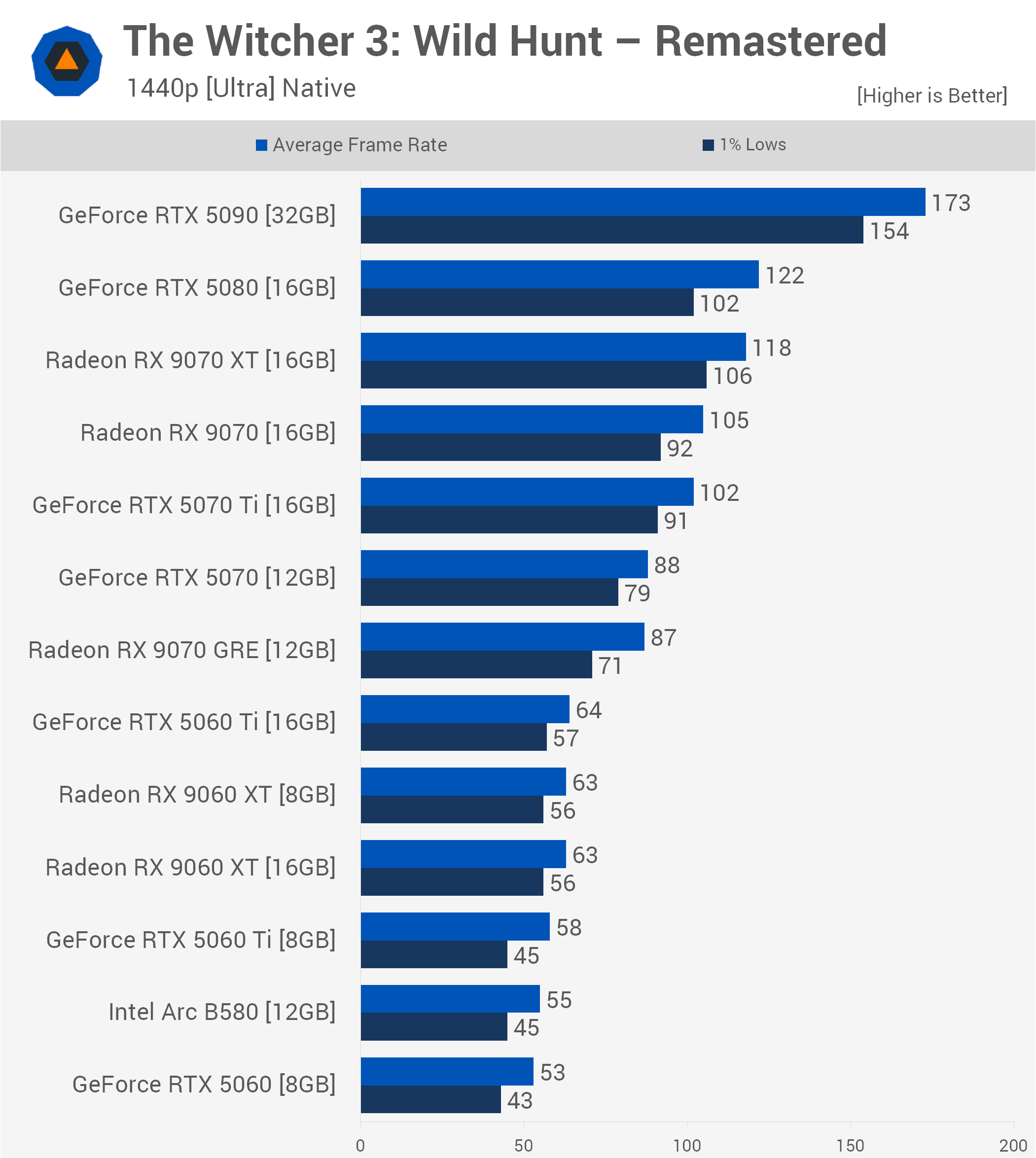
Increasing the resolution to 1440p changes the results considerably. The RTX 5090 is finally able to stretch its legs, extending its lead over the RTX 5080 to 42%. The RX 9070 XT also looks much stronger here. The RTX 5080 was just 3% faster, while the Radeon flagship beat the RTX 5070 Ti by 16%. In fact, the RTX 5070 Ti only managed to match the RX 9070. The RX 9070 GRE and RTX 5070 remained very evenly matched.
Both RX 9060 XT models averaged 63 fps, but the reduced PCIe bandwidth of the RTX 5060 Ti hurt the 8GB model. It was almost 10% slower in average frame rate and a little over 20% slower in the 1% lows compared with the 16GB version.
As a result, the RTX 5060 Ti 8GB wasn't much faster than the standard RTX 5060 and only narrowly edged out Intel's Arc B580.
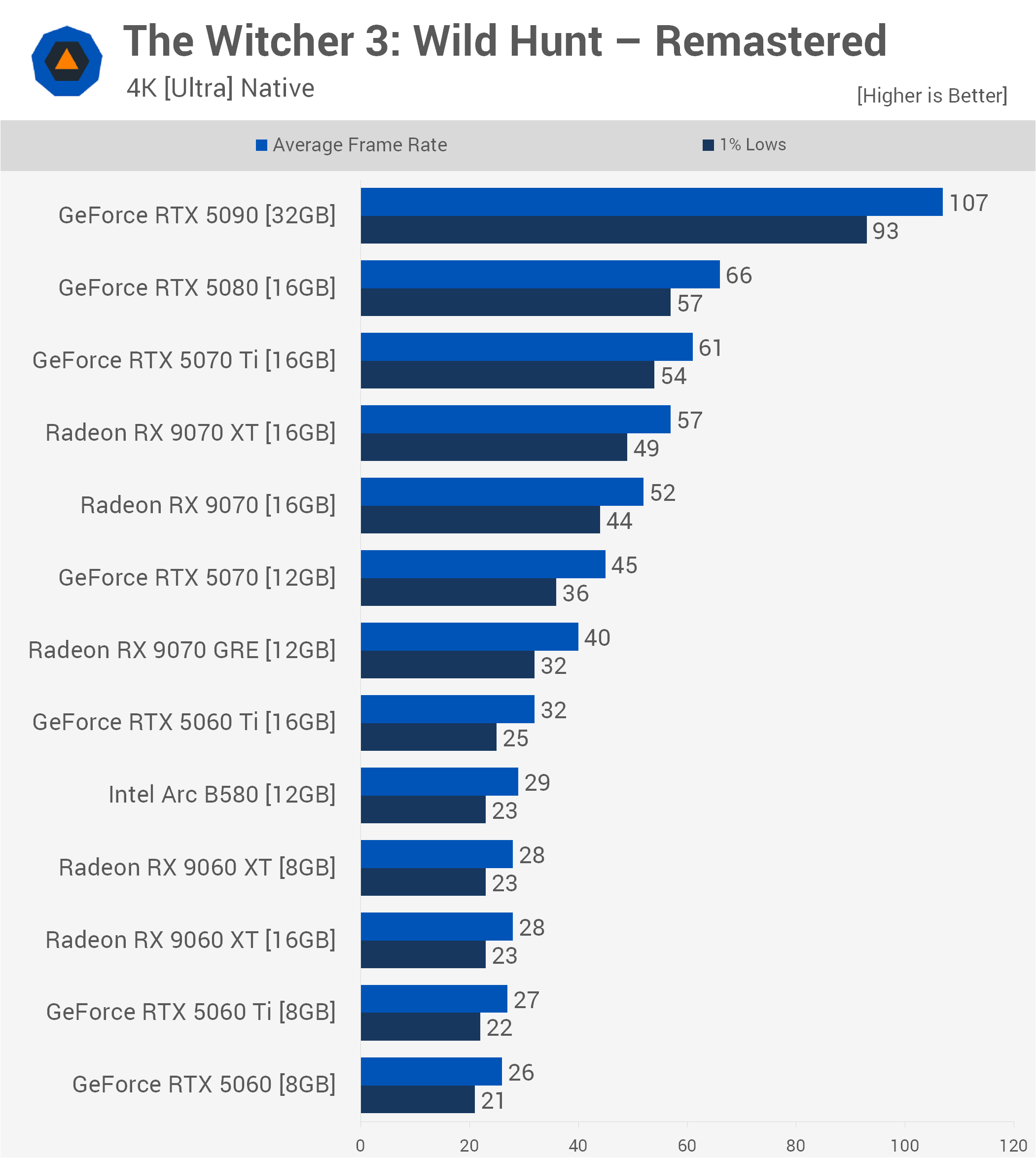
At 4K, most of these GPUs will benefit from upscaling. The RTX 5090 needs no such help, averaging 107 fps. That makes it 62% faster than the RTX 5080 and 75% faster than the RTX 5070 Ti, which averaged 61 fps. Beyond that, performance drops below 60 fps, including with the RX 9070 XT, so enabling upscaling will make sense for most GPUs at this resolution.
RT Ultra
Moving to the RT Ultra preset at 1080p, the high-end GeForce GPUs slam into a roughly 94 fps performance barrier, along with the RX 9070 XT. This appears to be some kind of game or system limitation. The first GPU to fall below that ceiling is the RTX 5070 at 87 fps, making it 7% faster than the RX 9070.
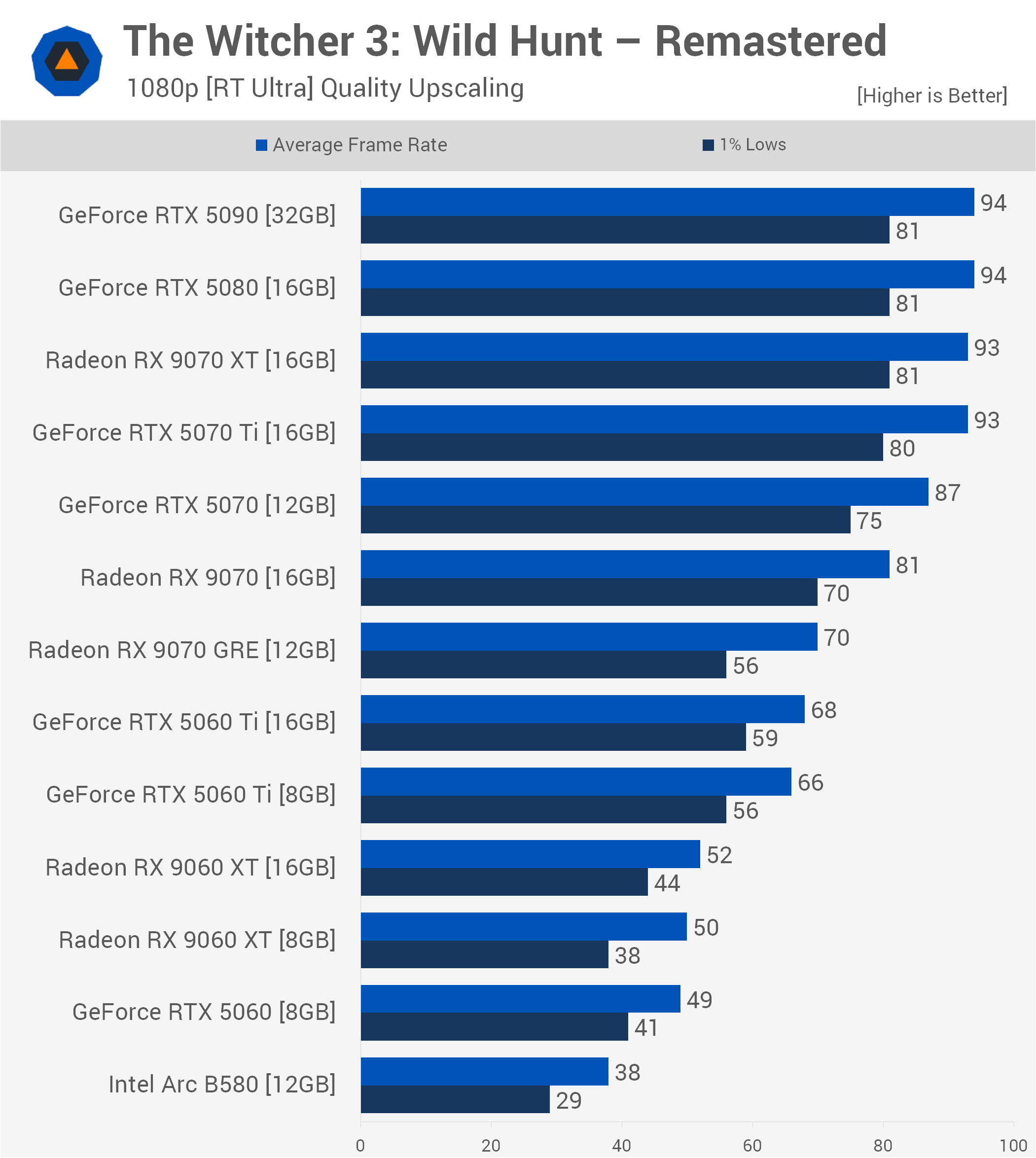
The RX 9070 GRE falls much further behind, averaging 70 fps and making it 20% slower than the RTX 5070. The RTX 5060 Ti also comfortably beats the RX 9060 XT, delivering 31% more performance.
That leaves the Radeon GPU only slightly ahead of the standard RTX 5060. Intel's Arc B580 struggled once ray tracing was enabled, averaging just 38 fps while using Quality FSR upscaling at 1080p.
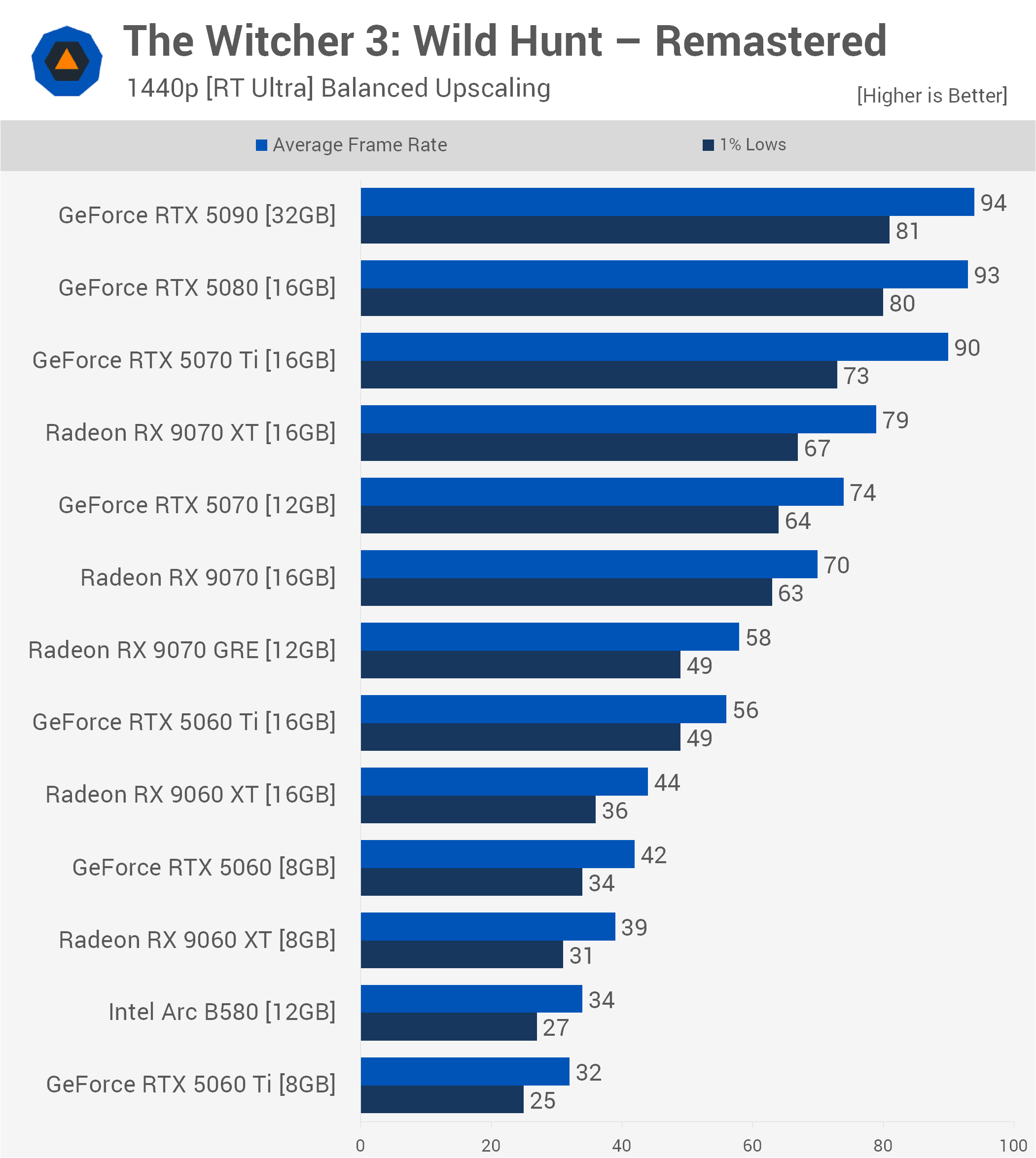
At 1440p, the strange performance ceiling persists for the top-end Nvidia GPUs. The RTX 5090 and RTX 5080 both hit the 93 to 94 fps wall, while the RTX 5070 Ti follows closely at 90 fps. The RX 9070 XT delivers 79 fps, leaving it behind the 5070 Ti.
Further down the stack, the RTX 5070 maintains a slight lead over the RX 9070, averaging 74 fps compared with 70 fps. VRAM capacity has a dramatic impact toward the lower end of the chart. The RTX 5060 Ti 16GB achieves 56 fps, while the 8GB version collapses to just 32 fps, placing it at the very bottom of the chart below the Arc B580.
Likewise, the RX 9060 XT 16GB comfortably outperforms the 8GB model.
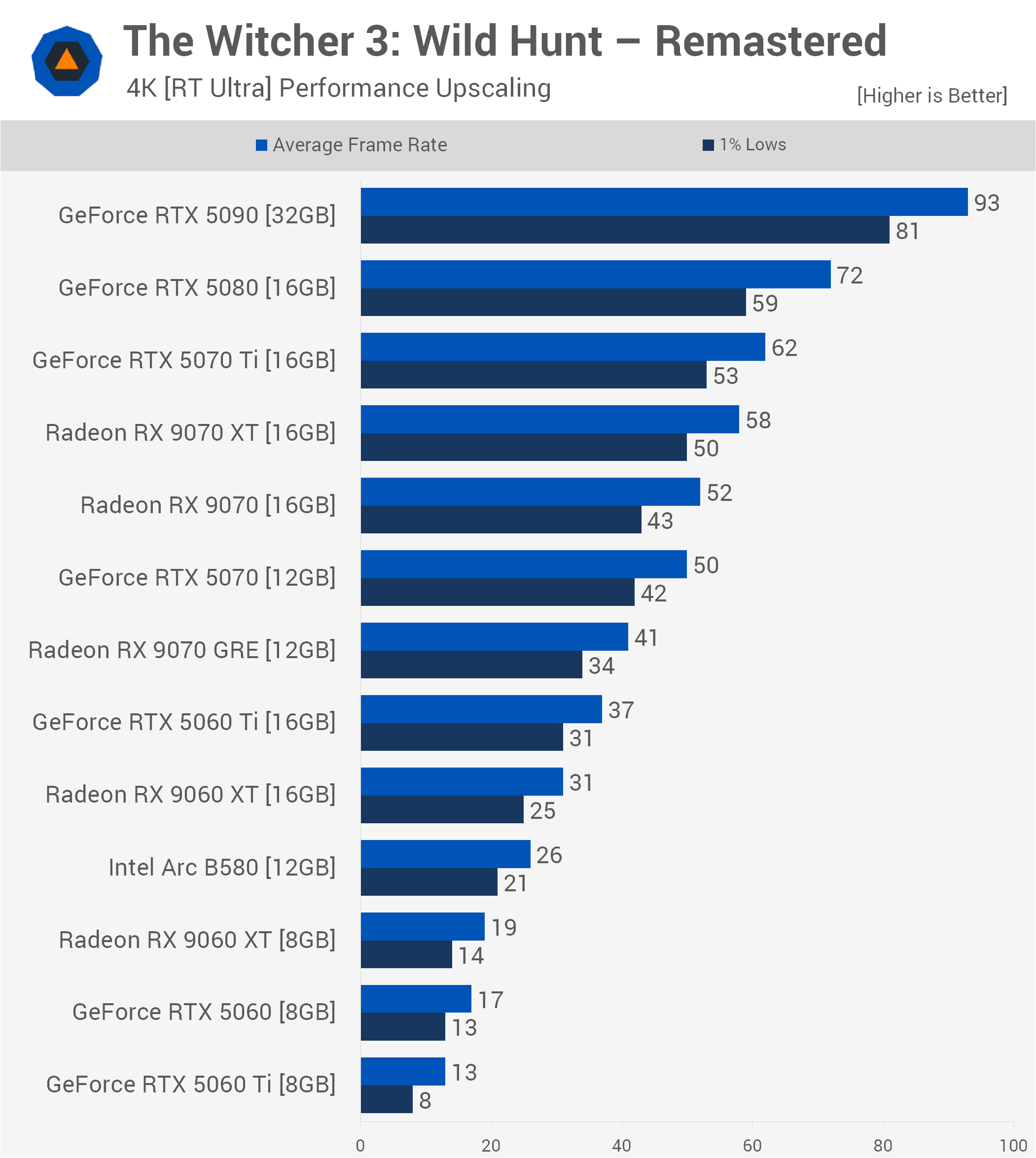
At 4K with Performance upscaling enabled, the upper-end bottleneck finally disappears. The RTX 5090 pulls away with 93 fps on average, followed by the RTX 5080 at 72 fps and the RTX 5070 Ti at 62 fps. The RTX 5070 Ti edges out the RX 9070 XT by 7%.
Further down, the RX 9070 narrowly beats the RTX 5070 with 52 fps versus 50 fps. Memory limitations become severe for the lower-tier GPUs.
The RTX 5060 Ti 16GB delivers a somewhat playable 37 fps, while the 8GB version falls apart at just 13 fps, even trailing the RTX 5060 and Arc B580. The RX 9060 XT 8GB experiences a similar problem, dropping to 19 fps compared with 31 fps for the 16GB model.
RT Ultra + Path Tracing
With path tracing and Quality upscaling enabled at 1080p, another unusual performance ceiling appears for the high-end Nvidia GPUs. The RTX 5090 and RTX 5080 both hit a hard limit of just 62 fps, while the RTX 5070 Ti follows at 61 fps.
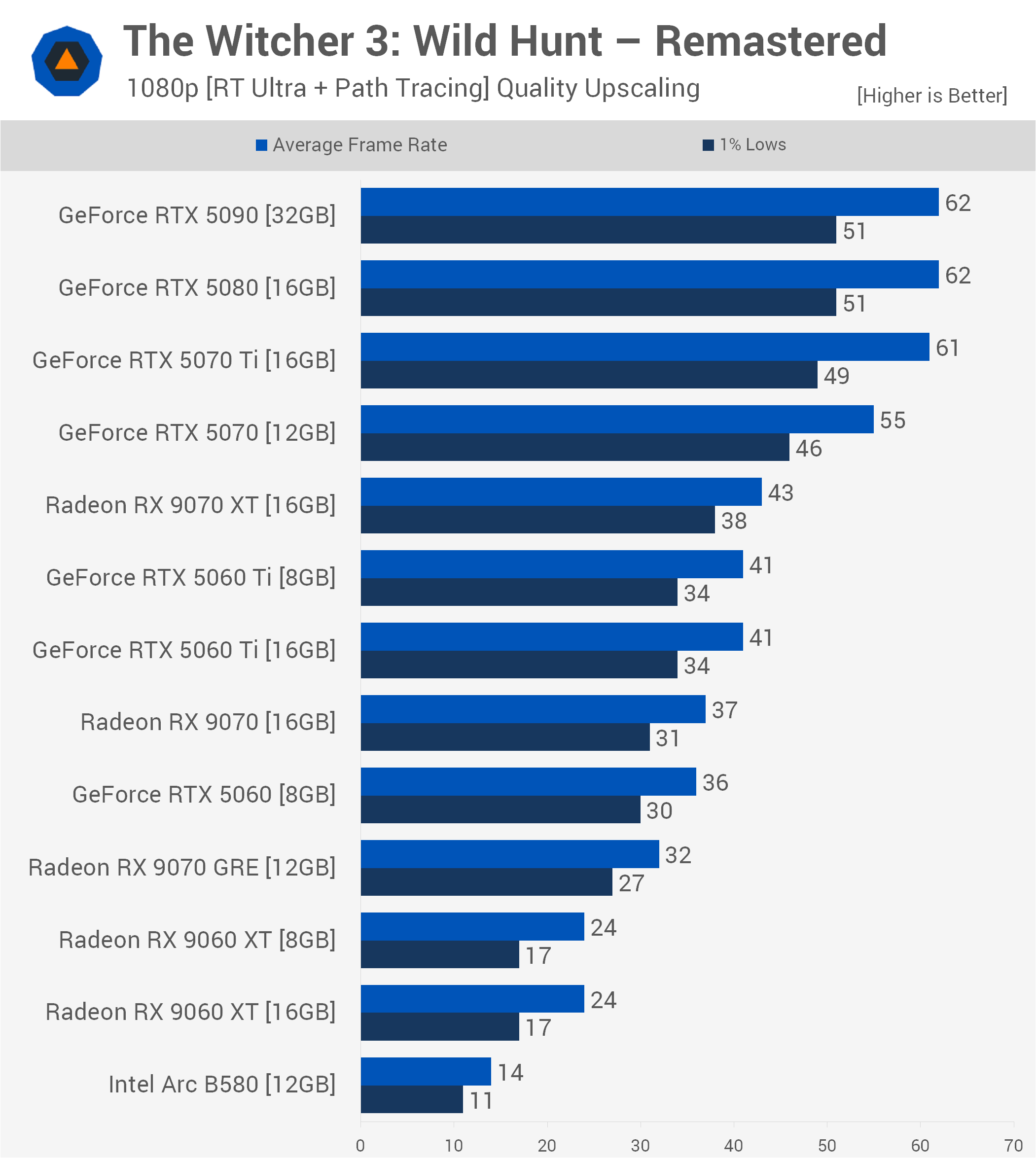
AMD's RX 9070 XT struggles considerably, averaging just 43 fps. That allows the RTX 5060 Ti models to close the gap at 41 fps.
The RX 9070 manages 37 fps, only narrowly beating the RTX 5060 at 36 fps. At the bottom of the chart, both RX 9060 XT models deliver unplayable averages of around 24 fps, while Intel's Arc B580 manages just 14 fps.
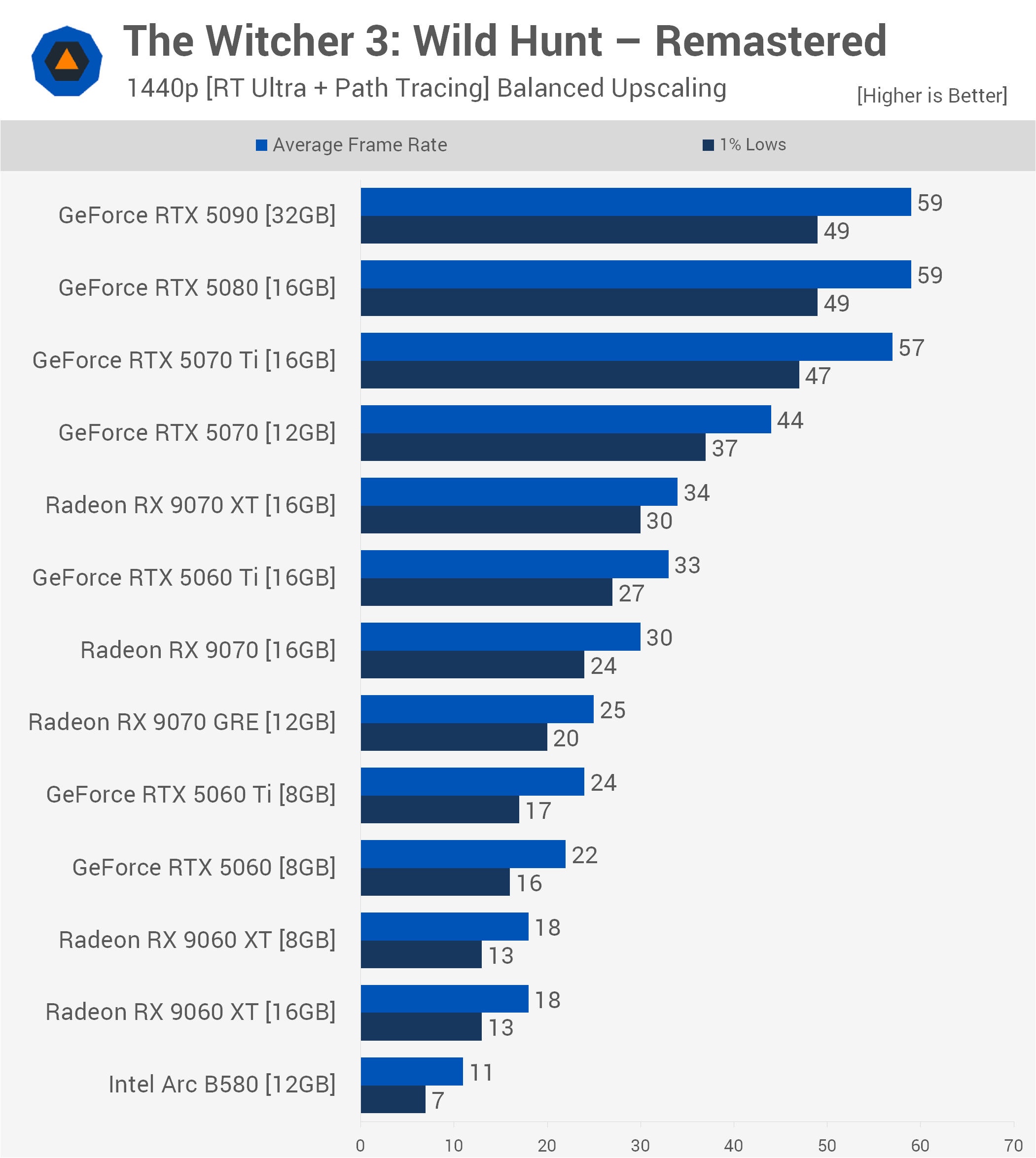
At 1440p using Balanced upscaling, the artificial ceiling remains. The RTX 5090 and RTX 5080 top out at 59 fps, with the RTX 5070 Ti just behind at 57 fps. Radeon GPUs fall much further behind when path tracing is enabled.
The RX 9070 XT averages only 34 fps, effectively tying the RTX 5060 Ti 16GB at 33 fps. The RX 9070 manages 30 fps, well behind the RTX 5070 at 44 fps. VRAM capacity doesn't rescue the RX 9060 XT models here either. Both the 8GB and 16GB versions fall to 18 fps, while the Arc B580 sits at the bottom of the chart with just 11 fps.
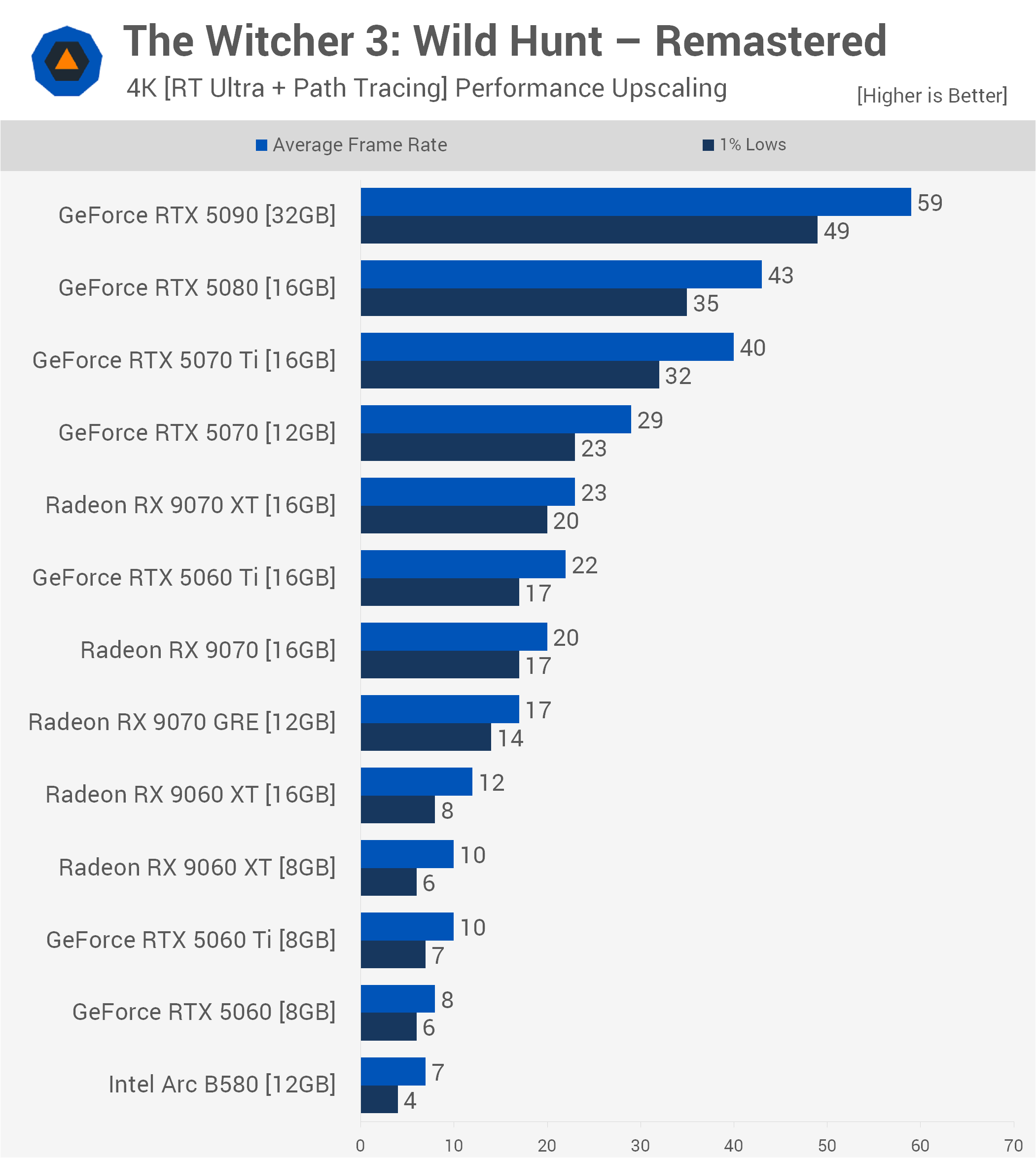
At 4K with Performance upscaling, the engine bottleneck finally lifts and the RTX 5090 pulls ahead with a 59 fps average. The RTX 5080 follows at 43 fps, while the RTX 5070 Ti manages 40 fps. Path tracing absolutely crushes the Radeon lineup at this resolution.
The RX 9070 XT manages just 23 fps, effectively matching the RTX 5060 Ti 16GB at 22 fps. VRAM limitations are again obvious toward the bottom of the chart. The RTX 5060 Ti 8GB collapses to just 10 fps, well behind the 16GB model.
The RX 9060 XT 8GB also manages only 10 fps, while the 16GB version reaches 12 fps. Intel's Arc B580 produces just 7 fps on average.
Medium Quality
Using the Medium preset at 1080p reveals another bizarre performance ceiling. The RTX 5090, RTX 5080, RTX 5070 Ti, and RTX 5070 are all limited to roughly 194 to 198 fps. The Radeon lineup suffers from a similar but much lower artificial ceiling.
The RX 9070 XT, RX 9070, RX 9070 GRE, and both RX 9060 XT models all flatten out between roughly 147 and 149 fps.
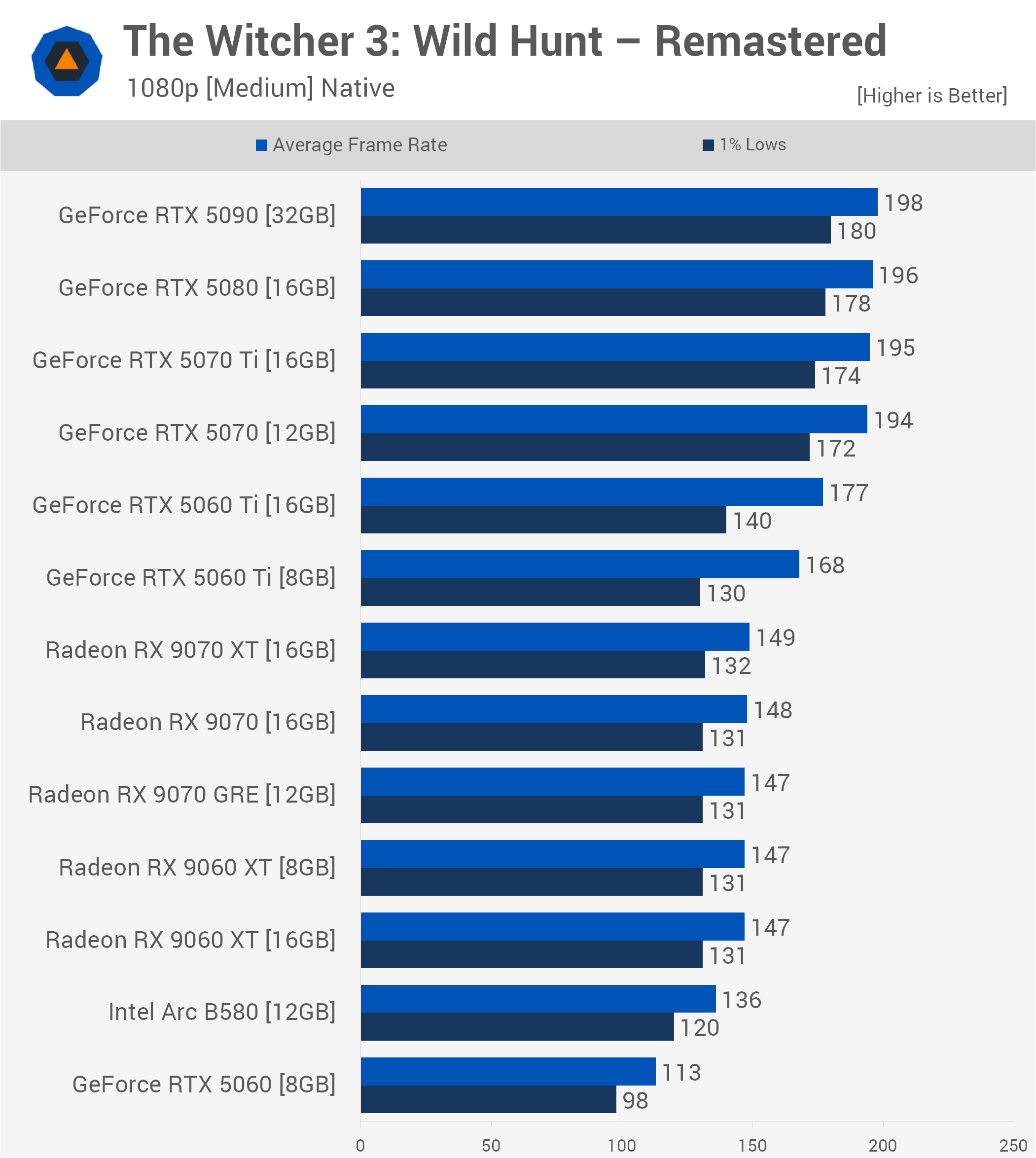
Because of this limitation, the mid-range RTX 5060 Ti 16GB easily outpaces AMD's flagship, delivering 177 fps. At the bottom of the stack, Intel's Arc B580 manages 136 fps, keeping it comfortably ahead of the standard RTX 5060 at 113 fps. Testing outside Novigrad does increase performance, but the unusual scaling remains.
In a more open area, the GeForce GPUs topped out at around 270 fps, while Radeon GPUs ran into their limit much earlier at roughly 180 fps. Something unusual is clearly happening here.
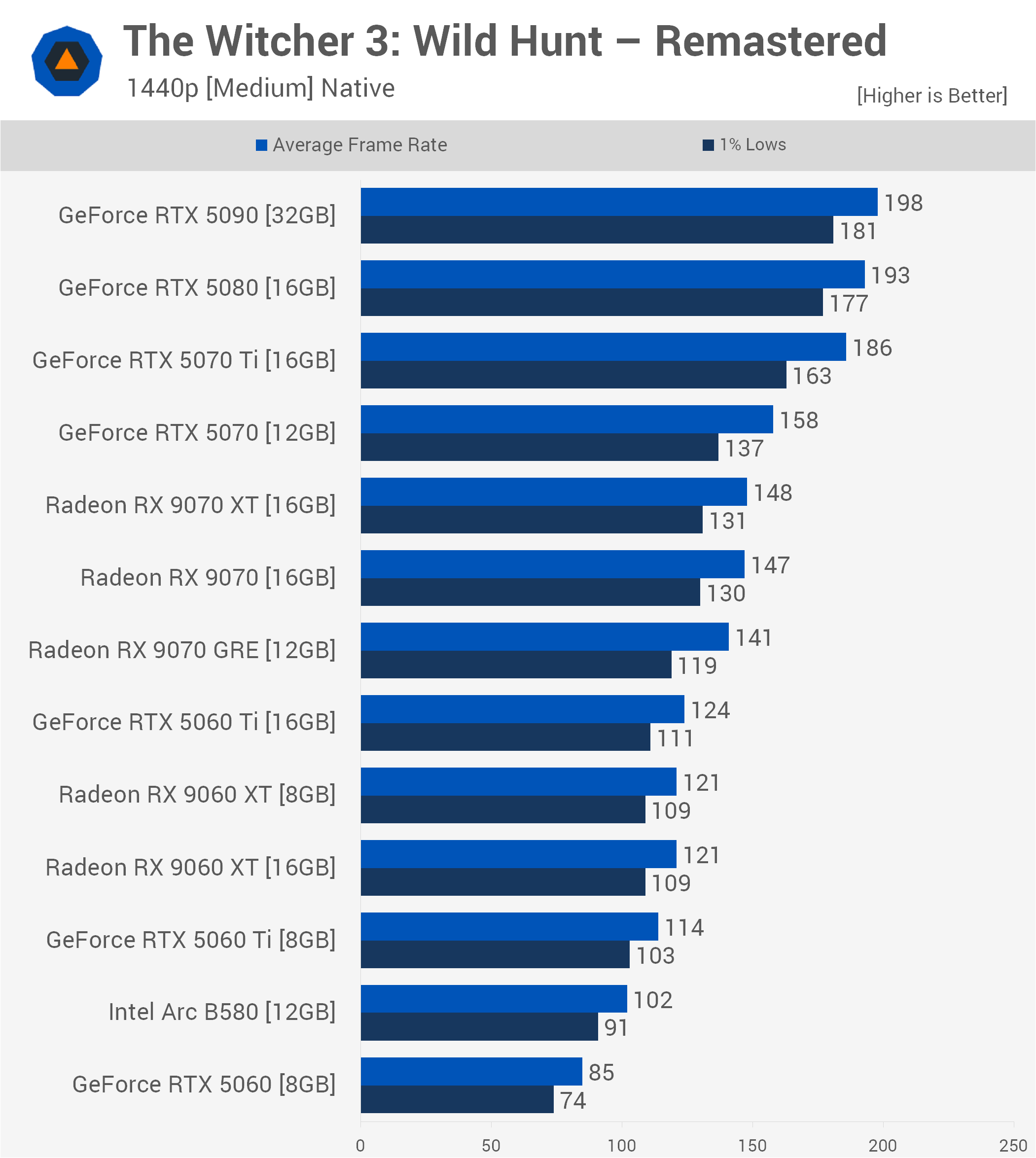
Moving to 1440p Medium, the Nvidia performance cap begins to lift slightly. The RTX 5090 reaches 198 fps, followed by the RTX 5080 at 193 fps and the RTX 5070 Ti at 186 fps. The artificial limitation affecting the high-end Radeon cards persists, however.
The RX 9070 XT and RX 9070 remain bottlenecked at 148 fps and 147 fps, respectively. This allows the RTX 5070 to easily surpass both with an average of 158 fps.
Further down the chart, the 16GB and 8GB versions of the RX 9060 XT both average 121 fps, placing them between the 16GB and 8GB RTX 5060 Ti models. The Arc B580 also maintains a comfortable lead over the standard RTX 5060.
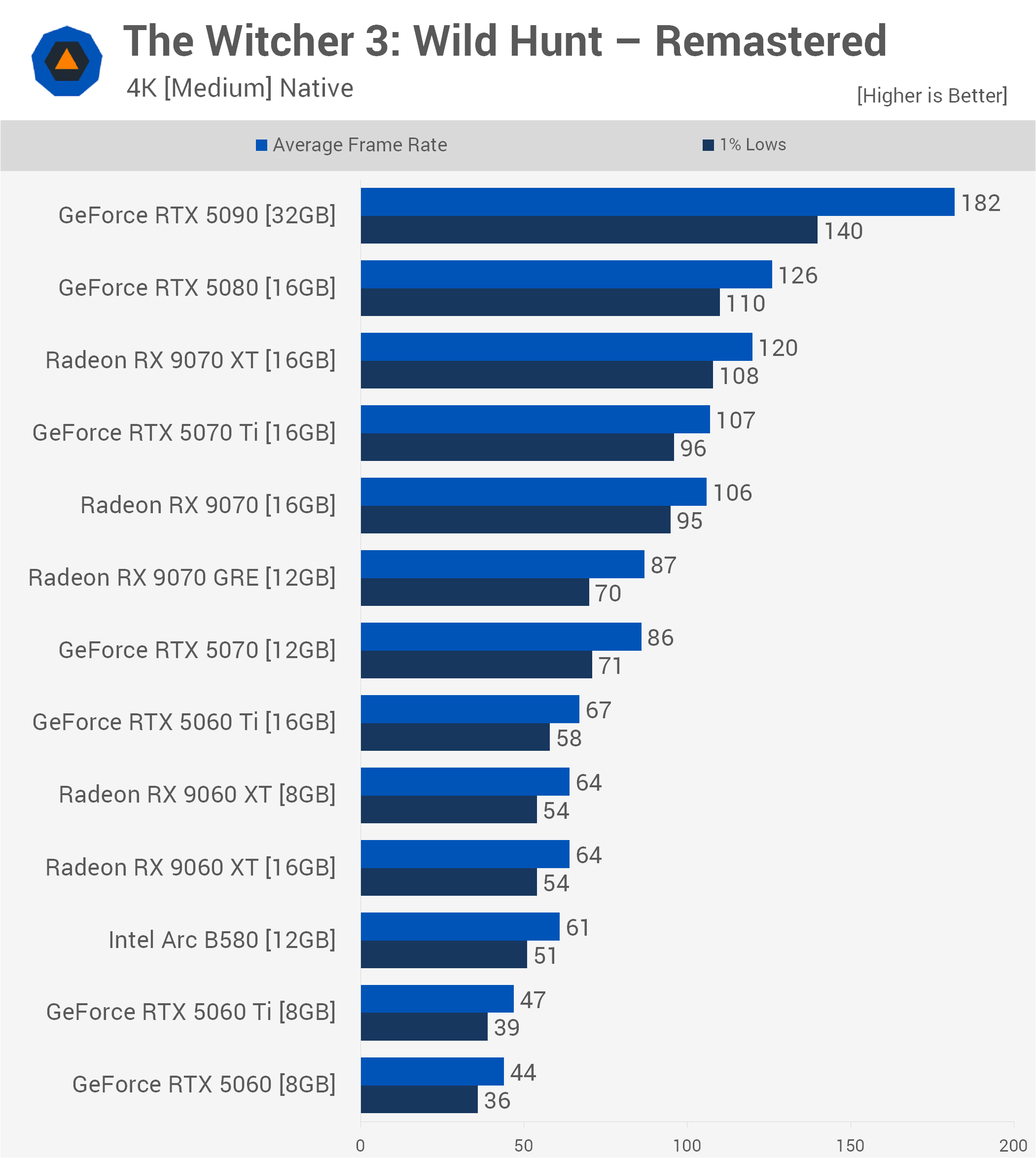
At native 4K, the unusual performance ceilings finally disappear and the hardware begins scaling normally. The RTX 5090 stretches its legs with an impressive 182 fps average. The RTX 5080 follows at 126 fps, narrowly holding off the RX 9070 XT at 120 fps.
The RTX 5070 Ti and RX 9070 are virtually neck and neck, producing 107 fps and 106 fps, respectively. Memory capacity once again becomes important at this resolution.
The RTX 5060 Ti 16GB maintains a playable 67 fps, while the 8GB version falls to just 47 fps, placing it near the bottom of the chart. Interestingly, thanks to their greater PCIe bandwidth, the 8GB and 16GB RX 9060 XT models both produce 64 fps, keeping them slightly ahead of Intel's Arc B580 at 61 fps.
A Better-Looking Witcher 3 That Often Runs Faster
Visually, The Witcher 3 Remastered is certainly improved, though the difference isn't always massive. Some players will probably prefer aspects of the original presentation, particularly when it comes to lighting, and much of this remains highly subjective.
Path tracing is considerably less convincing. In our view, it's surprisingly underwhelming in this game and can sometimes make the image look noticeably worse. Perhaps that's something that can be improved with future updates.
From a performance perspective, one of the most impressive aspects of the update is what happens at lower quality settings. At 4K using the Medium preset, we saw major performance gains compared with the original game: 36% for the RTX 5070 Ti and 45% for the RX 9070 XT.
That's particularly encouraging for gamers using lower-end GPUs, as the Remastered version can deliver substantially better performance while also looking better at Medium settings.

There are, however, some obvious performance oddities. In Novigrad with path tracing enabled, frame rates struggle to climb much beyond 60 fps even with the RTX 5090. Radeon GPUs also hit an apparent performance ceiling much earlier than their GeForce counterparts when using lower quality settings.
Interestingly, when testing path tracing at 1080p using the RTX 5090, CPU utilization peaked at only around 35%, with none of the Ryzen 7 9800X3D's cores getting anywhere near 100% utilization.
Moving outside Novigrad and away from the city increases the path-tracing ceiling from around 60 fps to roughly 80 fps, but even there the RTX 5090 is no faster than the RTX 5080.
The good news is that the game is very easy to run using Medium quality settings. At native 1440p, a relatively affordable GPU such as the Arc B580 averaged 102 fps. The RX 9060 XT 8GB also performed very well, delivering 121 fps under the same conditions.
Those looking for a ray-traced experience will need considerably more GPU power. The RX 9070 GRE averaged 58 fps at 1440p with Balanced upscaling, while the RX 9070 was considerably faster at 70 fps. The latter can currently be found for around $650, which is relatively attractive in the current GPU market.
If you don't care about ray tracing, however, the Remastered version is remarkably easy to run at Ultra settings. At 1440p, even the RX 9060 XT 8GB manages just over 60 fps, while the RX 9070 pushes beyond 100 fps.
So although the rendering upgrades introduce a few strange bottlenecks and path tracing isn't particularly convincing, the broader performance story is very positive.
The Witcher 3 Remastered looks better, can run exceptionally well without ray tracing, and in some cases is actually faster than the original game it replaces.