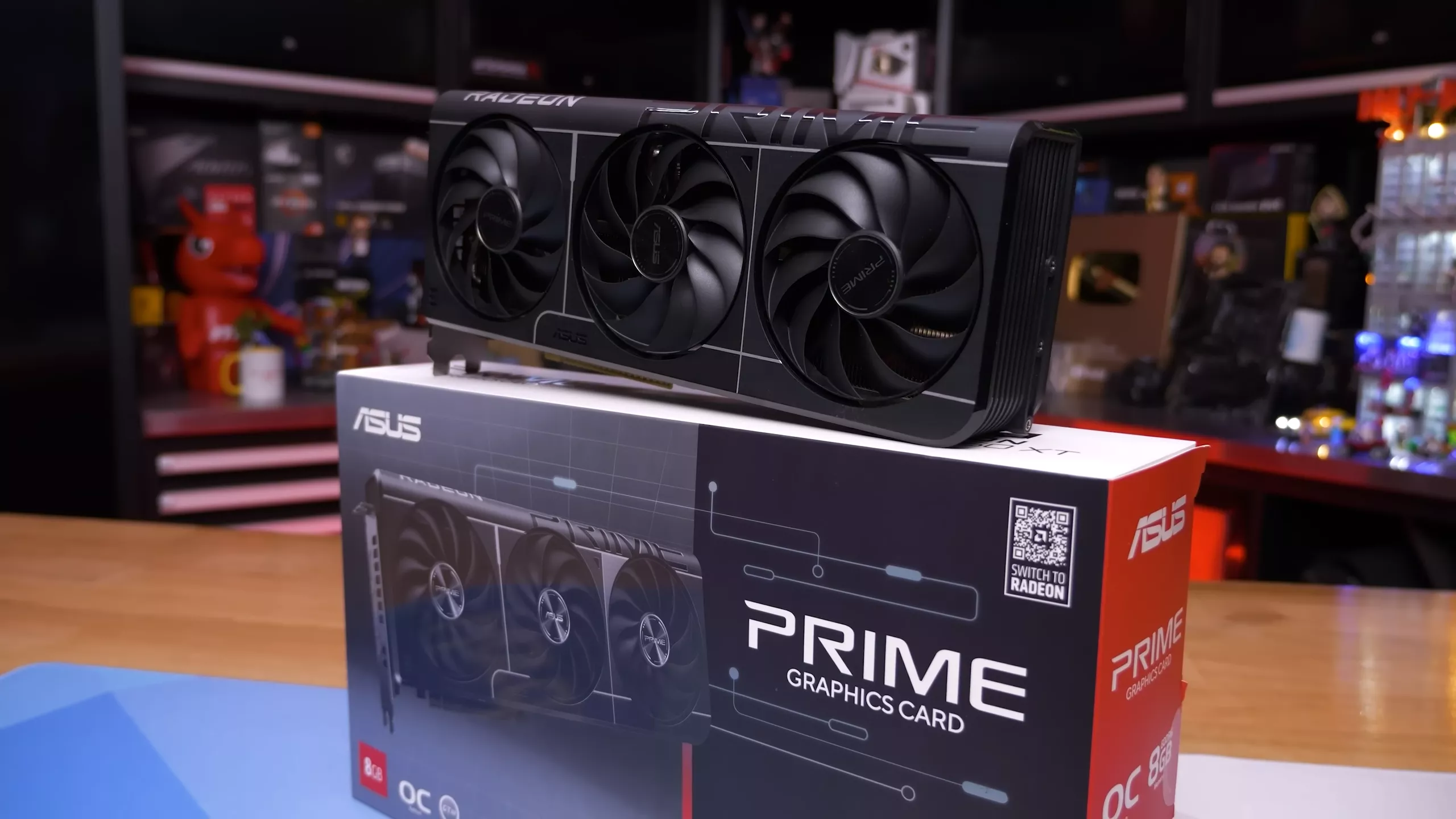
AMD Radeon RX 9060 XT PCIe Comparison: 8GB vs. 16GB

Interesting setup. Can you please show a test where you use the best settings for the 8GB that do not cause memory issues and compare the quality to the "standard" settings for the 16GB card? I'm sure we can run current games on 8GB cards with some (texture?) quality sacrifices but would be interesting how that translates in visual quality differences. Are they noticeable?
 
My 8700K@5Ghz and even older like my [email protected] or even i7 [email protected] do just fine @1080p and 4K; on average I can't tangibly tell much difference vs my i7 13700KF using RTX 4080 Super, RX 7900XT, RTX 3080Ti, RTX 2080Ti, Titan Xp, or 1080Ti. Here's a few with the RTX 4080 Super and CPUs from 13700KF back to the 2008 i7 920:
b0urBn9.jpeg

43jULlZ.jpeg

kbgHxEU.jpeg

rzpJmWp.jpeg

uu4jNm3.jpeg
 
Last edited:
A chart would have been nice...

Also, I can easily see that you guys focused on a mere sample to give weight to your narrative. You literally cherry picked what was going your way...

Ironically, Tims, I quote him, is recommending to buy a 12GB over a 16GB GPU for playing at 1440p and 2160p...

"In most regions, however, you'll need to pay 20% more (instead of 9%) to get the RX 9070 XT over the RTX 5070, which flips the value equation – making the RTX 5070 the superior choice. "

However, you slam AMD for having a 9060 XT 8GB variant aimed for the 1080p users. So why are you focusing on 1440p? Upscaling is having a non-negligible impact on memory, so basically your comparison is flawed!

And once again... explain me this...

average-fps-1920-1080.png


You guys are just making no sense lately. Be better...
 
Last edited:
By the way, I am fine with 8GB of VRAM for an entry GPU aimed for 1080p usage, because you know you are going to make compromises. I am NOT fine for a 70 class GPU, costing above 550$, having 12GB of VRAM aimed at 1440p and 2160p usage, because you are not expecting to make compromises.

Remember, the 5070 == 4090... Nvidia told us!
 
Interesting setup. Can you please show a test where you use the best settings for the 8GB that do not cause memory issues and compare the quality to the "standard" settings for the 16GB card? I'm sure we can run current games on 8GB cards with some (texture?) quality sacrifices but would be interesting how that translates in visual quality differences. Are they noticeable?
I think the reason he did it this way was because these cards will likely be going into old system for people on a budget.

Realistically, I see this problem mostly being solved by just turning the textures down. Low textures these days are high textures from 10 years ago. And, frankly, fancy lighting will make up for the fact that youre running "low" textures.

Is this ideal? No, but its also not the end of the world. Only thing I'll say is that the 8GB cards need to be cheaper to justify their handicap.

I know of a saying "there are no bad products, only bad prices." While that saying has its limits, I think 8GB cards can work within those limits.
 
I think the reason he did it this way was because these cards will likely be going into old system for people on a budget.

Realistically, I see this problem mostly being solved by just turning the textures down. Low textures these days are high textures from 10 years ago. And, frankly, fancy lighting will make up for the fact that youre running "low" textures.

Is this ideal? No, but its also not the end of the world. Only thing I'll say is that the 8GB cards need to be cheaper to justify their handicap.

I know of a saying "there are no bad products, only bad prices." While that saying has its limits, I think 8GB cards can work within those limits.
Gimping a GPU is pretty bad. There is no reason a 8GB 9060xt should exist, the GPU cannot stretch its legs with such a limitations.

8GB should be limited to a 9050 class card and be under $200.
 
Hello

I think maybe AMD's thinking is the 8GB version would be used at 1080p by most users buying the 8GB version of the card. I am not sure but does the 8GB version also have a lower power rating than the 16GB version. If this is the case that would also account for some of the lower performance. I should say also I think personally 8GB cards should not exist because the new games are taking way more vram these days.
 
However, you slam AMD for having a 9060 XT 8GB variant aimed for the 1080p users. So why are you focusing on 1440p?
Could you please provide an example where AMD has explicitly mentioned that the 8GB variant is designed for 1080p gaming? I cannot seem to find it. As a (singular) example, the formal announcement during Computex 2025 lumps the two together and makes no mention of 1080p, only 1440p.

(emphasis added)
The new Radeon RX 9060 XT GPUs are powered by the advanced AMD RDNA™ 4 architecture and deliver smooth, responsive 1440p gaming...

I am not disagreeing with the reasoning that 8GB is still useful/viable for 1080p gaming when it means getting acceptable frame rates at a lower cost. Anything that reasonably lowers the cost of entry for PC gaming is welcome in my book. However the marketing for the 9060 XT family, the almost complete reliance of DLSS at 1080p with cherry picked settings for the RTX 5060 family, and pricing on both do not mesh with the reality of what gamers are expecting to get if they are upgrading, or provide enough justification to not get the 16GB or something with significantly higher performance if they have the monetary wiggle room to do so.

Speaking of cherry picking:
Ironically, Tims, I quote him, is recommending to buy a 12GB over a 16GB GPU for playing at 1440p and 2160p...

"In most regions, however, you'll need to pay 20% more (instead of 9%) to get the RX 9070 XT over the RTX 5070, which flips the value equation – making the RTX 5070 the superior choice. "
The full quote of that statement is:
The inflated pricing of the RX 9070 XT has had a knock-on effect on the rest of the mid-range. At MSRP, the RX 9070 XT should be the card to get over both the RTX 5070 Ti and the RTX 5070; it is just 9% more expensive than the RTX 5070 while offering better performance, better cost per frame, and more VRAM.

In most regions, however, you'll need to pay 20% more (instead of 9%) to get the RX 9070 XT over the RTX 5070, which flips the value equation – making the RTX 5070 the superior choice. The RTX 5070 is widely available at MSRP, while the RX 9070 XT is not, effectively pushing the RX 9070 XT into a higher tier when it really should still compete in the same tier as the RTX 5070.
I would have probably used the phrasing "price bracket" instead of tier, but the point being made is not that the RTX 5070 is better in performance than the 9070 XT, but that the RTX 5070 is more affordable/better cost per frame given then current market prices.

I am not sure but does the 8GB version also have a lower power rating than the 16GB version. If this is the case that would also account for some of the lower performance.
The difference (for reference models) is 150W for the 8GB model and 160W for the 16GB model. I imagine the 10W difference has an almost negligible impact of performance, or at least not enough of an impact to matter.
 
Last edited:
A chart would have been nice...
Also, I can easily see that you guys focused on a mere sample to give weight to your narrative. You literally cherry picked what was going your way...

You guys are just making no sense lately. Be better...

Several games were tested in the review and now this extensive testing... doesn't seem like a "mere sample".

Instead, I believe there’s a pro-AMD (or pro-Nvidia) narrative being supported by some readers, depending on which company they personally prefer. From what I see on TechSpot, however, the criticism is directed toward anti-consumer behavior or poor value -- regardless of the brand.

In this particular case, they clearly explain and demonstrate how regular benchmark charts can hide important facts when VRAM runs out (e.g., lower image quality), hence the extra testing.

Here are my takeaways, summarizing TechSpot’s own conclusions:

  • * The 8GB RX 7600 XT is not worth the small savings compared to the 16GB version.
  • * The 8GB RX 7600 XT should be called something like the Radeon RX 7500 to reflect its significantly different performance.
  • * The "8GB RX 7600 XT" branding is misleading and anti-consumer. TechSpot is trying to raise awareness so fewer people are confused—or misled—by it.
 
Gimping a GPU is pretty bad. There is no reason a 8GB 9060xt should exist, the GPU cannot stretch its legs with such a limitations.

8GB should be limited to a 9050 class card and be under $200.
I understand this sentiment, but most of the VRAM is taken up by textures and texture processing. I don't think names really matter anymore, nVidia has shown us that naming means nothing and AMD hasn't ever really had an established naming scheme. I think what's most important is the price. it should be $250 tops, or they could have at least dropped the "XT" naming on it. That said, it is holding steady at about $100 less than the 16GB model.

The thing is, people like us aren't buying these cards. If you literally only have $300 to spend on a graphics card, what would you buy? As hobbyists and adults with adult incomes, we can afford basically whatever we want. There is a market for people with hard budgets. If you're someone who can afford "options", this is an awful buy. If you are someone who can't afford to have options, an 8GB 9060 might be a blessing. if a 16GB 9050 existed for $300, would you rather have the 16GB 9050 or the 8gb 9060? You get better RT performance at the cost of having to lower your textures.

I've been on both ends of the spectrum multiple times in my life. I've had "money is no object" builds and I've had budget builds. I think that the people who hate on this card are the ones who forget what it's like picking out parts for a budget build. This isn't as black and white as many people think it is and I'm actually kind of tired of the media manufacturing clicks by hating on 8GB cards in the news cycle. Reality is more of a series of shades of grey that blend into each other.

These businesses first and only priority is profit. If they thought that there wasn't a market for 8GB cards, they wouldn't make them.
 
I'm still trying to find a replacement for my 3080, I thought RX 9060 XT 16 GB could be an option, but it seems I could keep it for a year.
 
A card over 250€ with taxes must have 12 GB RAM to make any sense at all. Under 200€ with taxes I would understand the 8 GB.
 
Again, why not just post a normal review of the card. Why all this? Just show me the results at 1080p, 1440p, and 4k. Its a standard that has worked for years now, why do you feel the need to cause a brouhaha about this GPU when you gave a proper review for the NVIDIA side of the 8GB coin.
 
Could you please provide an example where AMD has explicitly mentioned that the 8GB variant is designed for 1080p gaming? I cannot seem to find it. As a (singular) example, the formal announcement during Computex 2025 lumps the two together and makes no mention of 1080p, only 1440p.

Are you living under a rock? How about fact checking before posting?

Untitledf.jpg
 
Several games were tested in the review and now this extensive testing... doesn't seem like a "mere sample".
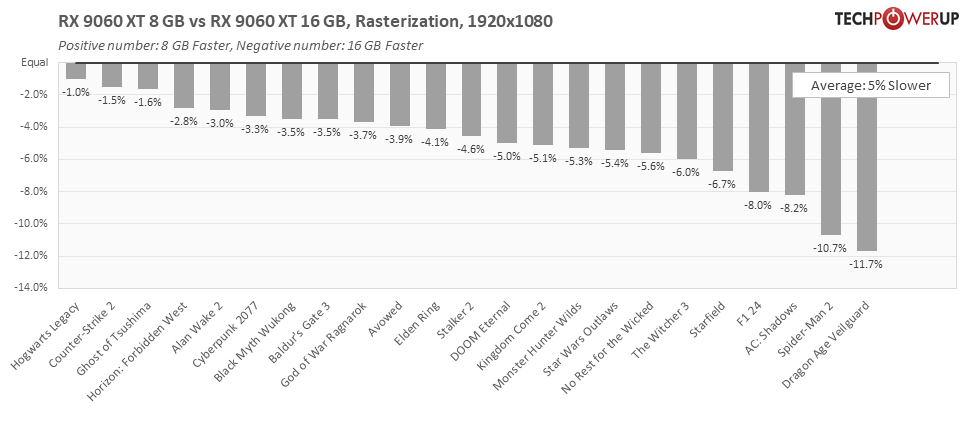
I am sorry, but if it was true, you will not see mere percent of difference on a sample of about 15-20 games at 1080p, and even 1440p.

If it was the case, why are we not having a 9060XT 8GB review like the 16GB received? No, instead of showing the big picture, they are limiting themselves at 1440p Quality Upscaling in F1 25.

We know that some AAA games are having problems, but the majority of them have absolutely none.

The proof is here... they focused on the worst examples like Dragon Age, F1 and Spider-Man.

performance-matchup-rx-9060-xt-16-gb-1920x1080.png


performance-matchup-rx-9060-xt-16-gb-2560x1440.png
 
Are you living under a rock? How about fact checking before posting?

Untitledf.jpg
Ah yes, thank you. I forgot he existed and posted that on his personal twitter account as a reply to a comment made by a youtuber (who of which Azor has interviewed with before) sitting at computex at the time. There's nothing to fact check either; I couldn't find/remember anything about it and simply asked for a reference. I might as well be living under a rock right now as I've been without power for 17 hours due to a local storm lol...

His comment reads more of a personal opinion and not an official stance by the company, despite the fact he is in fact AMD's Chief Gaming Architect. It further sounds more like backpedaling away from failed marketing and trying to explain away the existence of the 8GB model. I am not disagreeing with what he said either; I more or less agree with him in my own comment in the other 9060 article/thread that AMD would not make such a card if they did not think they could sell it and that card does in fact do well in 1080p.

However if the intention of the 8GB card was truly to target 1080p gaming specifically, then why has none of the promotional/marketing material reflected that? Had they done so I imagine the card may not have gotten nearly as bad of a press reaction as it did, though it would still probably get handed "overly expensive card for just 1080p" comments left and right, but it would nevertheless be seen as well equipped to do so.

I feel like there is a dissonance here between what was promised, what was intended, what was expected, and what was delivered.
 
I am sorry, but if it was true, you will not see mere percent of difference on a sample of about 15-20 games at 1080p, and even 1440p.

If it was the case, why are we not having a 9060XT 8GB review like the 16GB received? No, instead of showing the big picture, they are limiting themselves at 1440p Quality Upscaling in F1 25.

We know that some AAA games are having problems, but the majority of them have absolutely none.

The proof is here... they focused on the worst examples like Dragon Age, F1 and Spider-Man.

You seem incapable of understanding that both things can be true. The 8GB GPU isn’t much slower when measured by average FPS over a one-minute run. However, if you run out of VRAM, image quality can suffer, and there may be noticeable slowdowns in short spans and other issues.

What’s the incentive to defend one product or company over another?

And what incentive would TechSpot (or others) have to report results that aren’t accurate, unless those are genuinely the results they’re seeing and want to report?

Hint: There’s a track record to consider for both.
 
I mean the last year of posts have almost entirely been reposts from other AMD talking heads or other PR accounts and very rarely his own voice, but sure, whatever helps you sleep at night. :)
 
You guys are just making no sense lately. Be better...

They just follow the trend, users demanding 16GB cards, while this one is obviously aimed at 1080p.

RX480 4 or 8GB had no difference either, and it did not make it faster clock for clock the double amount of VRAM.

You can turn larger textures on, but the difference is (if coded right) it's stored as a cache in VRAM and not streamed over the PCI-E bus from CPU > RAM.

Larger VRAM is only useful for caching. Big difference between allocating and actually using it.

Just buy the card you like. I bought a 12GB 6700XT and running with a 300W tuned bios. Card works perfectly fine for what I do and thanks to the 12GB VRAM there's a advantage for some time to come still.

 
Are you living under a rock? How about fact checking before posting?

Untitledf.jpg
Sorry their official release was literally only about 1440p and so that is what the gpus will be tested at. A damage control tweet from Anzor that came out after they were being criticized is not anywhere near the same thing.
 
They just follow the trend, users demanding 16GB cards, while this one is obviously aimed at 1080p.

RX480 4 or 8GB had no difference either, and it did not make it faster clock for clock the double amount of VRAM.

You can turn larger textures on, but the difference is (if coded right) it's stored as a cache in VRAM and not streamed over the PCI-E bus from CPU > RAM.

Larger VRAM is only useful for caching. Big difference between allocating and actually using it.

Just buy the card you like. I bought a 12GB 6700XT and running with a 300W tuned bios. Card works perfectly fine for what I do and thanks to the 12GB VRAM there's a advantage for some time to come still.


"obviously amied at 1080p"

This is false as the official release and all promotional material advertised it as 1440p. Because of that it should be tested at 1440p otherwise its false advertising. If they would have promoted the 8gb for 1080p then the card would have been ok
 
Back