Honda wants to turn highways into giant wireless chargers for electric trucks while they drive

midian182

Posts: 11,970   +183
Staff member
Forward-looking: Having to stop to recharge is an obvious headache for electric trucks that earn their money by staying on the road. Honda wants to reduce that downtime by putting charging equipment beneath the road, allowing suitably equipped vehicles to collect power while driving.
Honda's research subsidiary is working with construction company Taisei and road builder Taisei Rotec on the charging system. The partners plan to join the Tateyama Project on Japan's Tateyama Expressway in Chiba from fiscal 2027 onward, which begins April 1, 2027.

Honda initially intends to put the technology to work in logistics and transportation.

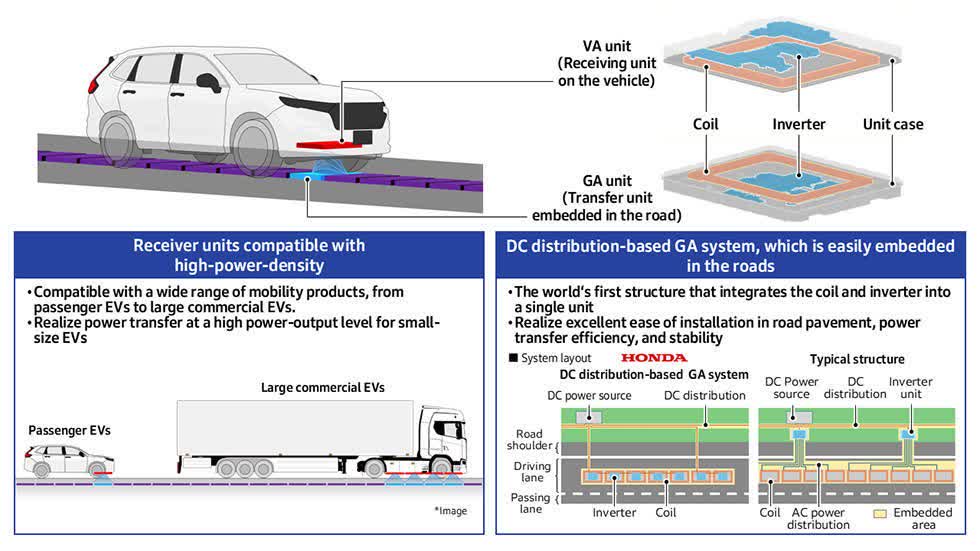
The method uses magnetic coupling to transfer energy between transmitters buried in the road and a receiver fitted to the vehicle. Coils beneath the road produce a magnetic field, which the receiving coil uses to supply energy to the battery.
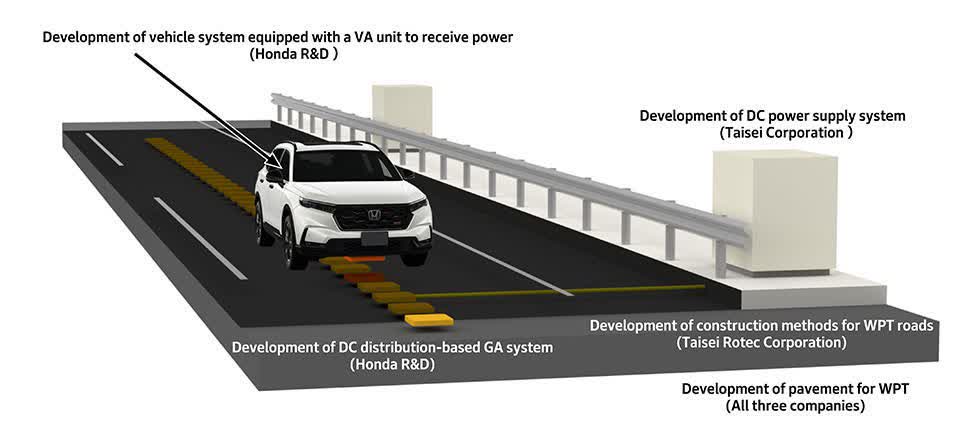
Honda's design connects the buried transmitters through a DC distribution system. Each road unit combines an inverter and coil, a setup Honda says simplifies wiring and reduces the components and installation work required.

The units are designed to fit into sections cut into the existing road surface, making installation possible without building an entirely new road.

Surviving the massive weight of truck traffic is another requirement. The partners have developed road structures and charging units designed to withstand traffic from vehicles weighing around 20 tons.

A further test roadway, with construction starting in late 2026, will support durability testing equivalent to one million wheel loads at 49 kN per wheel, alongside checks of charging performance and electromagnetic field leakage.

Later verification will examine power delivery up to 150 kW and reliability at high speeds. Those are testing objectives, rather than confirmed performance figures from the planned highway demonstration.
The idea has already appeared in several US projects. Florida has plans for a roughly three-quarter-mile charging section on State Road 516, designed to deliver up to 200 kW to compatible vehicles. There's also Electreon's earlier Detroit proposal, which used buried coils and vehicle-mounted receivers.

Reuters reports that a Honda engineer declined to compare the system's cost with a conventional fast-charging network, saying its economic viability still needed assessment. Reducing charging stops would be useful, but installing and maintaining electrical equipment beneath busy roads has to justify its cost.

While driving an electric vehicle on a road that automatically charges it sounds great, there's still the major limitation that ordinary EVs need additional hardware to make this vision a reality.

Permalink to story:

 
It seems to me that this would cost a LOT to deploy and keep maintained. Not to mention, you'd need to lay a lot more than a 3 quarter mile stretch of it to make any real difference for these big heavy trucks.
 
Call me skeptical but.

Solution 1: Have batteries big enough and chargers powerful to charge during mandated breaks to have no additional downtime.
Solution 2: Have a common standard for 'truck batteries'. Drop batteries off when you pass a station, pick up a fresh set and they can be charged at whatever speed. Ties in nicely with solar energy as well.
Solution 3: Trains for long haul transport. Short haul tends to involve a lot of unloading/loading with opportunities to charge whilst standing still.


And then I guess there's this tech bro approach of greatly increasing the cost of road infrastructure.
Also the costly endeavor of road maintenance I imagine will go up quite a bit due to it. Who's paying for this? Another case of privatize profits socialize losses?
 
Yes, because buying all the land and laying new track is definitely cheaper and easier than putting some magnets and wires in an existing road.

And that's before the logistics of loading and unloading of the train onto - yup, the same trucks.
As opposed to ripping up every highway, express way, state route, ece and laying millions of miles of copper conductors and, more importantly, powering them, with massive transmission losses?

Wrap your mind around this concept: you use the truck to take the trailer to a loading depot, where it is loaded on a train, which takes it long distance to another depot, where a truck takes it the last mile to the receiver.

AKA the way the rest of the world does it, and the way the US did it until we decided that having stock on hand was bad and we needed fresh truck loads in a JIT system that is incredibly vulnerable to disruptions.

We already had the rail infrastructure to do this. You don't need to " buy all the land" the railroads already own it. Just restore the system we had that worked perfectly fine for decades. Long range OTR trucking never should have become the de facto standard for industry.

Also logistics of loading? You mean moving a container? Trivial, the rest of the world has that figured out already.
 
The potential costs savings of this (on the truck side) is huge.

Autonomous trucks increase utilization from 11 hours/day with humans to ~19 hours because of charging. If the trucks don't have the charging time you can move more goods with fewer trucks.

And you don't need a central charging location which also saves money and expands where the trucks can operate.

Now does that savings offset the charging road costs? Unknown. And eliminating charging locations altogether requires some extensive rollout so that's more a future savings than a quick one.
 
As opposed to ripping up every highway, express way, state route, ece and laying millions of miles of copper conductors and, more importantly, powering them, with massive transmission losses?

Wrap your mind around this concept: you use the truck to take the trailer to a loading depot, where it is loaded on a train, which takes it long distance to another depot, where a truck takes it the last mile to the receiver.

AKA the way the rest of the world does it, and the way the US did it until we decided that having stock on hand was bad and we needed fresh truck loads in a JIT system that is incredibly vulnerable to distruptions.

We already had the rail infrastructure to do this. You don't need to " buy all the land" the railroads already own it. Just restore the system we had that worked perfectly fine for decades.

Also logistics of loading? You mean moving a container? Trivial, the rest of the world has that figured out already.
Trains work best where the population is largely smushed together. Texas alone is larger than France and twice Germany's size.

If trains were economically viable here - where they already own the track - they would be used more. Businesses don't pay more for shipping with trucks because trains are unAmerican - they pay less for shipping with trucks because trucks are cheaper most of the time.

And JIT system has NOTHING to do with trains being used less. That is simply logistical planning of when the new parts arrive not what machine moved them there.

You realize TV was black and white when trains were more economically viable. Maybe we should turn off color broadcasts to help them out? (correlation does not equal causation).
 
So even Honda have been suckered into this, marvellous, I don't even need to begin the explain the issues with energy losses and coil heating when you are trying to inductively couple a coil buried under tarmac and the roadbed to a moving truck at 150KW (I.e. expect to have to use 1MW or more to drive it), the generation and transmission capacity to drive such loads over a continuous road network and the issues with the road surface itself, issues which mean most engineers will tell you this is a crap idea, I thoroughly bet they will do a 100m section, say "look, it could be done!" and then someone tells them to think about the actual feasibility and they give up. If a train, which runs on metal rails on fixed lines and is very much the best case scenario for something like this still uses a third rail or a pantograph, then it should make it very clear that for a moving truck its an even worse idea, use a pantograph type system if you want to charge trucks on the move, or give up on this idea of charging the trucks while they move, not stuff nonsense into the roads
 
Back