New benchmarks show SteamOS outperforming Windows 11 on Lenovo's handheld PC

Cal Jeffrey

Posts: 4,595   +1,682
Staff member
That's called progress: SteamOS started life as a lightweight Linux-based system built for Valve's Steam Machines that never really picked up steam (pun intended). Now, it powers the Steam Deck and various other handhelds. New benchmarks show that the gaming OS outperforms Windows 11 on similar hardware.
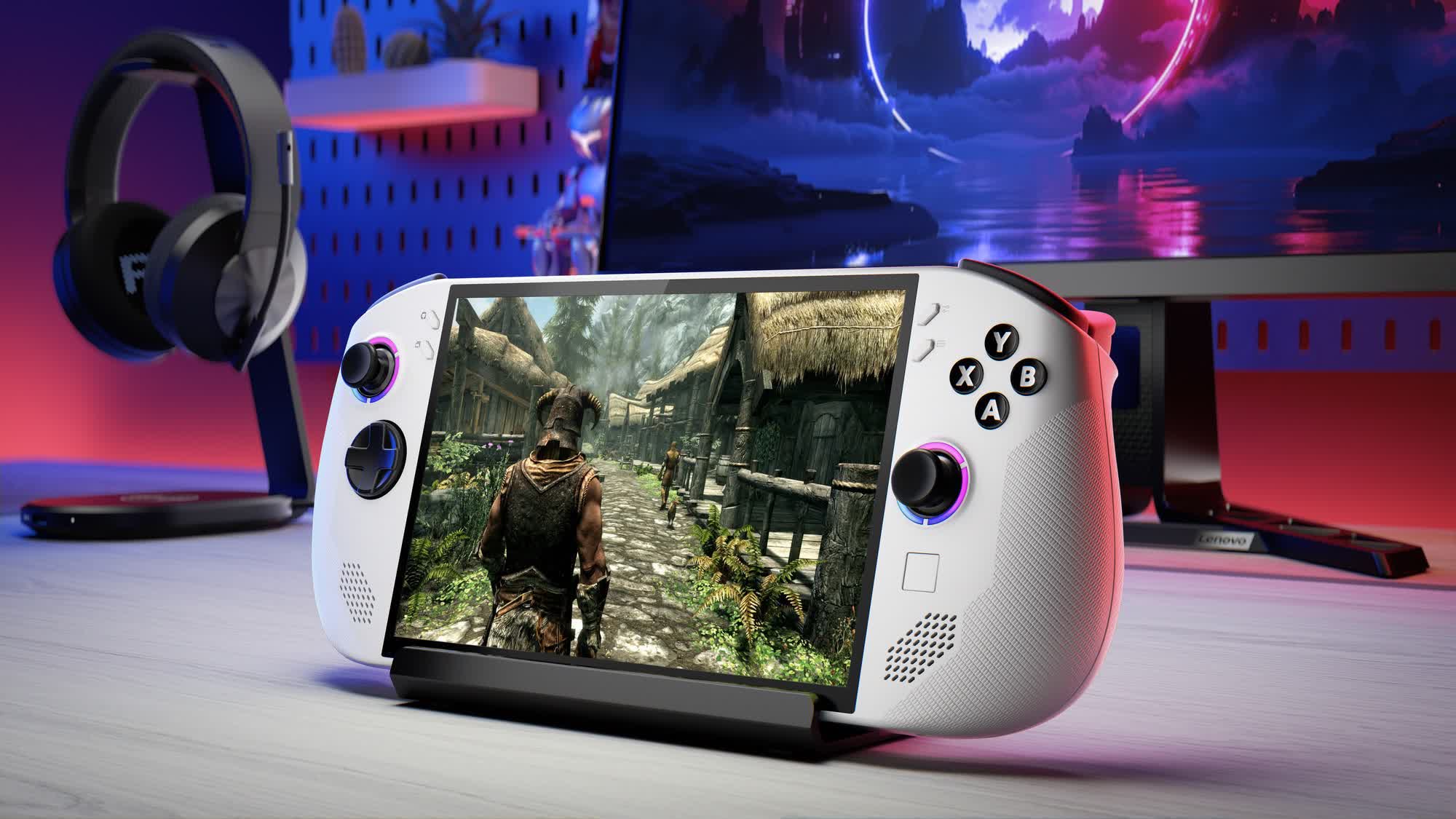
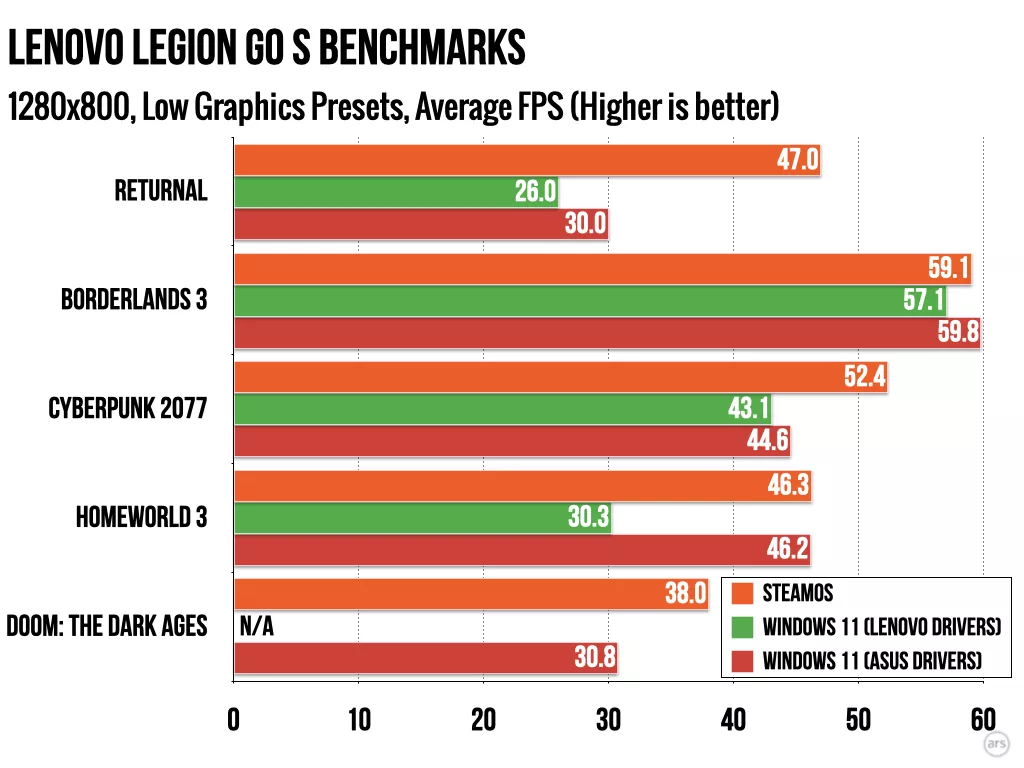
A recent Ars Technica report tested five demanding PC games on Lenovo's Legion Go S handheld, running both Windows 11 and the latest SteamOS. In most cases, SteamOS delivered smoother gameplay and higher frame rates.

That's a significant change from Valve's early Steam Machines era, when the Linux-based OS often lagged behind Windows because of immature drivers and software. This time, four of the five games ran faster on SteamOS – sometimes by a substantial margin. In one case, playing Returnal at 1920×1200 on "High" settings, SteamOS held a steady 33 frames per second, while Windows barely managed 18 FPS with Lenovo's official drivers.

Part of that advantage comes from Valve's Proton compatibility layer, which translates Windows game code into Linux instructions. Proton and the SteamOS drivers have benefited from years of updates to help Windows games run efficiently. Another factor is SteamOS' streamlining and focus on doing one thing – running games – unlike Windows, which often runs many background processes.
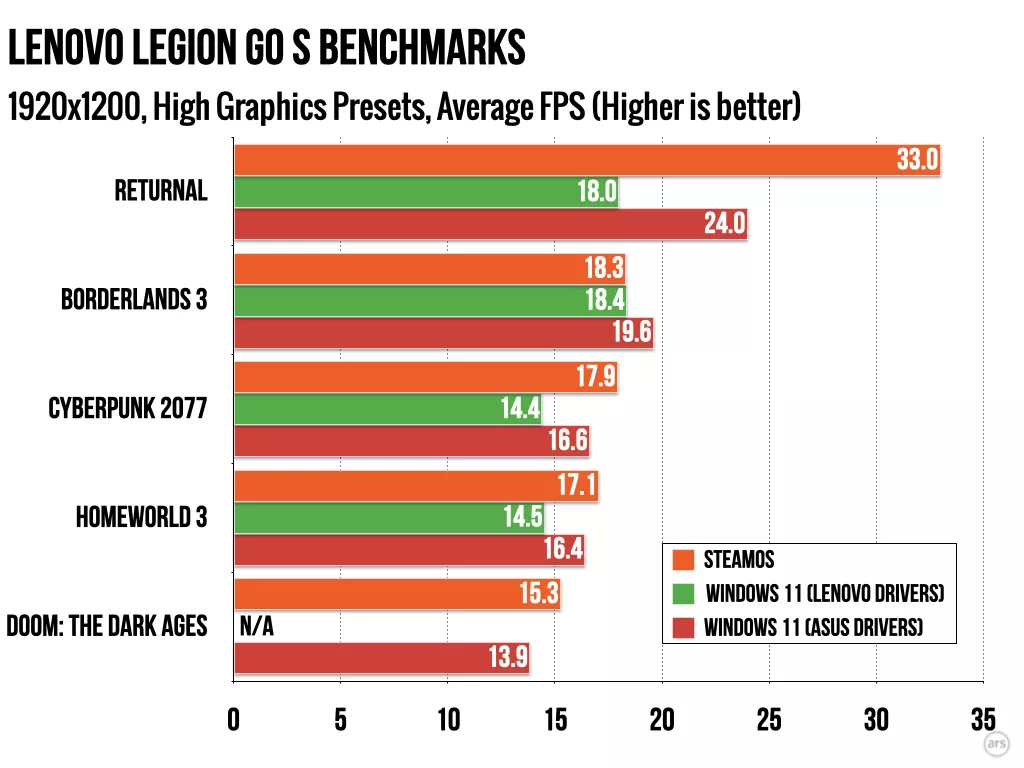
Ars also noted that Windows gaming performance could be improved by manually installing newer, unofficial AMD drivers – though most users wouldn't bother.

"Sideloading the updated Asus drivers showed a noticeable improvement in Windows performance across all tested games and even brought Homeworld 3's 'Low' graphics benchmark test to practical parity with SteamOS," Ars wrote.

However, even with the manually installed drivers, SteamOS still came out on top.

Of course, Windows still enjoys much wider game compatibility. Many games simply won't run on SteamOS without workarounds, and most manufacturers design PC hardware with Windows in mind. However, on a handheld like Lenovo's $599 Legion Go S – sold separately with either SteamOS or Windows – buyers may appreciate that SteamOS offers a smoother experience out of the box at a lower price.

Gamers once dismissed SteamOS as an underdog, incapable of competing with the more dominant bloatware out of Redmond. However, Valve's sustained work on Linux gaming is paying off. Ars Technica's tests suggest that handheld gamers willing to embrace SteamOS could enjoy better game performance – with no tweaking required.

Permalink to story:

 
Again, not surprised a handheld-focused SteamOS is doing better than a general-use OS like Windows (albeit it's a bit more handheld oriented this time).

But it looks like Windows did catch up a bit, now that those working on the Windows handhelds seem to be taking it a bit more seriously.
 
SteamOS does better in some games ON STEAMDECK CLASS HARDWARE, not in general since SteamOS doesn't run on anything other than a Steamdeck. No one would be surprised if running a game on a PS5 through windows (if it were possible) was slower than the native OS. It's the whole point of having narrow hardware options, to better optimize.

But beyond that, this is like when AMD had mantel. It showed big difference on low performance hardware because the goal was freeing up CPU cycle when then CPU is weak so the GPU is less bottlenecked. Remove the bottleneck and the performance differences disappear.
 
I wonder how much of the difference is thanks to the Linux kernel.
I've seen many crossplatform benchmarks that are either CPU intensive or on low-end hardware where Linux outperforms Windows.

Combine that with Windows lately seemingly to have trouble with first AMDs multi core complex architecture and then Intels little/large core combo whilst under Linux it all seems to have to worked smoothly from the start... makes me wonder at which point MS will do what Android does and simply use the Linux kernel with their own software stack on top. Would save them development costs in the long run, likely give a performance boost - win win.
 
Something designed for gaming outperforming something designed for everything else - and gaming by a few percentage points.
Amazing...

What's crazy is instead of getting excited about the competition that should soon follow, the masses will clown on Windows.
 
Something designed for gaming outperforming something designed for everything else - and gaming by a few percentage points.
Amazing...

What's crazy is instead of getting excited about the competition that should soon follow, the masses will clown on Windows.
Linux (steam os) is designed for everything else, and run games written for windows, using translation layer, better than windows.
Craaaaaazy, isn't it.
 
Linux (steam os) is designed for everything else, and run games written for windows, using translation layer, better than windows.
Craaaaaazy, isn't it.
Yet SteamOS is optimized for handheld gaming.
Craaaaaazy, isn't it.
 
While SteamOS is made for games, the underlying Linux is a general purpose OS, just like Windows. The problem with Windows is that they want to add a lot of features which their users have no way to opt out or uninstall. So with so many “bloat” running in the background, the issue is starting to become apparent with a Linux getting better game support. To me, the results just show how bad the situation is on Windows when you have games that run natively and losing so badly to a Linux based equivalent that requires an additional translation layer to function. I have moved my gaming machines away from running Windows for upward of 6 months and I don’t feel like I am missing anything offered by Microsoft to be honest. My Linux based gaming systems is not just intended for games, but also for streaming videos, surfing net, doing some light word processing, etc, everything that I do on them when they were running Windows OS.
 
Yet SteamOS is optimized for handheld gaming.
Craaaaaazy, isn't it.
any other linux is 'optimised' in the same way, craaaaazy. There is no issue with installing arch or fedora or even ubuntu on steam deck, load steam client in game mode enabling whatever you need, and that's it. If there are some additional drivers required not yet included in kernel you can add it, same as in windows.
The Steam OS advantage is not performance optimization, it is just qol changes, like button connected to on screen keyboard and some small stuff like this one.
And on topic, same config to open keyboard can be done on windows, and windows have as well 'game mode'. Both, Linux (including steam os) and windows are general use operating systems, and both are offering some gaming improvements. SteamOS offer just a Steam Big Screen layer on top of the more or less standard distro, in similar way like Windows offer the xbox app (and plans to offer more integrated one with the asus) on top of the standard Windows distro.
And yet, Linux often have a better performance, and that's craaaaaazy ;)
 
Again, not surprised a handheld-focused SteamOS is doing better than a general-use OS like Windows (albeit it's a bit more handheld oriented this time).
This is misleading.

SteamOS is essentially Arch Linux, but with preloaded drivers for hardware recognition and preloaded software for gaming. You could install Arch Linux yourself and, with the right drivers and software, achieve the same performance. Both SteamOS and Arch Linux are full featured, general purpose operating systems, just like Windows.

The big difference isn’t that SteamOS is uniquely optimized for gaming, but rather that Arch Linux is inherently lightweight and free of any unnecessary background processes. Meanwhile, Windows ships with countless unnecessary 'services' such as telemetry.

If you benchmarked video editing or even just spreadsheet work, SteamOS will again outperform Windows on low performance hardware.
 
This is more damning of the Lenovo hardware than Windows... If Lenovo provided better drivers the results would be different...
Lenovo spent more time on their Linux drivers than their Windows drivers? Interesting logic there...
Better drivers won't solve the windows bloat.
So?!? That has nothing to do with this…
Windows running loads of extra stuff in the background, that nobody uses or wants, has nothing to do with the performance difference? On a low powered portable?

Again, interesting logic there, you're gunna have to explain your reasoning behind those statements.

Because the way I see it, Lenovo released for Windows, the most popular OS, first, Valve later down the road started working with Lenovo to get some Linux drivers created, for a far less popular OS.

Now unless you have some kind of evidence that Lenovo put way more effort into their linux drivers over their Windows drivers, I don't really know where your getting this opinion from.
 
any other linux is 'optimised' in the same way, craaaaazy. There is no issue with installing arch or fedora or even ubuntu on steam deck, load steam client in game mode enabling whatever you need, and that's it. If there are some additional drivers required not yet included in kernel you can add it, same as in windows.
The Steam OS advantage is not performance optimization, it is just qol changes, like button connected to on screen keyboard and some small stuff like this one.
And on topic, same config to open keyboard can be done on windows, and windows have as well 'game mode'. Both, Linux (including steam os) and windows are general use operating systems, and both are offering some gaming improvements. SteamOS offer just a Steam Big Screen layer on top of the more or less standard distro, in similar way like Windows offer the xbox app (and plans to offer more integrated one with the asus) on top of the standard Windows distro.
And yet, Linux often have a better performance, and that's craaaaaazy ;)
Are you saying that SteamOS is just a skin? Nothing but a surface deep distro that Valve hasn't done ANY optimization for?
 
This is misleading.

SteamOS is essentially Arch Linux, but with preloaded drivers for hardware recognition and preloaded software for gaming. You could install Arch Linux yourself and, with the right drivers and software, achieve the same performance. Both SteamOS and Arch Linux are full featured, general purpose operating systems, just like Windows.

The big difference isn’t that SteamOS is uniquely optimized for gaming, but rather that Arch Linux is inherently lightweight and free of any unnecessary background processes. Meanwhile, Windows ships with countless unnecessary 'services' such as telemetry.

If you benchmarked video editing or even just spreadsheet work, SteamOS will again outperform Windows on low performance hardware.
So, it's handheld optimized (out of the box) as I said. Gotcha.
 
Lenovo spent more time on their Linux drivers than their Windows drivers? Interesting logic there...

Windows running loads of extra stuff in the background, that nobody uses or wants, has nothing to do with the performance difference? On a low powered portable?

Again, interesting logic there, you're gunna have to explain your reasoning behind those statements.

Because the way I see it, Lenovo released for Windows, the most popular OS, first, Valve later down the road started working with Lenovo to get some Linux drivers created, for a far less popular OS.

Now unless you have some kind of evidence that Lenovo put way more effort into their linux drivers over their Windows drivers, I don't really know where your getting this opinion from.
If you read the article, you’d know that with a different driver, Windows performs better… which means that Lenovo hasn’t done their job…

As for Windows “bloat”, it doesn’t matter if the performance is the same.
 
I thought this is a tech site. Most people can't get it that steamOS runs windows games through compatibility layers. Through emulation if it's easier for you to understand. Windows runs windows games worse than Linux.
 
Linux (steam os) is designed for everything else, and run games written for windows, using translation layer, better than windows.
Craaaaaazy, isn't it.
Crazy is comparing something with joysticks to a PC.

SteamOS is a Linux-based operating system developed by Valve, primarily designed for gaming.
 
Are you saying that SteamOS is just a skin? Nothing but a surface deep distro that Valve hasn't done ANY optimization for?
in terms of performance? close to nothing, if any. There is package tailoring, but not stricte for performance, but for space. They know what hardware is not in their devices, so they can remove nvidia drivers or similar, but this done to save space, not to increase the perforomace. Performance is similar to other arch-based distros, like cachyOS.
Valve made Steam OS immutable as well, similarly like Aeon, Aurora, Bluefin and more. This makes sense for a distro focused on stability and to reduce the support effort (config is always the same, and if user change it you just telling him to roll back without playing around personal config changes).

So, it's handheld optimized (out of the box) as I said. Gotcha.
no, you didnt. He wrote it really clearly:
The big difference isn’t that SteamOS is uniquely optimized for gaming, but rather that Arch Linux is inherently lightweight and free of any unnecessary background processes.
and if you somehow see there 'it's handheld optimised' our understanding of language is dramatically different. It is just an immutable arch. With same mesa as any other distro. With same gamescope as any other distro. And with same performance as any other arch (and possibly other, similar distros - debian stable or ubuntu 2204 is non comparable).
 
Crazy is comparing something with joysticks to a PC.

SteamOS is a Linux-based operating system developed by Valve, primarily designed for gaming.
SteamOS is a linux. Flavoured by Valve, installed on Steam Deck (or any other system if you want) so you can do whatever you want, e.g. made it a home server:

And if someone like pewdiepie managed to run home server 'on pc with joystick' it is safe to say you should broaden your horizons:
 
in terms of performance? close to nothing, if any. There is package tailoring, but not stricte for performance, but for space. They know what hardware is not in their devices, so they can remove nvidia drivers or similar, but this done to save space, not to increase the perforomace. Performance is similar to other arch-based distros, like cachyOS.
Valve made Steam OS immutable as well, similarly like Aeon, Aurora, Bluefin and more. This makes sense for a distro focused on stability and to reduce the support effort (config is always the same, and if user change it you just telling him to roll back without playing around personal config changes).


no, you didnt. He wrote it really clearly:

and if you somehow see there 'it's handheld optimised' our understanding of language is dramatically different. It is just an immutable arch. With same mesa as any other distro. With same gamescope as any other distro. And with same performance as any other arch (and possibly other, similar distros - debian stable or ubuntu 2204 is non comparable).
No. The answer was no, it's not just a skin. It is in fact optimized for handheld gaming out of the box. Stop being disingenuous. "Close to nothing"? Even you know that's utter BS, as you couldn't definitively say "no" 😂

No normal person actually cares if you take another distro and make a bunch of tweaks out of the box (optimizations) and it performs similarly to SteamOS. No normal person cares if it also is based on linux and can do linux stuff.
SteamOS is a handheld gaming OS first and foremost. And that was the point that you couldn't let be without starting some pointless argument 🤦‍♂️
 
So, it's handheld optimized (out of the box) as I said. Gotcha.
Other than power management which Windows should have accomplished decades ago with countless laptops and other portable devices, you're just arguing semantics.

Does preinstalling drivers to support handheld hardware make Windows “handheld optimized” as well?

Valve preinstalled drivers on Arch Linux to recognize the buttons/gamepads, AMD graphics, and installed Steam. The real optimization comes from Arch Linux not interfering with Valve’s STEAM (not SteamOS) optimizations. These optimizations essentially allow Linux to run Windows games without the bloat and spyware found in Windows. Ultimately, Linux runs Windows better than Windows.

Windows requires a debloated version to compete, while Linux never had bloat. Arch Linux for example is optimized with every installation on any device, since you select exactly which components you want.

On the other hand, Windows bundles thousands of components you don’t need with every installation and therefore requires custom optimization for specific use cases like handheld devices.
 
Other than power management which Windows should have accomplished decades ago with countless laptops and other portable devices, you're just arguing semantics.

Valve preinstalled drivers on Arch Linux to recognize the buttons/gamepads, AMD graphics, and installed Steam. The real optimization comes from Arch Linux not interfering with Valve’s STEAM (not SteamOS) optimizations. These optimizations essentially allow Linux to run Windows games without the bloat and spyware found in Windows. Ultimately, Linux runs Windows better than Windows.

Windows requires a debloated version to compete, while Linux never had bloat. Arch Linux for example is optimized with every installation on any device, since you select exactly which components you want.
That's fine. There are still optimizations in SteamOS on top of the base Linux they're using. Nobody is saying or implying otherwise. And nobody is saying or implying that they are game-changing optimizations (it would look really bad for Linux if they were). And I'm arguing semantics? See the irony?

Does preinstalling drivers to support handheld hardware make Windows “handheld optimized” as well?
If they focused on getting the most out of a set of specific hardware (instead of generic drivers), then that's another optimization.
And if Windows having/using a gaming mode outside of the normal Windows install, it would imply it's been gaming optimized. Though, I don't know if said gaming mode is standard in a normal Windows install.

On the other hand, Windows bundles thousands of components you don’t need with every installation and therefore requires custom optimization for specific use cases like handheld devices.
And that is also why I refer to Windows as the general-purpose OS (that bloat keeps maximum compatibility for a general range of items). And why I'm (still) not surprised SteamOS beats Windows (in most cases).
 
Back