Bottom line: Samsung Electronics' latest quarter makes one thing clear: the AI boom is no longer just lifting the semiconductor market – it's straining it. The company posted a record operating profit in the first quarter, almost entirely driven by its chip business. That division now dominates Samsung's earnings as AI hardware demand outpaces production capacity.
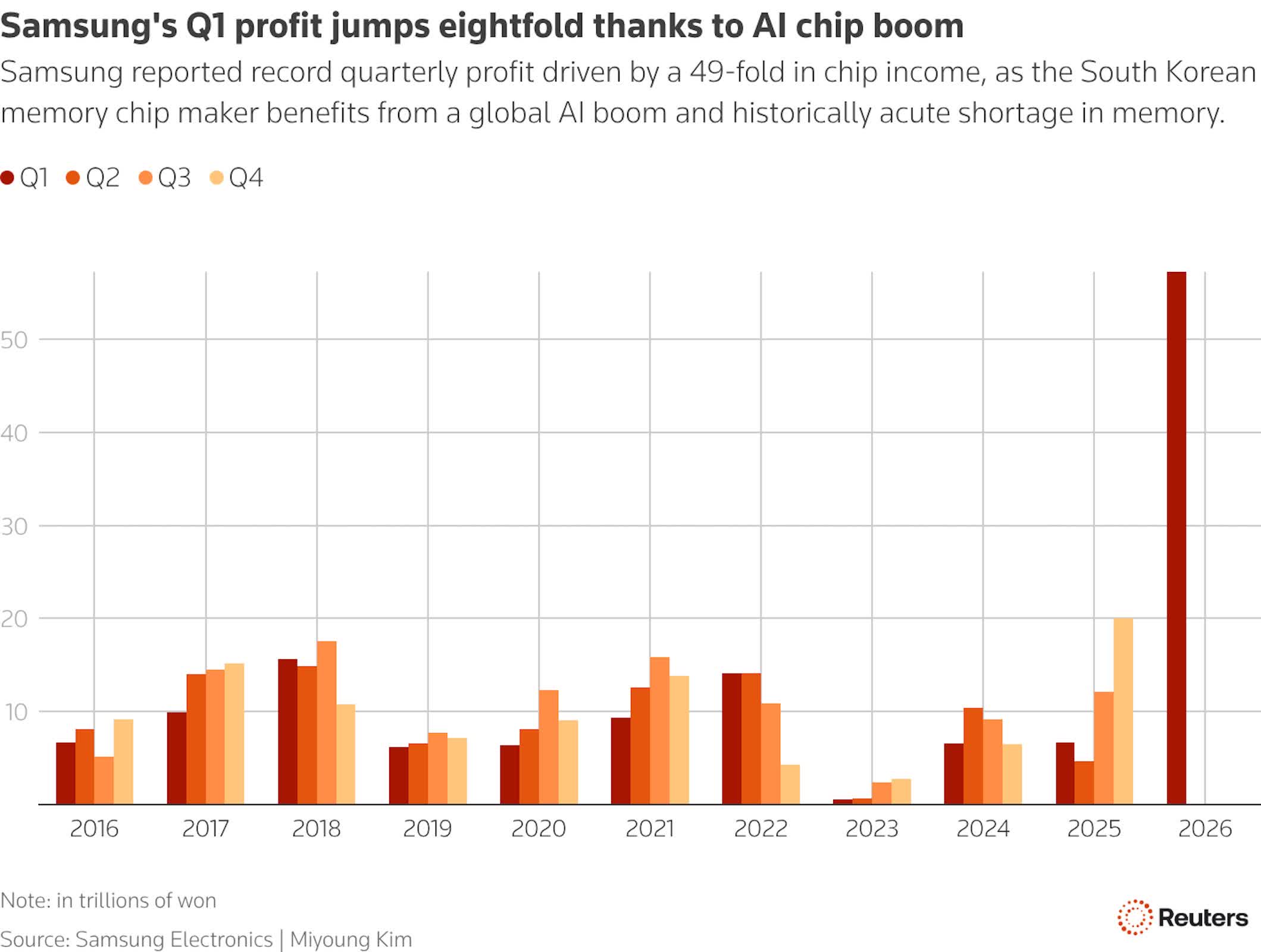
Operating profit in semiconductors climbed to 53.7 trillion won ($36.15 billion) for the January – March period, up sharply from 1.1 trillion won a year earlier. The figure accounted for roughly 94% of Samsung's total operating profit of 57.2 trillion won. Revenue rose 69% year over year to 133.9 trillion won.
Hyperscale companies are building AI data centers fast enough to absorb all available advanced memory. High-bandwidth memory is now essential for AI accelerators like those Nvidia makes. Chipmakers are shifting capacity to advanced nodes and specialized memory, squeezing supply of conventional chips.
Samsung executives say the imbalance is already severe and getting worse.
"Our supply falls far short of customer demand," said Kim Jaejune, an executive in Samsung's memory chip business, during the company's earnings call. "Based solely on the demand currently received for 2027, the supply-to-demand gap for 2027 is set to widen even further than in 2026."
Credit: Reuters
Customers are adjusting accordingly. Samsung disclosed that it has signed multi-year binding contracts with clients seeking guaranteed supply, suggesting shortages won't ease soon. New fabrication capacity takes years to build, even with higher investment.
Major US tech companies including Alphabet, Amazon, Meta, and Microsoft have all signaled continued AI spending, which keeps pressure on memory supply.
Samsung is also working to strengthen its position in high-bandwidth memory, where it has trailed rival SK Hynix. The company said it started mass-production sales of HBM4 chips for Nvidia's Vera Rubin platform in February and expects HBM revenue to more than triple this year. However, SK Hynix recently posted stronger gains in this segment.
To keep up, Samsung plans to significantly ramp up capital expenditures. Scaling production isn't just about money, though. The company warned that conflict in the Middle East hasn't disrupted chip production yet, but rising oil prices could push up transportation costs. Samsung said it has avoided supply disruptions by securing inventory and diversifying gas sources.
Closer to home, labor tensions in South Korea present another risk. Unions representing a large share of Samsung's workforce in South Korea, particularly within the chip division, are weighing strike action over pay. Samsung said it "plans to respond to the fullest extent through a dedicated organization and response system to ensure that production is not disrupted." A union spokesperson said the company had warned in court that a strike could result in "astronomical damage" and reduced output.
The semiconductor surge isn't helping Samsung's other divisions. Rising chip prices are pushing up component costs for Samsung's mobile and display divisions. Operating profit in the mobile and network segment fell 35% to 2.8 trillion won in the quarter, while the display business reported a 20% decline to 400 billion won.
The quarter shows how much the semiconductor cycle now depends on AI demand. Samsung's challenge isn't finding buyers – it's building enough advanced capacity while managing the risks of scaling this fast.
Samsung's chip profit jumped nearly 50-fold in a single year, execs warn the shortage will get worse


