As the digital landscape evolves, Notepad3 has emerged as an indispensable tool for many. While the Windows operating system has seen substantial updates over recent years, surprisingly, the default Windows Notepad has remained largely unchanged for two decades. Consequently, for those requiring a text editor for programming or more intricate textual tasks, simply relying on the basic Windows Notepad proves to be inadequate. In this context, Notepad3 stands out, offering a significant edge in functionality and versatility.
Recognizing the limitations of the default Windows Notepad, we therefore embarked on the development of Notepad3. Rooted in the legacy of the remarkable Notepad2 by Florian Balmer and the Notepad2-mod by XhmikosR, Notepad3 stands as a testament to their foundational work. This advanced tool is imbued with all the features notably absent in the Windows counterpart. Not only is Notepad3 a swift and lightweight text editor built on the robust Scintilla platform, but it also boasts syntax highlighting capabilities. Moreover, despite its minimal memory footprint, it's robust enough to tackle the majority of programming tasks with relative ease.
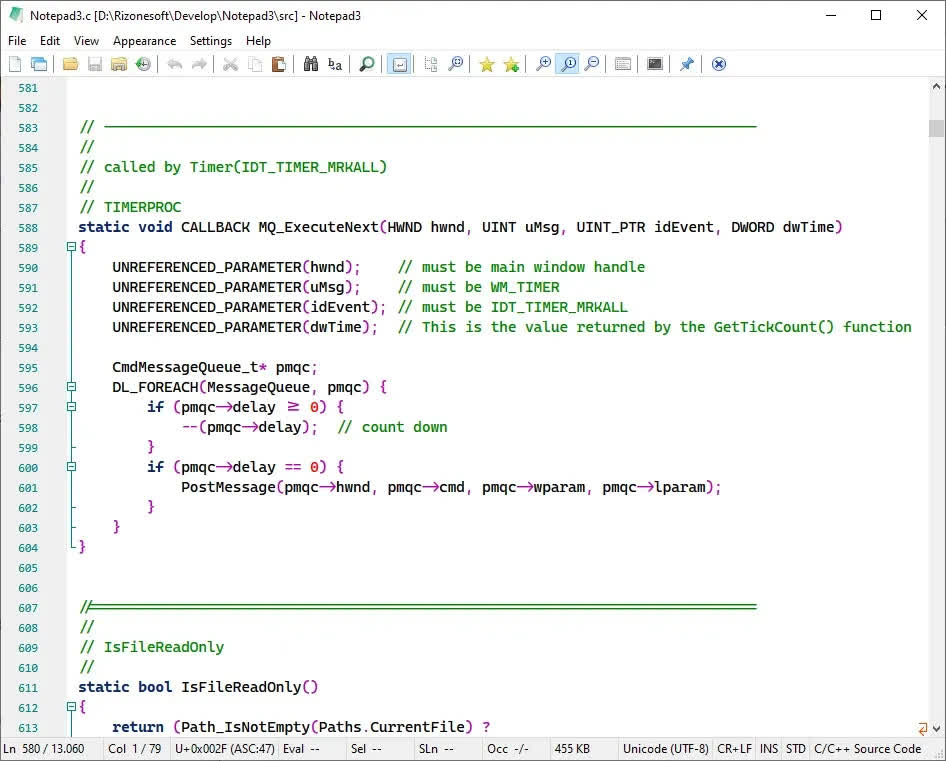
Features
Notepad3 has the following features: code folding, bracket matching, automatic indentation, word auto-completion, convert character encoding between various formats (ASCII, UTF-8, and UTF-16), newline format conversion (between DOS (CR/LF), Unix (LF), and Macintosh (CR) formats), multiple undo or redo, bookmarks, and regular expression-based find and replace.
Supported Languages
Previously we mentioned that Notepad3 can handle almost any programming job and we are not lying. Just take a look at the list of supported programming languages below and spot your favorite.
It offers syntax highlighting support for Apache, ASP, Assembly, AutoHotkey, AutoIt3, AviSynth, Awk, Bash, BAT, C, C++, C#, CGI, CMake, CoffeeScript, CSS, CSV, D, Dart, DIFF, Fortran, Go, HTML, INF, INI, Inno Setup, Java, JavaScript, JSON, Julia, KiXtart, Kotlin, LaTeX, Lua, Makefiles, Markdown, MATLAB, Nim, NSIS, Pascal, Perl, PHP, PowerShell, Python, REG, Resource, R-S-SPlus Statistics, Ruby, Rust, Shell, SQL, Tcl, TOML, VB, VBScript, Verilog, VHDL, XHTML, XML, YAML and improved support for NFO ANSI.