Instead of plain text, users communicated through cartoon avatars with messages displayed in speech bubbles inside dynamically composed comic panels. The application used an expert system to determine character placement, gestures, facial expressions, balloon shape, and panel layout in real time. It shipped as part of Internet Explorer 3.0 and was later bundled with Windows 98 and MSN before being discontinued in the early 2000s.
In July 2026, Microsoft released Comic Chat's source code under the MIT License, allowing developers to study, preserve, and modify one of the company's most unusual software projects.
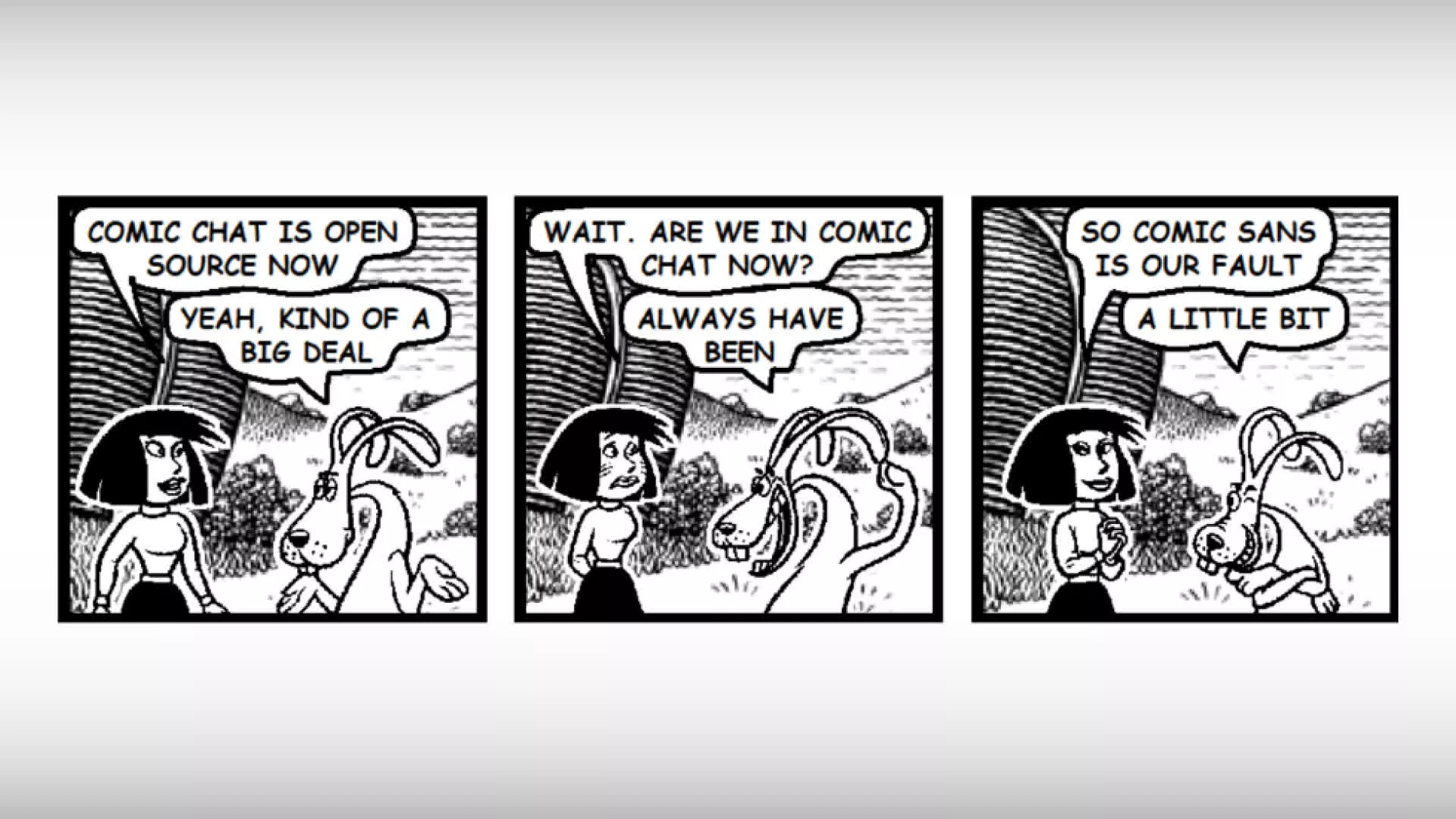
How Comic Chat Works
As users type messages, each Comic Chat client automatically determines:
- Which characters to place in each panel
- Gestures and facial expressions based on message content
- Character placement and orientation
- Word balloon shape, outline, and layout
- When to advance to a new panel
- Zoom factor for each panel
The application connects to standard IRC servers and is fully interoperable with text-based IRC clients. Non-Comic Chat users are automatically assigned characters so the entire conversation is rendered graphically.
History
Comic Chat was originally a Microsoft Research project developed by DJ Kurlander. The 1.0 release shipped in June 1996 bundled with Internet Explorer 3.0 and could run standalone or embedded as an OLE server within the browser. Version 2.0 shipped with Internet Explorer 4.0 and Windows 98 in 1997 – 1998, adding multi-server support, OLE scripting, and the Comic Chat SDK for third-party bots and extensions. The application was discontinued in the early 2000s as graphical chat gave way to instant messaging.
Release Notes:
These are unsigned, unsupported builds of the two modernized historical source snapshots in this repository. They are provided for archivists, educators, and experimentation, and are not an official Microsoft product release.
Both packages contain statically linked x86 executables, bundled comic art, documentation, the repository license, and build provenance. There is no installer: extract the entire ZIP and run the executable in place so the ComicArt directory remains beside it.
Verification
The packages were built on GitHub's windows-2022 runner. Each ZIP was extracted into a random path containing spaces, launched with an unrelated working directory, and verified to create a top-level window and remain running. Because the executables are intentionally unsigned, Windows may show a SmartScreen warning.