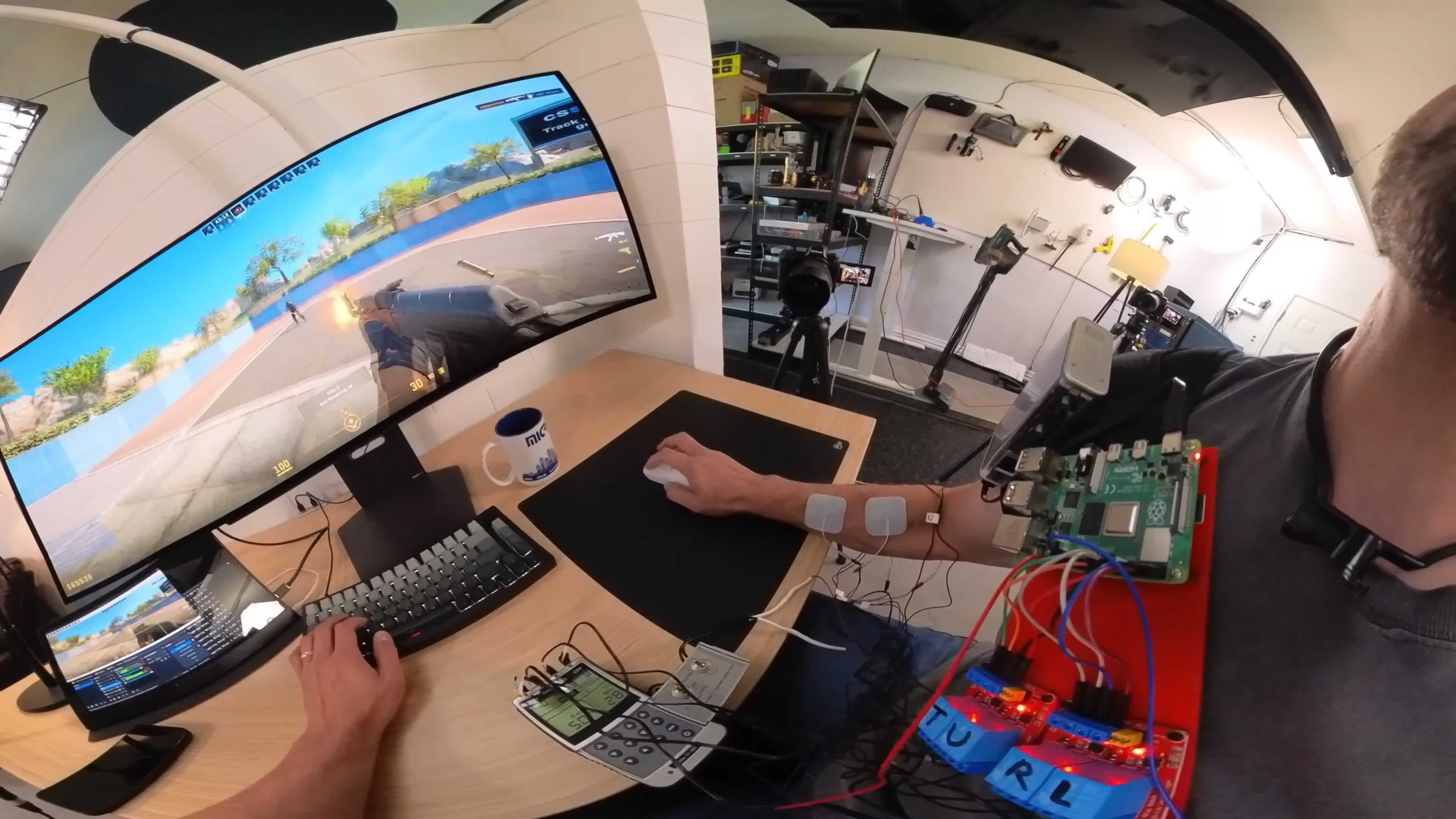
Cutting corners: Some controversial anti-cheat systems analyze the deepest layers of Windows to prevent sophisticated software from giving players an unfair advantage in multiplayer games. In response, some modders have gotten really creative and shown how they are testing aimbots that offer a similar advantage without any direct software intervention.
Two YouTubers recently showcased experimental aimbots that hack elements of online games that exist outside of the operating system, thus evading anti-cheat security. One modder manipulated the mouse and mousepad, and the other manipulated his arm's electrical signals.
Aimbots are among the most popular cheating tools. They automatically guide a player's aim toward detected enemies faster than most human players can react. However, popular titles have adopted increasingly invasive security measures to detect and ban players using aimbots and other illicit programs.
Valorant and the Battlefield 6 open beta employ the strictest type of anti-cheat system, known as kernel-level, which scans Windows' memory as soon as the PC turns on. While research suggests this approach reduces cheating by increasing the cost of developing effective hacks, accessing the Windows kernel also increases the potential damage from hacking and glitches.
YouTuber "Basically Homeless" bypassed the issue in Counter-Strike 2 (which doesn't use kernel-level anti-cheat) by customizing a PC to detect onscreen enemies and send signals to a Raspberry Pi, which then shocked his arm with muscle-stimulating diodes.
After identifying the optimal spots to stimulate his lateral movement muscles and trigger finger, the modder halved his reaction time – from roughly 200 milliseconds to about 100 – and significantly improved his ranked-match performance. Connecting the PC to the Raspberry Pi via Ethernet instead of Wi-Fi could theoretically cut reaction time to around 40 milliseconds.
Although Basically Homeless repurposed code from traditional aimbots to detect enemies, he doesn't consider his method, dubbed "Neuromuscular Aim Assist," to be cheating, since it technically works through his body. Whether Valve agrees remains to be seen.
Meanwhile, another creative modder, Kamal Carter, posted pro-level scores in Valorant's shooting range using a device that shifts a platform underneath his mouse to achieve rapid, precise aiming.
Like the previous mod, Carter connected his contraption to a screen reader, trained it to identify Valorant's bots, and programmed it to mimic professional aiming techniques. After adding an automatic mouse-clicker, he achieved near-perfect scores, though the device's effectiveness in a live match remains untested.
While some cheaters connect their PCs to custom hardware, which is a key reason developers employ kernel-level anti-cheat, devices that operate entirely outside of Windows could represent a new frontier for cheating if they ever become practical at scale.
Correction (August 19): The original headline used the phrasing "getting self-electrocuted," which is not a synonym for simply receiving an electric shock. Per the article, the YouTuber is deliberately shocking his muscles with low-voltage stimulators which is not lethal.