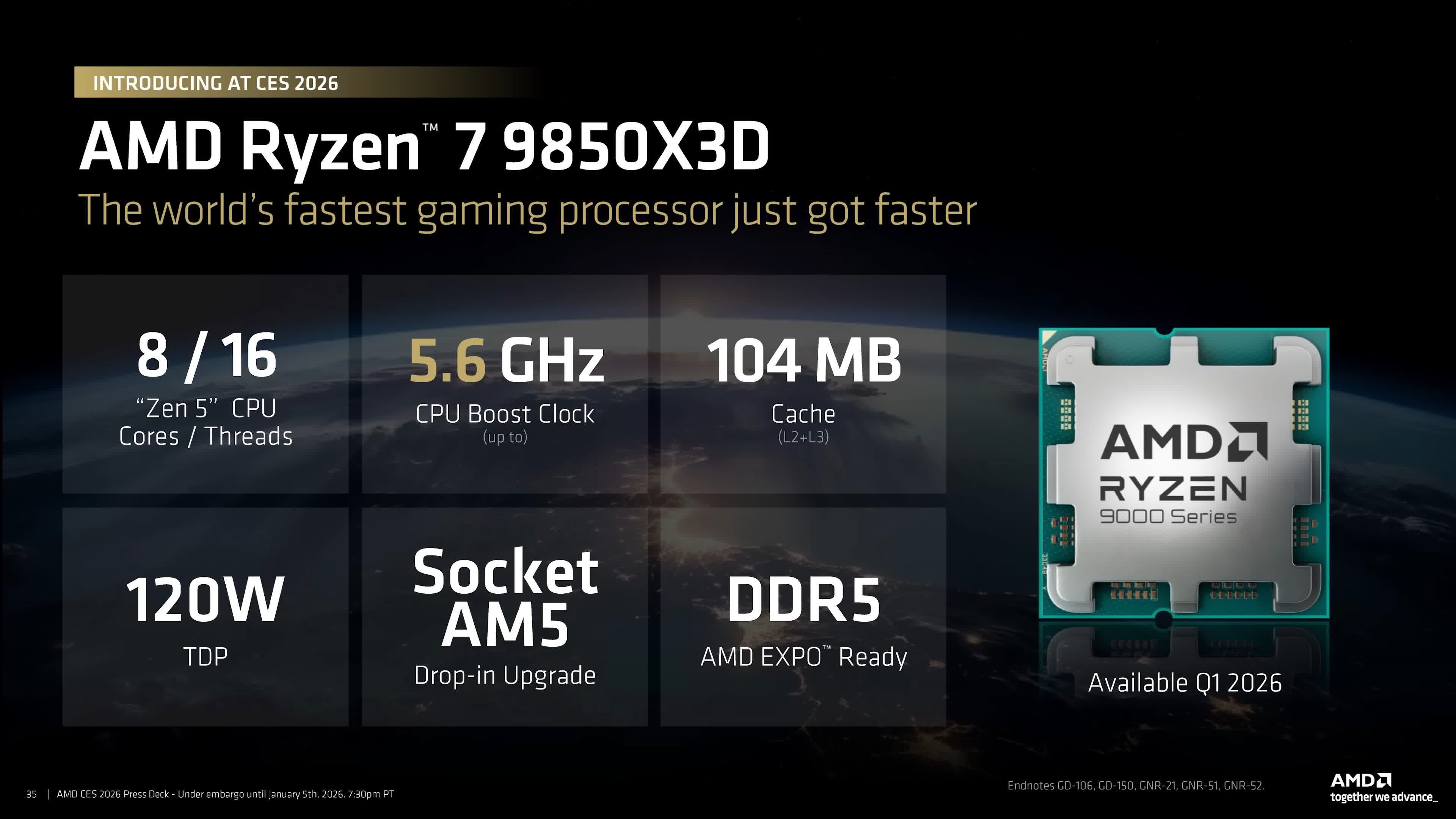
Sounding off: AMD has unveiled a new flagship gaming CPU, the Ryzen 7 9850X3D, signaling a push to extract more performance from its already dominant X3D lineup rather than introduce a clean-sheet upgrade. Long rumored and now confirmed for a Q1 2026 launch, the chip is expected to arrive early in the quarter and underscores AMD's confidence that even small gains at the top of the gaming charts still matter – and can still sell.
At a high level, this feels like AMD borrowing a page directly from Intel's recent playbook. With the gaming performance crown firmly in hand, the company appears eager to monetize the "best of the best" crowd. In that sense, the 9850X3D looks very much like a KS-style part: not a fundamental leap forward, but a premium, higher-binned SKU designed to extract a little more money from enthusiasts chasing peak numbers.
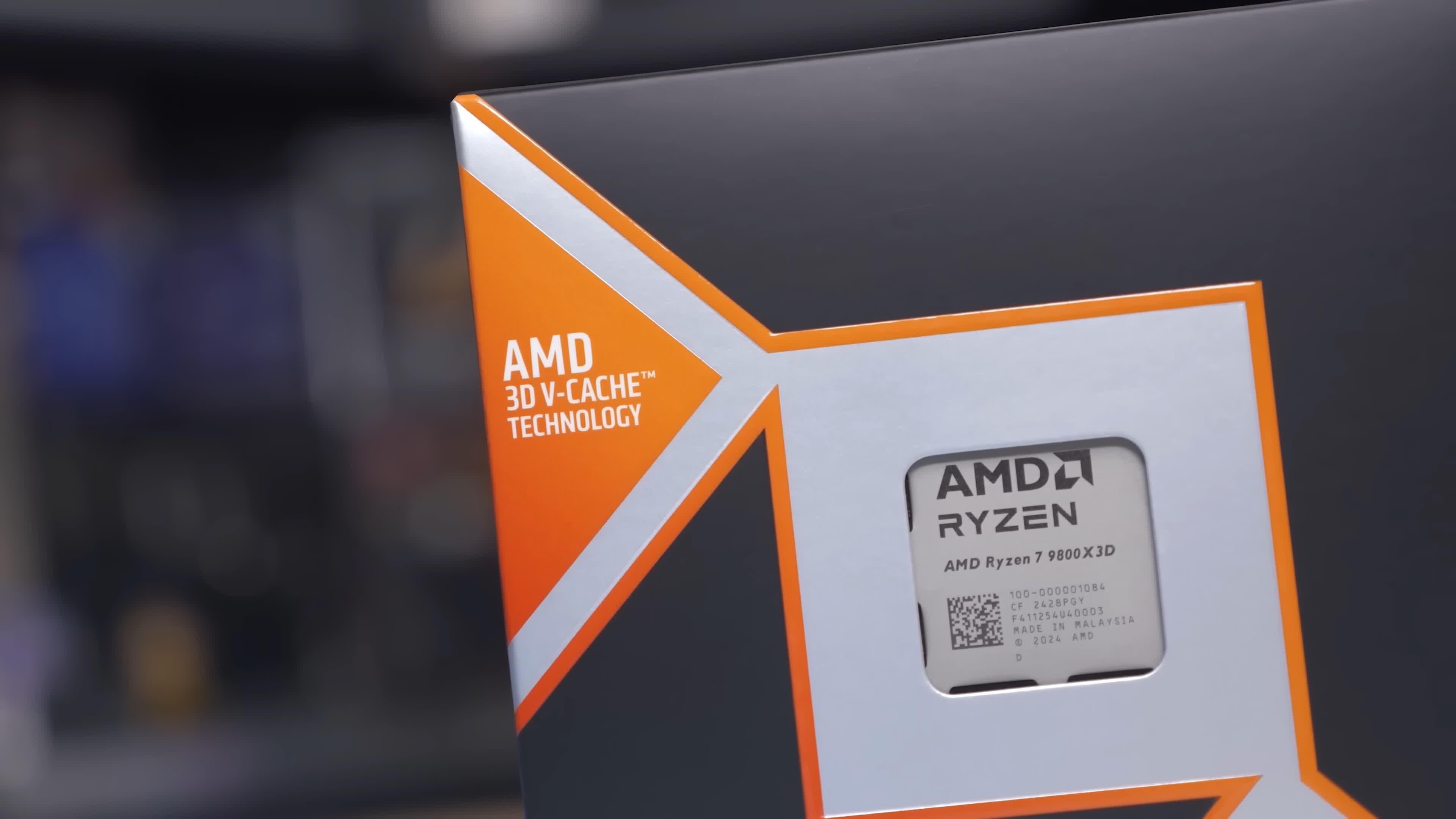
The chip itself is straightforward. The Ryzen 7 9850X3D uses the same 8-core, 16-thread Zen 5 configuration as the existing 9800X3D, along with the same 96 MB of total L3 cache. AMD says it's built from the exact same CCDs and I/O die, using the same second-generation 3D V-Cache technology. The key difference is binning: the 9850X3D is certified to boost higher, pushing peak frequency from 5.2 GHz to 5.6 GHz. TDP remains unchanged at 120 W.
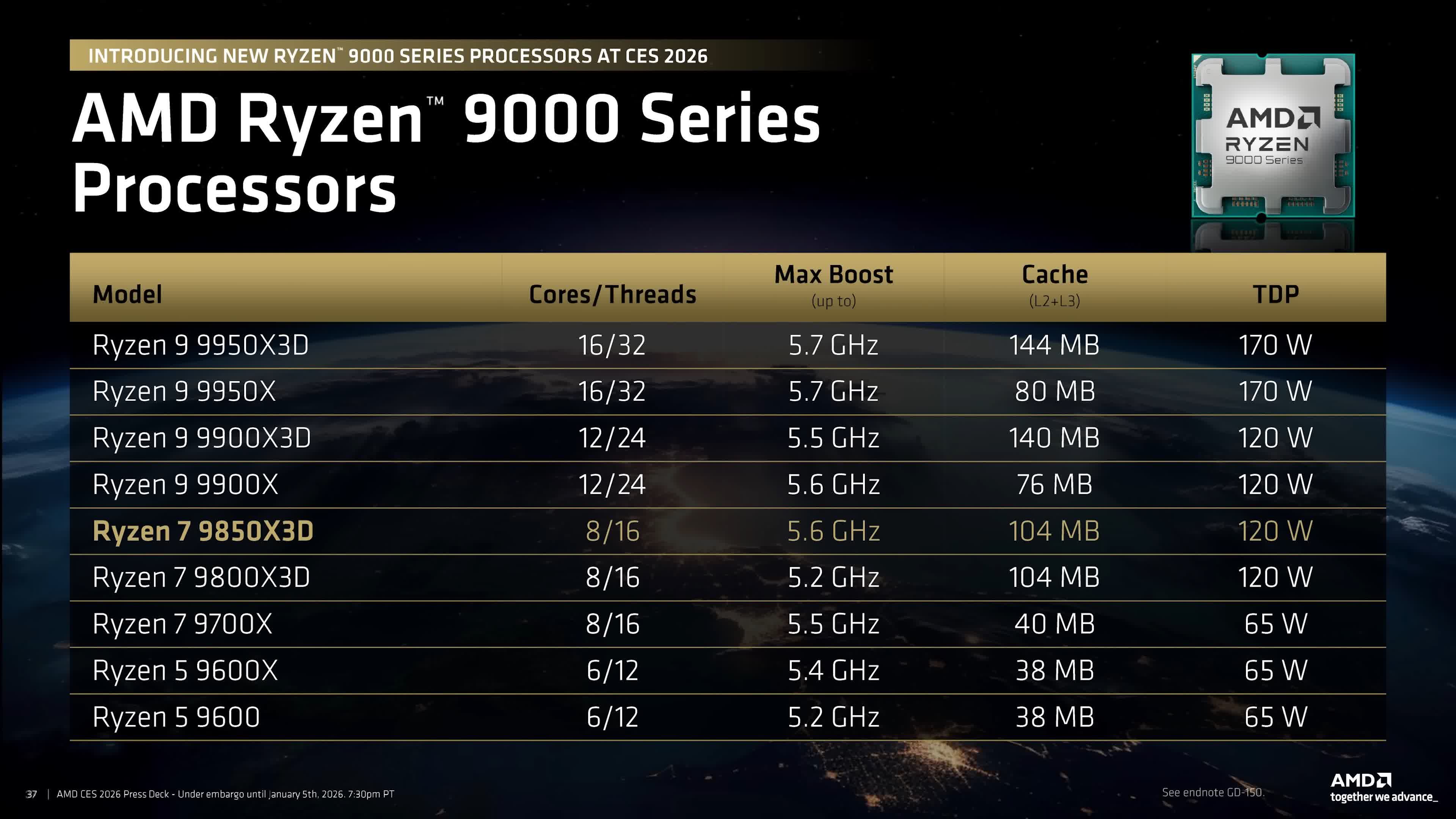
That frequency bump makes the 9850X3D the highest-clocked eight-core CPU in AMD's lineup, narrowly edging out the Ryzen 7 9700X, which tops out at 5.5 GHz. It's not the fastest AMD chip overall, though. Both the Ryzen 9 9950X and 9950X3D still reach 5.7 GHz.
In the case of the 9950X3D, however, that top clock only applies to the non – V-cache CCD, while the cache-equipped CCD runs at lower frequencies. With the 9850X3D, AMD is claiming the highest clock speed ever achieved on a V-cache CCD.
We're kinda splitting hairs here though. We're talking about 5.5 versus 5.6 versus 5.7 GHz. Compared to the 9800X3D, the new chip's peak frequency is just 8% higher, and only 2% higher than the 9700X. With no other architectural changes, that puts a very clear ceiling on the performance gains anyone should expect.
To put things in perspective, Intel's KS processors: the Core i9-12900KS, 13900KS, and 14900KS – typically increased boost clocks by around 200 to 300 MHz over their standard K counterparts. In practice, that translated to roughly a 3% to 4% uplift in the most favorable scenarios, with about a 2% performance gain out of the box. The real draw was better silicon binning and, potentially, more overclocking headroom.
AMD is being slightly more generous on paper, offering a 400 MHz bump that works out to an 8% frequency increase. But the underlying idea is the same: identify higher-quality silicon, push clocks a bit further, and sell it as a premium SKU. Pricing hasn't been confirmed yet, so this is still speculative.
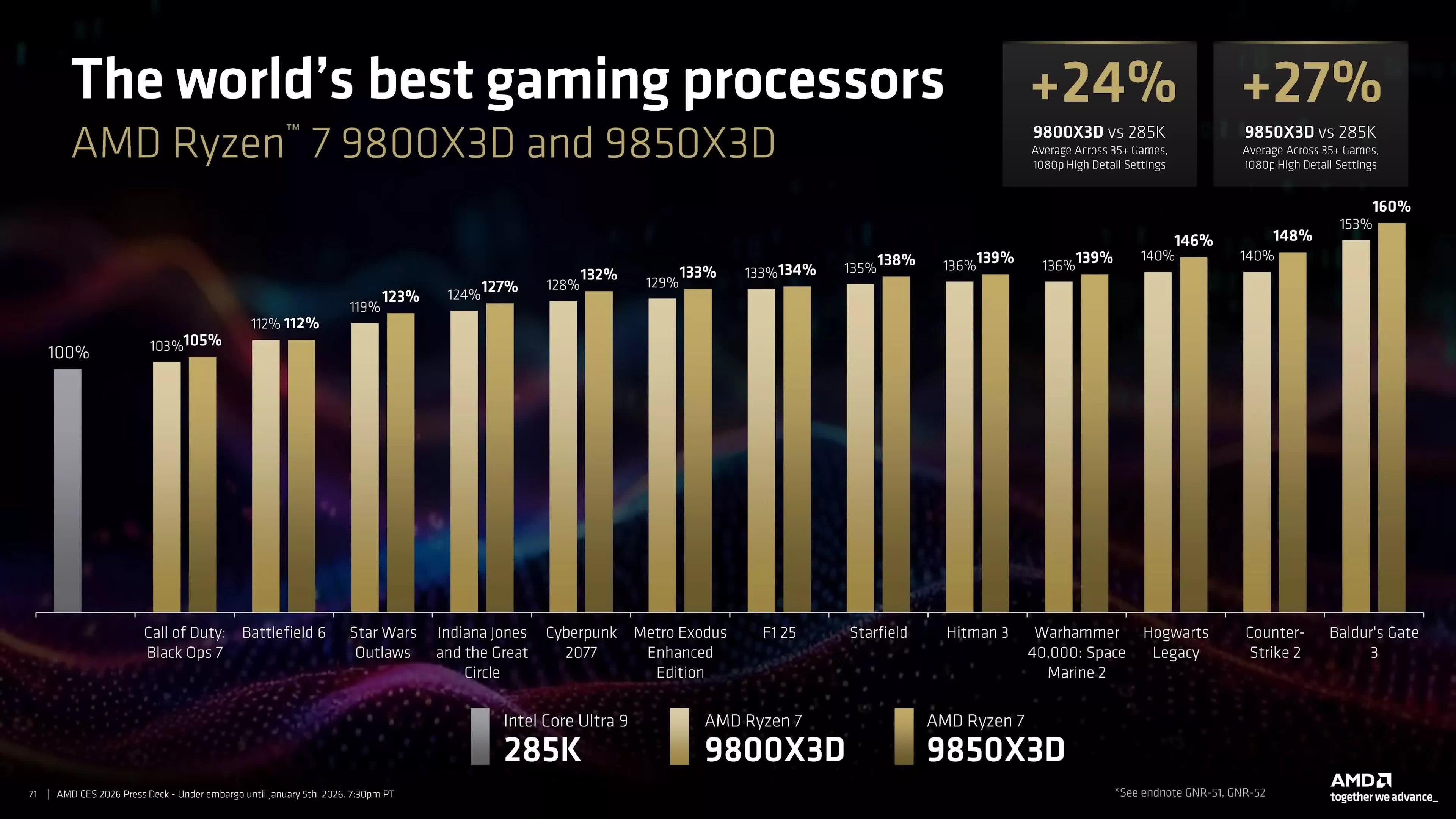
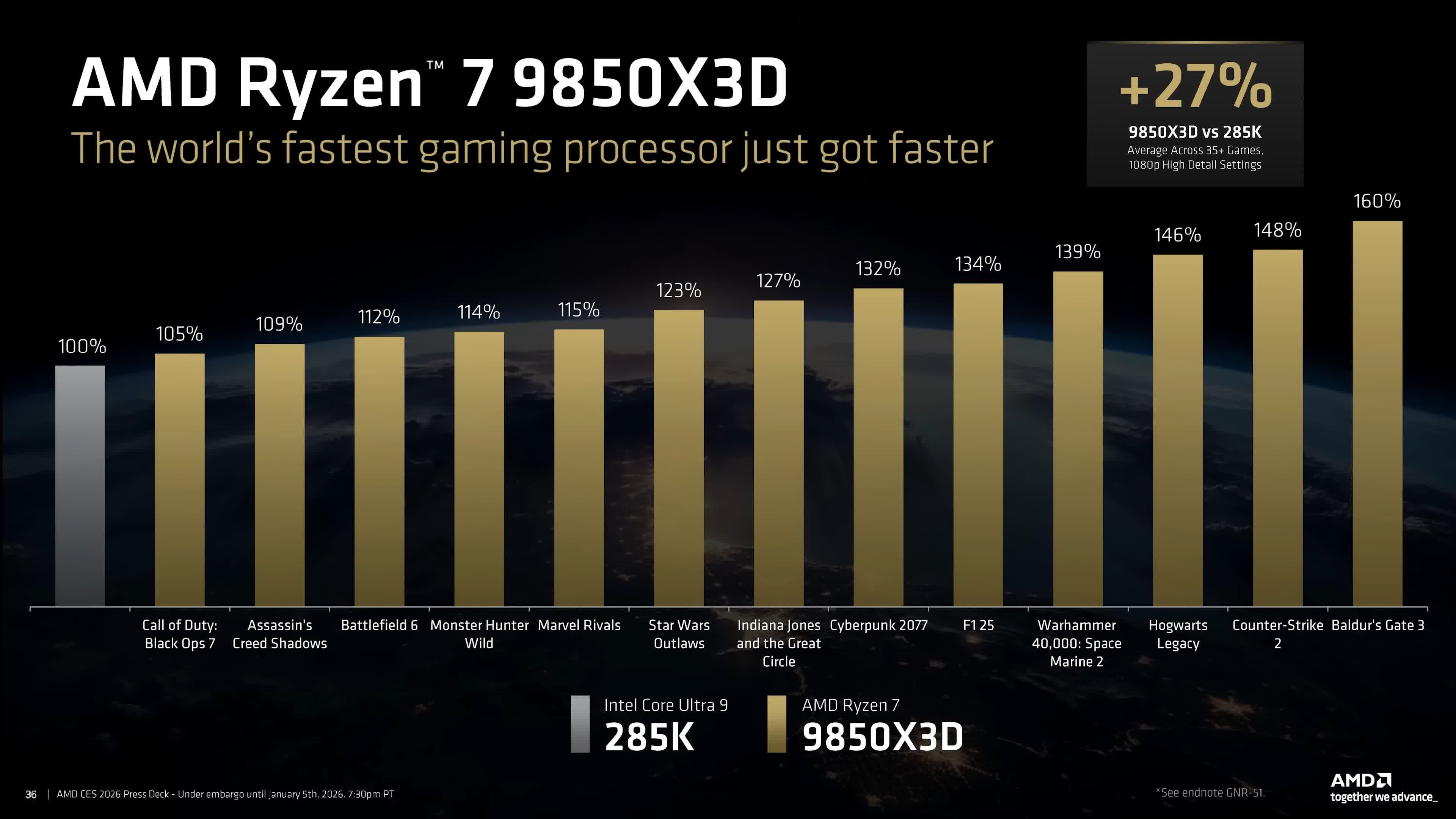
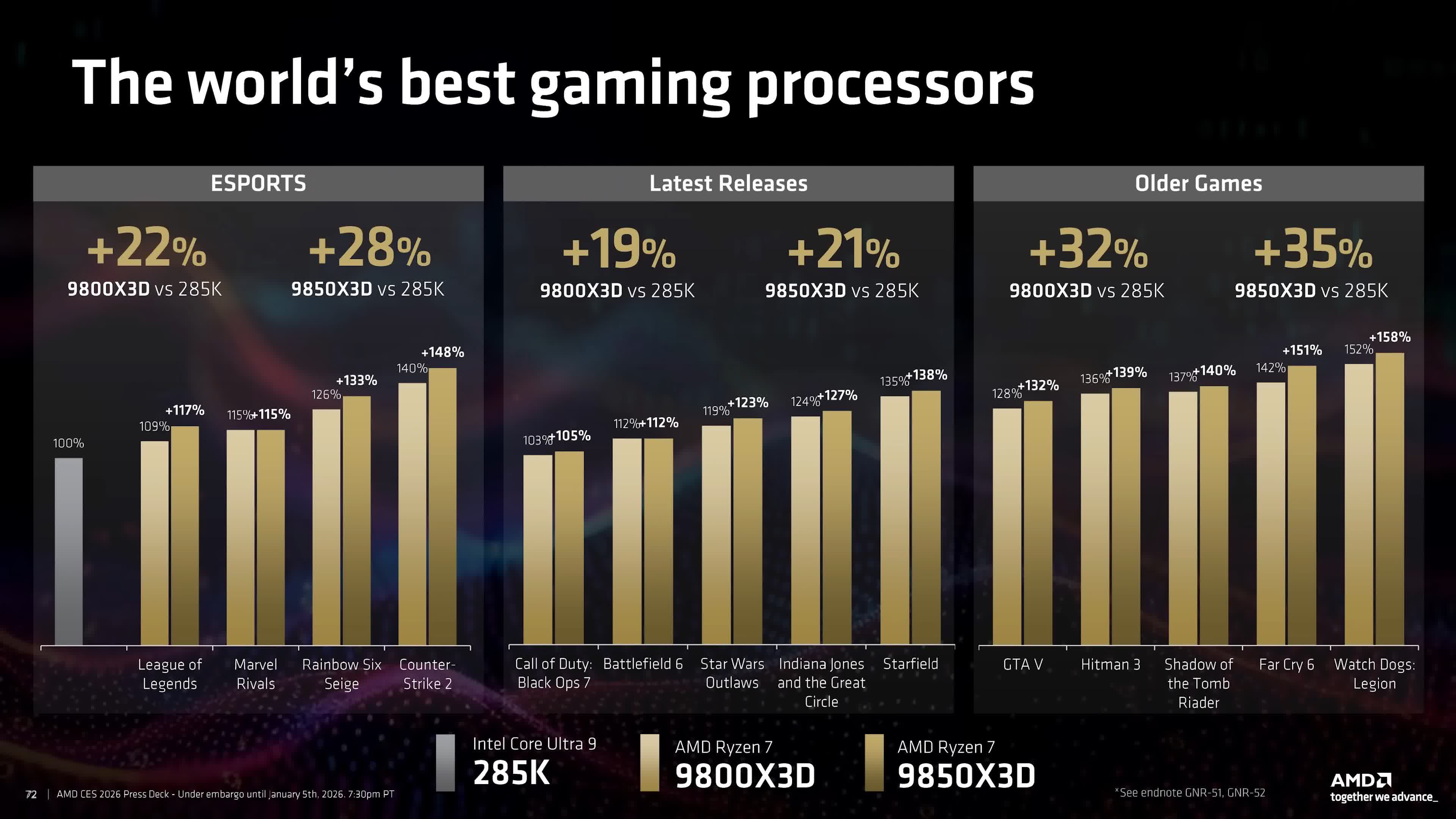
On performance, AMD's messaging focuses heavily on comparisons with Intel's Core Ultra 9 285K. Across a sample of more than 35 games, AMD claims the 9850X3D is 27% faster than Intel's flagship. In a later slide that also included the 9800X3D, the picture becomes more nuanced.
AMD says the 9800X3D is already 24% faster than the 285K across the same test suite. That implies the jump from 9800X3D to 9850X3D is just 2.4%. Looking at the individual game results AMD shared, the average uplift across the 13 titles shown is about 3%. That's the kind of gain most gamers should realistically expect: low single digits.
In the best-case scenarios, AMD says the 9850X3D can be up to 7% faster than the 9800X3D, with the largest improvement shown being 6%. Unsurprisingly, those gains appear in titles that are more frequency-limited. In games that aren't especially sensitive to clock speed, performance is often identical, or only marginally better. None of this is unexpected, and nothing here suggests the chip performs beyond what its specifications would predict.
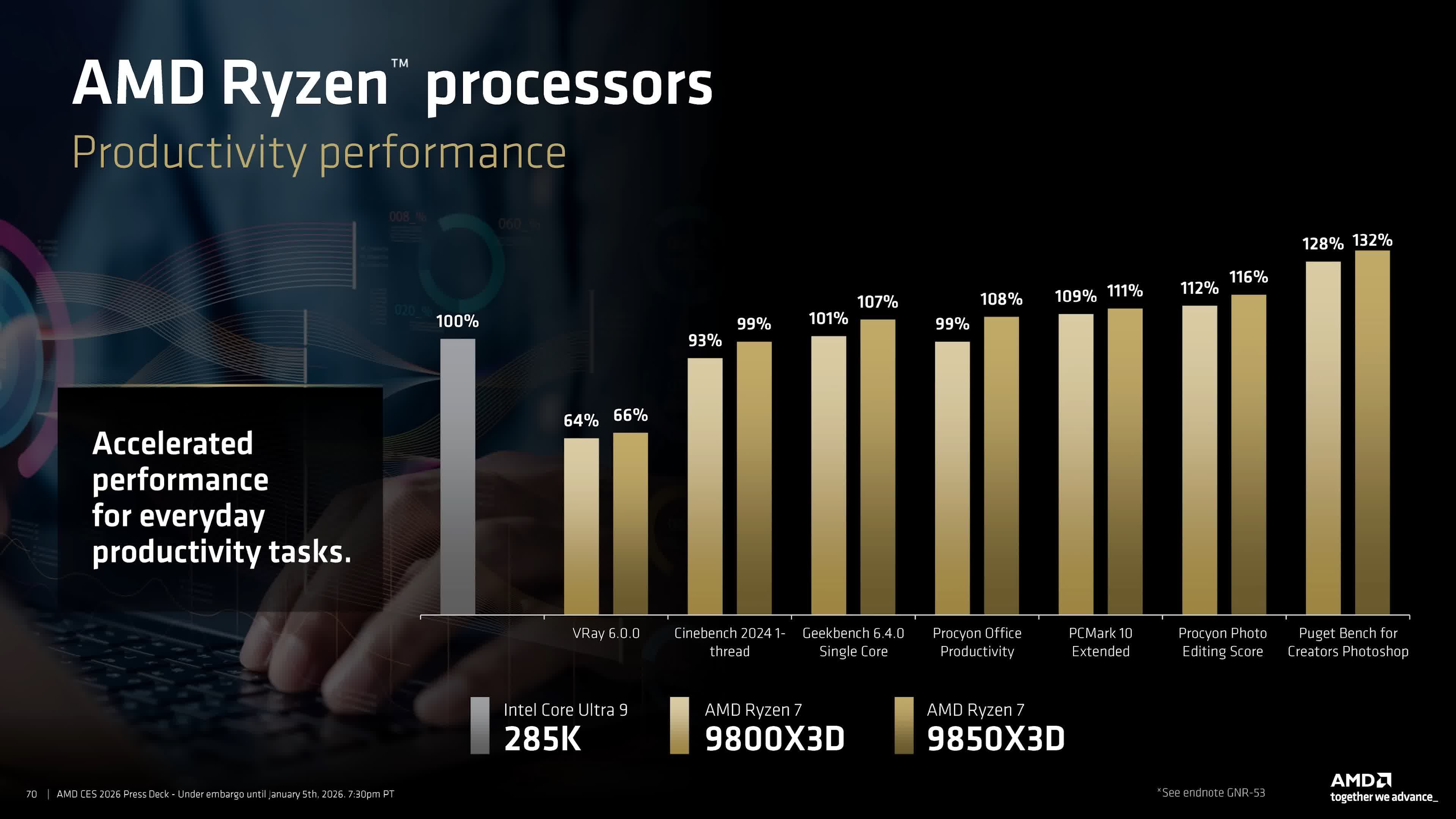
Productivity workloads see similar behavior. Across the seven applications AMD highlighted, the 9850X3D averages a 5% uplift over the 9800X3D, with mixed results versus Intel's 285K. Most of the showcased workloads are single-threaded, which naturally puts the frequency increase in the best possible light.
All of this leads directly to pricing, which AMD has so far declined to discuss. The 9800X3D carries a $480 MSRP, and typically sells in the $470-$480 range, with occasional dips to around $450. If the 9850X3D is only 3% faster on average, a modest price increase would make the most sense. A $500 MSRP, for example, represents a 4% bump and would still look reasonable relative to current street prices.
AMD could also choose to replace the 9800X3D outright at the same $480 price point, but the company has already confirmed that both chips will coexist. Given that the 9800X3D already holds a comfortable lead over Intel in gaming, AMD has little incentive to discount it in order to make room for the new model.
If AMD follows Intel's KS strategy more closely, pricing could climb much higher. Intel charged a 25% premium for the 12900KS over the 12900K, and around 17% more for the 13900KS and 14900KS compared to their K counterparts. Applying that logic here would put the 9850X3D at $560 or even $600. At that level, the value proposition falls apart, though it would still appeal to buyers who refuse to compromise on owning the absolute fastest option.
OEMs complicate matters further. AMD will be supplying this chip to system integrators for use in ultra-high-end gaming desktops. At least one mainstream vendor is already planning to debut systems built around the 9850X3D at CES. Those systems could easily carry $100-$200 premiums over comparable 9800X3D configurations, even though the real-world performance difference is minimal.
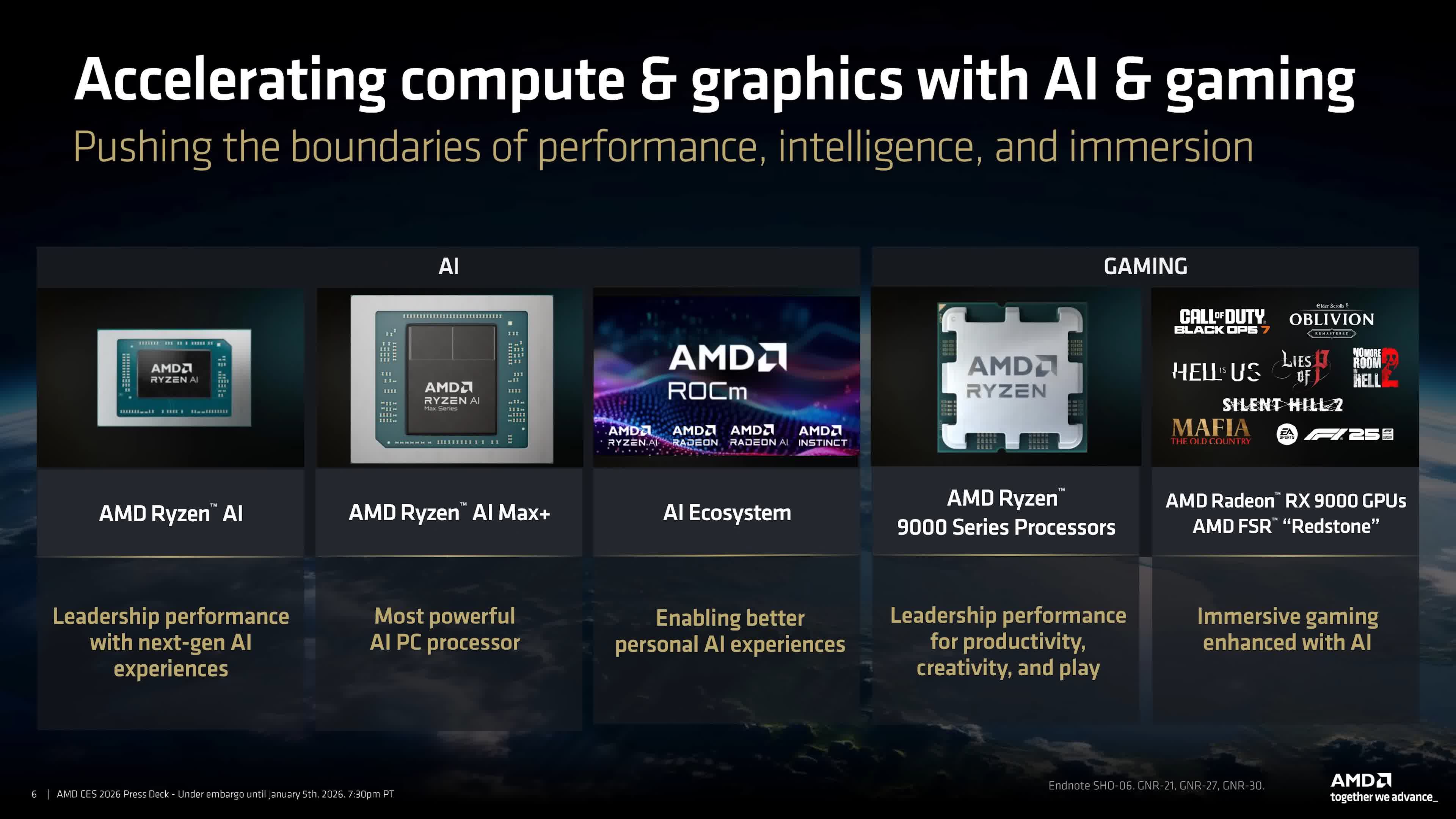
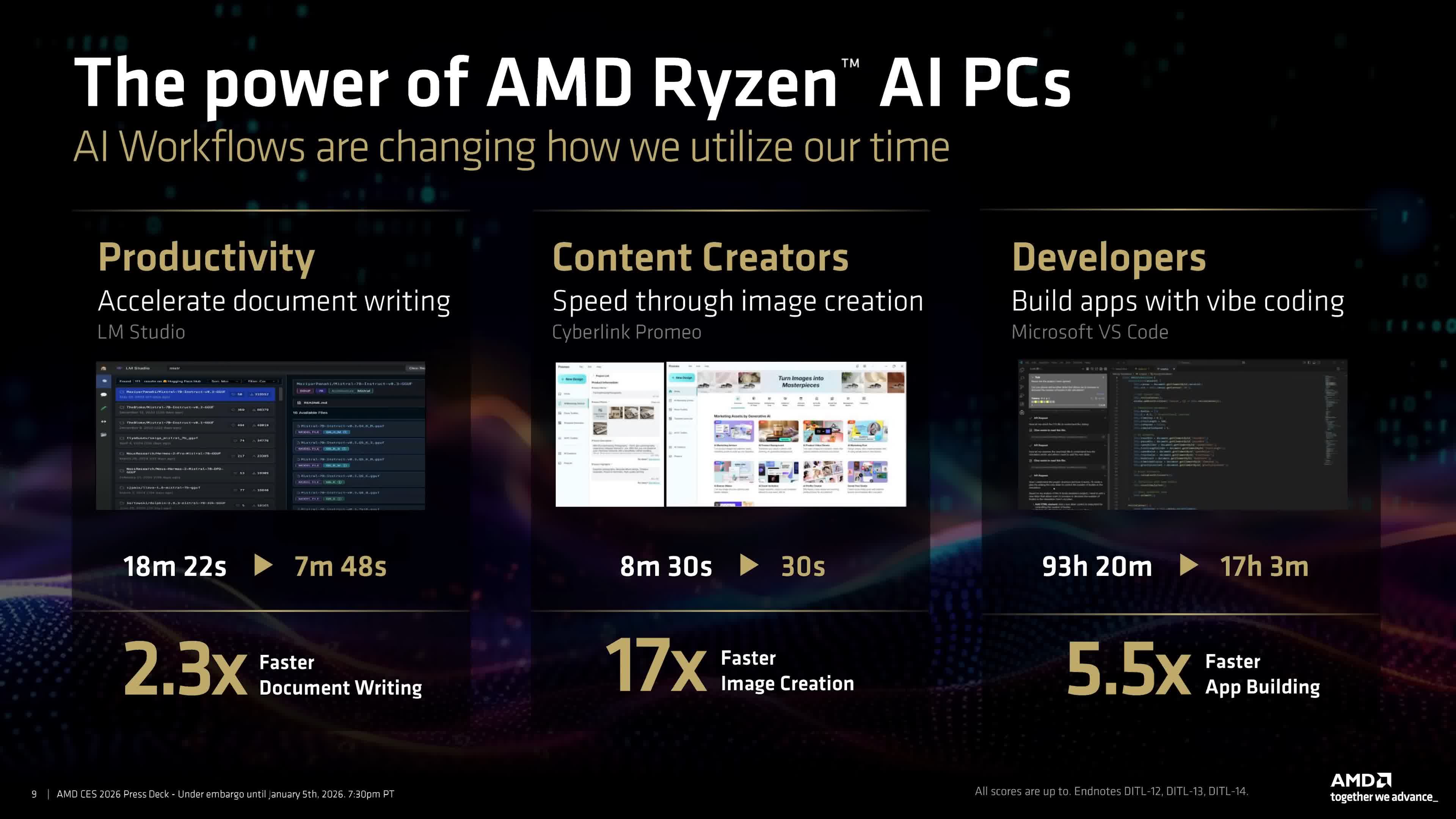
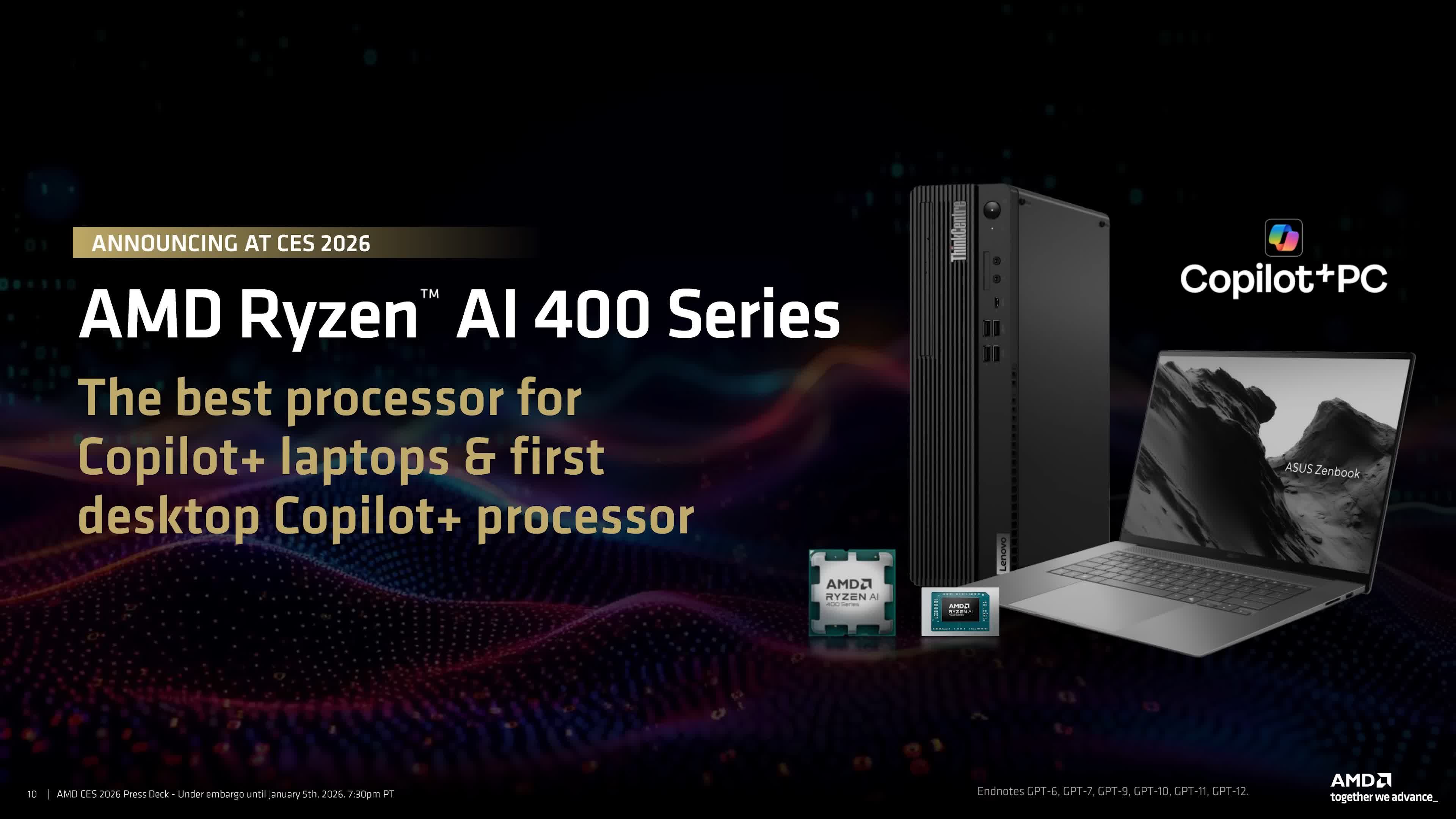
As for the rest of AMD's CES 2026 presentation, the themes are predictable. AI dominates nearly every slide. AI CPUs, AI accelerators, AI refreshes, AI laptops, AI desktops, and extensive coverage of ROCm – also in the context of AI. There's an "AI 400" CPU refresh, new laptop models where AI branding looms large, and incremental updates across existing product lines, all framed through an AI-first lens.
One notable omission from AMD's pre-briefings was the long-rumored Ryzen 9 9950X3D2.
This hypothetical chip would reportedly add 3D V-Cache to both CCDs, unlike the current 9950X3D, which only equips one CCD with extra cache and relies on scheduling to choose between cache-heavy or higher-frequency cores. A dual – V-cache design could simplify scheduling and offer small gains in workloads that benefit from both clock speed and L3 cache.
Still, the existing 9950X3D already performs extremely well, often matching or slightly surpassing the 9800X3D in gaming, which makes the practical need for an X3D2 questionable, even if rumors about it have been circulating for some time.